Universe Today
A seismic shift occurred in astronomy during the Scientific Revolution, beginning with 16th-century polymath Copernicus and his proposal that the Earth revolved around the Sun. By the 17th century, famed engineer and astronomer Galileo Galilei refined Copernicus' heliocentric model using observations made with telescopes he built himself. However, it was not until Kepler's observations that the planets followed elliptical orbits around the Sun (rather than circular orbits) that astronomical models matched observations of the heavens completely.
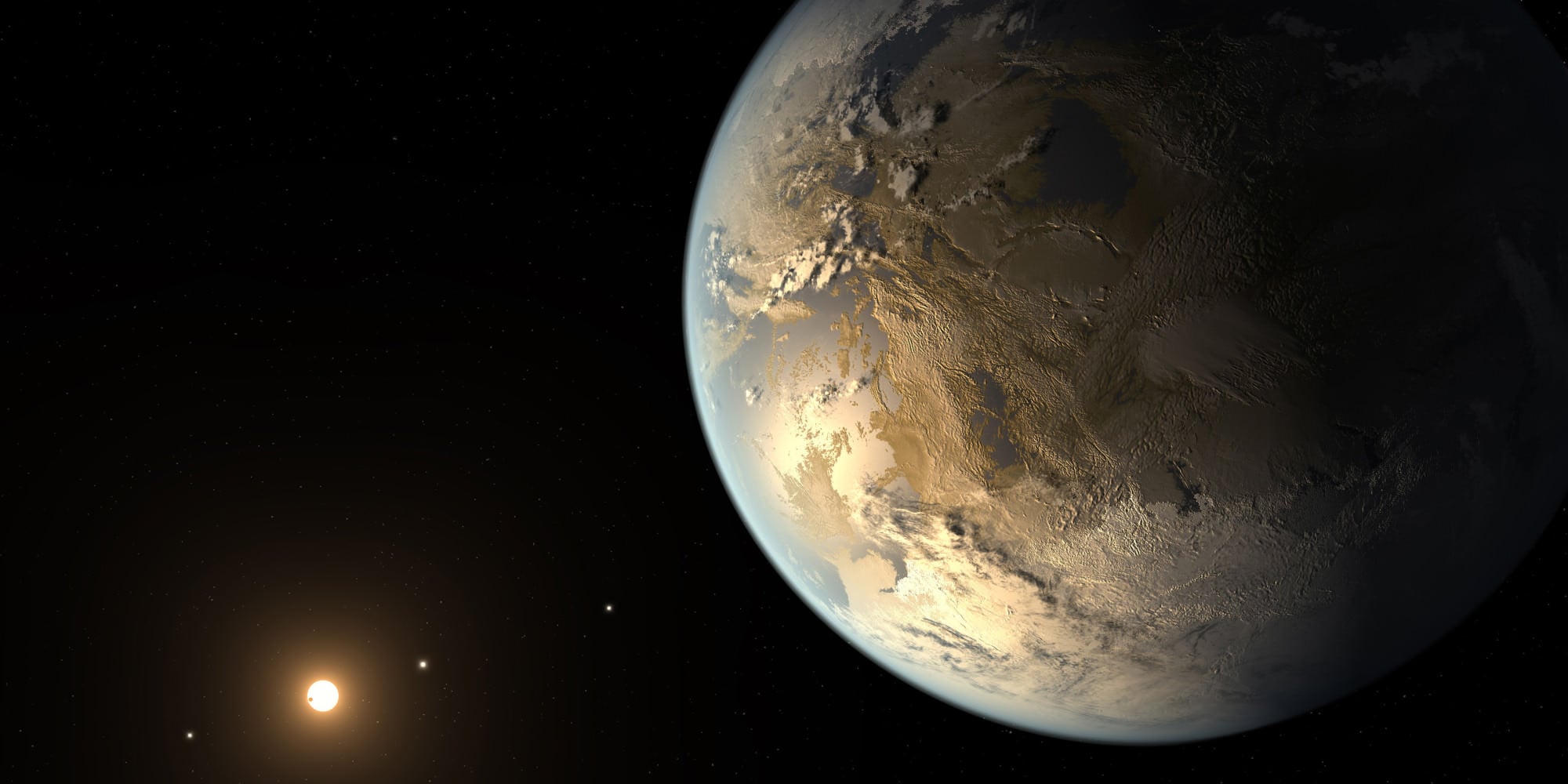
As it turns out, this very quirk of orbital mechanics may be essential to the emergence of life on planets like Earth. That was the hypothesis put forth in a recent study by a team of astronomers led by the University of Leeds. According to their work, orbital eccentricity (how much aplanet's orbit deviates from a circle) can influence a planet's climate response, which could have a profound effect on its potential habitability. These findings could be significant for exoplanet researchers as they continue to search for Earth-like planets that could support life.
The team was led by Binghan Liu, a PhD Student in the School of Physics and Astronomy at the University of Leeds, who conducted the research as part of his thesis. He was joined by Daniel R. Marsh, the Priestley Chair in Comparative Planetary Atmospheres (and Liu's thesis advisor), and other colleagues from Leeds and the Institute of Astronomy at the University of Cambridge. Their paper, " Eccentric orbits may enhance the habitability of Earth-like exoplanets," was recently published in the Monthly Notices of the Royal Astronomical Society.
The idea of circular orbits has deep roots in Western astronomy, going all the way back to Classical Antiquity. Some examples include Plato and Aristotle, who argued that the then-known celestial bodies (the Moon, Mercury, Venus, the Sun, Mars, Jupiter, and Saturn) were perfect spheres that orbited Earth in concentric circles. This belief endured well into the Scientific Revolution, with both Copernicus and Galileo arguing that the then-known planets (Mercury, Venus, the Earth and the Moon, Mars, Jupiter, and Saturn) orbited the Sun in concentric circles.
It was not until Johannes Kepler introduced the concept of elliptical orbits that scientists could match their astronomical models to the observed motions of the planets. Since then, scientists have learned a great deal about orbital parameters - such as semi-major axis (a), eccentricity (e), axial tilt (?), inclination (i), and periapsis - and how they can influence a planet's climate over time. These parameters have also become very important for exoplanet studies, as they are vital to determining if a planet could be "potentially habitable."
For their study, Liu and his colleagues used the Whole Atmosphere Community Climate Model (WACCM6), a high-top interactive Earth-system model capable of simulating conditions on Earth (from the oceans to the upper atmosphere) to simulate Earth-like exoplanets with two different orbital parameters. For one set, they assigned circular orbits (e = 0), while the others were assigned highly eccentric orbits (e = 0.4) - far greater than Earth's eccentricity (0.016). They were also assigned zero obliquity (? = 0) and a fixed level of annual solar irradiance (aka. annual mean insolation).
After running 30 simulation years for each case, they examined how both groups of exoplanets behaved regarding their climate response. This included latitudinal and seasonal variations in their hydrological cycle (sea ice, land snow, and clouds) and land habitability metrics like surface temperature and precipitation. As they indicated in their paper, exoplanets within the highly eccentric orbit group had 25% more habitable land area for more than 80% of their orbit, with an average increase of 7% for their entire orbital cycle.

Naturally, there were some caveats and addendums that they were sure to include:
"It is important to note that the habitability of land depends on the chosen metric and the duration of time during which the conditions are met for a specific metric. We conclude that, under the same annual mean stellar flux, an Earth-analogue planet with zero-obliquity in a highly eccentric orbit around a Sun-like star may have enhanced land habitability compared to its circular counterpart."
In other words, the simulations are based on planets with far more eccentric orbits than Earth and are not subject to the same changes in obliquity, which also profoundly impact Earth's climate (i.e., glacial and inter-glacial periods). Nevertheless, their study demonstrates that planets with eccentric orbits are more likely to be habitable than those with circular orbits that experience little in the way of seasonal variations throughout the year. These results could have significant implications for exoplanet studies and the search for habitable worlds beyond the Solar System.
In addition, they note how astronomers will benefit from next-generation observatories that will be capable of spotting Earth-like exoplanets with eccentric orbits in the near future:
"The detection of highly eccentric terrestrial exoplanets is low due to the limitation of the current observation techniques, which are biased towards close-in and thus, tidally locked exoplanets in circular orbits. However, with the upcoming ground and space telescope missions such as PLATO, ELT, and HWO, more highly eccentric Earth-like rocky exoplanets may be revealed and characterized. Understanding the potential climate outcomes and habitability of highly eccentric rocky exoplanets remains a challenging task."
Further Reading: MNRAS