 Universe Today
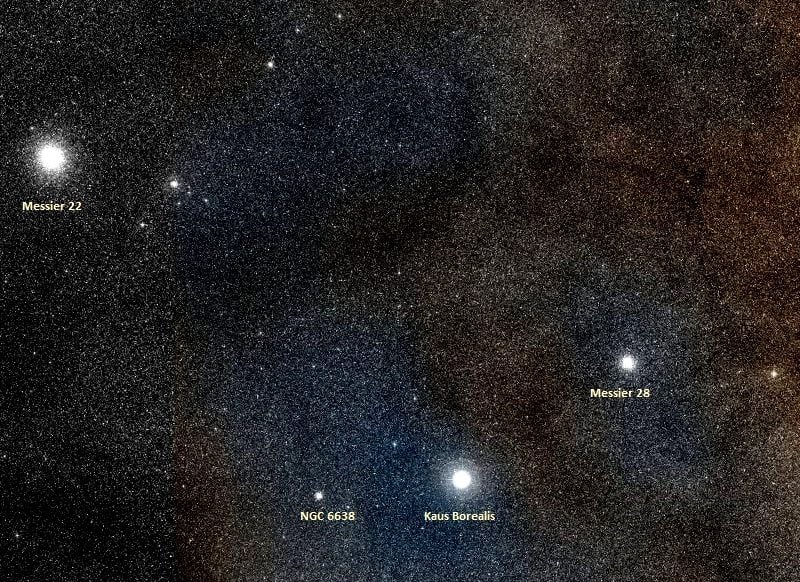
Welcome back to Messier Monday! In our ongoing tribute to the great Tammy Plotner, we take a look at the Globular Cluster known as Messier 28. Enjoy!
Back in the 18th century, famed French astronomer Charles Messier noted the presence of several "nebulous objects" in the night sky. Having originally mistaken them for comets, he began compiling a list of them so that others would not make the same mistake he did. In time, this list would come to include 100 of the most fabulous objects in the night sky.
One of these objects was the globular cluster now known as Messier 28. Located in the direction of the
Sagittarius constellation
, some 17,900 light-years from Earth, this "nebulous" cluster is easily detectable in the night sky. It is also the third largest known clustering of millisecond pulsars in the known Universe.
Description:
Compressed into a sphere measuring about 60 light years in diameter, globular star cluster Messier 28 happily orbits our galactic center about 19,000 light years away from Earth. In all of its thousands upon thousands of stars, M28 contains 18 known RR Lyrae variables and a W Virginis variable star. This very different variable is a Type II, or population II Cepheid that has a precise change rate which occurs every 17 days.
There has also been a second long period variable discovered, which could very well be an RV Tauri type, too. However, one of M28's biggest claims to fame happened in 1986, when it became the first globular cluster known to contain a millisecond pulsar. This was discovered by the Lovell Telescope at Jodrell Bank Observatory. The work on the pulsar was later picked up by Chandra researchers.
As Martin C. Weisskopf (et al) of the Space Sciences Department put it in a
2002 study
of the object:
And the search has far from ended as even more X-ray counterparts have been discovered inside this seemingly quiet globular cluster! As W. Becker and C.Y. Hui of the Max Planck Institute wrote
in their 2007 study
:
So is it possible that these can be seen? According to the 2001 study - "
A search for the optical counterpart to PSR B1821-24 in M 28
" - by Hubble researcher A Golden (et al.):
History of Observation:
This globular cluster was an original discovery in July 1764 of Charles Messier who wrote in his notes:
As always, Sir William Herschel would often revisit with Messier's objects for his own private observations and in his notes he states:
Regardless of whether or not you use binoculars or a telescope on M28, part of the joy of this object is understand how very rich the stellar field is in which it appears. As John Herschel once said of M28 in his many observations, "Occurs in the milky way, of which the stars here are barely visible and immensely numerous."
Locating Messier 28:
Finding M28 is another easy object once you've familiarized yourself with the "teapot" asterism of the constellation of Sagittarius. In binoculars, simply center Lambda in the field of view and you will see Messier 28 as a small, faded grey circular area in the 1:00 position away from the marker star.
In the finderscope of telescope, you can start by centering on Lambda and go to the eyepiece and simply shift the telescope to the northwest slowly and Messier 28 will pop into view. While this globular cluster is easily bright enough to be seen in the smallest of optics, it will require at least a 4" telescope before it begins any resolution of individual stars and telescopes in the 10" and larger range will fully appreciate all it has to offer.
And here are the quick facts to help you get started:
- Object Name
-
Messier 28
- Alternative Designations
-
M28, NGC 6626
- Object Type
-
Class IV Globular Cluster
- Constellation
-
Sagittarius
- Right Ascension
-
18 : 24.5 (h:m)
- Declination
-
-24 : 52 (deg:m)
- Distance
-
18.3 (kly)
- Visual Brightness
-
6.8 (mag)
- Apparent Dimension
-
11.2 (arc min)
We have written many interesting articles about Messier Objects here at Universe Today. Here's Tammy Plotner's
Introduction to the Messier Objects
, ,
M1 – The Crab Nebula
,
M8 – The Lagoon Nebula
, and David Dickison's articles on the
2013
and
2014
Messier Marathons.
Be to sure to check out our complete
Messier Catalog
. And for more information, check out the
SEDS Messier Database
.
Sources:
- Messier Objects – Messier 28
- SEDS Messier Database – Messier 28
- Constellation Guide – Messier 28
- Wikipedia – Dumbbell Nebula
