
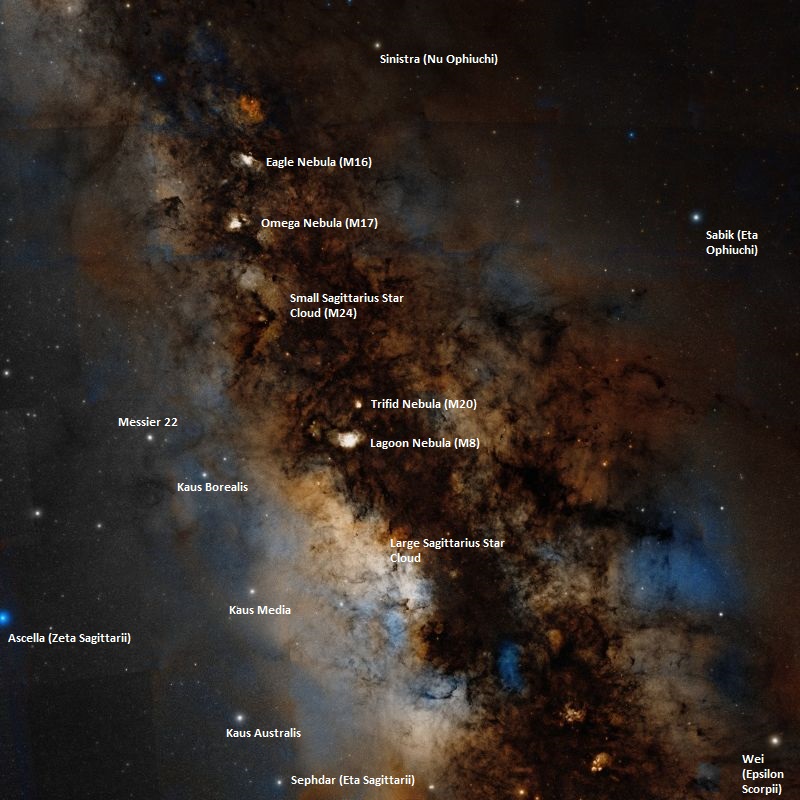
Welcome back to Messier Monday! In our ongoing tribute to the great Tammy Plotner, we take a look at the Messier 24 star cloud. Enjoy!
Back in the 18th century, famed French astronomer Charles Messier noted the presence of several “nebulous objects” in the night sky. Having originally mistaken them for comets, he began compiling a list of these objects so that other astronomers wouldn’t make the same mistake. Consisting of 100 objects, the Messier Catalog has come to be viewed as a major milestone in the study of Deep Space Objects.
One such object is Messier 24, otherwise known as the Sagittarius Star Cloud (or Delle Caustiche). Located in the Sagittarius constellation, located approximately 100,000 light years from Earth, this cluster of the Milky Way is one of the densest concentration of individual stars in the night sky.
Description:
Messier 24 is one of the most curious of the catalog entries because it really isn’t a star cluster – simply an oddity. What we are looking at is thousands of stars that belong to the Sagittarius arm of the Milky Way galaxy seen through a chance hole in the gas and dust… a clear “window” in space.
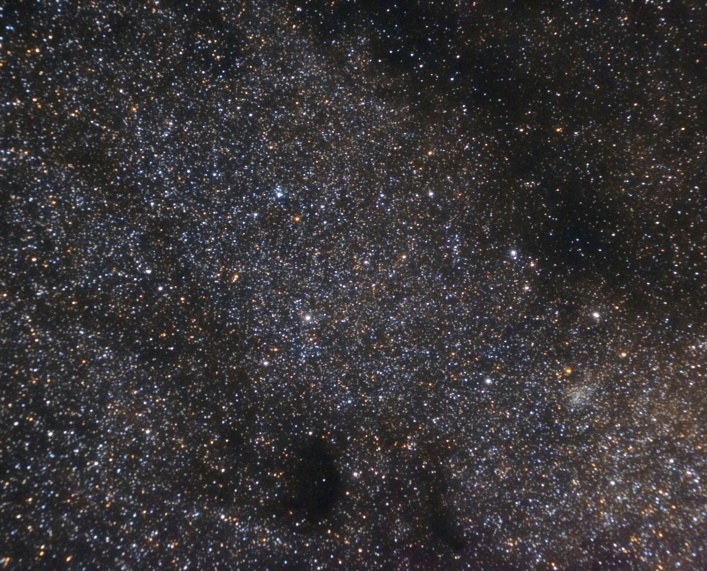
And speaking of space, M24 fills a space of significant volume, to a depth of 10,000 to 16,000 light-years. This makes it the most dense concentration of individual stars visible using binoculars, with around 1,000 stars visible within a single field of view!
Still, it is sometimes referred to as the Small Sagittarius Star Cloud in order to differentiate it from the Great Sagittarius Star Cloud located north of Gamma Sagittarii and Delta Sagittarii. When viewing this awesome area, take into account how many different objects you can spot just within this region – like dim open cluster, NGC 6603.
E.E. Barnard has cataloged two dark nebulae in the northern region as objects 92 and 93. How about lesser known clusters like Collinder 469 and Markarian 38? Along the southern edge you’ll find emission nebula IC 1283-1284, with two adjacent reflection nebulae, NGC 6589 and NGC 6590.
Their fueling source is the notable little open cluster NGC 6595. Take a tour on the western edge of M24 and see if you can spot 12th-magnitude planetary nebula NGC 6567. Need more? Then how about Delta Cephei variable WZ Sagittarii in the southern area. Its a pulsating giant star that varies in brightness between magnitude 7.5 and 8.5 in slightly less than 22 days!

History of Observation:
As bright as the Sagittarius Star Cloud is, we know that Messier probably wasn’t the first to see it – but he was the first to catalog it. As he wrote about it in his notes:
“In the same night, June 20 to 21, 1764, I have discovered on the same parallel as the star cluster I have just been talking about and near the extremity of the bow of Sagittarius, in the milky way, a considerable nebulosity, of about one degree and a half extension: in that nebulosity there are several stars of different magnitudes; the light which is between these stars is divided in several parts. I have determined approximately the position of the middle of this cloud of light; its right ascension is 270d 26′, and its declination 18d 26′, south.”
While other historic astronomers would also look at Messier’s “discovery”, they realized they were looking at a portion of the Milky Way and were somewhat less than enthusiastic. The Sagittarius Star Cloud was named “Delle Caustiche” by Fr. Secchi, “from the peculiar arrangement of its stars in rays, arches, caustic curves, and intertwined spirals.”
As is often the case with Messier Objects, it was the late Admiral Smyth who described it with flowering prose. As he wrote of the large star cloud in July of 1835:
“A beautiful field of stars, below the sinister base of the Polish shield, and in a richly clustering portion of the Milky Way. This object was discovered by Messier in 1764, and described as a mass of stars — a great nebulosity of which the light is divided in several parts. This was probably owing to want of power in the instruments used, as the whole is fairly resolvable, though there is a gathering spot with much star dust [This is NGC 6603!].”
Locating Messier 24:
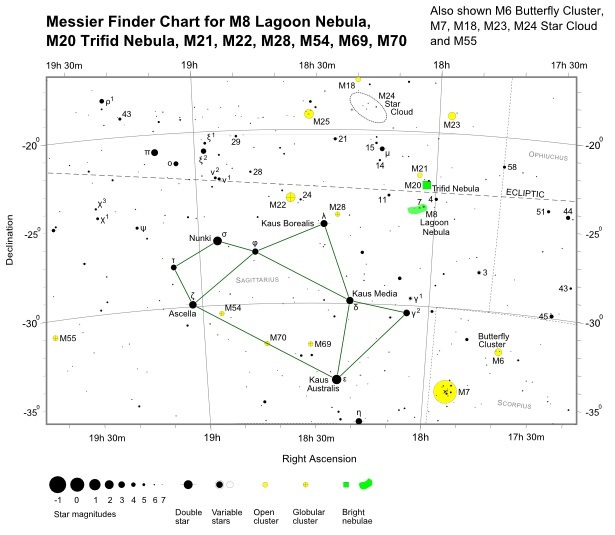
From a dark sky location, M24 is easily located with the unaided eye. It will appear as a large hazy patch in northern portion of the constellation of Sagittarius, about a handspan above the teapot-shaped Sagittarius asterism. For those observing under urban skies, even the slightest optical aid will easily reveal this massive cloud of stars.
Spanning a degree and a half of sky means this huge object is going to cover anywhere from about 1/3 to 1/2 the field of view in most binoculars. It can easily be seen in all optical finderscopes and requires minimum magnification in all telescopes. Even then, you’ll only be able to study portions of the Sagittarius Star Cloud at a time. given its sheer size.
So go forth, and gather ye some star dust of your own. There’s plenty for everyone!
And here are the quick facts on the Sagittarius Stat Cloud to help you get started:
Object Name: Messier 24
Alternative Designations: M24, IC 4715, Sagittarius Star Cloud, Delle Caustiche
Object Type: Star Cloud – contains Open Cluster NGC 6603 and NGC 6595, Barnard 92, Barnard 93, Collinder 469, IC 1283-1284, NGC 6589/90 and planetary nebula NGC 6567
Constellation: Sagittarius
Right Ascension: 18 : 16.9 (h:m)
Declination: -18 : 29 (deg:m)
Distance: 10.0 (kly)
Visual Brightness: 4.6 (mag)
Apparent Dimension: 90 (arc min)
We have written many interesting articles about Messier Objects here at Universe Today. Here’s Tammy Plotner’s Introduction to the Messier Objects, , M1 – The Crab Nebula, M8 – The Lagoon Nebula, and David Dickison’s articles on the 2013 and 2014 Messier Marathons.
Be to sure to check out our complete Messier Catalog. And for more information, check out the SEDS Messier Database.
Sources: