Obama to Re-examine Constellation Program

by Nancy Atkinson on May 5, 2009

Want to stay on top of all the space news? Follow @universetoday on Twitter

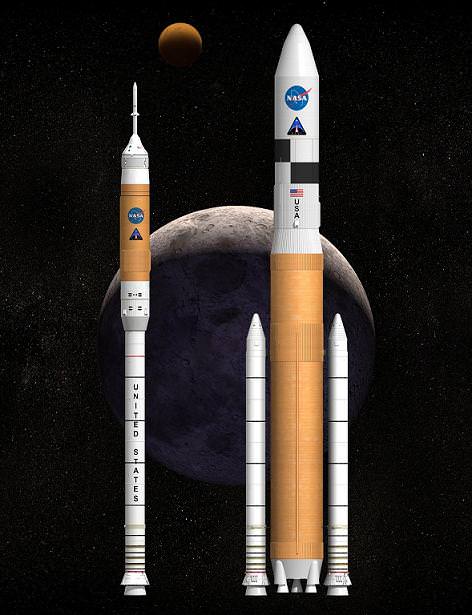
The Constellation program's Ares rockets.  Credit: NASA

The Constellation program's Ares rockets. Credit: NASA


The White House is expected to announce on Thursday that they will order a full review of the NASA’s Constellation program. The reason for the review is to determine whether the Ares I rocket and the Orion crew capsule are the best options for replacing the space shuttle. According to the Orlando Sentinel, this announcement will coincide with the release of the Obama administration’s $18.7 billion spending plan for NASA. Obama has said little about NASA since he took office in January, but altering plans for the next generation of crewed space vehicles would be a major change of course for the space agency.

This review follows decisions by NASA to alter the Orion spacecraft – decreasing the crew size from six to four in order to save weight – as well as months of critical reports questioning whether the new Ares I rocket and Orion capsule will be ready to fly to orbit by 2015.

Other problems with Ares have surfaced, such as potential violent shaking caused by vibrations in its solid-rocket first stage, and the rocket’s tendency to drift on takeoff into its launch tower. Also, its estimate costs through 2015 have risen from $28 billion in 2006 to $44 billion today.

Agency and industry insiders said this budget proposal should offer the first major clues as to the new president’s plans for the agency, the Sentinel reported. Without an administrator NASA has not had clear direction from the current administration.

The news of a possible review of Constellation have given hope to the proponents of an alternative rocket system called Direct 2.0. The Direct system proposes a Jupiter 120 rocket, which is essentially the shuttle’s fuel tank and two solid rocket boosters with a capsule mounted on top in place of a side-mounted orbiter.

This plan was designed in part by NASA engineers working on their own time who were frustrated with the Ares rocket.

One study, called the Exploration Systems Architecture Study, or ESAS, ruled out using the military rockets and other systems while another independent study commissioned by NASA found that rockets currently being used by the military to launch top-secret spy satellites could be affordably and safely adapted to ferry humans to the international space station and, eventually, the moon and beyond.

But under administrator Mike Griffin, NASA decided against that course of action. The ESAS study was protested by many as having little input and participation from contractors and rocket companies.

Source: Orlando Sentinel

About

Nancy Atkinson is Universe Today's Senior Editor. She also is the host of the NASA Lunar Science Institute podcast and works with the Astronomy Cast and 365 Days of Astronomy podcasts. Nancy is also a NASA/JPL Solar System Ambassador.

  • Lawrence B. Crowell

    I am all for LISA. There was one of these UT articles last month about microrockets meant to stationkeep this sort of spacecraft.

    I am personally not a big fan of the space shuttle. There has been little working science that came out of it. The Hubble service missions, such as the one coming up, and a couple of other missions actually accomplished something. Most of the rest of the STS missions amounted to gymnastics in space. Even the satellite launch service missions were abandoned by the early 1990′s. That should be a hint! The costs were larger than regular launch programs. The space station is frankly a hugely expensive boondoggle that has accomplished almost nothing. Compare this with Spitzer, WMAP, Casinni, Mars rovers, and so forth.

    Space capsules might be “old fashioned,” but if we are to return to the moon, likely for dubious purposes unfortunately, then a no-fuss approach is better.

    Lawrence B. Crowell

  • jayem4646

    @ Jon Hanford

    Thanks Jon… Re: New Moon Atlas.

    Regards
    John — w w w.moonposter.ie

  • Shaula Brandt

    All along I like the concept of Direct 2.0. The baby doesn’t get thrown out with the bath water using that concept. The idea allows for the reuse of a lot of elements of the shuttle program, including a lot of the tooling that goes into making the SRBs and the main fuel tanks. Direct 2.0 will will give us some great heavy lift capability.

    With Ares, I never favored the idea of solely relying on an SRB to launch a human crew. 2.0 seems to offer a better margin of safety (or at least survivability) in the event of an all-out launch failure. The configuration should also allow us the lift capacity to keep the 6-person capsule.

    In the process, I sort of would hope they could help out projects like Falcon and Dragon to be able to hitch a ride to the space station instead of reling on ‘outside’ source for trips to orbit…seems to be a ‘lot’ of potential there as well.

  • Vanamonde

    Sadly, I must agree that is time for a long hard review of attended spaceflight. We have invested so much in the ISS and I want that to continue but for now, we need to leave deep space (beyond the Van Allen belts) to the robots.

    We are at a crisis, if you have not noticed. A world-wide depression and wars in at least two nations that are still unresolved. We have military hardware deploy around the planet for some damn reason while millions are living on the street and a work force that lives in fear and loathing of joining them. And our nations’s pollution affects the entire world.

    There is so much that the U.S. needs to do first to join the community of civilized nations. The planets can wait and the moon can wait. Would not a tried and true Delta IV or Altas 5 booster make a good launch vehicle for a new craft to carry people and cargo to the ISS?

    It is both sad and iconic to remember that the Shuttle program was delayed for years due to demands of the military for more payload and now we are talking about delaying the replacement to make it less. But this is necessary until the U.S. is civilized and strong again.

Previous post:

Next post: