Astronomers Compile Most Detailed Map of Nearby Universe

by Nancy Atkinson on April 3, 2009

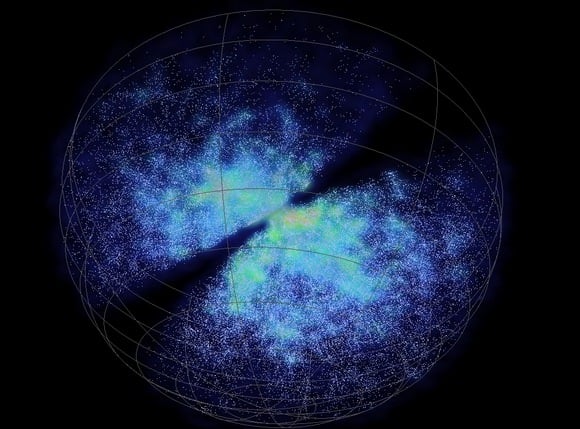
The clustering pattern of about 100,000 nearby galaxies, revealed by the 6dF Galaxy Survey. Each galaxy is shown as a dot. The galaxy we live in is at the centre of the pattern. Credit: Dr Chris Fluke, Centre for Astrophysics and Supercomputing, Swinburne University of Technology.

The clustering pattern of about 100,000 nearby galaxies, revealed by the 6dF Galaxy Survey. Each galaxy is shown as a dot. The galaxy we live in is at the centre of the pattern. Credit: Dr Chris Fluke, Centre for Astrophysics and Supercomputing, Swinburne University of Technology.


A new detailed map of the nearby Universe reveals not only where local galaxies are currently, but where they are heading, how fast and why. “It’s like taking a snapshot of wildebeest on the African plain,” said Dr. Heath Jones of the Anglo-Australian Observatory (AAO), lead scientist for the Six-Degree Field Galaxy Survey (6dFGS), the most detailed survey of nearby galaxies to date. “We can tell which waterholes they’re heading to, and how fast they’re traveling.”

The project was a collaboration between astronomers from Australia, the UK and the USA. The survey was carried out with the 1.2-m UK Schmidt Telescope, which is operated by Siding Spring Observatory in New South Wales, Australia. Broader and shallower than previous comparable surveys (it covered twice as much sky as the Sloan Digital Sky Survey) it has recorded the positions of more than 110,000 galaxies over more than 80% of the Southern sky, out to about two thousand million light-years from Earth, (a redshift of 0.15).

Galaxies are tugged around by each other’s gravity. By measuring the galaxies’ movements, the researchers were able to map the gravitational forces at work in the local Universe, and so show how matter, both seen and unseen, is distributed.

Giant superclusters of galaxies are huge concentrations of mass, but they can’t be weighed accurately by looking at their light alone.

“Light can be obscured, but you can’t hide gravity,” said Dr. Jones.

The UK Schmidt Telescope. Photo: Shaun Amy

The UK Schmidt Telescope. Photo: Shaun Amy

The survey shows strings and clusters of nearby galaxies on large scales in unprecedented detail, and has revealed more than 500 voids—”empty” areas of space with no galaxies.

The special aspect of this survey is that it will let the researchers disentangle two causes of galaxy movements.

As well as being pulled on by gravity, galaxies also ride along with the overall expansion of the Universe.

For about 10% of their galaxies, the 6dFGS researchers will tease apart these two velocity components: the one associated with the Universe’s expansion, and the one representing a galaxy’s individual, “peculiar”, motion.

“The peculiar velocities collected as part of this survey number more than five times as many as in any previous survey,” said Professor Elaine Sadler of the University of Sydney, a 6dFGS team member.

Source: Anglo-Australian Observatory


  • solrey

    Or maybe there is a strong intrinsic component to redshift. I wonder if redshift is all that well understood. Like many things that are claimed to be well defined that often turn out to be quite different. It’s going to be interesting to see what their final velocity vectors show.

    It’s stuff like the following that make me wonder about popular assumptions:

    http://www.extinctionshift.com/SignificantFindings.htm

    Abstract
    Intense observations of the galactic center since 1992 have revealed the presence of a supermassive object located there, some 26 000 light years from Earth. The mass of the galactic center was determined using time resolved astrometry over a time span of 13 years, from 1992 to present. The observations clearly show that the stars in the immediate vicinity of the supermassive galactic center, denoted as Sagittarius A* (Sgr A*), move along purely Keplerian orbits around Str A*. Observation of the rapidly moving stars permitted astrophysicists to determine a mass for the galactic center of around 3.6 million solar masses. Time resolved images of the Keplerian motions of these stars has exhibited to date no evidence of distortions in the images due to gravitational light bending effects, as predicted by General Relativity. In this paper, a well known tool commonly used by astrophysicists for estimating the effect of gravitation on light rays was examined. The results reveal flaws in the understanding of fundamental principles in mathematical physics applied to gravitational effects on rays of light, as predicted by General Relativity, at the site of a point-like gravitating masses such as the galactic center mass. Application of the Gauss Law to point-like gravitating masses shows that a requirement for the colinear alignment of the light source, the lensing and the observer is not necessary for an observation of gravitational lensing as predicted by General Relativity. (© 2007 WILEY-VCH Verlag GmbH & Co. KGaA, Weinheim)
    Received: 12 June 2005; Accepted: 1 December 2006

  • Olaf

    Dave, Yes I did confuse diameter with radius. LOL

    I also agree, the background radiation distance does not mean the furthest distance of the universe, it is only the furthest distance we can see things, what is beyond that is hidden.

    So far I have seen 2 numbers.
    Assuming you freeze time in the complete universe, then the radius would be 78 Billion lightyears and the other number was 41 Billion lightyears (latest astronomy podcast).

  • http://www.anon.com anon

    it seems to me that the milk way has obscured a ten degree arc on both sides of the image.

  • ND

    Anaconda: “All this solidly contradicts the so-called “big bang” hypothesis.

    “Anaconda, quit being so damn inconvenient by bringing up the facts and the evidence.

    Us, “big bangers”, don’t want to hear that kind of stuff…you hear.””

    Can you be any more full of yourself Anaconda? This just further reinforces that your ego is obscuring your judgment. Most of your motivation is ego tripping it seems to me.

  • Excalibur
  • Anaconda

    When you can’t attack the message, NewScientist article reporting fractal analysis contradicting so-called “big bang” hypothesis, attack the messenger.

  • James Walczak

    That map needs a little caption with a little red arrow that says “You Are Here”…

  • Shaula Brant

    Looking at this picture makes me believe in the idea of the universe inside another universe.

    For those who have seen the end of the movie “Men in Black”, our galaxy or even our universe may be only a simple particle inside yet another larger structure (the marble) and that bigger structure inside yet a larger structure still.

    The possibilities are endless.

    The ‘real’ big question of the day is where my next job is going to be so I can keep making money to keep my Internet connection going in order me to visit this forum and the wonderful ideas and articles they place here. (Thank you for this one, Nancy.)

  • Johny

    Hello new desktop background!

  • Jon Hanford

    @ Anaconda: ‘Many cosmologists find fault with their analysis, largely because a fractal matter distribution out to such huge scales undermines the standard model of cosmology. According to the accepted story of cosmic evolution, there simply hasn’t been enough time since the big bang nearly 14 billion years ago for gravity to build up such large structures.’ And: ‘Modelling a fractal universe with general relativity is possible in theory, but in reality it would be devilishly complicated. That would leave cosmologists without a working model, like acrobats without a net.’ And according to Neil Turok: ‘The standard picture of a homogeneous universe on large scales is holding up very well when tested with very large-scale observations like those mapping the cosmic background radiation, X-rays and radio galaxies,’ says physicist Neil Turok of Cambridge University in the UK.

    ‘If the observations of galaxies in optical surveys don’t agree, there may be a number of possible explanations, without resorting to an extremely inhomogeneous, fractal universe,’ he told New Scientist. These are direct quotes from the New Scientist link in your previous post. Do you understand plain English? Also, the universe can be infinite but bounded (have a boundary). Sound counterintuitive.? Consider a 2-D example of an ant walking on the surface of a cue ball.From his point of view he can walk infinitely around the cue ball until he dies and not find an edge (or boundary) to the space he has traveled. Yet the cue ball clearly has a diameter and a circumference. In our 3-D world spacetime takes the place of the cue ball & the visible universe forms the outer spacelike surface we exist in. @ James Walczak: Our galaxy is at the center of the illustration, since this is from where the survey was conducted!

  • Jon Hanford

    I noticed that most of the comments posted with the New Scientist come from the Plasma Cosmology cult….er camp. Looks like New Scientist is similarly plagued by the PC, PU, EU, AWT, AGM infection, similar to what’s happened here at UT. It’s unfortunate to see legitimate discourse concerning physics and astronomy being edged out by these fringe groups espousing their pseudoscientific nonsense.

  • Astrofiend

    Look – let’s get one thing clear – New Scientist is pretty much a speculation rag. It doesn’t really report on science – It takes theorists wildest musings and dresses them up into an article. It is to science reporting what women’s gossip rags are to world news.

    This is not to say that it’s not fun to read every now and then, but these things should be at the forefront of one’s mind when reading an article in it. You’d be drawing a long bow to take a New Scientist article and try to argue that the research therein is in any way verified, a product of scientific consensus, or even merely suggestive.

  • Astrofiend

    And – congats to 6dF. Wonderful achievement, and it just goes to show that much of the advancement of our chosen science comes from clever instrumentation, as much or more than it is simply about who points the biggest mirror around the sky.

    Great work!

  • Anaconda

    Jon Hanford:

    Hanford quotes “modern” astronomy’s reaction to the article:

    “Many cosmologists find fault with their analysis, largely because a fractal matter distribution out to such huge scales undermines the standard model of cosmology.”

    Exactly!

    It’s not based on reason, it’s based on fear of contradiction of the standard model.

  • Anaconda

    “And according to Neil Turok: ‘The standard picture of a homogeneous universe on large scales is holding up very well when tested with very large-scale observations like those mapping the cosmic background radiation, X-rays and radio galaxies,’ ”

    Complete garbage that only a brainwashed “modern” astronomer and their mindless chanting acolytes would swallow.

    Actually, the evidence that is coming back is that the visible Universe is far too clumpy and unevenly spread out to fit the so-called “big bang” hypothesis.

  • Shaula Brant

    Maybe (probably) a silly question, but I have to ask and this inquiring mind would like to know…

    Since our universe consist of three spatial dimensions and one of time, is it possible that what we know as our universe…matter and energy…is the resultant ‘smoke ring’ due to the interaction of our space with that of other higher dimensions. (Is this what membrane theory – brane theory – is all about?)

  • Jon Hanford

    @ Anaconda, Neil Turok is in league with a lot of other “brainwashed ‘modern astronomers’” whose research may hold sway with many mainstream astronomy.

Previous post:

Next post: