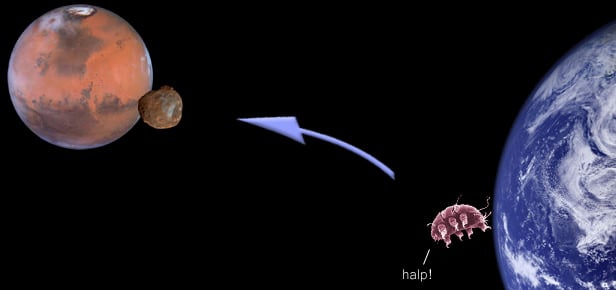
Russia Will Send Life to Phobos

by Ian O'Neill on March 1, 2009

Going where no tardigrade has gone before

Boldly going where no tardigrade has gone before (edited by Ian O'Neill)

How ironic. Not content with searching for life on Mars, the Russian space agency and the US-based Planetary Society will soon be sending terrestrial life to the Martian moon Phobos. The mini-interplanetary travellers will consist of bacteria, spores, seeds, crustaceans, insects and fungi. Why? To see how biological life, in various forms, deals with space travel spanning three years.

So if you thought that a human (or monkey) would be the first of Earth’s ambassadors to land on Mars or one of its moons, you’d be very mistaken

The Phobos-Grunt mission profile

The Phobos-Grunt mission profile

Russia has been carrying out a variety of biological space tests to see how life deals with the hazards of spaceflight recently. In one experiment carried out in collaboration with Japanese scientists, a mosquito was attached to the hull of the International Space Station (ISS) to see… what would happen.

The mosquito was a part of the Biorisk project, and the scientists knew the insect had the ability to drop into a “suspended animation” during times of draught in Africa. The African mosquito can turn its bodily water into tricallosa sugar, slowing its functions nearly to a stop. When the rain returns, the crystallised creature is rehydrated and it can carry on its lifecycle. The Biorisk mosquito however survived 18 months with no sustenance, exposed to temperatures ranging from -150°C to +60°C. When returned to Earth, Russian scientists gave the hardy mozzie a health check, declaring:

We brought him back to Earth. He is alive, and his feet are moving.” — Anatoly Grigoryev, Vice President of the Russian Academy of Sciences.

©Gerald Yuvallos/Flickr

Quite happy with living in space, the mosquito ©Gerald Yuvallos/Flickr

Was this insect cruelty of the most extreme kind, or did it serve a purpose? Actually, the mosquito experiment provided an insight to a biological specimen after being exposed to cosmic rays for long periods, and it also showed us that the African mosquito’s natural ability to slip into a defensive coma, only to be revived and appear to be healthy (that is, if it was more than just its feet moving – there was no indication as to whether the little guy was successfully re-integrated into mosquito society). Perhaps the lessons learned from this small test may go to some way of helping us realise the potential for putting future interplanetary astronauts into some kind of biological stasis.

So that’s the idea behind sending creatures into space: we need to understand how animals and plants deal with space travel. This will aid the understanding of how humans will cope in space for long periods, plus we need to understand if there are any harmful effects from growing foodstuffs away from our planet. This is why the Russian space agency wants to go one step further when it launches its Phobos-Grunt mission next year, to send biological specimens on a voyage of a lifetime. A return trip to the Martian moon Phobos.

Say hello to our interplanetary ambassador, the tardigrade (FUNCRYPTA)

Say hello to our interplanetary ambassador, the tardigrade (FUNCRYPTA)

On board, it is hoped the US-based Planetary Society will be able to send a small package filled with 10 different species including tardigrades (“water bears”), seeds and bacteria. The main purpose of this experiment will be to test the panspermia hypothesis, where it is thought that life may travel from planet to planet, hitching a ride on fragments of planetary material. Most of the biological samples will be in a dormant state (i.e. the plant spores), and tests will be carried out when Phobos-Grunt returns to Earth to see if the bacteria survived, seeds germinate and spores… do what ever spores do.

Russia on the other hand has far loftier goals; the space agency will attach a small petting zoo. Inside the Russian experiment will include crustaceans, mosquito larvae (already proven to be enthusiastic space travellers), bacteria and fungi. The Russian experiment will specifically look at how cosmic radiation can effect these different types of life during an interplanetary trip (essential ahead of any manned attempt to the Red Planet).

Naturally, there are some concerns about contamination to the moon (if Phobos-Grunt doesn’t do the “return” part of the mission), but the chances of any extraterrestrial life being harboured on this tiny piece of airless rock are low. Having said that, we just don’t know, so the mission scientists will have to be very careful to ensure containment. Besides, there’s something unsettling about infecting an alien world with our bacteria before we’ve even had the chance to get there ourselves…

Source: Discovery

[Follow me on Twitter (@astroengine)][Check out my space blog: Astroengine.com][Check out my radio show: Astroengine Live!]Hello! My name is Ian O'Neill and I've been writing for the Universe Today since December 2007. I am a solar physics doctor, but my space interests are wide-ranging. Since becoming a science writer I have been drawn to the more extreme astrophysics concepts (like black hole dynamics), high energy physics (getting excited about the LHC!) and general space colonization efforts. I am also heavily involved with the Mars Homestead project (run by the Mars Foundation), an international organization to advance our settlement concepts on Mars. I also run my own space physics blog: Astroengine.com, be sure to check it out!

  • Naia

    Of course the universe exists for us to experiment with, be the scale small or large, the risks and possible suffering calculated by us. Isn’t this called anthropocentrism or human supremacy? I believe Carl Sagan, among others, has had something to say about the attitude.

  • Bonr

    Don’t they follow the Prime Directive?!!

    /sorry, also the best I could do.
    // and also needed to be said!!

  • Joe

    Whats the big fuss we will end up colonizing mars sooner or later.

    Joe.TO.

  • Frank Glover

    “Who cares if they contaminate Phobos?

    At * most * there are some microbes or bacteria there… and if there is, I don’t care.”

    It’s a safe bet that nothing lives on the asteroid-like moons of Mars, and I’m no more concerned about Earth-life endign up there (it would almost certinly just curl up and die) than I am with Earth’s Moon. But…

    …Anything sent to the Moon, if it misses, will stay more or less in cisclunar space, perhaps one day eventually impacting Earth or the Moon, no harm no foul. Any kind of navigational or propulsion accident near MARS however (and such has happened to both sides before…indeed, the Russians thed to have very bad luck at Mars), risks impacting and contaminating Mars, possibly making it very difficult for subsequent landers to know if any evidence of biology is native or imported. (This should be obvious, but some people here seem to need that spelled out.)

    If the Russians want do do a long-duration space biology experiment, don’t let recent events make you think that all possible Earth orbts are full…

  • Rodrigo

    I just can’t believe how there is people reading this news and not supporting it.

    where is the crazy scientist inside your hearts ?

    How can you be so scared about “contamination” if we, universetoday reader’s, have something in common, that is, the passion by the universe and the unknown.

    As far as i know, i will try to follow this field test step by step, it’s sounds amazingly interesting.

  • Aqua

    Hopefully the Russians have taken the issue of contamination into their equation? Who do we ask, “What’s being done about that?” In fact, I think we all should ask…

  • Lawrence B. Crowell

    We should explore Mars for possible extraterrestrial life, or molecular traces for maybe prebiotic processes early on. Sending biological specimins to Mars has got to be the stupidest thing imaginable. This would amount to data contamination. Maybe Earth life or bacteria has made it to Mars by secondary meteoroids produced by impacts here, but let’s not intentionally introduced bio-contaminents on a planet which might have valuable data.

    I really doubt we are going to colonize Mars, at least not any time really soon.

    Lawrence B. Crowell

  • Naia

    Actually, Lawrence B. Crowell’s comment is eminent and would deserve to be the last in this debate. – But still I have to say: Three things in Rodrigo’s comment baffle me. a) Why can’t he belive people honestly expounding their views, black on white? b) Why should a possible scientist in our hearts be crayzy, why not sane? c) What does a “passion by the universe and the unknown” exclude any apprehensiveness regarding “contamination”? – Kind regards to all.

  • Naia

    Sorry about bad proof reading. Shuld have spelled “crazy” right, and also: c) WHY does a…

  • Vanamonde

    Well, it does make some sense to put the wee beasties into space for some time. But why drop then on Phobos? We are no 100% sure that nothing is there? Who expect Venus to be so hot? Or Mars to have such thin air? Or an ocean on Europa.

    I vote for caution. Like Putin cares.

Previous post:

Next post: