Ancient Pulsar Still Pulsing

by Nancy Atkinson on February 27, 2009

Want to stay on top of all the space news? Follow @universetoday on Twitter

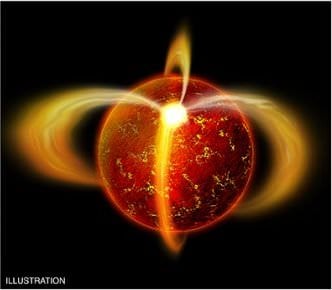
Artist concept of ancient pulsar J0108. Illustration: CXC/M. Weiss

Artist concept of ancient pulsar J0108. Image credit: X-ray: NASA/CXC/Penn State/G.Pavlov et al. Optical: ESO/VLT/UCL/R.Mignani et al. Illustration: CXC/M. Weiss


It may be old, but it ain’t dead. The Chandra X-Ray Observatory has found the oldest isolated pulsar ever detected. While this pulsar is ancient, this exotic object is still kicking and is surprisingly active. According to radio observations, the pulsar, PSR J0108-1431 (J0108 for short) is about 200 million years old. Among isolated pulsars — ones that have not been spun-up in a binary system — it is over 10 times older than the previous record holder. A team of astronomers led by George Pavlov of Penn State University observed J0108 in X-rays with Chandra, and found that it glows much brighter in X-rays than was expected for a pulsar of such advanced years.

At a distance of 770 light years, it is also one of the nearest pulsars we know of.

Pulsars are created when stars that are much more massive than the Sun collapse in supernova explosions, leaving behind a small, incredibly weighty core, known as a neutron star. At birth, these neutron stars, which contain the densest material known in the Universe, are spinning rapidly, up to a hundred revolutions per second. As the rotating beams of their radiation are seen as pulses by distant observers, similar to a lighthouse beam, astronomers call them “pulsars”.

Astronomers observe a gradual slowing of the rotation of the pulsars as they radiate energy away. Radio observations of J0108 show it to be one of the oldest and faintest pulsars known, spinning only slightly faster than one revolution per second.

J0108 in a combination of optical and X-ray. Image credit: X-ray: NASA/CXC/Penn State/G.Pavlov et al. Optical: ESO/VLT/UCL/R.Mignani et al.

J0108 in a combination of optical and X-ray. Image credit: X-ray: NASA/CXC/Penn State/G.Pavlov et al. Optical: ESO/VLT/UCL/R.Mignani et al.


Some of the energy that J0108 is losing as it spins more slowly is converted into X-ray radiation. The efficiency of this process for J0108 is found to be higher than for any other known pulsar.

“This pulsar is pumping out high-energy radiation much more efficiently than its younger cousins,” said Pavlov. “So, although it’s clearly fading as it ages, it is still more than holding its own with the younger generations.”

It’s likely that two forms of X-ray emission are produced in J0108: emission from particles spiraling around magnetic fields, and emission from heated areas around the neutron star’s magnetic poles. Measuring the temperature and size of these heated regions can provide valuable insight into the extraordinary properties of the neutron star surface and the process by which charged particles are accelerated by the pulsar.

The younger, bright pulsars commonly detected by radio and X-ray telescopes are not representative of the full population of objects, so observing objects like J0108 helps astronomers see a more complete range of behavior. At its advanced age, J0108 is close to the so- called “pulsar death line,” where its pulsed radiation is expected to switch off and it will become much harder, if not impossible, to observe.

“We can now explore the properties of this pulsar in a regime where no other pulsar has been detected outside the radio range,” said co- author Oleg Kargaltsev of the University of Florida. “To understand the properties of ‘dying pulsars,’ it is important to study their radiation in X-rays. Our finding that a very old pulsar can be such an efficient X-ray emitter gives us hope to discover new nearby pulsars of this class via their X-ray emission.”

The Chandra observations were reported by Pavlov and colleagues in the January 20, 2009, issue of The Astrophysical Journal. However, the extreme nature of J0108 was not fully apparent until a new distance to it was reported on February 6 in the PhD thesis of Adam Deller from Swinburne University in Australia. The new distance is both larger and more accurate than the distance used in the Chandra paper, showing that J0108 was brighter in X-rays than previously thought.

“Suddenly this pulsar became the record holder for its ability to make X-rays,” said Pavlov, “and our result became even more interesting without us doing much extra work.” The position of the pulsar seen by Chandra in X-rays in early 2007 is slightly different from the radio position observed in early 2001. This implies that the pulsar is moving at a velocity of about 440,000 miles per hour, close to a typical value for pulsars.

Currently the pulsar is moving south from the plane of the Milky Way galaxy, but because it is moving more slowly than the escape velocity of the Galaxy, it will eventually curve back towards the plane of the Galaxy in the opposite direction.

Source: NASA

About

Nancy Atkinson is Universe Today's Senior Editor. She also is the host of the NASA Lunar Science Institute podcast and works with the Astronomy Cast and 365 Days of Astronomy podcasts. Nancy is also a NASA/JPL Solar System Ambassador.

  • Salacious B. Crumb

    @ Anaconda
    (Sorry to repeat this yet again folks, but it crucial that Anaconda actually defines precisely the terms below.)

    Now, please for the FIFTH time. Please DEFINE IN PRECISE TERMS (individually), so we know what exactly you mean, in your interpretation of;
    1. Plasma Cosmology
    2. Plasma Astrophysics
    3. Plasma Universe
    4. Plasma Physics

    I.e. “Plasma Cosmology” is…, etc.

    If for some reason just can’t answer this. Why not?

    This is requested, so some people responding to your ideas and finally work out what you are saying!

    Thanks.

  • Anaconda

    @ Salacious B. Crumb:

    You’re a joke.

    Crumb responds to my proceeding comment with, “Oh, such venom.”

    Oh, really?

    Pointing out your strawman arguments and your evasions to a yes or no question is “venom”?

    Anyway, to the point:

    Obviously, you have no compunctions about taking somebody’s quote out of context.

    Here’s what I said about gravity, earlier, in that same thread you quote from:

    “As to gravity, yes I am convinced gravity exists, and Newton did an admirable job of describing its mechanics (particularly in reference to the general state of scientific knowledge at the time) and developing mathematical equations (calculus) to predict gravity’s effects. After all, with little modification those equations took Man to the Moon and back, alive!

    No small achievement” — 2/27/09, 10:09am

    The quote you take out of context was referring to the difficulties of gravitational theory in explaining binary and multiple star systems alone, not that gravity doesn’t exist.

    Also, the quote you provide afterwards is also taken out of context: “…’modern’ astronomy will be required to back away from this infatuation with invented imaginary ‘forces’ and concentrate on known, observed, and measured physical forces.” (date, time unknown)

    This refers to “black holes”, “neutron’ stars, “dark” matter, and “dark” energy. None have been observed & measured by astronomers. Electromgnetism actually can account for those objects and doesn’t require unseen “dark” matter and energy. Again, twisting my words does nothing for your credibility.

    The above objects & phenomenon were necessary because the gravity “only” model failed by its own constraints and requirements. In other words, without the listed items, the gravity “only” model would be falsified.

    Wow — I must’ve hit a nerve for Crumb to go quote hunting and reach back to a quote 2 and 1/2 months ago, on a small blog.

    By the way, “gravitrons” have not been observed & measured, they are a theoretical construct. So, no, I don’t know.

    Again, you mislead readers because the implication of your passage is that “gravitrons” have been observed & measured; they most certainly haven’t.

    Back to passing off your strawman arguments, I see.

    I hate to take the time and space, but this string of strawman arguments is Crumb’s “Big Lie” push.

    “- You may or may not think gravity is a fundamental force”

    I’ve never stated gravity wasn’t a fundamental force.

    “- Electromagnetism exists in binary stars but not gravity”

    Again, I didn’t write that, it’s a shameless twisting of my words. Gravity doesn’t adequately or SUFFICIENTLY explain binary and multiple star system formation.

    “- Gravity waves don’t exist”

    Yes, gravity waves have NEVER been observed & measured, even after millions spent and satellites sent up into space.

    Gravity could easily operate at a distance without “gravitrons” or “gravity waves”. Maybe, those things will be observed & measured, but so far they haven’t.

    Science has to be based on what has been observed & measured, not on what hasn’t.

    The reason I wrote: “”Do you expect anybody to take you seriously?”, is simple enough, your style of argument with the use of strawmen and twisting words out of context is fraudulent.

    Ah… Now, we come to the heart of the matter, Crumb: “Stating ‘Do you deny NASA has confirmed by in situ measurements that electromagnetism is ubiquitous in the solar system’s interplanetary medium?’ is a DIRECT THREAT [to the status quo of the gravity "only" model].”

    So, now we come to the purpose of Sal. B. Crumb’s comments: To protect the status quo, even if he has to be disingenuous to do it.

    Sal B. Crumb’s preferred form of the question: “Do you think NASA have confirmed that electromagnetism is insignificant, weak or strongly significant in the solar system’s interplanetary medium?”

    Okay, I agree, that would have been a more ‘artful’ form of the question.

    Too bad, you had to stack up all your strawman arguments before simply rephrasing the question.

    But regrettably, there you go again.

    You pose a reasonable form of the question, but then you go off without answering it.

    Sorry, when you misstate my position and then attack me based on your false characterization — that’s a stawman argument, plain and simple.

    Sal. B. Crumb: “If you say gravity is NOT caused by an exchange of photons, then what is the transmitter particle of gravity?”

    I didn’t call this a strawman argument.

    But the first half of your quote: “You must therefore believe that gravity is caused by an exchange of photons. Right?”

    Is most definitely a form of strawman argument because I never expressed an opinion about photons one way or the other, yet, here, Crumb is attempting to assign a position to me, I’ve never expressed.

    Sal. B. Crumb: “[Y]our actual problem is how you express your own arguments.”

    Maybe so, but readers can judge for themselves.

    Yes, moderators, Sal B. Crumb’s comments speak loudly and are edifying: “I might be rancid butter, but I am on your side of the BREAD.”

    In other words, the “ends justify the means” and I’m on your “side” of the argument, so leave my comments.

    Problem is, Crumb, your intent is transparent and your tactics are so “rancid” that you are an embarrassment to your “side” (science doesn’t have “sides”) because it leaves the impression that only “rancid” arguments like yours can preserve the status quo, gravity “only” model.

    Is that what it’s come down to for “modern” astronomy to have to rely on Crumb’s kind of discussion?

    A sad state of affairs.

    A final note: Crumb never responded regarding my characterization of his “neutron” star weaseling and evasion.

    That’s the subject of the post, after all, which should tell readers something.

    As I stated off the top, Crumb is a joke.

    And he does no favors to his side of the argument. Any “side” that has to rely on a disingenuous attack dog like that is not on a firm scientific foundation.

  • Salacious B. Crumb

    Oh dear, at the computer too long, to write such as string of errors . I originally said said;

    “To learn anything new, sometimes more important to listen, then think what it means, and then somehow applies to what you are doing.”
    Unknown (but it is what my teaching lecturer once said. I didn’t forget it.)

    It should read.

    “To learn anything new, sometimes it is more important to listen, and then think what it means, and then somehow apply it to what you are doing.”
    Unknown (but it is what my teaching lecturer once said. I didn’t forget it.)

    My apologies.

  • Trippy

    Anaconda/OIM:

    Perhaps one of you two would care to show us what an Ambiplasma looks like?

    Yes? No?

  • Anaconda

    @ Salacious B. Crumb:

    One concluding thought: Your arguments are designed to roil gravity “only” minded folks’ opinions by playing to their prejudice against the scientific theory I bring to their attention. My arguments are designed to appeal to their reason. Why? because if they do respond emotionally, likely it will only work against my position, whereas, if you roil their emotions against me it will work to your side of the argument.

    (Their emotions being predisposed to your side of the argument.)

    In that regard, your intentions and tactics are clear.

  • Salacious B. Crumb

    Anoconda…
    Let it go.mate. I think you have already lost the argument.
    The more you write, the more you show your ignorance.
    So I’ll come back to what I originally said.
    It was YOU who made the contentions NOT me.
    As for prosperity, your understanding of plasma cosmology (and we still don’t know what you mean) is very poor at best and limited in its usefulness. You have weak knowledge of current theories, and you don’t understand why the majority of astrophysicists and cosmologists think like they do.
    As for the neutron star points, you keep saying the degenerate matter in neutron stars does not exist, but you don’t say why do you? I have told you it has to do with the strong force and atomic theory – but you just ignore it by saying I’m avoiding the question.
    I recall somewhere you say you believe in white dwarf stars but not neutron stars? Why?
    Clearly you bring it up in a side issue and a distraction (but I still won’t bite), because you wish to avoid the tenet of the nature of gravitational sources hiding behind electromagnetic (whatever).

    Now let’s see.

    1) You also said; “But the first half of your quote: “You must therefore believe that gravity is caused by an exchange of photons. Right?”
    Is most definitely a form of strawman argument because I never expressed an opinion about photons one way or the other, yet, here.”
    Oh yes you did!
    You said photons were dualistic “waves / particles.” Remember. Ergo, if you concluded that, and “Binary stars (and multiple star sytems) — Gravity doesn’t account for binary and multiple star systems. Electromagnetism does.” Hence we must conclude electromagnetism is gravity in binary and multiple stars.

    But then you say that this was never said.
    I.e. ” “Gravity doesn’t account for binary and multiple star systems. Electromagnetism does” Hence the point “- Electromagnetism exists in binary stars but not gravity”
    Again, I didn’t write that, it’s a shameless twisting of my words. Gravity doesn’t adequately or SUFFICIENTLY explain binary and multiple star system formation.” ”

    Oh yes you did write that!
    I.e. “Binary stars (and multiple star sytems) — Gravity doesn’t account for binary and multiple star systems. Electromagnetism does.” (no mention of formation by the way)
    [See "Jupiter, Saturn Plowed Through Asteroids, Study Says " February 28th, 2009 at 9:40 am ]

    Hence my statements are actually true.
    Your argument is therefore false and contention is wrong. (need I say more)

  • Salacious B. Crumb

    Anaconda,
    Perhaps some timely advise is in order, and you might be able to understand this when you calm down.
    If you can’t construct a logical argument, well really their is no point in saying anything at all. So one thing is positive, at least you have given us a much better insight into what you may or may not believe. (ND will be happy!)
    Even better they have been recorded for prosperity, so I suggest you be a bit more more cautious when stating what you say or didn’t say.
    As some honest advice, I would suggest you perhaps collect your ideas together is some semblance of order, and start to work out what theories you support and what evidence there is to disprove it. I would avoid also expression things in terms of absolutes. I..e “gravity waves don’t exist”. A better way is to say something like “…because of contention ‘A’ and contention “B’, it is more likely that gravity waves don’t exist ” If you don’t do this, your arguments will be always instantly be destroyed if only one point proves the statement false. Sadly, your aims seem more deliberate to trick or catch out others to make believe what you believe.
    Anyway thanks for your someone somewhat strange and quirky views on the Universe. Sadly I have other more important issues to deal with.
    So have a NICE day, won’t you….

  • Salacious B. Crumb

    Now this is truly beginning to be delusional.

    “Your arguments are designed to roil gravity “only” minded folks’ opinions by playing to their prejudice against the scientific theory I bring to their attention.”

    I (again) recall you to my very plain an unemotional statement that I have now given you on numerous occasions.

    “The position regarding the role of electromagnetism (whatever} and gravity is crystal clear, and what is held by current theory and 99.9% of the astronomical community is that;
    “Presently explanations of astrophysical phenomena seem mostly and significantly influenced by gravity, and that the effects of electromagnetic forces are fairly minor.” ” **

    NOTE: OK, different perspective, and now without emotion or excuses, what PERCENTAGE do you roughly think gravitational forces to electromagnetic forces are important in all astronomical phenomena should be? 100%, 90%, 50%, 20%, 0%, etc.?

    As for; “My arguments are designed to appeal to their reason. Why? because if they do respond emotionally, likely it will only work against my position, whereas, if you roil their emotions against me it will work to your side of the argument.”

    This is just pure paranoia.
    Again. Who are “they”? Whose “emotions”?
    What are my (and the other respondents) motives, here?
    Why would they be against you?

    Also I have no “side”.

    Yet again
    ******************************************************
    It was YOU who made the contentions NOT me !
    ******************************************************

    ** The bottom line is that there are ZERO people I.e. NOBODY in either cosmology or astrophysics are “gravity “only” minded folks’ ” The evidence is perfectly clear. A vast majority of known astronomical objects have a electromagnetic component and a gravitational component. What we observe is that the gravitational component is overwhelmingly the predominate force, and much of the observed behaviour of astronomical objects can be calculated solely in terms of provable gravitational theory calculations. Sorry, that is how it is – no emotions no delusions.
    So the million dollar question remains is why can’t you just accept that?

  • Mr. Obvious

    Different day… same morons.
    It only takes a few idiots to ruin a web site. We are witnessing this process here.

    Before you have a debate about forces, you should at least have a complete understanding of them. To believe electromagnetism is the force keeping you on the ground is rediculous.

    If you really understood how electromagnetism worked, you would easily understand that IF electromagnistism was the force pushing you down to earth, then EVERYTHING on earth would STICK TO YOU, as if you and everything else was a magnet.
    In reality, it is electromagnetism which keeps us from actually being able to touch anything, as well as keeping objects from passing through each other.

    Just because you “Think” something happens, doesn’t mean it does.

  • Neil

    jesus, get a room

  • http://www.superrelativity.org msuper

    There is a new Theory of Everything Breakthrough. It exposes the flaws in both Quantum Theory and String Theory. Please see: Theory of Super Relativity at Super Relativity Einstein was right!

  • Anaconda’s Ghost

    Neil say:
    “jesus, get a room.”
    Actually no.
    There are claims being made here that are both misleading and untrue.
    Do you want to know the truth or are you just happy to be deceived?
    My suggest to you instead “…get a book.”, then you might just know what is going on…
    In the future I’d suggest you quell such irrelevant comments.

  • Salacious B. Crumb

    I have duplicated this post to aid in the issues brought up in aspects for the portions of discussion on this article.
    (If the moderators feel this was not particularly necessary, I would not be put out if you removed it.

    *****************************************
    Quite frankly, probably like most responding here, I have become very frustrated especially in arguing against Anaconda. Reading some of the ancillary response here, I’m beginning to know why.
    Two points I would like to make, who aim is to quell the continuous and somewhat bitter debate here;
    1) In a general short discussion at a meeting yesterday with some astronomical educators and professional astronomers, I brought up the issue of those who express dogmatic views on astronomical phenomena. I gave an example of Anaconda views regarding plasma physics and the presumed importance / weakness in our knowledge of gravitational sources.
    Needless to say two main ideas were raised
    a) The perception that the majority of the astronomical sources in universe are comprised of exotic phenomena.
    b) That components of magnetic fields, generation of electromagnetic radiation, and gravitational sources were of significant importance to explain the vast majority of known astronomical phenomena.
    However, the first contention is probably the most interesting and relevant. Articles on galactic or extragalactic stories (like we see throughout Universe Today”) tend to concentrate on exotic phenomena. I.e. Gamma-ray bursters, X-ray sources, interacting close binary system, galaxy jets, quasars, etc.
    What some forget to realise is that most observed astronomical phenomena is in fact very very ordinary – passive going through formation and their evolution. Electromagnetic activity in most cases is quiescent.
    So in the end, Anaconda is basically right that electromagnetic activity can be significant, but mostly only in active objects. Regarding the run-of-the-mill objects in the universe its influence is small compared to gravitational sources. (exactly like Lawrence B. Crowell has said above and ND.)
    [Perhaps the other biggest question is the proportion of exotic phenomena to quiescent astronomical phenomena - but that is yet another matter]
    2) I have been reading some of the issues Anaconda has brought up, because few papers discuss gravitation and their electromagnetic counterparts.
    A recent released arvix article given on 2nd March 2009 (you can get more recent than that) might be very useful as an independent source. This will also aid greatly in relevant discussion
    Entitled; “Finding and Using Electromagnetic Counterparts of Gravitational Wave Sources”, by E. Sterl Phinney http://arxiv.org/pdf/0903.0098
    This paper joins information and perspective, study into the immediate future and the role of electromagnetic and gravitational sources.
    [If Anaconda (and Oillsmastery) cannot accept such relevant an up to date information, then I suggests he/they takes his views to another forum.]
    Again many apologies for the length of this reply, or if it is irrelevant.

  • Vanamonde

    Maybe it is time for registration and moderation.

    i dunno.

Previous post:

Next post: