 Universe Today
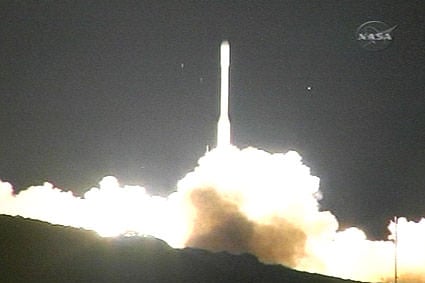
This morning (Tuesday), shortly after 2am PST (10am GMT), the launch of Orbiting Carbon Observatory (OCO) mission resulted in failure. According to reports from NASA, a "launch contingency" was declared shortly after the Taurus rocket upper stage finished firing T+12 minutes, 30 seconds into the flight. The rocket nose cone fairing failed to separate as expected, therefore the satellite could not be released. Further news is pending, but it appears that the failed Taurus XL upper stage plus OCO satellite remains in orbit. The OCO mission is declared lost...
The Orbiting Carbon Observatory (OCO) was launched by a Taurus XL rocket at 1:55:30 am PST from California's Vandenberg Air Force Base, set for a polar orbit at an altitude of 438 miles (704 km) to begin an important and detailed study into the carbon dioxide content of our atmosphere. The satellite was designed to provide NASA with an insight to the sources of human and natural carbon emissions, as well as pin-pointing our planet's carbon "sinks". Unfortunately, the opportunity to gather valuable data with this about the global impact of carbon emissions with the advanced OCO mission has been lost.
At 2:16 am (PST), NASA launch commentator George Diller confirmed that a launch contingency had been implemented:
"This is Taurus launch control. It appears that we have had a launch contingency. We don't have the exact nature of the loss of mission, but NASA launch director Chuck Dovale has directed that the launch contingency plan be implemented. We will try to bring you any additional information as soon as we have it." -- Chuck Dovale (courtesy of Spaceflight Now)
A few minutes later, Diller went into some more detail about the failure to get the OCO into orbit. The casing (or fairing) failed to separated successfully, trapping the satellite inside the Taurus XL upper stage. NASA scientists continued to ascertain what condition the spacecraft was in, but any hopes of a successful outcome to the contingency were dashed when Diller said, "Right now, we do know that we have not had a successful launch tonight and will not be able to have a successful OCO mission."
A terribly sad night for NASA and a terrible set-back to efforts to understand the full impact of human activity on the Earth's atmosphere.
Special thanks to @govertschilling and @Zurack for their help with notifying me of the situation and forwarding me links via Twitter.
Source: Spaceflight Now
