What About the Space Exploration Crisis? NASA Budget Could be Cut to Save Money

by Ian O'Neill on December 12, 2008

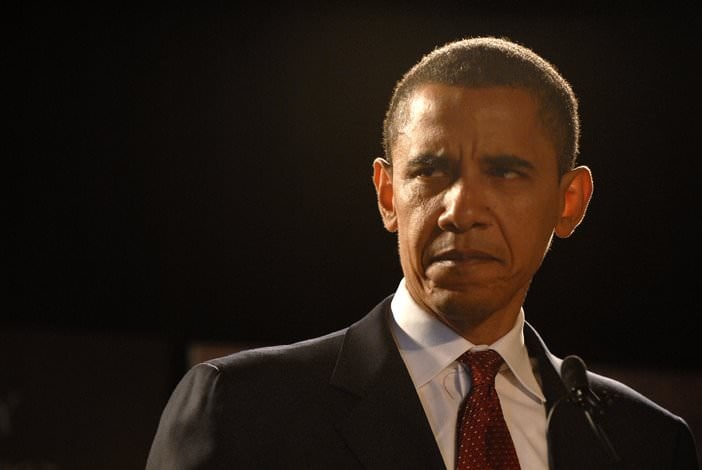
Obama is in for a rough ride to get the economy back on track, but NASA cutbacks are not the answer

Obama is in for a rough ride to get the economy back on track, but NASA cutbacks are not the answer

There’s no denying it, President-elect Barack Obama will have one of the toughest jobs in presidential history. The challenges the 44th President of the United States will face are deep and varied. Everything from the economy to housing, from health care to warfare, from energy to security; everything appears to be in a state of “crisis”. So, of the incoming administration’s priorities, getting man back to the Moon is low on the list. Unfortunately, the exploration of space is often viewed as a luxury rather than a necessity, policy changes interfere with long-term projects, and the NASA budget can become an easy target for cutbacks.

It will come as no surprise then, that news is surfacing about some friction between Obama’s new administration and the existing top brass in NASA. Some reports point to direct non-cooperation by NASA Administrator Michael Griffin, an allegation that both NASA and the Obama transition team deny. Regardless, there is tension building, especially when it is becoming clear that the transition team may be eyeing up NASA budget cuts, postponing the Constellation program, possibly putting long-term US manned access to space at serious risk.

A space exploration crisis is on the horizon, but what damage would it cause?

nasa-logoWriting about NASA’s endeavours in space can be a frustrating experience. On the one hand, the US space agency is responsible for mankind’s biggest space-faring achievements. NASA has always led and the world has followed. NASA pushes back the frontiers of manned and robotic exploration, and now the agency’s expertise is being passed down to commercial spaceflight companies (such as SpaceX support through COTS contracts) to fill in the void behind NASA’s advances.

We are reaching an age where other nations are investing in space exploration too. The European Space Agency (ESA) is rapidly growing, Russia has one of the most robust launch systems on the planet, China is making huge leaps in manned spaceflight, India has sent a probe to the Moon; the list is growing by the month. Therefore, the US is beginning to feel competition from the international community, and although the US won’t be toppled as #1 in space any time soon, what about a decade from now? Will the playing field turn against NASA’s dominance in Earth orbit and beyond? Fortunately the US has close collaborative ties with ESA and Russia, but what happens if this situation changes?

NASA recently extended their use of the Russian Soyuz vehicle to fill in US manned access to space during the “5-year gap” between Shuttle decommissioning in 2010 and (proposed) Constellation launch in 2015. Although it is reassuring to know astronauts will still be able to fly with cosmonauts to-and-from the International Space Station (ISS) beyond 2010, what happens if relations between the US and Russia chill even further (the South Ossetia conflict is a prime example of how the politics between the two nations can freeze solid)? The Russian government could very quickly pull the plug on US manned access to space.

Artist impression of the SpaceX Dragon approaching the space station (SpaceX)

Artist impression of the SpaceX Dragon approaching the space station (SpaceX)

And so, all eyes on US space companies accelerating their development of alternative means of transportation. Elon Musk’s SpaceX for example, is a front-runner when it comes to commercial manned spaceflight. In a recent interview I conducted with SpaceX, Diane Murphy (Vice-President of Marketing and Communications) was very optimistic about SpaceX’s Dragon module providing the answer to manned spaceflight. “I think we’ll surprise them [NASA] with how quickly we are moving so they can use us for crew as well. We’ll be ready!” she told me. Judging by the speed at which the company is developing, it certainly seems to be a possibility.

But, for now, we are stuck in an awkward position. NASA gets a minuscule budget when compared with other government departments. The US government has underfunded the agency for many years, and the funds it does receive are constantly open to erosion by changing administrations and space policy. Now Barack Obama’s administration must balance the needs of NASA with the worsening financial crisis hitting the world, so a transition team has been sent to look into NASA business to understand where work needs to be done.

Now it seems as if tensions are coming to a head. According to reports in the Orlando Sentinel, Michael Griffin, who was attending a book launch with members of the Obama transition team (including ex-NASA senior administrator Lori Garver), accused Garver as being “unqualified” to be assessing whether funds should be cut from the development of the Constellation Program. According to witnesses at the book launch, Garver tried to reason with Griffin saying, “Mike, I don’t understand what the problem is. We are just trying to look under the hood.”

Griffin apparently disliked this assertion and said, “If you are looking under the hood, then you are calling me a liar. Because it means you don’t trust what I say is under the hood.”

Associates who attended the book launch said the exchange between Griffin and Garver was not an argument, it was simply “a discussion about stuff.” Still, whatever tone the discussion was pitched at, there seem to be problems brewing. To calm rumours that he was not cooperating, Griffin wrote an email to NASA employees saying, “This report, largely supported by anonymous sources and hearsay, is simply wrong. We are fully cooperating with the [transition] team members.”

Hemorrhaging the NASA budget? Stern cites the MSL as a prime example of damaging overspending (NASA)

Hemorrhaging the NASA budget? Stern cites the MSL as a prime example of damaging overspending (NASA)

This could be the symptom of recent accusations by Alan Stern, ex-NASA Associate Administrator for Science, that there was a “cancer” in the administration’s management structure. According to Stern, the result of this “cancer” is zero-accountability for project budget overspending and wasteful practices. His words came when NASA announced it would be removing a sample storage box from the Mars Science Laboratory after it had been developed and constructed (thereby throwing away $2 million), then followed by an announcement about a two year postponement of the mission. Needless to say, Stern is highly critical of the mission, prompting him to say that the “Mars Program is slowly committing suicide before our very eyes.”

Putting government underfunding, and alleged NASA mismanagement to one side, it appears to be a continuing misconception that the exploration of space (whether it be manned or robotic) is an academic endeavour. Personally, I’d argue that manned exploration of space is essential for the long-term survival of our species, but politics only thinks about the next four-year term in office. Although politics is a fantastic motivator for space exploration in some cases (cue: Apollo Program during the Cold War in the late ’60′s and early ’70′s) to fulfil short-term goals, during periods of social and economic upheaval, space exploration becomes an unnecessary luxury and policies become a lot more introverted.

To finish off, let’s look at the European Space Agency. Although ESA is a completely different entity from NASA–it is not politically-driven (although some leaders want it to be), it is a consortium of many nations and its budget is smaller than NASA’s–its outlook for Europe’s efforts in space are far more optimistic. Rather than trying to cut funding to save money, ESA appears to have a renewed vigour toward using space exploration as a means to stimulate the economy:

These decisions have particular relevance at the present time, showing as they do Europe’s determination to invest in space as a key sector providing for innovation, economic growth, strategic independence and the preparation of the future.ESA press release

To avoid any regrets in space policy, the upcoming US administration needs to look hard at ESA’s motivation. Investment in space provides independence, economic growth and preparation for the future. Alas, by making cutbacks to the Constellation Program, the US will start depending on Russia for manned access to space (if a commercial alternative isn’t available in time), economic influence of a manned space program will be cancelled out, and as for the future? Well, we’ll just have to hope for the best.

Sources: Seattle PI, FOX News, ESA

  • JoeThePlumber

    Michael Says: “I want to show what a redneck repubtard I truly am by making the stupidest comment on this page”

    Michael, I am laughing and dancing right now at the fact that you are still a whining looser limbaugh goat sucker. I love the fact that even a simple image of Obama can set off idiots like yourself, raising your blood pressure; hopefully to a level that causes you to have a heart attack without health insurance.

    And don’t forget to go to church on sunday you good little rightwing nutjob! LOL

  • RetardedFishFrog

    Joe The Plumber – Please flush the vitriol. You’re not advancing the discussion. Try sticking to the subject.

    That said…

    There must be a space advocacy group that can organize an email writing campaign in support of NASA. Politicians will listen if our voices are loud enough.

  • http://change.gov/ Dan Tillmanns

    Science
    In the past, government funding for scientific research has yielded innovations that have improved the landscape of American life — technologies like the Internet, digital photography, bar codes, Global Positioning System technology, laser surgery, and chemotherapy. At one time, educational competition with the Soviets fostered the creativity that put a man on the moon. Today, we face a new set of challenges, including energy security, HIV/AIDS, and climate change. Yet, the United States is losing its scientific dominance. Among industrialized nations, our country’s scores on international science and math tests rank in the bottom third and bottom fifth, respectively. Over the last three decades, federal funding for the physical, mathematical, and engineering sciences has declined at a time when other countries are substantially increasing their own research budgets. Barack Obama and Joe Biden believe federally funded scientific research should play an important role in advancing science and technology in the classroom and in the lab.

  • Sholtz

    Making budget cuts for the military in order to better fund education and technology (NASA) is the most logical choice.

    Because it is better to have smart kids than smart bombs.

  • Clint Lack

    I am not as educated as I would like to be but one thing I do know -We must lead and not follow- We must set the example and push ourselves and strive to become a better nation. Better society through better education for ALL! In all fields and technologys. If we can come up with money for bailouts we must come up with money to support new arts and science.Nasa enables us to dream without dreams what do we stand for as a nation? We must have goals and hopes and dreams.

  • http://www.r1313.info Ralph Rewes

    As I said before. Make interesting. Re-release all those crummy, rigged, blurred, unenhanced pictures with questionable items on the Martian surface. Forgodssake. You have the capability of doing this, do it, put a will on your abilities.

    NASA has the most beautiful, enhanced, crystal clear pictures of moons much farther away, why you feed a truth-hungry audience of admirers this pile of crappy pictures.

    Go back to your archives, fix the crummy pasting, enhance the pictures you keep in the dark, and you will see a revolution of interest in space all over the world.

  • Maxwell

    Space exploration and military interests are too closely intertwined to simply hack one budget apart with a machete and figure it wont affect the other.
    Especially when both entities share launch systems.

    I think what aggravates me more is the idea that soldiers and astronauts are being held publicly accountable for their spending. Meanwhile congress works tirelessly through the night to write a trillion dollar blank check so wealthy businessmen wont suffer the consequences of their own actions.

    Auto-makers were on the verge of taking home more money than NASA’s entire budget… and if we play our cards right, they just maybe might build us that electric car they’ve been promising for the last 30 years!

  • marcellus

    I agree that the U.S. has to lead. There’s no place like first place, but the competition is getting steeper all the time.

    In human spaceflight, the U.S. has gone farther (the only nation to the Moon), but the Russians have the total hours in space. In robotic missions, the U.S. is supreme, with the most missions and the greatest success rate.

    This is the future that we’re talking about. Mars and the Moon. That future is not very far away.

  • Louis Friedman

    Ian O’Neill’s article on the NASA transition team politics is the best I have seen on the subject. It is trite to say, but worth repeating, that it is a very unstable time for economic planning — in the large, and for NASA. Let’s hope that Obma’s interest in creating an inspiring NASA dominates those economic forces.
    I presented the Society Roadmap to Space. http://www.planetary.org/roadmap to the transition team a week ago. We are, and will be, conducting a grass roots campaign strongly advocating support for space exploration: human and robotic — extending human presence into the solar system. Join with us.

  • Shaun

    Thanks for another excellent article, Ian.

    In my opinion, Europe will be the economic powerhouse of the 21st century, with the US and China struggling to keep up. ESA is in many ways a much better organised agency than NASA, being based more on intelligent advancement of the European community rather than continually harrowed by politics and economics, like NASA. ESA could well be the agency that leads us to the Moon, Mars and beyond.

  • Relic Flyer

    RE: “”Exactly what positive effects would there have been if the US won the vietnam war? It’s not like the domino theory actually turned out to happen.”

    What? — The US’s willingness to fight communism in Vietnam — even if the US loses — sent a message to the USSR. It was a stategic victory; communism did not spread in SE Asia.”
    Hush children! we have more important things to talk about. First of all, Laos and Cambodia both fell under Communist control after Saigon fell. The “Domino Theory” was all too accurate. At first, our willingness to fight startled the USSR and the PRC…..and then they discovered they could keep us tied up there cheaply for years. Thanks to the fact that Stalinist or Maoist economics do not work worth a crap, all of SE Asia welcomes US investment and economic interests these days. We could have done much better, either by fighting smarter, or by sponsoring locals to oppose the Red backed locals, or by not fighting at all.

  • Chuck Lam

    I’m not so certain that the new administration isn’t on the right track cutting back on non-essential programs In light of the current economic pain and suffering of main street America. It is absolutely critical that the United States get back on economic solid ground. Saving a few billion here and there will help speed up recovery. If we fail in this regard, we will be in big trouble and NASA’s present efforts won’t mean a thing.

  • http://www.lostworldarts.com Karl

    It looks like Griffin has pretty much insured he’ll be replaced. I just hope he hasn’t done too much damage to NASA on his way out.

    If NASA’s budget does get cut I would put most of the blame on Griffin. He seems to be squandering the chance to work with what could have been the most NASA-friendly administration in decades.

    I only hope Obama replaces him quickly and retains the Constellation program despite Griffin’s foolish antics.

  • Spoodle

    Shaun says

    “ESA is in many ways a much better organised agency than NASA, being based more on intelligent advancement of the European community rather than continually harrowed by politics and economics, like NASA. ESA could well be the agency that leads us to the Moon, Mars and beyond”

    I agree with that statement but its kind of funny to think that a multi-government organisation like the ESA is more united than a single government organisation NASA.

    Further thinking on this is that all past co operative missions also seem to have far better success.

  • http://aviation-space-news-for-aviators.top-seo-solutions.com/ Aviation News

    Excellent post and I would like to add the following. It is no surprise that NASA has been having problems receiving the funding that it truly needs. The problem with NASA is that it has been dragging it’s feet for to long. Year after year, and decade after decade, of low earth orbit would make any common American citizen bored of what NASA is doing. If the American citizen gets bored with NASA, then Congress may get bored with NASA. That means less funding. No bucks, no Buck Rogers. The only really exciting science related stuff has come from the unmanned Mars robotic rovers Spirit and Opportunity, which have been enormously successful, and relatively cheap. The problem is only scientists and technical people get excited about Spirit and Opportunity. If NASA wants to gain the backing of the American people, they need to speed up the process of human exploration of space. Back in the Apollo days, we went to the moon within a 9 year period. Today, it can take 9 years just to get a NASA program approved by Congress. At the rate that NASA is going, private enterprise will pass it in terms of getting humans back into space exploration. And if not private enterprise, then China will gladly take the role of
    a global leader in space exploration. For news about aviation and space visit Aviation News – Aerospace Headlines.

Previous post:

Next post: