“Leap Second” to be Added to World Clocks

by Nancy Atkinson on December 9, 2008

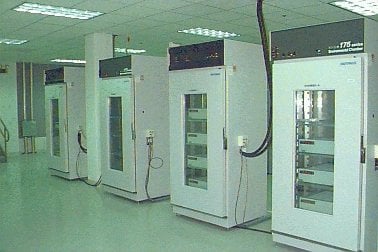
The US Naval Observatory operates 70 cesium atomic clocks.  Credit: USNO

The US Naval Observatory operates 70 cesium atomic clocks. Credit: USNO


If you ever feel like you need more time, here’s some great news: you’re actually going to get it. On December 31, 2008 a “leap second” will be added to the world’s clocks at 23 hours, 59 minutes and 59 seconds Coordinated Universal Time (UTC). This corresponds to 6:59:59 pm Eastern Standard Time, when the extra second will be inserted at the U.S. Naval Observatory’s Master Clock Facility in Washington, DC. This is the 24th leap second added to UTC, a uniform time-scale kept by atomic clocks around the world, since 1972. Coincidentally, Fraser and Pamela’s most recent episode of Astronomy Cast is about time, so if you want to know more about time and the atomic clocks used to provide precise timekeeping, check it out.

Historically, time was based on the mean rotation of the earth relative to celestial bodies and the second was defined in this reference frame. However, the invention of atomic clocks defined a much more precise “atomic time” scale and a second that is independent of the earth’s rotation. In 1970, an international agreement established two timescales: one based on the rotation of the earth and one based on atomic time.

Atomic clocks do not use radioactivity, but they use the exact frequency of the microwave spectral line emitted by atoms of the element cesium, in particular its isotope of atomic weight 133 (“Cs-133″). The integral of frequency is time, so this frequency, 9,192,631,770 hertz (Hz = cycles/second), and this provides the fundamental unit of time, which are measured by cesium clocks.

The problem is that the earth’s rotation is very gradually slowing down, which necessitates the periodic insertion of a “leap second” into the atomic timescale to keep the two within 1 second of each other. The International Earth Rotation and Reference Systems Service (IERS) is the organization which monitors the difference in the two timescales and calls for leap seconds to be inserted or removed when necessary.

Since 1972, leap seconds have been added at intervals varying from six months to seven years, with the last being inserted on December 31, 2005. The U.S. Naval Observatory is charged with the responsibility for the precise determination and dissemination of time for the Department of Defense and maintains its Master Clock. The U.S. Naval Observatory, together with the National Institute of Standards and Technology (NIST), determines time for the United States.

Source: US Naval Observatory


  • Cynthia

    Well ShadowDancer, via the web there seems to be some consensus that the length of an Earth day might have been on the order of 14 hours 4 billionish years ago, or after the moon was formed. More recent geological evidence points to 21 or 22 hour days a mere 400 to 600 million years ago. In the long run the Moon will continue to spiral away from the Earth until a lunar month is equal to an Earth day, which will be something on the order of over 1000 hours. Fortunately that would take a trillion years and surely the Earth and Moon would be consumed by a bloated Sun long before then, perhaps in a billion years or so.

    But getting back to the original question, what would the rotation rates of the Earth be for the last 4 billion years? I’d guess that the slow-down rate is somewhat proportional to the tidal forces, but that the tidal forces are not linearly related to the change in the Earth-moon distance. Move the moon twice as far away from the Earth and the tidal forces should drop by a factor greater than two. But what’s the relationship? 1/radius^2 ? 1/radius^3 ? I suppose the shape of the curve as a function of time is pretty much a decaying exponential, more or less, and that would mean the change in rotation rate was quicker in the past and will asymptotically approach a final value in the future.

  • ShadowDancer

    Reply to Cynthia:

    The transformation of the sun into a red giant is approximately 5 billion years from now according to our current understanding of the sun and how it is changing. As for the moon, the theoretical prediction for reaching an orbit that matches the rotation of the Earth would be in about 50 billion years. As for the Earth’s rotation, it should indeed be a decaying change in rotation over time due to the moon moving farther away (i.e. the Earth slowed down more when the moon was closer). As far as gravity is concerned, it is inversely proportional to the square of the distance between two bodies. The math for changing tidal forces is more complicated though.

    As for the leap second, that has more to do with keeping the atomic clocks in sync with the background stars due to the fact that the Earth doesn’t rotate in exactly 24 hours. What this really means is that inserting leap seconds has to do with the current rotational speed of the Earth as opposed to the slowing of the rotation of the Earth, even though that is the technical cause of the leap seconds being inserted. The actual change in Earth’s rotation is only about 2 microseconds since 1820. A good explaination can be found here: http://novan.com/earth.htm

  • Paul

    It’s my understanding that the the Earth’s rotation will never actually stop. It may slow down substantially over the millenia but never halt. Look at Venus – no moon but it still spins on its axis. Ditto Mars and the other planets. The moons of the others barely register as brakes on rotation and of course barring Mars they’re all gas/ice giants not rocky/metallic ones.

  • Robert Kling

    The 24 extra seconds in the last 37 years…
    If we take the idea to the absurd and we could ride along with Einstein holding on to the tail of a photon at the speed of light, time would stop. With this adding of the occasional
    second because of slowing velocity does that mean that if we could stop our rotation and orbit and expansion through the universe that likewise time would stop? If time is just a function of mass and velocity can it work both ways,… that, ultimate velocity and none at all, both yield some kind of crazy stasis?

Previous post:

Next post: