Universe Today
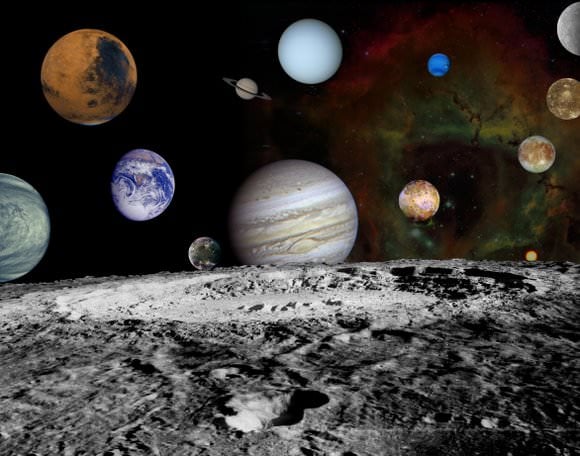
Navigating a spacecraft through the heavens has been compared to sailing a ship on the open seas or driving a vehicle on a long, cross country journey. Analogies are necessary, since spacecraft navigation is performed by a relatively small sampling of the human race, and the job usually involves doing things that have never been done before. Those of us who have trouble making sense of a road map here on Earth stand in awe of what these celestial navigators can accomplish.
Literally, this is rocket science.
In simplest terms, spacecraft navigation entails determining where the spacecraft is and keeping it on course to the desired destination. But it’s not as easy as just getting from Point A (Earth) to Point B (a planet or other body in our solar system.) These are not fixed positions in space. Navigators must meet the challenges of calculating the exact speeds and orientations of a rotating Earth, a rotating target destination, as well as a moving spacecraft, while all are simultaneously traveling in their own orbits around the Sun.
Chris Potts, who helped lead the navigation teams for the Mars Exploration Rovers (MER), compared the target requirements of landing the Spirit rover inside a specific crater on Mars to being able to shoot a basketball through a hoop 9000 miles away. “Not only do you have to make the shot perfectly without the ball touching the rim, but the timing has to be perfect, so you make the shot exactly as the buzzer sounds,” he said.
Ken Williams was the Navigation Team Chief for the Stardust mission’s return of pristine samples of a comet back to Earth. For a successful re-entry and landing at a precise location in Utah, the navigation team had to target the return capsule’s entry to a specific point in the Earth’s atmosphere to within eight 100ths of a degree, a feat that’s been compared to hitting the eye of a sewing needle with a piece of thread from across a room.
Navigation is essential to every robotic mission, and while mission success hinges on how well the navigation team performs, navigators aren’t usually found in the limelight, sitting up on stage for a press conference. Typically that’s reserved for the mission scientists and designers. The navigators, seemingly, work behind the scenes, manning the trenches in relative anonymity.
But I had the opportunity to talk to a few spacecraft navigators, learning more about their job and discovering the innate qualities of those who guide our spacecraft to places beyond.
Neil Mottinger has been part of numerous missions since he started working at the Jet Propulsion Laboratory in 1967. He assisted with some of the early lunar and planetary missions, and developed some of the software that navigators still use today.
Listen to my interview with Mottinger on the Aug. 21 edition of 365 Days of Astronomy podcast.
There are several different sub-disciplines to spacecraft navigation, and one of Mottinger’s specialties is orbit determination. “Orbit determination is knowing where the spacecraft is and where it’s going,” said Mottinger, who currently works with the Mars Reconnaissance Orbiter (MRO) mission and the upcoming LCROSS (Lunar Crater Observation and Sensing Satellite) mission to the moon. “It starts with predicting the trajectory where the spacecraft will be immediately after launch so that the Deep Space Network (DSN) knows where to point their antenna and on what frequency to expect the signal.” The DSN consists of a network of extremely sensitive deep space communications antennas at three locations: Goldstone, California; Madrid, Spain; and Canberra, Australia. The strategic placement approximately 120 degrees apart on Earth’s surface allows constant observation of spacecraft as the Earth rotates.
Since there’s no GPS in outer space, navigators process the radiometric tracking data received from the DSN to determine the spacecraft’s position and velocity. They also use optical data, where the spacecraft takes a picture of the star background to help refine the spacecraft’s trajectory.
For many years, Mottinger worked with a group that provided navigation support for the launch of over 100 spacecraft. “I never got attached to any one mission since right after a launch we moved on the next mission,” Mottinger said. But now he stays with missions longer and has been with the MRO mission for the better part of three years. Mottinger is thrilled with the scientific data this mission has returned. “We have to provide accurate predictions of where the spacecraft is going to be. Then the engineers know how to orient spacecraft so that the scientists can make their observations,” he said. “If we do our job, the scientists can see a landslide on Mars or look at specific areas on the planet. If our predictions are wrong, the cameras are pointed in the wrong direction. Navigation is integral to the whole process of ensuring mission success.”
Mottinger said that typically one doesn’t think of navigators as scientists, only as a means to an end for the scientists to get results. However, sometimes scientific by-products come from navigation. The most famous instance involved the Voyager mission when navigator Linda Morabito discovered a volcano on Jupiter’s moon Io from looking at optical navigation images. In the Lunar Orbiter missions, navigators realized there were large concentrations of mass, (now called mascons) underneath the moon’s surface that were accelerating spacecraft in orbit.
Additionally, the science used in navigation has improved dramatically over the years. “When you look at the types of things we didn’t understand when I first started versus what we know now, it’s overwhelming,” said Mottinger. For example navigators can now create very accurate models of solar pressure – how particles of sunlight push against a spacecraft and alter its trajectory -- which includes not only how sunlight is reflected from different surfaces of the spacecraft, but also the re-radiation of energy absorbed by the solar panels and radiated out the back side.
Additionally ephemerides, the tables navigators use to obtain the positions of astronomical objects, have also improved in accuracy over the years. “The devil is in the details,” said Mottinger. “Navigation is getting to be an incredibly precise game.”
Like many who work at JPL, Mottinger enjoys talking to schools or community groups to share the excitement and recent discoveries of space exploration. “It’s important to be out there telling our message to get people excited about what we’re doing,” he said. “And the public is entitled to be excited, because they’re paying the bill.”
Several years ago Mottinger returned to his hometown of Oswego, Illinois to talk to students about his job as a navigator. Sitting in the classroom was a young Chris Potts, who decided spacecraft navigation was the career he wanted to pursue. Potts, who has been at JPL since 1984, was the Deputy Navigation Team Chief for MER and now works with the Dawn Mission that is en route to orbit two asteroids, Ceres and Vesta.
Potts’ specialty is flight path control. This involves firing the propulsion system to alter the spacecraft’s velocity or trajectory, known as Trajectory Correction Maneuvers (TCM). “That includes understanding the spacecraft’s control capabilities and determining any limitations,” said Potts. “You determine when you’re going to fire the propulsion system, how often and the objective of each maneuver. You also have to evaluate the delivery requirements, to make sure you can land within a crater on Mars, for example, and minimize risk along the way.”
The design aspect is Potts’ favorite part of the job. “You try to develop a strategy that puts all the pieces together,” he said. “You have to talk with the mission scientists and understand what their requirements are, and then know what the spacecraft can do. It’s like people who have an old car and they’ve been around it so long, they know how to get the most out of that vehicle. Taking advantage of what the spacecraft does well and working around its limitations feeds into the design of a strategy that pulls it all together to make it work.”
Much of Potts’ work involves simulations and testing. “We see how the spacecraft behaves, and try out different strategies to improve it for our situation,” he said. “The navigation section has a whole ‘toolbox’ of software that we’re able to use.”
The Dawn spacecraft uses an ion engine, and this is the first time Potts has worked with a low thrust propulsion system. “It’s quite a different mission,” he said. “The concerns are little bit different than other missions because the thrust is so efficient. One of the things you worry about is not having enough time to make any corrections that are needed. Although the thrust is low, over time it builds up quite a velocity change and you’re always designing trajectories and changing commands to make sure the ion engine is firing in the right direction. If there’s any kind of spacecraft fault or hiccup along the way, you have to scramble, and some future events might have to be moved around.” Dawn will arrive at Vesta in 2011.
Potts enjoys being part of the excitement of all the different missions at JPL. “I really enjoy working with some extremely intelligent and talented people here and you can definitely sense the passion for the work that they do,” he said. “Sometimes that can be intimidating, but you realize that everyone has their own talent to offer, and everyone helps drive you to do your best here. We get to do a variety of interesting work, and it’s very challenging. No two days are the same.”
One of the rewards of his job, Potts said, is seeing the fruition of his work come to light in scientific discoveries. “With the Stardust sample return, to watch the capsule land right where it was supposed to in Utah was very rewarding,” he said. “And to see the scientists get their hands on that data and start to perform their investigations, you sense how thrilled and excited they are to finally get to work on their lifelong ambition.”
Recently, Stardust scientists announced finding an amino acid, one of the building blocks of life, in a sample the spacecraft returned to Earth.
Potts and Mottinger both worked on the Stardust mission under the leadership of Ken Williams. Williams worked at JPL for several years, but currently is employed by KinetX, a private engineering firm specializing in aerospace technology and software development. At present, KinetX provides navigation support for the New Horizons mission to Pluto, as well as the MESSENGER (Mercury Surface Space Environment Geochemistry and Ranging) mission to Mercury, and Williams is MESSENGER’s navigation team chief. Unlike Mottinger and Potts, Williams hasn’t always been involved in space missions and his career in navigation evolved from a background in physics. He worked at the Applied Physics Lab at Johns Hopkins University before coming to work at JPL in 1994.
Williams’ favorite part of being a navigator is finding and solving interesting technical problems. “That’s what gets my interest,” he said. “MESSENGER certainly has a number of those. We flew by Earth once, Venus twice and Mercury twice. We’ll have to fly by Mercury one more time before we finally go into orbit on the fourth encounter. Finding a trajectory that does all those things successfully is a very interesting technical problem that I’m very glad to be involved with. We have to consider all sorts of constraints, too, such as keeping the spacecraft pointed away from the sun so that the components don’t get too warm.”
As a Navigation Team Chief, Williams coordinates all the sub-disciplines of orbit determination, flight path control, and optical navigation along with the needs of mission scientists in terms of observations when they encounter a planet or comet.
Williams, too, enjoys the exhilaration of being in the thick of the action in important space missions. “I suppose it’s like being in a battle, or in a basketball or football game,” he said. “You feel the excitement of seeing events unfold, and responding to any anomalies or surprises that come up. And when it’s all done you have a tremendous sense of satisfaction.”
His experiences with Stardust’s return to Earth stand out as a highlight. “Getting all that effort coordinated and getting the spacecraft down successfully was probably the single most rewarding experience in all the time I was at JPL,” he said. “On nearly every mission I’ve worked on there has been a time where you have a sense of euphoria about having the spacecraft be in the right place at the right time. That’s a good feeling to have.”
Although leaving JPL was a difficult decision, Williams enjoys his experiences at a private company. “It would have been easy to stay at JPL and be what they call a ‘greybeard’ in terms of having experience, but after Stardust, I liked the challenge of leading a navigation team and growing in technical areas,” he said. “I thought there would be a better opportunity to do that with a small team in a small company, and I thought KinetX was a good place to accomplish that.“
Quite the opposite of a ‘greybeard’ is navigator Emily Gist. She has been at JPL for 4 years and is part of the navigation team for the Cassini mission at Saturn. Like Potts, she works in flight path control, helping to plan the trajectory and estimate the future position of the spacecraft, and to control the corrections required to achieve the mission objectives.
She takes great satisfaction knowing she is helping to facilitate exploration. “The Saturnian system is more beautiful than most would have imagined and more diverse than previously known,” she said. “The information Cassini has provided has enlightened us all. More specifically I love how much I learn each and every day at JPL and working on the Cassini Mission.”
As part of the ‘next generation’ of navigators, Gist enjoys the challenging environment that JPL provides. “We had an Operations Readiness Test on Cassini where the team was tested to see how we would react to a failure or fault on the spacecraft in an operational environment,” she said. “The senior engineers weren't in play so the newer generation had to figure it out on our own and we did an excellent job. It made me proud of all the folks I work with. They are truly talented people.”
Gist said gender has never been an issue in her job as a navigator. “JPL has a wonderfully diverse staff and while there are not very many female navigators we are not treated differently,” she said. “I am pretty biased, but I think what we lack in quantity we make up for in quality. I work with some amazing women.” “Additionally, I feel fortunate to live in a time and society where regardless of gender one can find the thing they want to do and do it to the best of their ability. I love being an engineer and what I try to convey to young women is that they can love anything they want, even if it's math and science, without fear that it's a less feminine job.”
The hardest question for all the navigators to answer was if they had a least favorite part of the job. They cited the usual problems with any job: not enough time and too much paperwork. And stress comes with the job. “Deadlines, especially working at JPL, are very real,” said Potts. “If you’re not prepared for a critical event in the mission, you usually don’t get a second chance. There’s a lot riding on getting your job done properly.”
But all the navigators emphasized the importance of the team aspect in their job. “You look for the inherent quality of the team,” said Mottinger. “I had a project manager who said that a team catches each other’s mistakes and the whole is greater than the sum of the parts. Everything is done in a spirit of camaraderie, and there’s no such thing as a stupid question.”
But seeking individual limelight just doesn’t seem to be in a navigator’s makeup.
“I’m more comfortable working behind the scenes than doing an interview,” said Potts. “When I know I’ve done my job, and contributed to the mission success, that’s enough for me.”
“I am fine with my work being behind the scenes,” added Gist. “However when I consider the work the engineers before me and around me have done I sometimes feel they should get more recognition.”
Williams feels, in general, the field of navigation itself should get more recognition. “I think scientists and people who do purely hardware systems underestimate the difficulty of what navigators have to do,” he said. “It would be nice if we got more recognition from our peers just from the standpoint of being able to influence how missions are planned and designed to begin with so that navigation issues can be addressed before launch and not only left for us to deal with after launch. I feel more strongly about that than any recognition of my own accomplishments.”
Williams said that what navigators do is more of an art form. “It’s not reducible to a set of algorithms that can be stored on board a flight system like power or propulsion, for example. It’s constant refining.”
And are navigators bothered by the sometimes long and odd hours their job requires? “No,” said Mottinger, “I wouldn’t trade it for anything. There’s nothing else like it.”