This Week's Where In The Universe Challenge
Written by Nancy Atkinson

It’s time once again for another Where In The Universe Challenge. Test your visual knowledge of the cosmos by naming where in the Universe this image was taken and give yourself extra points if you can name the spacecraft responsible for this picture. Post your guesses in the comments section, and check back later at this same post to find the answer. To make this challenge fun for everyone, please don’t include links or extensive explanations with your answer. Good luck!
UPDATE: The answer has now been posted below — don't peek if you haven't guessed yet!
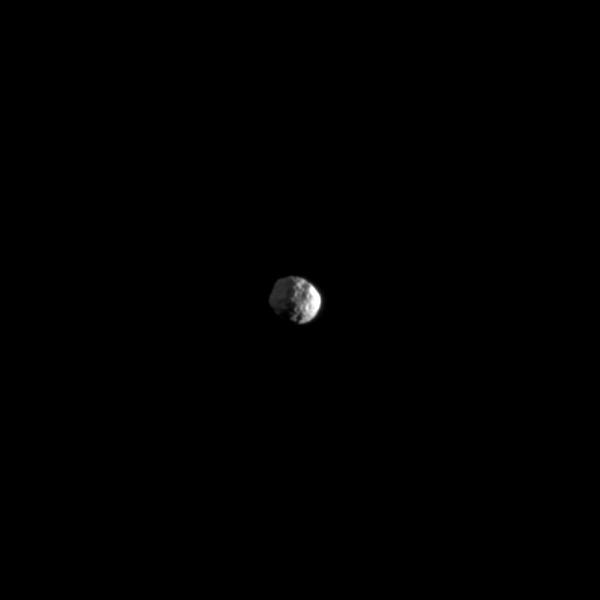
This is Saturn's small moon Janus, taken by the Cassini spacecraft. Here, Janus is illuminated by light from both the sun and Saturn.
This view looks toward the south pole of Janus (179 kilometers, or 111 miles across) which lies on the terminator just below the center of the image. Brightly lit terrain seen on the right is on the leading hemisphere of Janus. Light reflected off Saturn dimly lights the Saturn-facing side of Janus on the top left of the image.
Check out the Cassini website for more information about this image.
Check back next week for another WITU challenge!

Filed under: Where In the Universe?
Related stories on Universe Today
Comment policy: Be nice and brief. Don't advertise your stuff, or promote your personal theories. We'll delete any comments that break these policies. Click here for more details.


July 9th, 2009 at 3:08 pm
Hm… small, irregular body, planetshine…
It can be a few different moons of Jupiter or Saturn. I'm guessing a moon of Saturn here, though, which would mean Cassini, and the moon… Prometheus?
July 9th, 2009 at 3:19 pm
I'm guessing it's Dactyl, the small moon of the asteroid Ida, taken by Galileo
July 9th, 2009 at 3:25 pm
My guess is Phobos, Spacecraft Voyager.
July 9th, 2009 at 4:11 pm
An asteroid? A minor moon of Jupiter or Saturn (or, possibly, Uranus)? Perhaps even Deimos or Phobos??
July 9th, 2009 at 4:28 pm
I'm working with some HiRISE images of Phobos & Deimos for my summer internship, and my first instinct was that it was Phobos. It's pretty low resolution, so throw out HiRISE, and probably the Viking Orbiters as well. I doubt that it's MGS…
I'll go along with Bill928 – Voyager
July 9th, 2009 at 4:28 pm
How about Comet 81P/Wild 2 photographed by the Stardust mission before returning to the Utah desert?
July 9th, 2009 at 4:28 pm
It is Saturn's moon Janus. Image taken by Cassini
July 9th, 2009 at 4:29 pm
Shapewise it looks a lot like Phobos.
MGS, Mars oddyssey or MRO.
July 9th, 2009 at 5:56 pm
Looks a lot like Dactyl, the moon of the asteroid Ida. Taken by the Galileo
July 9th, 2009 at 7:08 pm
My guess is Dactyl, the moon of the asteroid Ida. Spacecraft? I do not know.
July 9th, 2009 at 10:33 pm
Quite sure raulm is right, and beat me to it. 99.99% sure it's Janus, as taken by Cassini.
July 10th, 2009 at 1:25 am
Lots of different opinions here. Dactyl looks very different to me, and Phobos looks more "lumpy" – for me, it's a toss-up between Janus and Wild 2… and I go with … Janus, by Cassini, which is one of my "favourite spacecraft".
I didn't actually toss – I seem to see light spread over much more than 180 degrees, with a darker zone in the generally lit area, i.e. probably two sources, possibly Saturn and the Sun.
July 10th, 2009 at 1:46 am
Hi all !
I don't think that's an asteroid ! Maybe a moon !
July 10th, 2009 at 2:55 am
That's no moon. It's a space station!
July 10th, 2009 at 3:38 am
It's the Planet of the Clangers! Hooray! Soup for everyone!!
( http://www.clangers.co.uk )
July 10th, 2009 at 3:54 am
Seriously, though…
The moon is lit from both sides. It is getting a lot of light from the right (presumably the sun), and about 10% of the light from the left and about 10 degrees up, assuming the camera gamma is somthing like my display. This leaves us with two options…
If the light from the left is sunlight, bouncing off a planet, then the planet has got to look huge as seen from the moon. To intercept 10% of the light, the planet would have to take up a third of the sky as seen from the moon. I don't think it is quite that close because you can see a distinct penumbra at about 7 o-clock, which means the illuminating body can't be that big. Okay – maybe someone has tweaked the image gamma to make it look more arty, and it is in fact getting about 1% – it is still going to be pretty close in.
The other option is that the body on the left is self-luminous. This is not absurd if you are talking about Jupiter and the picture is taken in the deep IR.
This one's fun. If we knew the tone curve of the camera, we could probably figure it out just form the shadows. Nice!
July 10th, 2009 at 6:13 am
one of the moons around Mars
July 10th, 2009 at 6:23 am
Moon of Saturn, perhaps Janus by Cassini.
July 10th, 2009 at 6:38 am
Janus by Voyager
July 10th, 2009 at 7:03 am
I thought Mimas at first, but it's more like Janus. By Cassini?
July 10th, 2009 at 9:12 am
Death Star, taken by Han Solo in the Millenium Falcon.
July 10th, 2009 at 11:30 am
It's that moon of Saturn that's half black and half white. Can't remember what it's called. (Memory's the 2nd thing to go….). Triton?
July 10th, 2009 at 3:13 pm
Neoguru- I think you're thinking of Iapetus.
July 10th, 2009 at 9:02 pm
Saturn's moon Janus, as taken by Cassini.
Iapetus – no, Iapetus is almost round.
It absolutely can't be a Mars moon as taken by Voyager because Voyager didn't fly by Mars.
July 11th, 2009 at 1:38 am
It looks like an early picture of Phobos
July 11th, 2009 at 7:45 am
Himalia (Moon of Jupiter)
Taken by New Horizons spacecraft in early 2007
July 11th, 2009 at 8:00 am
For Richard Kirk:
Two Light Sources would indicate to me the sun and a large nearby planet (via reflected Sun light), Jupiter or Saturn, as been the light sources.
July 11th, 2009 at 4:31 pm
has to be mars
July 11th, 2009 at 11:34 pm
I am now convinced that it is a picture of Dactyl orbiting about 90 kilometers above Ida and the spacecraft is Galileo. The proximity to both the sun and Ida explains both light sources and Dactyl is unusually round for a small object with a large crater.
July 12th, 2009 at 9:56 am
My first impression was Janus by Cassini.
July 12th, 2009 at 9:33 pm
It's definitely a small moon of one of our solar system's gas giants
July 13th, 2009 at 4:25 pm
@ toseek
Right, I had forgotten that NASA, in their infinite wisdom cancelled the Voyager Mars program, renaming it Viking several years later. I guess this is all of little consequence since I had the moon wrong anyway!