 Universe Today

Want to know about the atmospheres of planets around other stars, and the stars themselves?
Start at home.
A pair of papers in this week's issue of Nature is advocating continued studies of both lunar eclipses, when the Moon transits Earth's shadow, and solar eclipses -- when the Moon comes directly between Earth and the sun.

Enric Palle, of the Spanish Instituto de Astrofisica de Canarias, and his co-authors point out in one of the papers that of the 342 planets known to be orbiting other stars, 58 ‘transit’ the stellar disk, meaning that they can be detected through a periodic decrease in the flux of starlight.
"The light from the star passes through the atmosphere of the planet, and in a few cases the basic atmospheric composition of the planet can be estimated," they write. To calibrate our abilities to study those other atmospheres, it's best to practice on Earth, they propose.
The team utilized the optical and near-infrared transmission spectrum of the Earth, obtained during a lunar eclipse. The technique is different from another common practice: observing the earthshine, or the light reflected from the dark side of the Moon.
"Some biologically relevant atmospheric features that are weak in the reflection spectrum (such as ozone, molecular oxygen, water, carbon dioxide and methane) are much stronger in the transmission spectrum, and indeed stronger than predicted by modelling," Palle and his co-authors write. "We also find the ‘fingerprints’ of the Earth’s ionosphere and of the major atmospheric constituent, molecular nitrogen (N2), which are missing in the reflection spectrum."
"Thus, the transmission spectrum can provide much more information about the atmospheric composition of a rocky planet than the reflection spectrum can."
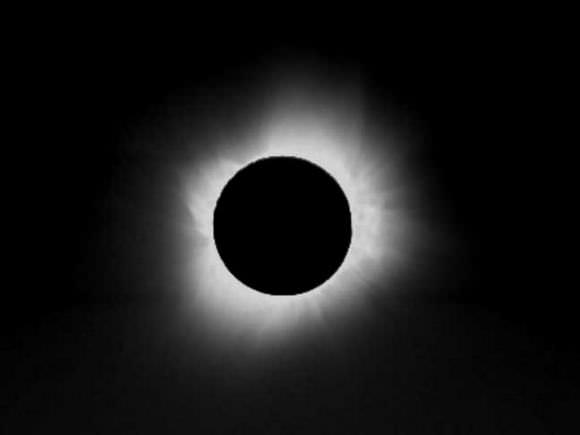
In the second paper, author Jay Pasachoff, who splits his time between Caltech and Williams College, in Massachusetts, reviewed a wealth of knowledge gleaned from solar eclipses.
"Observations of the Sun during total eclipses have led to major discoveries, such as the existence of helium (from its spectrum), the high temperature of the corona (though the reason for the high temperature remains controversial), and the role of magnetic fields in injecting energy into—and trapping ionized gases within—stellar atmospheres," he writes.
Pasachoff notes that there's no real end in sight for the usefulness of solar eclipses: "The Moon is receding from the Sun sufficiently slowly that our descendants on Earth will be able to see total eclipses for over 600 million years."
But he predicts an eventual transition from ground-based to space solar telescopes, especially for getting at tantalizing solar mysteries like the nature of coronal heating.
"At present the paired science and beauty of solar eclipses remain uniquely available to scientists and others in the path of totality."
Source: Nature
