Forget the LHC, the Aging Tevatron May Have Uncovered Some New Physics
Written by Ian O'Neill
If you thought any quantum discoveries would have to wait until the Large Hadron Collider (LHC) is switched back on in 2009, you'd be wrong. Just because the LHC represents the next stage in particle accelerator evolution does not mean the world's established and long-running accelerator facilities have already closed shop and left town. It would appear that the Tevatron particle accelerator at Fermilab in Batavia, Illinois, has discovered……something.
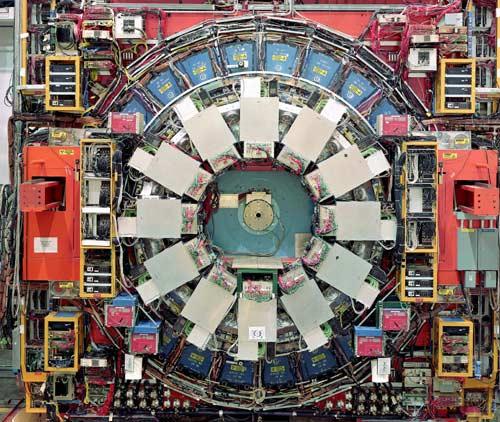
Scientists at the Tevatron are reluctant to hail new results from the Collider Detector at Fermilab (CDF) as a "new discovery" as they simply do not know what their results suggest. During collisions between protons and anti-protons, the CDF was monitoring the decay of bottom quarks and bottom anti-quarks into muons. However, CDF scientists uncovered something strange. Too many muons were being generated by the collisions, and muons were popping into existence outside the beam pipe…
The Tevatron was opened in 1983 and is currently the most powerful particle accelerator in the world. It is the only collider that can accelerate protons and anti-protons to 1 TeV energies, but it will be surpassed by the LHC when it finally goes into operation sometime early next year. Once the LHC goes online, the sub-atomic flame will be passed to the European accelerator and the Tevatron will be prepared for decommissioning some time in 2010. But before this powerful facility closes down, it will continue probing matter for a little while yet.
In recent proton collision experiments, scientists using the CDF started seeing something they couldn't explain with our current understanding of modern physics.
The particle collisions occur inside the 1.5 cm-wide "beam pipe" that collimate the relativistic particle beams and focus them to a point for the collision to occur. After the collision, the resulting spray of particles are detected by the surrounding layers of electronics. However the CDF team detected too many muons being generated after the collision. Plus, muons were being generated inexplicably outside the beam pipe with no tracks detected in the innermost layers of CDF detectors.
CDF spokesperson Jacobo Konigsberg, is keen to emphasise that more investigations need to be done before an explanation can be arrived at. "We haven't ruled out a mundane explanation for this, and I want to make that very clear," he said.
However, theorists aren't so reserved and are very excited about what this could mean to the Standard Model of sub-atomic particles. If the detection of these excess muons does prove to be correct, the "unknown" particle has a lifetime of 20 picoseconds and has the ability to travel 1 cm, through the side of the beam pipe, and then decay into muons.
Dan Hooper, another Fermilab scientist, points out that if this really is a previously unknown particle, it would be a huge discovery. "A centimetre is a long way for most kinds of particles to make it before decaying," says . "It's too early to say much about this. That being said, if it turns out that a new 'long-lived' particle exists, it would be a very big deal."
Neal Weiner of New York University agrees with Hooper. "If this is right, it is just incredibly exciting," he says. "It would be an indication of physics perhaps even more interesting than we have been guessing beforehand."
Particle accelerators have a long history of producing unexpected results, perhaps this could be an indicator of a particle that has previously been overlooked, or more interestingly, not predicted. Naturally, scientists are quick to postulate that dark matter might be behind all this.
Weiner, with colleague Nima Arkani-Hamed, have formulated a model that predicts the existence of dark matter particles in the Universe. In their theory, dark matter particles interact among themselves via force-carrying particles of a mass of approximately 1 GeV. The CDF muons generated outside the beam pipe have been calculated to be produced by an "unknown" decaying parent particle with a mass of approximately 1 GeV.
The comparison is striking, but Weiner is quick to point out that more work is needed before the CDF results can be linked with dark matter. "We are trying to figure that out," he said. "But I would be excited by the CDF data regardless."
Perhaps we don't have to wait for the LHC, some new physics may be uncovered before the brand new CERN accelerator is even repaired…
Source: New Scientist
Filed under: Dark Matter, Physics
Related stories on Universe Today
Comment policy: Be nice and brief. Don't advertise your stuff, or promote your personal theories. We'll delete any comments that break these policies. Click here for more details.


November 3rd, 2008 at 10:37 pm
so a particle accelerator conducting regular annihilation tesst between matter and antimatter found this? isnt it more likely a broken… something?
November 3rd, 2008 at 11:07 pm
Things appearing to pop in and out of existence? Sounds like there are some extra dimensions we don't fully understand yet.
November 3rd, 2008 at 11:57 pm
Intriguing… but I guess we'll just have to wait and see what eventuates. I'd say most likely there is some sort of mundane explanation, but it'd be simply great if there weren't!
LHC experiments would then be a whole new ball game, and we could finally kick off the new post standard-model era of physics for real! It would be a fitting crowning achievement for Tevatron and the scientists that work there, and it'd be a grandiose batton-pass to the LHC – throwing down the gauntlet if you will…
November 4th, 2008 at 12:03 am
Provisional theories and the ability to absorb unexpected data by accepting the limited applicability of one's understanding!
Science works!
November 4th, 2008 at 2:13 am
Is Gordon Freeman part of this project? If he is, then we're doomed
.
November 4th, 2008 at 4:12 am
LOL Rey! :p
November 4th, 2008 at 4:44 am
2010 Nobel prize stuff, after confirmation by the LHC…
November 4th, 2008 at 5:27 am
@ SanitysEdge
What it means is rather that the detectors weren't the kind that could see the particles. I guess some slowly moving chargeless guys could do this. Unfortunately, this might be just a malfunction because a clear mismatch in the amount of produced particles compared to what is expected would probably be noticed before. But then again, it's usually the unexpected that leads to discoveries.
/Adam
November 4th, 2008 at 8:31 am
http://www.mallard-design.com
November 4th, 2008 at 8:57 am
Why after 25 years does the data suddenly show something new? Have there been changes to the experimental setup? Higher energy? More sensitive detectors? Faster or more sophisticated software?
I hope the existing data from the past 2.5 decades show something that indicates they've been missing this phenomenon all along because right now, the skeptic in me is scratching his head double-time.
It all sounds very exciting though.
November 4th, 2008 at 12:07 pm
To travel 1cm in 20 picoseconds you must be going at 67% above light speed. If that's not a stupid journalist's mistake, this really could mean new physics!
November 4th, 2008 at 12:57 pm
You've got to be right there. Light travels about 3cm in 100 picoseconds.
November 4th, 2008 at 1:28 pm
Hey, you're right ioresult. I wish I'd bothered to calculate the velocity of this new "undiscovered" particle. By my calculations, light can only travel 0.6 cm in 20 picoseconds. Therefore, this "thing" will have travelled at the velocity of 5×10^8 m/s, that's 60% faster than light…
My calculating skills might be a bit rusty, but I feel this is significant!
November 4th, 2008 at 2:26 pm
Well, the original paper actually says "produced outside of the beam pipe of radius 1.5cm" (see http://arxiv.org/abs/0810.5357) which doesn't necessarily mean that the particles traveled 1cm. Doing a *very* quick look at the paper I didn't find the researchers suggesting that the particle actually traversed that distance. They just don't know, it seams. The jury is still out…
/Adam
November 4th, 2008 at 4:19 pm
I hate to burst you're collective bubbles, but the 20 picosecond lifetime given above is not the time it took the particle to travel the distance of approx. 1cm (assuming they where detected 0.25cm outside the beam) The article doesn't say what the measured travel time, if travel occured, is. What the lifetime of 20 picoseconds means is that in the special relativistic reference frame of the partcle, it traverses the distance (which would be considerably contracded in said ref frame and easily as little as 0.1mm) in 20 picoseconds. Go to the following page and read under the heading "Experimental Evidence for Time Dilation: Dying Muons" It might not be a reffereed source, but it is correct. Consult a text if you don't believe it.
http://galileoandeinstein.physics.virginia.edu/lectures/srelwhat.html
Note: I'm not saying the particle is a muon through using this comparison. If you got that impression, read again.
Ok, bye.
November 4th, 2008 at 11:47 pm
Feel free to check my math but due to relativistic effects the muon is moving at 85.75% the speed of light. Not 60% over C
November 5th, 2008 at 1:29 am
Might these be strangelets?
November 5th, 2008 at 1:10 pm
Wow, having come from Batavia, I must say that i'm excited to hear news that my town's claim to fame isn't completely exhausted yet…
Really interesting though.. I wonder what happens next. Keep us updated please
November 5th, 2008 at 10:20 pm
Popping into existance could be the disintegration of a neutral charge too, or perhaps a position-momentum measurement effect related to probability amplitudes as per Twister Theory.
November 6th, 2008 at 8:28 am
It's the beginning of Warp Drive.
November 6th, 2008 at 1:56 pm
Has there been any updates on this yet?
November 6th, 2008 at 5:44 pm
Dark Energy + Dark Matter = a catchy label to hang on a whole load of observations we don't understand yet.
November 7th, 2008 at 7:51 am
"somethings" popping in and out of existence doesn't sound like they have a grasp of what there dealing with. So how can they with 100% certainty say everything is safe..
November 8th, 2008 at 5:50 am
Could not the particle whatrever it was have quantum tunnelled the tube? Hence why it appears to have travelled FTL.
November 10th, 2008 at 3:40 pm
The LHC will not discovery anything that will increase understanding. The quality of two Nobel Prizes rest on the LHC. The electroweak unification and symmetry breaking. The evolution of physics is not based on theoretical or experimental physics. It based on conceptual physics. The conceptual physicist can only advance this theory if it explains previous theories. Quantum physic did not explain any previous theories they abandoned them as so abandon hundreds of years of physics because Bohr and his friends where not smart enough to break the code. Einstein knew this is where they would be. Big machine and no real understanding. Einstein was a conceptual physicist and he did more for physics in 1905 then any super machine.
November 25th, 2008 at 3:50 pm
You're all going about this the wrong way. You can't do it with a machine, you do it with your mind. Because of fear I,ve never actually completed but vow today that the next time I will.