Universe Today
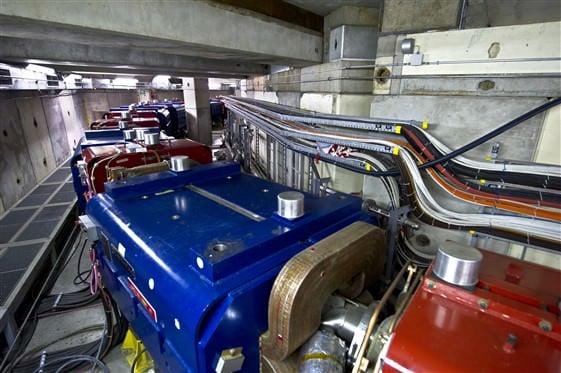
We don't mean to beat a dead horse – both Fraser and Ian have already covered this topic quite thoroughly -- but just in case anyone still has any fears about the Large Hadron Collider meaning the end of the world, a new report published today provides the most comprehensive evidence available to confirm that the LHC's switch-on, due on Wednesday next week, poses no threat to mankind. A copy of the report is available HERE. In a nutshell, it says nature's own cosmic rays regularly produce more powerful particle collisions than those planned within the LHC, and nothing bad has happened to Earth from those quite natural and frequent events. The LHC will be studying nature's laws in controlled experiments. So just relax and watch the LHC rap video.
The LHC Safety Assessment Group have reviewed and updated a study first completed in 2003, which dispels fears of universe-gobbling black holes and of other possibly dangerous new forms of matter, and confirms that the switch-on will be completely safe.
The report, 'Review of the Safety of LHC Collisions', published in IOP Publishing's Journal of Physics G: Nuclear and Particle Physics, proves that if particle collisions at the LHC had the power to destroy the Earth, we would never have been given the chance to exist, because regular interactions with more energetic cosmic rays would already have destroyed the Earth or other astronomical bodies.
The Safety Assessment Group compares the rates of cosmic rays that bombard Earth, other planets in our solar system, the Sun and all the other stars in our universe itself to show that hypothetical black holes or strangelets, that have raised fears in some, will in fact pose no threat.
The report also concludes that, since cosmic-ray collisions are more energetic than those in the LHC, but are incapable of producing vacuum bubbles or dangerous magnetic monopoles, we should not fear their creation by the LHC.
LHC collisions will differ from cosmic-ray collisions in that any exotic particles created will have lower velocities, but the Safety Assessment Group shows that even fast-moving black holes produced by cosmic rays would have stopped inside the Earth or other astronomical bodies. Their existence proves that any such black holes could not gobble matter at a risky rate.
As the Safety Assessment Group writes, "Each collision of a pair of protons in the LHC will release an amount of energy comparable to that of two colliding mosquitoes, so any black hole produced would be much smaller than those known to astrophysicists." They conclude that such microscopic black holes could not grow dangerously.
As for the equally hypothetical strangelets, the review uses recent experimental measurements at the Brookhaven National Laboratory's Relativistic Heavy-Ion Collider, New York, to prove that they will not be produced during collisions in the LHC.
Source: EurekAlert