Cosmic 'Needle in a Haystack' Confirms Dark Energy
Written by Nancy Atkinson

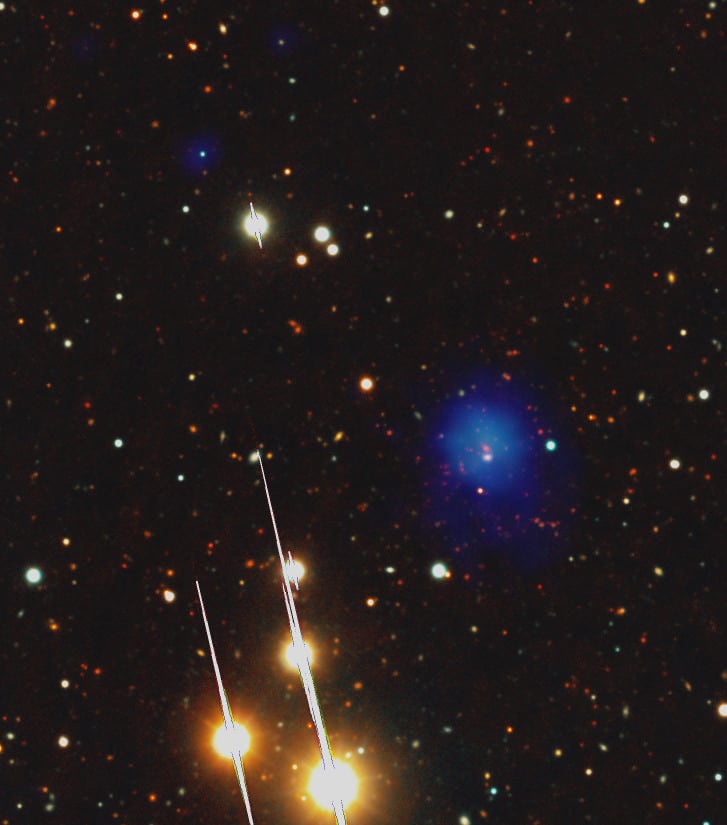
The bright blue blob is an ancient galaxy cluster. Credits: ESA XMM-Newton/EPIC, LBT/LBC, AIP (J. Kohnert)
A massive cluster of galaxies seen in the distant universe by ESA’s orbiting XMM-Newton x-ray observatory is so big that astronomers believe there can only be a few of them that far away in space and time. “Such massive galaxy clusters are thought to be rare objects in the distant Universe," said Georg Lamer, Astrophysikalisches Institut in Potsdam, Germany. "They can be used to test cosmological theories. Indeed, the very presence of this cluster confirms the existence of a mysterious component of the Universe called dark energy.†The astronomers compared the rare find to a cosmic 'needle in a haystack.'
The newly-discovered monster, known by the catalogue number 2XMM J083026+524133, is 7.7 thousand million light-years distant and is estimated to contain as much mass as a thousand large galaxies. Much of it is in the form of 100-million-degree hot gas. The bright blue blob of gas was found during a systematic analysis of catalogued objects as Lamer and his team were looking for patches of X-rays that could either be nearby galaxies of distant clusters of galaxies.
Based on 3,500 observations performed with XMM-Newton's European Photon Imaging Camera (EPIC) covering about 1% of the entire sky, the catalogue contains more than 190,000 individual X-ray sources. J083026+524133 stood out because it was so bright. While checking visual images from the Sloan Digital Sky Survey, the team could not find any obvious nearby galaxy in that location. So they turned to the Large Binocular Telescope in Arizona and took a deep exposure, which found a cluster of galaxies in that location.
The astronomers were surprised to find the cluster contains a thousand times the mass of our own Milky Way Galaxy.
No one knows what dark energy is, but it is causing the expansion of the Universe to accelerate. This hampers the growth of massive galaxy clusters in more recent times, indicating that they must have formed earlier in the Universe. “The existence of the cluster can only be explained with dark energy,†says Lamer.
Yet he does not expect to find more of them in the XMM-Newton catalogue. “According to the current cosmological theories, we should only expect to find this one cluster in the 1% of sky that we have searched,†says Lamer.
Source: ESA

Filed under: Dark Energy, galaxies


August 26th, 2008 at 8:56 pm
Matt- there is little empirical evidence that the universe is actually flying apart or that any matter is actually missing.
You have 'dark stuff' trying to handle our basic misunderstanding of gravity, whether it's energy to explain why the universe may be expanding, or extra matter to explain why clusters aren't.
It's all the same thing, a proxy for gravity. 'Dark Stuff'…
August 27th, 2008 at 3:42 am
My only real problem with DM and DE was that, unlike the Higgs boson, neither was predicted by any of the existing models/theories. I always thought that the truest test of a theory was its ability, not just to explain, but to predict.
It isn't often that you get to read in the popular press about alternative theories but here's one that intrigued me:
http://www.sciam.com/article.cfm?id=the-self-organizing-universe
August 27th, 2008 at 7:43 am
Matt gains +1 respect from me. Intelligent, informed & succinct post. Refreshing to see comments from someone that understands scientific method.
August 27th, 2008 at 12:25 pm
[QUOTE=JamesB]Matt- there is little empirical evidence that the universe is actually flying apart or that any matter is actually missing.[/QUOTE]
That's what creationists say about evolution as well. Doesn't change the fact that there is a scientific consensus and the public just isn't educated on the subject. Of course for YOU there probably seems to be little empirical evidence supporting DM and DE, because you appear to be ignorant of its existence. arxiv is full of scientific papers illustrating the evidence. Go do some research: http://arxiv.org/abs/astro-ph/0309368
If you want sources that are easier to understand… maybe you should listen to the AstronomyCast episodes or check out wikipedia.
[QUOTE=JamesB]You have 'dark stuff' trying to handle our basic misunderstanding of gravity, whether it's energy to explain why the universe may be expanding, or extra matter to explain why clusters aren't.[/QUOTE]
Our understanding of gravity works fine, thank you. There has yet to be ANY indication that general relativity has ANY problems, besides its working on the quantum scale. It's shown again and again (google: pulsar + relativity) that it explains gravitational phenomena on large scales.
Also: The scientific community is working on MOND (modified newtonian mechanics, see wikipedia) to see whether MAYBE our understanding of gravity needs SOMEHOW be modified after all. Turns out, it doesn't. MOND doesn't work yet and the majority of scientist think it never will. And since DM explains ALL of the phenomena that MOND can't… why bother? Researchers go with the theory that has merit, not the one that appeals to our common sense.
PS: my comment might have been a bit harsh, but it really ticks me off when lay-people (arrogantly imo) assume that they know more about the subject than researchers who spend half of their life working on these problems.
August 27th, 2008 at 12:36 pm
Doh… quotes. I'm used to those cute brackets.
Andi wrote: "My only real problem with DM and DE was that, unlike the Higgs boson, neither was predicted by any of the existing models/theories. I always thought that the truest test of a theory was its ability, not just to explain, but to predict."
They weren't initially predicted, but what's the point? If every discovery in science were predicted by our theories, we wouldn't need to do… y'know, do experiments.
The important thing here is not that we didn't expect to see those things, but now THAT WE see them, they don't contradict our current theories. Dark Matter isn't unimaginable, it could be explained with our model of particle physics (namely with WIMPS) and fits neatly with our views on the formation of galaxies.
Dark Energy is a parameter that even Einstein added to his GR (even if for completely different reasons), but we don't need to rewrite the whole GR because of it's discovery.
August 27th, 2008 at 1:14 pm
Oh another point I missed:
JamesB wrote: "Matt- there is little empirical evidence that the universe is actually flying apart or that any matter is actually missing."
I think you meant to say: "there is little empirical evidence that the universe's expansion is accelerated by DE"
I hope you do not doubt that the universe is flying apart at all.
August 27th, 2008 at 3:43 pm
[QUOTE=Matt]We see that the expansion of the universe accelerates[/QUOTE]
Actually, we infer that the expansion of the universe accelerates by interpreting obervations of supernova redshift within the conceptual framework of the FLRW (or FRW) metric. That metric is based on two pillars: General Relativity and the Cosmological Principle, the latter based in turn on the Copernican Principle: the Earth (or in more contemporary speak, our galaxy, group or even supercluster) does not occupy a special place in the universe.
By leaving aside the Copernican Principle, a different metric would apply, in which redshift observations could be interpreted so that they do not lead to the conclusion that the expansion of the universe is accelerating.
While General Relativity is the best scientific choice so far, the Copernican Principle is a phylosophical choice, and leaving it aside is as scientifically valid as postulating it.
August 27th, 2008 at 3:48 pm
It was "philosophical".
August 27th, 2008 at 8:31 pm
robbb: Please don't take this wrong, as I can even follow your line of thought. But as you write I can see the possibilities of a sci-fi writer in you. Seriously, think about it. Whether you were joking, serious or just frustrated with the grumbling and argueing here, hang onto astronomy and research, but think about writing some sci-fi also. It never hurts to try!
August 28th, 2008 at 7:35 am
Matt,
So you're saying that because the Higgs particle was predicted by the Standard Model there was really no reason to build the LHC to detect it. Is that right?
August 28th, 2008 at 10:08 am
hey kootstar, no offense taken here, i was just spouting off! actually, what i wrote is an extension of ideas in Ray Kurzweil's non-fiction book "Spiritual Machines" which you might enjoy if you like speculating on future technologies.
i would love to write some sci-fi if i had more time. (i use most of my creative energy on music, and i do have a few 'space songs'!)
but the more i think on it i really don't have trouble believing that computers in another civilization could evolve into 'cosmic travellers'. non-biological entities are much better suited for interstellar travel.
August 28th, 2008 at 10:40 am
I am glad to see Matt's thoughtful, intelligent replies to many DM doubters that have posted here. Finally a voice of reason and common sense in a sea of baseless and uninformed 'comment'. The recently published paper on MACS J0025.4-1222 (at http:/arxiv.org/abs/astro-ph/0808.2320v2) not only dismisses MOND & TeVeS in explaing this merging cluster, it also says the same with regards to the 'Bullet Cluster' 1E 0657-56. For DM doubters, scrutinize page 9 of this 10 page paper for detailed info on why standard DM theory explains both of these clusters observed cluster's observed properties, then rebut their observations with peer reviewed papers on these clusters (especially MOND & TeVeS advocates). Lets elevate this discussion about DM above speculation, links to sites on 'Anti Gravity Matter' & the like posted by non-astrophysicists (chemists, biologists, economists, etc.) & back to the realm of serious astrophysicists who spend much of their careers studying & trying to understand the universe as it really is.
August 28th, 2008 at 10:43 am
Parvulus wrote: "By leaving aside the Copernican Principle, a different metric would apply, in which redshift observations could be interpreted so that they do not lead to the conclusion that the expansion of the universe is accelerating.
While General Relativity is the best scientific choice so far, the Copernican Principle is a philosophical choice, and leaving it aside is as scientifically valid as postulating it."
The funny thing about the Copernican Principle is that it makes a claim about the structure of the universe, which, lo and behold, is testable! And in fact has been tested. Let me quote wiki for you: "Measurements of the effects of the cosmic microwave background radiation in the dynamics of distant astrophysical systems in 2000 proved the Copernican principle on a cosmological scale.[5] The radiation that pervades the universe was demonstrably warmer at earlier times. Uniform cooling of the cosmic microwave background over billions of years is explainable only if the universe is experiencing a metric expansion."
Doesn't sound like an open philosophical question, if you ask me (and science).
August 28th, 2008 at 10:50 am
Andi wrote: "So you're saying that because the Higgs particle was predicted by the Standard Model there was really no reason to build the LHC to detect it. Is that right?"
Ok… here is what I wrote: "They weren't initially predicted (DE and DM), but what's the point? If every discovery in science were predicted by our theories, we wouldn't need to do… y'know, do experiments."
So, I said that not everything we have discover has been predicted by our theories (which is true, duh, otherwise we wouldn't make progress).
And your reply to that is that I'm suggesting not to build the LHC because the Higgs has been predicted by our theorie?
I don't get you.
August 28th, 2008 at 11:18 am
Matt
This part of your comment:
". . . . If every discovery in science were predicted by our theories, we wouldn't need to do… y'know, do experiments."
seems to equate theoretical prediction with experimental observation. I feel certain that this is not what you meant to convey because none of your other comments are absurd as this seems to be.
August 28th, 2008 at 2:23 pm
I'm confused now.. I certainly didn't mean to equate theoretical prediction with experimental observation. (I'm still not sure whether that, admittedly somewhat messed up sentence, can be interpreted that way).
Anyway, my point: Quite often experiments show us phenomena we'd never expect to see judging from our current theories of how something works. That's how science progresses. You get new input and refine your theories to explain all the data you gathered up to that point + the new data.