Astronomers Find a New "Minor Planet" near Neptune
Written by Nancy Atkinson

Orbit of solar system object SQ372 (blue) compared with the orbits of Neptune Pluto and Sedna (white, green, red). Credit: N. Kaib.
Astronomers announced today that a new "minor planet" with an unusual orbit has been found just two billion miles from Earth, closer than Neptune. Using the Sloan Digital Sky Survey, astronomers detected a small, comet-like object called 2006 SQ372, which is likely made of rock and ice. However, its orbit never brings it close enough to the sun for it to develop a tail. Its unusual orbit is an ellipse that is four times longer than it is wide, said University of Washington astronomer Andrew Becker, who led the discovery team. The only known object with a comparable orbit is Sedna — the distant, Pluto-like dwarf planet discovered in 2003. But 2006 SQ372's orbit takes it more than one-and-a-half times further from the Sun, and its orbital period is nearly twice as long.
2006 SQ372 is beginning the return leg of a 22,500-year journey that will take it to a distance of 150 billion miles, nearly 1,600 times the distance from the Earth to the Sun. Scientists believe the object is only 50-100 kilometers (30-60 miles) across.
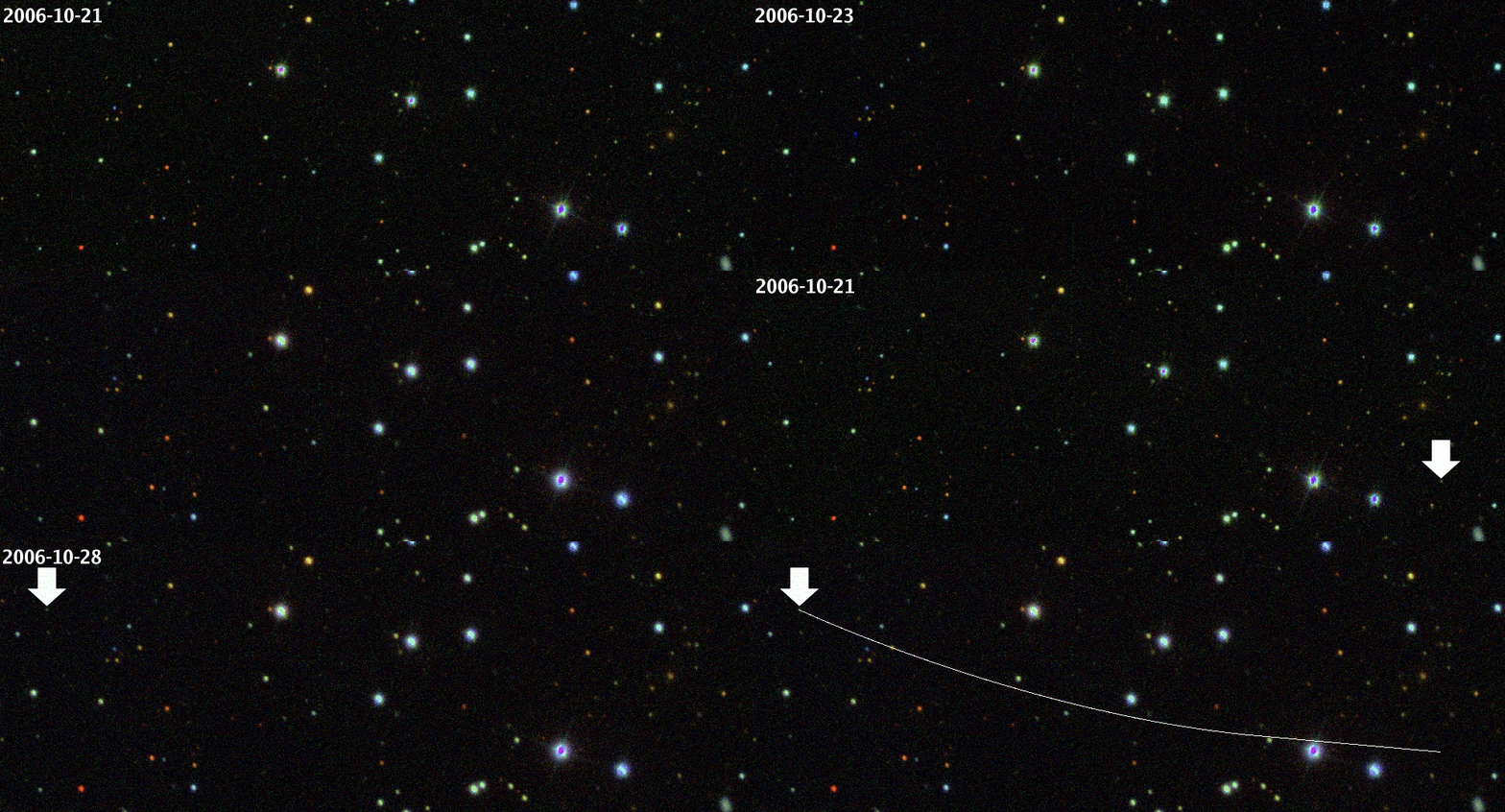
Click here for an animation showing the detection of SQ372 by SDSS.
Becker's team was actually using the SDSS to look for supernova explosions billions of light-years away to measure the expansion of the universe. "If you can find things that explode, you can also find things that move, but you need different tools to look for them," said team member Lynne Jones, also of the University of Washington. The only objects close enough to change position noticeably from one night to the next are in our own solar system, Jones explained.
The SDSS-II supernova survey scanned the same long stripe of sky, an area 1,000 times larger than the full moon, every clear night in the fall of 2005, 2006, and 2007.
SQ372 was first discovered in a series of images taken in 2006 by the SDSS, and were verified from images taken in 2005 and 2007.
The researcher team is trying to understand how the object acquired its unusual orbit. "It could have formed, like Pluto, in the belt of icy debris beyond Neptune, then been kicked to large distance by a gravitational encounter with Neptune or Uranus," said UW graduate student Nathan Kaib. "However, we think it is more probable that SQ372 comes from the inner edge of the Oort Cloud."
Even at its most distant turning point, 2006 SQ372 will be ten times closer to the Sun than the supposed main body of the Oort Cloud, said Kaib. "The existence of an 'inner' Oort cloud has been theoretically predicted for many years, but SQ372 and perhaps Sedna are the first objects we have found that seem to originate there. It's exciting that we are beginning to verify these predictions."
Becker noted that 2006 SQ372 was bright enough to find with the SDSS only because it is near its closest approach to the Sun, and that the SDSS-II supernova survey observed less than one percent of the sky.
"There are bound to be many more objects like this waiting to be discovered by the next generation of surveys, which will search to fainter levels and cover more area," said Becker. "In a decade, we should know a lot more about this population than we do now."
"One of our goals," said Kaib, "is to understand the origin of comets, which are among the most spectacular celestial events. But the deeper goal is to look back into the early history of our solar system and piece together what was happening when the planets formed."
The discovery of 2006 SQ372 was announced today in Chicago, at an international symposium about the Sloan Digital Sky Survey. A paper describing the discovery technique and the properties of 2006 SQ372 is being prepared for submission to The Astrophysical Journal.
News Source: SDSS press release

Filed under: Astronomy
Related stories on Universe Today
Comment policy: Be nice and brief. Don't advertise your stuff, or promote your personal theories. We'll delete any comments that break these policies. Click here for more details.


August 18th, 2008 at 9:50 am
Wonder if it is cylindrical..
August 18th, 2008 at 9:59 am
this must be Nibiru, the doom planet. i bet i gets closest to earth in 2012, as predicted. yes, everything is going acording to plan
August 18th, 2008 at 10:33 am
actually they called Nibiru a sun and they just clearly said that this new minor planet is made out of rock and ice.
August 18th, 2008 at 10:37 am
Wonder if it is spherical.
August 18th, 2008 at 10:38 am
Thanks again, Nancy, for a great article from the SDSS Symposium. Just imagine this object is thought to be from the 'inner' Oort Cloud & lucky enough to be near the sun to be detected by the SDSS. I can't wait for more of these distant solar system bodies that will surely be found by upcoming deep all-sky surveys like LSST & PanStarrs.
August 18th, 2008 at 10:42 am
I don't remember what the minimum size of an object is for it to be spherical, but I think it's around 400 km, so I doubt an object 50-100km will be.
August 18th, 2008 at 10:46 am
http://en.wikipedia.org/wiki/Rendezvous_with_Rama
Cylindrical, not spherical
August 18th, 2008 at 10:48 am
Oh, sorry.
Just woke up.
August 18th, 2008 at 11:22 am
"actually they called Nibiru a sun and they just clearly said that this new minor planet is made out of rock and ice."
That is because they left out one important detail, its solid Plutonium core, which when it hits Saturn in 2012….well you get the picture.
August 18th, 2008 at 12:42 pm
Harvesting comets in the Oort Cloud site.
For propulsion purposes! Well here is to the future!
August 18th, 2008 at 3:41 pm
Hmm. More evidence that Neptune has not cleared out
its neigborhood.
August 18th, 2008 at 5:39 pm
Actually Neptune have cleared out its neighbourhood, as it contains the dominant mass of its entire region…
Earth are more in danger of being deemed not a planet than Neptune is, as it have not cleared out its region to more than a factor 81:1. There is some rocky thingy circling nearby and sometimes even blocks the sun…
August 18th, 2008 at 10:29 pm
its called pluto!! lol!!!!
August 19th, 2008 at 1:47 am
Wow this is really interesting, great article, thanks for sharing!
August 19th, 2008 at 5:35 am
Again next object on very prolongated elliptical orbit,..very close to perihelia,…where orbit looks to be close to time of precession cycle,…..Where are bigger planetoids behind Pluto, Pluto included now!?
All are close to their extremes of their orbits!!!!
Eris present-current distance 97AU!!!,Aphelia97AU,..perihelia38AU
2003EL61 52AU!!!,….52AU,…… 35AU
2005FY9 52AU!!!!,…52AU,…….39AU
2003UB313-Sedna 90AU!!! 975,6AU,…. 76,2AU
Pluto
close toperih. 49AU,………30AU
Orcus 48AU!!! 48,3AU 30,5AU
Quaoar 45AU 42AU-nearly circular orbit
http://www.solstation.com/stars/orcus.htm
Qaoar is circa 43AU from us-nearly circular orbit.,…
You anti Planet X scepticts have NO theory why are dwarf planets behind Pluto, Pluto included so close to their extreme points on their orbits. My theory was presented in previous discussion comments,…
I made my conclusions. Probability to have all planetoids close to perihelia, or aphelia (without proper reason) is less than 1:100000!!!!
I was, it is 1000000 now???""
Pavel Smutny
August 19th, 2008 at 5:41 am
It was 1:100000, it is 1:1000000 now???!!!
August 19th, 2008 at 6:42 am
"actually they called Nibiru a sun and they just clearly said that this new minor planet is made out of rock and ice."
Or did they? Well yeah I guess so.
But isnt the sun made out of ice and rock?!?!
Well no I guess not.
But….. 2012!!!!
August 19th, 2008 at 6:49 am
Oh, for Pete's sake!
Pavel, *think*. Use whatever grey matter you have.
Outer-system bodies have very long orbital times. Neptune takes 164 years to go around the sun once. All the other planets and minor bodies take longer than that, some much longer. With the exception of Pluto, we started discovering them only in the 1990s. Which ones would you think were discovered first? The larger ones, or the smaller ones?
I'll let you brood on that for a while.
If your answer was the larger ones, you're correct.
Now, brood on this: which ones would you think were discovered first? The ones that, at the time of discovery, were closer to the Sun, or the ones that were farther away?
Go on, think. Think of size, and how it seems to lower with distance, and think on how a light source (the Sun) fades away with the distance. I'll wait.
Got an answer? Cool. If it's the ones closer to the Sun, you got the right answer.
Now's the tricky part. If you discover mostly larger bodies and closer bodies, if the orbits are all 200-year or more orbits, and if they've all been discovered less than 20 years ago, why would you think most of the Kuiper Belt population we've discovered so far is at the moment close to perihelium? No? No clue? Only the Planet X stupidity?
OK, sorry, you don't get to take home the prize money. The right answer is: most of the KBOs discovered so far are near perihelium because we still didn't discover those that are near aphelium, particularly if their orbits are highly elongated as in this case.
Better luck next time.
August 19th, 2008 at 7:30 am
I admit I'm no astronomer, but wouldn't that goofy of an orbit suggest that something is pulling SQ372 away from Sol? Causing the orbit to be so wide? Thank in advance to any replies.
August 19th, 2008 at 8:26 am
Pavel, people who throw statistics around are usually peabarians like yourself.
Get a life….
August 19th, 2008 at 9:22 am
Jorge, your : most of the KBOs discovered so far are near perihelium because we still didn't discover those that are near aphelium
is not true espec. for bigger planetoids, because half number of bigger planetoids are close to APHELIA, not to perihelia
August 19th, 2008 at 11:08 am
Jorge, thanks for the voice of reason. I felt I was having brain drain just reading Pavel's post. Pavel, check out Kepler's 3rd law of planetary motion (e.g. Wiki 'Kepler's laws of planetary motion') for a start. Then, look up the inverse square law governing the apparent brightness of celestial objects. These 2 laws should be clear enough for high school students (or younger). Obviously we are just now finding objects in the Kuiper belt(the biggest & brightest first, naturally) Add to that we may be seeing the first Oort cloud objects( again, the biggest, brightest & nearest of the group) It doesn't get much simpler than that. Why do you think Ceres was the first asteroid discovered in the belt between Mars & Jupiter(again, the biggest & brightest first). Maybe half of the known Trans-Neptunium are near their perihelia, but professional astronomers believe the Kuiper belt has a population of several thousand objects, the Oort cloud may contain BILLIONS of objects, with the nearest & brightest being found first. SQ372 is thought to originate in the inner Oort cloud. It may not be the biggest object in the Oort cloud, but it( & possibly Sedna) are the closest & brightest now known. Do your homework first, then think, man, think. It doesn't get much simpler than that.
August 19th, 2008 at 11:10 am
Funny how all roads lead to 2012. Its written that a comet will herald the arrival of Niburu, weeks in advance.
August 19th, 2008 at 11:18 am
Sisyphus, seeing that researchers believe SQ372 may have originated in the inner Oort cloud, it's doubtful that a passing star or molecular cloud gravitationally (or "Planet X" for that matter) may have nudged this body into its' highly elliptical orbit. My guess is that it may have collided with some other member of the Oort cloud or has been either nudged or interacted gravitationally in the past by Neptune or Uranus. Still a good question that may take some time to work out.
August 19th, 2008 at 11:42 am
Jon Hanford-you must check Keplers lows!!!, because you don't understand it and you absolutely didn't look at chart of planetoids what is placed even some rows above, where it is placed what planetoids have and where are their perihelia, aphelia, their present possitions!!!
August 19th, 2008 at 12:24 pm
Pavel, for crying out loud!
Some "bigger planetoids" aren't close to the perihelia? Wow, ain't that a treat! Of course, the fact that they are larger than the others and therefore would be the first to be discovered farther away is irrelevant. The fact that, by the very, very basic Kepler's laws of orbital movements, bodies in elongated orbits spend a lot more time in the vicinity of the aphelia than during the comparatively fast passage in the perihelia doesn't matter. The fact that, even so, about half the TNOs detected so far are close to the aphelia rings no bells in that head of yours. No, it's all about the planet x idiocy. Actual facts are to be shuned; stupid theories based on crackpot numerology stemming from old fairy tales, now that's what really matters, that's were truth lies.
Pavel, if you won't do yourself the favor of actually using your brain, please refrain from treating the rest of us as retarded. We don't appreciate it. If anything at all even remotely similar to the planet x happens in 2012, then you're welcome to get back and call us all idiots, but until then, please close your trash bin. It stinks.
August 19th, 2008 at 12:42 pm
I think that the most americans are quite well educated in their job science but their comprehensive education is very poor. If they are physicists so they now nearly nothing from history, biology, ecology, dendrology, seismology,….and so for astronomers are knowledges, new discoveries from other fields of science only nothing. They don't accept even historical events, ice probes researches,….It is quick way to hell. I am very disappointed from it. So called Planet X idiocy would cost 95 percent and more of 6billion population on Earth in 2012, 2013,…
August 19th, 2008 at 1:19 pm
Americans? Who's american? There's americans here? Where are they? Quick, quick, don't let 'em get away!
August 19th, 2008 at 1:42 pm
Dear Pavel and the rest of you nerd geniuses; You speak way over everyone elses head and say so much but yet say nothing of any importance. What I do know is ; is that Helium is a gas in the Periodic Table after Hydrogen. It is not ApHelium or Perihelium. It is Perihelion and Aphelion. That little ball of ice and rock and frozen mud will be out there long after 500,000 generations have come and gone on the earth and then there might not be nothing to knock it out of it's orbit and send it hurtling towards the earth or the sun. So much Sturm und Drang uber nicht. Get a life kidoes while you're still young enough to enjoy it before you become an old fossil worrying about things you can't do anything about. Jimmany Crickets!!!
August 19th, 2008 at 8:27 pm
Pavel:
Where are you? Your English grammatical mistakes lead me to think you're in Russia, no? There's a guy named Smutny in my astronomy club here in Virginia, probably no relation to you, though.
Glad to have you here, really. However, the amateur & professional scientists who post here have little patience for mythology.
2012 (as a year of doom) is a prime example of of a myth. It's just gonna be another year (just like 2000). Nothing much will happen. Well, there will be a super cool radio telescope array called ALMA that will start science operations then, but nothing Earth-shattering will happen.
Take your time, read all the astronomy (not astrology) books you can get your hands on. Here's the start of a reading list:
The Demon Haunted World – by Carl Sagan
Bad Astronomy – by Phil Plait
Cosmos – by Carl Sagan
Death By Black Hole – by Neil DeGrasse Tyson
Any of you others out there have any suggestions for reading material for Pavel and others?
Rich
August 20th, 2008 at 12:05 am
I forgot, that espec. amer. astronomers have their second hobby – grammar. Aphelion and perihelion are aphelia and perihelia, in many other languages,……
August 20th, 2008 at 1:22 am
It's interesting that they got the grad student to make the sensational inner Oort cloud claim. That way the whole team gets extra attention, but if they are challenged on orbital dynamics or if they are challenged to define exactly what they mean by "inner Oort cloud", they have an expendable scapegoat to appease the critics.
The irony is that a body scattered by Uranus into such an elongated orbit is really quite novelty enough.
August 20th, 2008 at 7:42 am
Pavel:
I see now that you're in Slovenská! I'm sure your English is far better than our Slovak! Not to worry, you're doing great!
I see now from your page http://hamops1.szm.sk/ that you're a believer in (or at least interested in) "YGGDRASIL-THE WORLD-COSMIC TREE" and crop circles. These both are myths and are examples of the sort of nonsense that will earn you derision from the hard-headed reality-based scientists here.
I expect you've heard all this before and are looking for more coincidences where the Yggdrasil myth appears to be true. This effort (if indeed this is what you're doing) is doomed to failure. It might be a fun exercise but it is not science.
This is a science blog and the posters here will not tolerate mythology for long.
The sword of scientific truth is sharp and true. It is hard to wield, though, and non-scientists always pick it up by the blade and cut themselves. It's hard work to pursue science but the effort is very rewarding. It takes a great deal of time and work and is not for everybody, but you are a smart guy and can handle it.
Go to your local university and take some classes in astronomy and learn about the scientific method and how it is applied to the study of the natural world (and universe) around us. It is fascinating and will reward all who pursue it richly.
Richard B. Drumm
August 20th, 2008 at 8:05 am
for Richard Drumm, -you again, how many other main stream scientists perusuaded me that your interest for history,…and other sciences is minimal. Astronomers, or people who seen unusual astronomical events thousands years ago wrote it on papers, to maps, to stone,…other way than it is now custom. But for you are those historical persons and they deads NOTHING. It is pity. ASTRONOMY is but not only what happened during last century, ies.
If Senmut astromap, Dendera zodiac, Narmer palete, Funneral banner of markiza Tai, Bible, Texts from pyramids, Enuma Elis, Mayan codexes, legends about Yggdrasil,…are nothing important for you, so it is your problem, but after it you are not complete scientist, you see only one color from whole spectrum of reality,…
August 20th, 2008 at 12:51 pm
Stop predicting the end of the world already, and do something to save it, cause the only thing for sertain that is dooming this world is the humans that lives on it.
Heres simple math
Theorizing and guessing doomsday possibilleties + sharing it with others = stupid and useless outcomes
Theorizing and researching possible solutions to save the world + shearing with others = interesting and usefull outcomes
August 20th, 2008 at 2:14 pm
"…Its orbit never brings it close enough to the sun for it to develop a tail." Why do astronomers still insist that comets or comet-like objects have to be close to the sun to have tails? Comet Holmes, sadly out of the news, has been heading away from the sun with an increasing coma that is many times the diameter of the sun. Other trans-saturnian comets exhibit activity.
August 20th, 2008 at 4:54 pm
who cares if this 2012 thing is going to happen. Everyone just chillax because theres nothing we can do about theses disasters esspecially the man-made ones like global warming. The reason why i say that is because people are always assuming the person next to them will clean it up and so on and so forth
August 20th, 2008 at 9:31 pm
"2012 (as a year of doom) is a prime example of of a myth. It's just gonna be another year (just like 2000). Nothing much will happen. Well, there will be a super cool radio telescope array called ALMA that will start science operations then, but nothing Earth-shattering will happen."
as for 2012 i believe wut that says. its just gonna be another Y2K incident. i heard about the ALMA on some magazine at skool it looked pretty awesome.
plus wut i dont get is the fact that y does ppl still believe in that stupid doomsday myth when scientists already proved that nothing will happen and y would they plan to cure cancer by 2014 and start another moon mission on 2020? ever thought of that?
and pavel ur just an idiot thats trying to get attention. hell i bet u spread the Y2K incident to ur friends and were one of the dumasses hiding in bomb shelters or hiding in trailers with a crap load of water. hell i was only about 10 at the time and i was partying it up
August 21st, 2008 at 3:34 am
Add minor planet a day.
August 21st, 2008 at 5:06 am
For example,.. periodicity of super strong earthquakes in mediterranian area according scientific researches is 1300-1700years ( approx. period of X), when last strong wave (with tsunami,..) was 551A.D. Tidal forces have signif. influence on intensity of earthquakes,..look at Sumatra 2004,…many mainstream idiots didn't know it, probably, so for information,…
September 3rd, 2008 at 12:57 am
As I've posted previously, can we have a special page for cranks like Pavel that by-passes the main page? An immediate indicator of cranks, conspiracy theorists etc is the use or over use of exclamations marks. I'm afraid I now close an article when I come across posting such as Pavel's and his like. A responsible, adult site such as this deserves better. Tragic really.
Paul.
September 7th, 2008 at 2:40 am
In 2012 there is one interesting alignment (sun with center of galaxy) that most likely signifies nothing. (Most of the travel to this alignment from the 'above/below the plane' position has already happened and No Bad Thing came of it…) It's a nice place to start a calendar cycle though. (The only mystery here is how the Maya knew about it…)
Also in 2012 there ought to be the peak of solar cycle 24 (if it ever starts…) If this is, as presently looks to be the case, a very weak cycle, then the fall from the 2012 "peak" ought to happen along with a plunge of global temperatures down into something like a Dalton Minimum (i.e. Very cold winters and summers with poor crops and cool conditions).
Unfortunately for the 'end of life as we know it' 2012 doom and gloomers, there is about a 2 year lag between solar drop and temperature drop due to thermal lag in the oceans et.al. So even if this were a calamity it would not hit hard until 2014. So much for Mayan doom in 2012.
Pavel: American scientists, as with most others, are required to study a lot of non-science to graduate. Social sciences including history. Many of them read history just for fun too. (I'm fond of my Marcus Aurelius and have a wonderful old copy of Adam Smith's The Wealth of Nations. The style of the old writers is something to revel in.) That does not mean they are enamored of your pet theories. Do not assert ignorance when all that is evidenced is disagreement.
In particular, the guys who invented crop circles have admitted it. They even made a film showing how to do it in the dead of night and had crop circle "experts" come out who then were completely convinced these were of e.t. origin. Anyone who still thinks crop circles are anything other than a good hoax is deluded and does not know their history. The list goes on.
Now there may well be some decent information hidden in old myths and legends, but they are a very unreliable source. Do you believe in leprechauns? How do you separate their myth from the ones you do believe in? It isn't via science.
I personally believe that the old Sumerian writings have a (possibly distorted) record of the creation of man via a genetic manipulation by a space visitor. I can't say if there is truth in that story or if it is just really exceptional 'science fiction' that would be astounding for it's age. Nor can anyone else. There is not sufficient data to decide. You can have an opinion, but not a decided answer.
The point? You need to learn to enjoy the old stories as stories and maybe even accept that they might have a grain of truth in them somewhere but NOT swallow them whole as gospel.
In science each information source is weighted as to it's veracity and probability. Please realize that de-weighting very old (near mythological) sources is a normal and expected result of their age and lack of supportive evidence. No mater where the scientist was born, raised, or educated.
An example? For years the notion of an 'evil star' (literally a disaster) was held to be mythical, and in school the fear of comets was held up to ridicule. But it still was a good 'story' that eventually led to folks realizing that comets could hit the earth, and did hit the earth. The science caught up with the legend. BUT it would still have been wrong to have just asserted the legend was true until there was outside evidence to confirm it.
Enjoy the legends. Use them as source material for finding ideas to research or test. Don't assert they prove anything until you have verifiable confirmatory evidence. So planet X? Interesting theory and the stuff of legends. NOT a reality until someone spots it in a telescope. Maybe it really is there, headed for earth; but you can't KNOW that until there is physical evidence to show it exists. Legends are the hypothesis, not the experiment nor the result and certainly not the conclusion.
I expect we will be finding a whole zoo of things toward the Oort cloud now that we are looking. Don't leap to conclusions as to what they are or you will be blind as to their real nature.
November 20th, 2008 at 10:39 pm
I wonder if you have yet stepped into you oblivion of ablsolute ignorancy! wow cynderlism is not even equal to your
MOM haha stupid if you read this!