 Universe Today
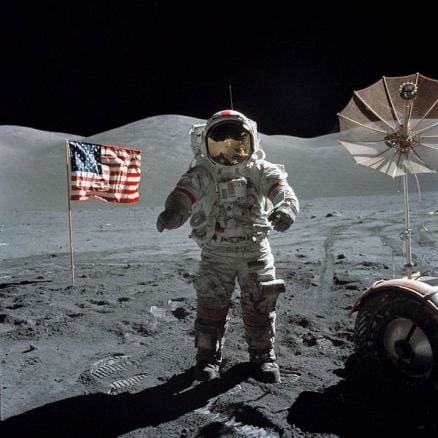
NASA has signed a landmark agreement to collaborate with emerging space-faring nations for the exploration of the Moon. This collaboration will include Canada, Germany, India, Italy, Japan, South Korea, Britain and France in the aim to work with NASA developing new technologies and send a series of robotic exploratory missions to pave the way for a manned return mission. The director of NASA's planetary science division points out that these eight member states are keen to send their first astronauts to the lunar surface. Whilst some may view this collaboration as an attempt by NASA to 'spread the cost' of space travel (especially in the current climate of budget cuts), the main point of this deal is to make manned missions to the Moon more of an international effort. This will give smaller space agencies more opportunities, boost the quality of the science that can be achieved and possibly lead us to some answers about how life formed on Earth 4 billion years ago...
The deal was brokered at NASA's Ames Research Center, Moffett Field, California, last Thursday, and it is expected to be finalized tomorrow. The meeting took place during the largest Moon-specific conference since the US Apollo missions, highlighting the recent drive to get man back to the lunar surface. NASA had already allocated significant funding toward four manned landers, but scientists have asked for eight, so an international collaboration is required so adequate science can be carried out.
At the centre of this renewed vigour is the quest to understand how life was kick-started on Earth. From recent analysis of Apollo rocks brought back to Earth in the 1970's, it is thought that the early Solar System was a violent place. Scientists believe this planetary chaos may be the root cause of life on Earth; analysing the lunar surface is critical so a better picture may be created of the Earth-Moon system billions of years ago.
"What's happening right now is that a revolution in planetary science is going on. We are taking these small pieces and we are starting to put together the puzzle, and we are surprised by what we find." - James Green, Director of NASA's Planetary Science Division.
Why is the Moon so special anyway? Surely most of the answers can be found down here on Earth? Well, that's not entirely correct. The Moon is an open history book of the Solar System's evolution. Its surface has not been altered by plate tectonics, volcanoes or atmospheric erosion processes (unlike the terrestrial surface); ancient events are etched in its rock, waiting to be read by future lunar explorers. This was the conclusion reached by National Research Council of the National Academy of Sciences last year. From the evidence stored in lunar rock, it is hoped that the "terminal cataclysm hypothesis" may be proven or disproved. This theory suggests that Uranus and Neptune once orbited within the orbit of Jupiter. The cataclysm occurred when the powerful Jovian gravitational field flung the smaller gas giants to the outer reaches of the Solar System.
But where is the Earth-Moon connection? This turmoil in the Solar System will have displaced huge numbers of asteroids and comets, scattering them toward the inner planets. This event may have been the trigger of the "late heavy bombardment" between 3.8 to 4 billion years ago which coincided with the formation of life on Earth. This period of time can be studied in great depth on the Moon.
This increased interest in lunar science and the emergence of Japan, China and India create an opportunity NASA will not want to miss. This new international collaboration may be exactly what NASA needs to invigorate funding and help us understand how life was sparked on our blue planet.
Source: Mercury News
