 Universe Today
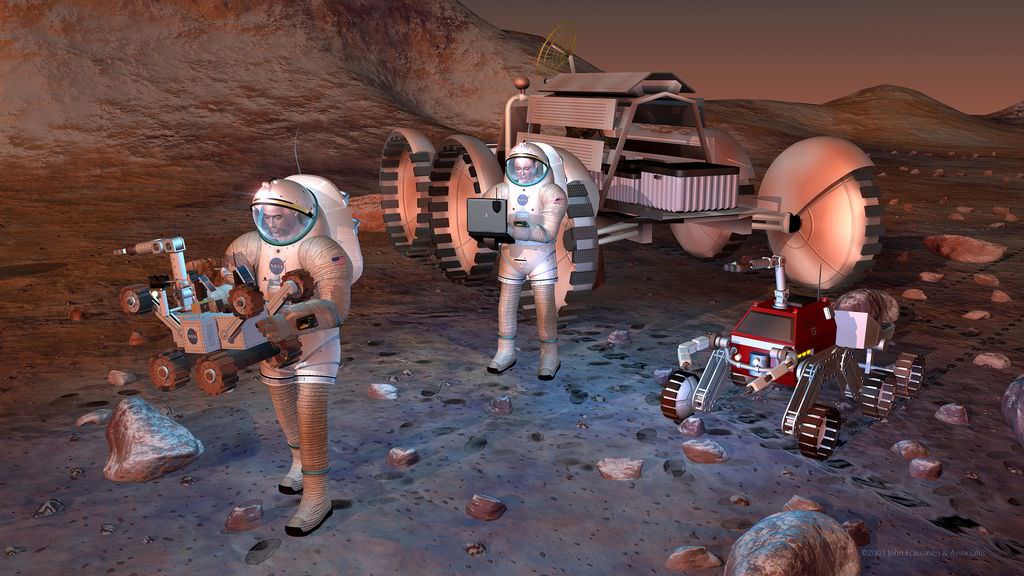
Imagine you are on the crew of a Mars mission and you fall out with a fellow crew member. You can't walk away from them. Imagine you are on the surface of Mars and you suffer terrible home sickness. You can't simply fly back to your family. Imagine there is a medical emergency in your team
en-route
to the Red Planet. You can't call emergency services,
you're on your own
. These issues with long-period missions into space, especially on future missions to colonize Mars, could cause serious psychological issues and may jeopardise the mission. Many groups are currently working on understanding how humans could react in these situations when they are isolated and confined so far away from home, and "Mars Analogues" based here on Earth are proving to be very useful...
It may seem obvious that it is going to be mentally (let alone physically) tough for future astronauts on the first manned missions to Mars, but space organizations (like NASA and ESA) and voluntary groups such as the Mars Society are gaining a valuable insight to how we function when restricted to very confined spaces with only a handful of people for company. Mars settlement mock-ups known as "Mars analogue environments" based in locations like the Utah Desert or the
Arctic island of Spitsbergen
are extremely valuable to mission planners when researching how to live and work on the Martian surface. However, they are also proving to be very influential when selecting crew members who will spend all of their time together. This psychological factor may be key to the future of Mars missions that could last years.
Plans are afoot for a long 520-day mock Mars mission this year to study the effects isolation has on a group of 12 volunteers. The study is being carried out by ESA and the Russian Institute of Biomedical Problems so psychological issues can be identified and understood. It is work like this on Earth that will influence the selection of astronauts to be sent to Mars who are compatible in a work and social environment.
A lot of research has been done on astronauts ever since Yuri Gagarin was launched into orbit alone in 1961. Before Gagarin's historic journey, doctors were very concerned that weightlessness may cause acute mental disorders such as schizophrenia. Fortunately, this was not to be the case, but there are many disorders we cannot fully test until man ventures far into interplanetary space.
It seems natural that Mars astronauts will want gifts, luxuries and other "reminders from home", as is possible on the International Space Station, but they will be totally isolated with no ferrying of items when they leave the safety of Earth. This need can be subdued by regular communications with home (although a 40+ minute delay for communications between Earth and Mars will make any "live" conversation impossible), and generally we know the problems we'll face should these "homesick" feelings surface.
But what happens when man loses sight of Earth? Dr. Nick Kanas, who has studied astronaut psychology at UC San Francisco, is concerned about this unknown factor. He has even given this situation a name: the "Earth out of view" phenomenon.
" " - Dr. Nick Kanas.
This is the nature of the task in hand, humans are going to be pushed beyond what we would consider to be a "natural" situation. Perhaps we might surprise ourselves and find that space exploration is as natural to us as it was for our ancestors to discover new continents. In fact, many astronaut psychologists are looking back into the history books to gain an insight as to what it was like for early pioneers of global exploration.
" ." - Walter Sipes, NASA psychologist, Johnson Space Center, Houston.
These factors combined with
space euphoria and the "Overview Effect"
, our future Mars astronauts are possibly in for a bumpy psychological ride...
Source:
CNN
