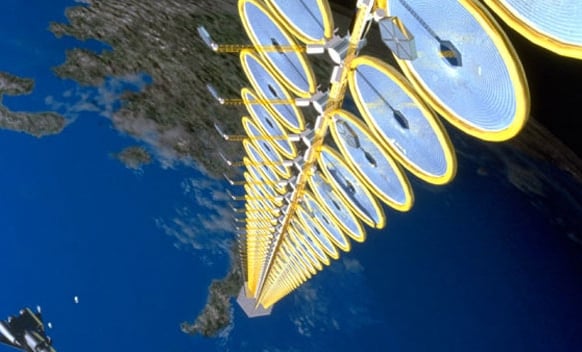
Harvesting Solar Power from Space
Written by Ian O'Neill
In a new report, the viability of sending solar panels into space to collect a vast quantity of uninterrupted energy has been re-investigated. Although the idea has been around since the 1970's, space solar power has always been viewed as prohibitively expensive. In the current energy climate down here on Earth with spiralling oil prices and a massive push toward green energy sources, sending massive solar arrays into geosynchronous orbit doesn't seem like such a strange (or expensive) idea. There are many obstacles in the way of this plan, but the international community is becoming more interested, and whoever is first to set up an orbital array will have a flexible and unlimited energy resource…
It sounds like the perfect plan: build a vast array of solar panels in space. This avoids many of the practical problems we have when building them on Earth such as land availability, poor light conditions and night time, but sending a sunlight farm into space will be expensive to set up. In the 1970's a plan was drawn up by NASA for the possibility of orbital sunlight "harvesting", but it was deemed too expensive with a hefty price tag of at least $1 trillion. There was no country in the world that could commit to such a plan. But as we slowly approach an era of cheaper space travel, this cost has been slashed, and the orbital solar energy case file has been re-opened. Surprisingly, it isn't the most developed nations in the world that are pushing for this ultimate renewable energy source. India and China, with their ballooning populations are reaching a critical point for energy consumption and they are beginning to realise their energy crisis may be answered by pushing into space.
"A single kilometer-wide band of geosynchronous Earth orbit experiences enough solar flux in one year to nearly equal the amount of energy contained within all known recoverable conventional oil reserves on Earth today." - Pentagon's National Security Space Office 2007 report.
So how could this plan work? Construction will clearly be the biggest expense, but the nation who leads the way in solar power satellites will bolster their economy for decades through energy trading. The energy collected by highly efficient solar panels could be beamed down to Earth (although it is not clear from the source what technology will go into "beaming" energy to Earth) where it is fed into the national grid of the country maintaining the system. Ground based receivers would distribute gigawatts of energy from the uninterrupted orbital supply. This will have obvious implications for the future high demand for electricity in the huge nations in Asia and will wean the international community off carbon-rich non-renewable resources such as oil and coal. There is also the benefit of the flexible nature of this system being able to supply emergency energy to disaster (and war-) zones.
"It will take a great deal of effort, a great deal of thought and unfortunately a great deal of money, but it is certainly possible." - Jeff Keuter, president of the George C. Marshall Institute, a Washington-based research organization.
The most optimistic time frame for a fully operational space-based sunlight collection satellite would be 2020, but that is if we started work now. Indeed some research is being done (Japan is investing millions of dollars into a potential prototype to be put into space in the near future), but this is a far cry from planning to get full-scale operations underway in a little over a decade…
Source: CNN International
Filed under: Earth, Environment, Satellites


June 2nd, 2008 at 12:03 pm
Our electrical appliances are no were near 100% efficiency. So as we beam terrawatts of energy down to earth to supply a First World lifestyle of all 10 billion of us (by 2020) my guess is the majority of that will turn into heat. At risk of sounding like a green-hippy (which I certainly am not!) how environmentally friendly will that be. We'd still be capturing extra solar energy but not actively rather than our current passive CO2 greenhouse.
I'd rather see an increase in consumer product efficiency and a decrease in First and Developing World waste then switch away from fossil fuels to a non-CO2 energy source than just adding more energy.
June 2nd, 2008 at 12:56 pm
I read these comments and I just weep for humanity at the stupidity of people. I don't even know where to start.
Adding energy is adding energy. However it's done, it would add to global warming by increasing the energy from additional sunlgiht..
what? no. I'm sorry, but this comment is just silly. Global warming is a problem because the sun emits energy at a wavelength that can be absorbed and retained by greenhouse gases. The microwaves that a solar power satellite will use will NOT add to global warming.
There is no feasible way to clean up the space junk that's out there.
At geosynchronous altitude, the amount of junk as a proportion of the total area, it so small that it amounts to zero. LEO is where the space junk problem exists.
There is no way to feasibly cheaply maintain the arrays.
The arrays would be simpler than the average satellite. Sure, some sats fail, but overall satellites appear to be a good idea. So if your objection doesn't apply to sateillites, then it doesn't apply here.
If China or somebody gets pissed off at the US, they could simply blast the solar panel stations into a million pieces.
This is also an objection to building the hover damn. OMFG IF CHINA GETS MAD THEY WILL DESTROY IT THEREFORE WE SHOULDNT BUILD IT!!11oneone Please, try to have a little courage.
My problem with this idea is that it must surely take quite a bit of energy to get the harvested energy to Earth… making it a bit counter productive.
And do you also look at the power lines that send electricity to your house and say, "it must surely take quite a bit of energy to get the electricity to my house, so therefore, power lines don't work" You're right, there is overhead to transmission by microwave. It is estimated that as much as 10 to 15% of the energy will be lost during transmission.
June 3rd, 2008 at 1:22 am
I sympathise with you "theoneguy" - lack of quantitative argumentation skills means people fear the ridiculous and ridicule the worthwhile.
Earth absorbs and reradiates 120 petawatts from the Sun. Excess Greenhouse gases return to the ground about 2 petawatts. Every energy liberating activity conducted by humans amounts to 0.015 petawatts. IF every human used energy like a American or Australian we'd be liberating 0.07 petawatts - 1.4% of what greenhouse gases trap. And using powersats would lead to the eventual end of coal and nukes as power sources - unless they pick up their game too.
Nuclear fusion might make a difference - but not as colossii like ITER. Who wants electricity costing 10 times the cost of coal and still 50 years away?? If focus fusion and/or Bussard Polywell fusion prove viable then the whole game changes… IF…
June 3rd, 2008 at 4:07 am
i 've heard that the lunar soil is so rich in a certian element that can be converted in electricity so cheaply
June 3rd, 2008 at 5:55 am
theoneguy:
Obviously, your intelligence is far superior than the rest of us, so feel free to use your vastly supply of brainpower and guide us to a collective utopia.
We're waiting………
….thought so.
My point is that there are easier ways to get more energy. It has nothing to do with courage, and everything to do with common sense. Blindly pursuing an idea and ignoring the risk is stupid.
I'm all for solar energy, but I'd prefer to have my OWN solar panels on my roof. The government should be figuring out how to make those more affordable, so that people don’t have to rely on the “grid†as much.
June 3rd, 2008 at 7:23 am
I agree with dark gnat on the problems.
However, it's more a question of WHOEVER gets their rig up in space, the thing will be vulnerable, not just ol' Uncle Sam.
Such projects may be cheaper compared to the past, but it may yet still require international co-operation.
This adds another practical problem-international red tape & wrangling over who does what, who gets what share of the power/profit. Any one deciding to throw their toys out of the pram could render such an energy farm inoperative.
I'm not being (unneccessarily) pessimistic, but any such undertaking would have to deal with these issues head-on.
Red tape, you gotta love it
June 3rd, 2008 at 9:33 am
Also, the article implies that going into space solves the problem of night time… however geosynch orbits still have night time - a little less maybe but its still there. Polar orbits could avoid nights but then of course you are not geo-synch any more.
ROFL at the comment "Nothing more than a scaling problem, really" when talking about quantum mechanics. That just made my day.
On the topic of ppl blowing the crap out of your national power grid because they are angry that you get cheap clean power… thats just stupid. Its like declaring war on some country coz they have the energy that you want and are charging lots of cash for it… oh wait, yeah thats happened before…
Anyhow im sure that if it were something like an orbiting platform then the countries involved would realise just how vulnerable EVERYTHING in space is so they would play nice and not kill the chinese power grid incase they turn around and blow up the ISS or something else we care about.
June 3rd, 2008 at 7:09 pm
To - theoneguy.
Your observations and corrections to other's misunderstandings of science are generally accurate and appreciated.
But FYI - you're a prick for your attitude and condescending tone. Your obvious sense of superiority diminishes whatever appearance of real intelligence you actually may have had.
June 7th, 2008 at 10:52 am
The idea of beaming down solar energy goes back further than "the seventies". Isaac Asimov used the Idea in one of his early robot stories "reason" in 1941!
June 8th, 2008 at 10:24 am
Does anyone know what "new report" this article is based on?
No matter what, the concept of harvesting the power emitted by the sun for our energy needs is the most brilliantly obvious I've heard all day.
The idea is valid; the major drawback is the technical problem of getting the power to the ground in an efficient manner. Costs will be funded by government or perhaps the oil companies themselves, and as our current energy crisis worsens, the demand will only grow.
June 14th, 2008 at 11:10 am
Of course, there's the flip side. The military is always involved in basic research about things that have destructive potential. Knowing secrecy is the order of the day -and 'treaties' governing weaponry in orbit - would you trust the Pentagon with rivers of power and a beam which could be focussed as desired ?
Idealistic plans die for many reasons. The Tesla one is classic : JP Morgan couldn't figure out a way to restrict power from deadbeats if he funded Tesla's broadcast power idea.
June 16th, 2008 at 1:36 pm
I thought this a while ago in school (im only 17)
is it not possible to have a HUGE generator which powers its own motion but creates an excess power which we can harvest?
it would only need a bit of power to start it off and then could keep going forever with absolute zero carbon footprint or anything
or maybe a huge pendulum that has a motor at the fulcrum?
(if there are any scientists that want to develop my idea go ahead, its best for the world)
June 17th, 2008 at 5:43 pm
The first hurdle isn't the actual technology, its putting a price tag on the ocean, air, and land we live on (i.e the environment). Until a carbon tax is created, implemented and assessed, conventional energy will always be "cheaper" than it's alternative counterpart.
A trillion dollars or 10 for that matter, may not seem so expensive considering the mere fact one may not have a place to spend it in 75 years.
Scientists, politicians, and consumers alike discount the "free" resources we use to live everyday because there is no monetary transaction; there is no money coming out of their pocket today.
The symptoms of our negligence is apparent and impacting people's way of life worldwide.
Many cities in Asia have "atmosphere alerts" where it is too dangerous to walk outside during certain hours of the day. Moreover, the eastern seaboard is slowly sinking into the Atlantic Ocean.
The availability and access to fresh drinking water has become increasingly serious whereby many countries have and are building desalination stations to meet the growing demands analogous in scale to the growing rate in energy consumption of quickly growing nations that represent almost 2/3 of the world population.
Albeit, I am not a tree hugger ( i don't mind their presence however) the "price tag" is not relavent. In fact, government's overspend ridiculous amounts of money on many things, this would be no different excluding an actual and substantial return on "their" money at some point
FIGURE OUT THE SOLUTION(S), try new things, KISS and stop complaining, YOUR ARE WASTING ENERGY!
October 7th, 2008 at 9:05 am
Now throw in the space elevator which world scientists are meeting next month to discuss/plan.
This thing just gets a lot more practical - very quickly.