How Can Galaxies Recede Faster than the Speed of Light?
Written by Fraser Cain

Question: How Can Galaxies Move Away Faster Than Speed of Light?
Answer: Einstein's Theory of Relativity says that the speed of light - 300,000 km/s - is the maximum speed that anything can travel in the Universe. It requires more and more energy to approach the speed of light. You could use up all the energy in the Universe and still not be traveling at light speed.
As you know, most of the galaxies in the Universe are expanding away from us because of the Big Bang, and the subsequent effects of dark energy, which is providing an additional accelerating force on the expansion of the Universe.
Galaxies, like our own Milky Way are carried along by the expansion of the Universe, and will move apart from every other galaxy, unless they're close enough to hold together with gravity.
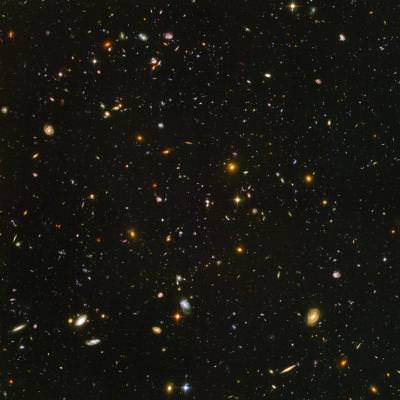
As you look at galaxies further and further away, they appear to be moving faster and faster away from us. And it is possible that they could eventually appear to be moving away from us faster than the speed of light. At that point, light leaving the distant galaxy would never reach us.
When that happens, the distant galaxy would just fade away as the last of the photons reached Earth, and then we would never know it was ever there.
This sounds like it breaks Einstein's theories, but it doesn't. The galaxies themselves aren't actually moving very quickly through space, it's the space itself which is expanding away, and the galaxy is being carried along with it. As long as the galaxy doesn't try to move quickly through space, no physical laws are broken.
One sad side effect of this expansion is that most of the galaxies will have receded over this horizon in about 3 trillion years, and future cosmologists will never know there's a great big Universe out there.
You can read more about this in an article I did called the End of Everything.
Filed under: Cosmology, Questions


April 22nd, 2008 at 3:43 pm
Regarding: "How Can Galaxies Recede Faster Than the Speed of Light"
It was stated: "And it is possible that they (galaxies) could eventually appear to be moving away from us faster than the speed of light. At that point, light leaving the distant galaxy would never reach us. When that happens, the distant galaxy would just fade away as the last of the photons reached Earth, and then we would never know it was ever there".
I do not understand why its light would never reach us — If light travels at the speed of light, then it seems that it reach us eventually no matter what speed the galaxy is traveling. Its frequency would certainly be reduced — largely reddened. It seems to me that it would only be a matter of time for a given photon to reach us — the farther it is the longer it will take to reach us.
If an object was very close to us, but traveling away from us at a speed greater than light speed, wouldn't we still be able to observe it, but at lower, reddened frequency?
Thank you for the opportunity to comment.
John Tomassoni
April 22nd, 2008 at 11:38 pm
The light wouldn't reach us because light has had only 13.7 billion years to reach us. Because of this it may be possible that something is 15 or 20 billion light years away and we wouldn't know about it since it'd take a few more billion years to reach us.
The expansion of the universe is very similar to baking cookies. Pretend that galaxies are the chocolate chips in the cookies- when you cook them the chips don't move away from each other. It's the dough expanding. Space works exactly like this.
April 23rd, 2008 at 1:32 am
Tomassoni is quite right (the first part at least). The distance from us at which galaxies *appear* to recede at the speed of light defines the Hubble radius. We see galaxies further away than that all the time. We see them in the past. We will see them in the future *unless* the expansion of space in between is too fast. Forget about dark energy for a moment and eventually, a photon from a galaxy receding faster than c would cross into our "Hubble sphere" and actually be moving toward us instead of away. And it would eventually reach us.
Dark energy makes it more complicated. If the Hubble radius is decreasing (because of the accelerated expansion) faster than c, then we'll never see a photon emitted from a galaxy on the other side of it because the expansion of space will continue to carry the photon away from us. This is what Cain is trying to explain.
For a somewhat (but maybe not too) technical review of these confusing things, see http://arxiv.org/abs/astro-ph/0310808.
April 23rd, 2008 at 5:21 am
Hmm . . . interesting question. I suspect that space itself might be static in shape. That is galaxies travel through it rather than with it. Why are galaxies literally flying apart at an accelerated rate? This phenomenon could be driven by the equivalent of "like polarity repulsion" contrary to gravitational attraction. So . . . "how can galaxies recede at a rate faster than the speed of light?" Why not! We know or at least we think we know that a recession rate of red shift .one might represent an actual barrier crossed by receding faster than light never to be seen again.galaxies. If this is close to factual, this suggests the observable portion of our universe is an infinately tiny part of an incomprehensible mind-bending total universe. Again, why not? Any physical laws broken? And how does the "big bang" fit into all this? I believe it does, but not in the accepted sense. More later..
April 23rd, 2008 at 7:22 am
I am just trying to understand this my own way but could this theory by analogous to the following bad dream I have had? There is one hallway (space/time) and two doors appearing at either end of the hallway. What I will call door number one will represent a distant galaxy, and door number two at the other end will be observers on earth, earth itself or our galaxy, it doesnt matter which one. Now in this dream I represent light itself. As I escape through and away from door number one (distant galaxy), I run down the hallway (light traveling through space time), but due to this bizzare dark energy the hallway itself actually starts elongating (expanding). As I run towards people on earth inside the milky way (door number two at the other end) I progressively lose sight of that second door as it gets pushed further and further away at each step I take. Where as I may not lose running speed the hallway expands faster than I can run making my attempts to exit a distant galaxy and reach the milky way, futile. I would imagine in this analogy it is as relevant to ask why dark energy increases the distance of the hallway as it is to ask why in another scenario (perhaps a different universe) the hallway would remain static. It is the predestined nature of our universe to expand and inside are our felt implications. The confusing thing is in agreeing that nothing can travel faster than c across a distance, but when you are distance itself you arent traveling at all, you are growing larger. I am thinking of this phenomenon as an issue of growth and the illusion of travel from our perspective of being inside the belly of the beast, where the universe itself may or may not be traveling anywhere. That would be like the hallway I am running in traveling towards another hallway some other me might be running in, while either hallway elongates. We experience time (as does light) when a distance is traveled, but the universe contains time and is said distance so its expansion, and the resulting effect that has on its internal parts, is quite a different experience than the one I can think of having. Then again, I could be completely off the mark, I am just thinking.
p.s. when I say the universe contains time I mean it in the same way that the human body contains water, both are essential to the natural design and function of the resulting body (universe), when either time runs out or water dries out the universe and body are at their end.
April 23rd, 2008 at 11:51 am
The light from the farthest galaxies is red shifted. Some are so red shifted that we can only get a good look at them through infra-red imaging.
The reason for the red-shifting is because the space between the galaxies and us is expanding, and the waves are spreading apart. The radiation from the earliest times that we can detect is in microwaves (cosmic microwave background radiation).
Eventually, the farthest galaxies will be so far away, that the we won't be able to detect the whole wavelength, and it will thus be invisible.
April 23rd, 2008 at 3:36 pm
To Dark Gnat, Isn't it generally accepted that red-shift is as much a measure of recessional speed as is this thing you call expansion?
April 25th, 2008 at 10:14 am
A simpler way to look at it is this: We look at ourselves as stationary and "see" them receding faster than the speed of light. From their point of view, we are the ones receding at a superluminal velocity. Either way, we are lost ot each other.
May 10th, 2008 at 1:05 pm
Our traditional model of an expanding Universe is probably on the wrong track. See my study "The Mystery of Life - Does science hold the key?" (www.dwv-net.de).
Sincerely, Wolfgang
June 10th, 2008 at 6:38 pm
if galaxies were getting far away from us at the speed of light we would never lose the light of them because they can only speed up to the speed of light, only change would be the picture we get, simply i would be just older.
June 22nd, 2008 at 11:17 pm
Since light does not require an “ether”, it propagates freely and independently of space, meaning it propagates free of any expansion of space. Even if the apparent velocity of expansion reaches or exceeds the absolute velocity of light, light will eventually reach us from even the most distant objects in the Universe. The only way to outrun light is to exceed the absolute velocity of light, which is impossible. Suppose the velocity of a bullet to be 1000 meters/second. Now two automobiles are speeding away from each other, each travelling at 600 meters/second. Their net velocity of 1200 m/s exceeds the velocity of the bullet. Now fire a gun from one auto, directed at the other. Do you think the auto, travelling at 600 meters per second will outrun the bullet, travelling at 1000 meters per second? It will take a bit longer, but the bullet will catch up with the car and a simple quadratic equation will prove it! Also, as space expands, gravity will pull the galaxies in our local group closer together, making the night sky much brighter than it is today, not darker!
July 10th, 2008 at 1:19 pm
Why does everyone think of the "expanding universe" as purely a physical phenomenon involving dark matter as propulsion and expanding space as somehow drawing the matter further away!
The reason the entire universe appears to be moving away from our vantage point here on Earth is qutie simple. TIME.
Einsteins theory of relativity showing light to be the speed limit was based on the fact that the light from object A when object A was moving at say 100mph didn't arrive any faster than the light from object B not in motion did, and vice versa (no shift if object moving away from us either)
Of course objects light years away from us appear to all be moving away… we aren't looking into deep space… we are looking into deep past. The past will never appear to be moving toward us.
Think about this: when ever you view the night sky, you are looking at layer upon layer upon layer of ILLUSION because the TIME it takes the various layers of past photonic emmissions to reach us greatly various for the single perspective we view from. Where is that matter RIGHT NOW. Right now, when we look up, where is that matter NOW at the moment we are looking up? We don't know, and that is why the factor of Time is often ignored when dealing with physics, other than half lifes for particles or such. It throws a wrench into the "raisin bread" or whatever expansion theory. Space doesn't expand, but time does! The deeper we see into the past, the greater we just increased the half life of the entire universe. If that object 22 billion light years away is observed, than it also has photons that went 22 billion light years in the opposite direction we are observing from, for an effective diametric distance of 44 billion light years across as the newest "size" of the universe.
Does any one get it?