Universe Today
For those of you hoping that
Pluto the dwarf planet
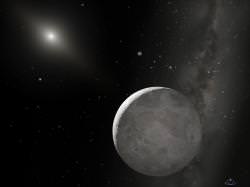
would get its full planethood status restored again, the news isn't looking good. The most recent observations peg the newly discovered dwarf planet Eris as being 27% more massive. And if
Pluto is a planet
again, shouldn't the even larger Eris get to be a planet too? Should we have 8 planets, or 10 or 20? Oh, it's madness.
The latest observations were made by discoverer Mike Brown and his planet hunting team. They made detailed observations using the Hubble Space Telescope and Keck Observatory, and concluded that Eris has a density of about two grams per cubic centimetre; a mixture of ice and rock that matches the density of Pluto. Since its diameter is 2,400 km (1,500 miles), that pushes it above the mass of Pluto.
And
Eris
is much colder. Since it's 97 astronomical units (the distance from the Earth to the Sun) away from the Sun, its average temperatures hover around -240 degrees Celsius (-400 degrees Fahrenheit). During its elliptical orbit, the dwarf planet can sweep in getting as close as 38 astronomical units.
Researchers think the planet is covered in a layer of methane that seeped out from inside the planet and then froze on the surface. This methane has then undergone a chemical transformation in the solar radiation, turning yellowish. The planet also has a moon, 150-km (93-mile) diameter Dysnomia. It orbits Eris every 16 days.
Caltech News Release
Here are some interesting
Pluto facts
.