Universe Today
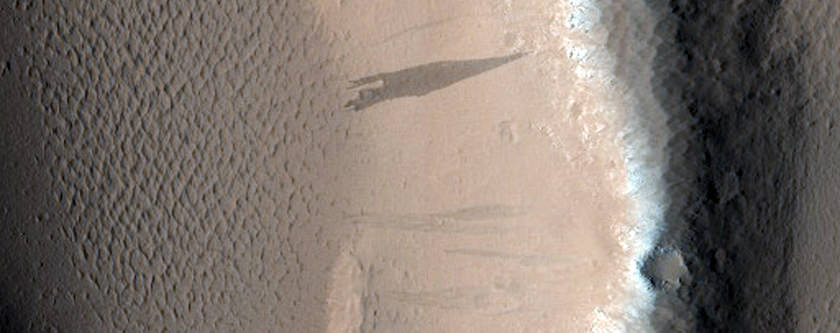
We frequently call the HiRISE camera on board the Mars Reconnaissance Orbiter "our favorite camera" and for good reason. HiRISE, the High Resolution Imaging Science Experiment, is the largest and most powerful camera ever flown on a planetary mission, sending back incredibly beautiful, high-resolution images of Mars. While previous cameras on other Mars orbiters can identify objects about the size of a school bus, HiRISE brings it to human scale, imaging objects as small as 3 feet (1 meter) across.
The HiRISE team has
just released more than 1,000 new observations
of Mars for the Planetary Data System archive, showing a wide range of gullies, dunes, craters, geological layering and other features on the Red Planet. Take a look at some of the highlights (click on each image for higher resolution versions and more info):
[caption id="attachment_130144" align="aligncenter" width="640"]
Chloride and Paleo Dunes in Terra Sirenum. Credit: NASA/JPL/University of Arizona.[/caption]
MRO orbits at about 300 km above the Martian surface. The width of a HiRISE image covers about about 6 km, with a 1.2 km strip of color in the center. The length of the images can be up to 37 km. If you click on each of these images here, or go to the
HiRISE website
, you can see the full images in all their glory. To fully appreciate the images, you can download the special
HiView application
, which allows you to see the images in various formats.
[caption id="attachment_130145" align="aligncenter" width="580"]
Dunes Within Arkhangelsky Crater. Credit: NASA/JPL/University of Arizona[/caption]
HiRISE has been nicknamed "The People's Camera" because the team allows the public to choose specific targets for the camera to image. Check out the
HiWISH page here
if you'd like a certain spot on Mars imaged.
[caption id="attachment_130146" align="aligncenter" width="580"]
Crater Near Hydaspis Chaos. Credit: NASA/JPL/University of Arizona.[/caption]
The lead image (
the link to the image on the HiRISE site is here
) shows a possible recurring slope lineae (RSL), mysterious dark streaks on slopes that appeared to ebb and flow over time. They darken and appear to flow down steep slopes during warm seasons, and then fade in cooler seasons. One possibility is this is evidence of liquid water present on Mars today. Some scientists said it could be a salty, briny liquid water flowing down the slopes.
But a recent analysis says
the RSLs show no mineralogical evidence for abundant liquid water or its by-products, and so it might be mechanisms other than the flow of water -- such as the freeze and thaw of carbon dioxide frost -- as being the major drivers of recent RSLs.
Check out the full release of images from August 2016 here.