I Heart the ISS: Ten Reasons to Love the International Space Station

by Nancy Atkinson on February 14, 2008

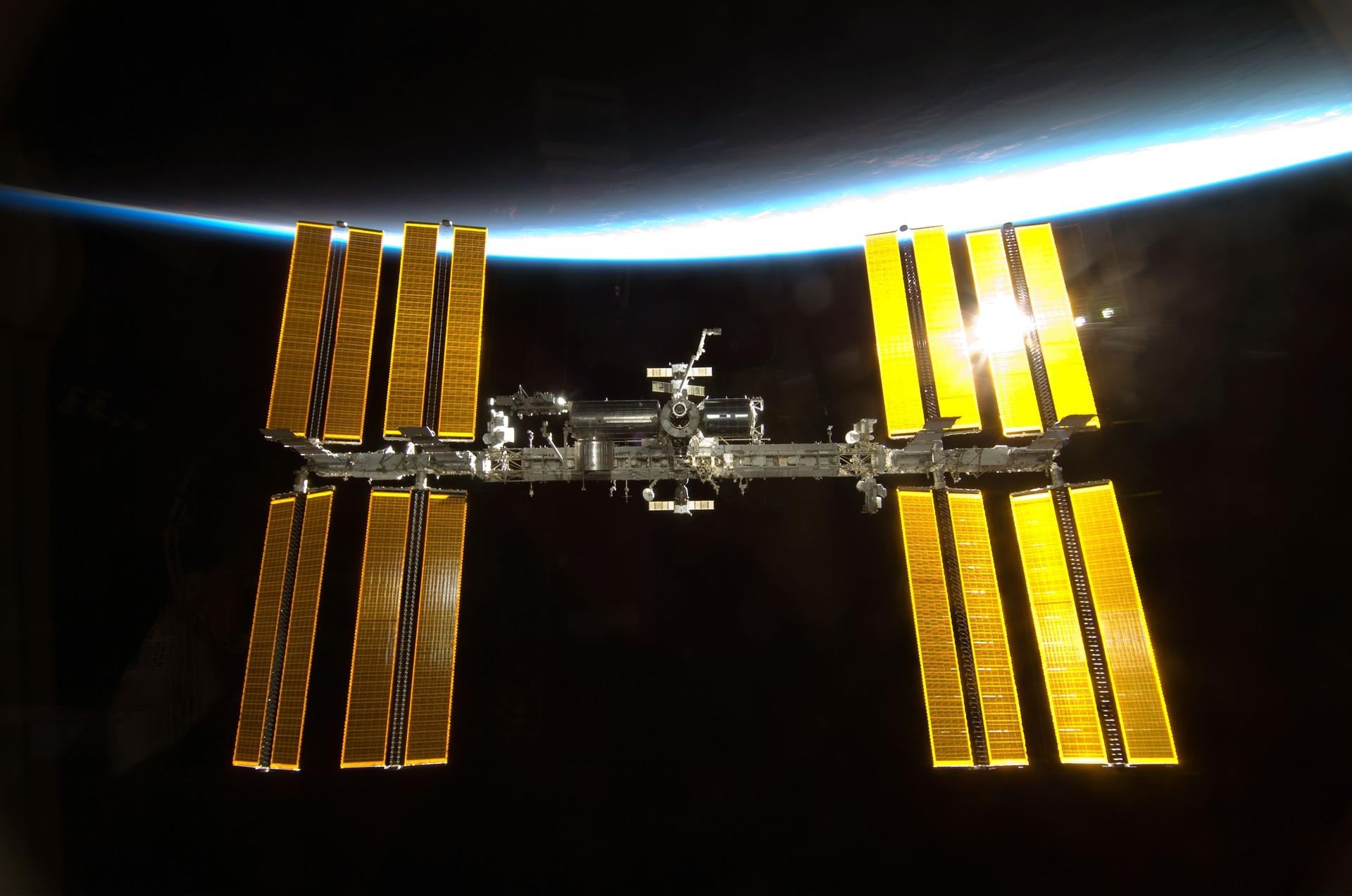
The International Space Station.  Image Credit:  NASA
It’s been called a white elephant, an orbital turkey, a money pit, and an expensive erector set. Seemingly, there’s even people at NASA who think building it was a mistake. The International Space Station has been plagued with repeated delays, cost overruns, and bad press. Additionally, the ISS has never really caught the fancy of the general public and most likely there’s a fair percentage of the world’s population who have absolutely no idea there’s a construction project the size of two football fields going on in orbit over their heads.

But I’m going to be honest. I’ll come right out and say it: I really like the ISS. In fact, I’m crazy about it, and have been ever since Unity docked with Zarya back in 1998. Yes, my heart belongs to the space station, and since its Valentine’s Day, I’m going to profess my feelings here and now with ten reasons why I love the International Space Station:
(In no particular order:)

1. International Cooperation. Didn’t your heart swell with pride for the Europeans when the Columbus science module finally became part of the station this week? And you gotta love the Canadians for their reliable, heavy-duty Canadarm 2. The Russians have been steady partners in station construction and re-supply for years now. Japan’s science lab will be added on the next shuttle mission. The ISS is the largest, most complex, international engineering project in history. In a world where violence and political animosity floods the daily news, it’s incredible that this structure is quietly being built by 16 different countries working together in relative harmony. If not for the international partners, the ISS probably wouldn’t have gotten off the ground. NASA Administrator Mike Griffin has said that the station’s most enduring legacy is the international partnership that created it.

2. Actually Building an Outpost in Space. The dream of almost every post-Apollo space enthusiast is to have a settlement or colony in space. As humble as it is, the ISS is exactly that. Humans have been living on board the station for over 7 years now. The experience of constructing and living aboard this complex structure in space is invaluable, and any future outpost will benefit from what’s been learned with the ISS.

ISS Crew & STS-120 Crew.  Image Credit:  NASA

3. The Personalities. Peggy Whitson, the first female station commander. Clay Anderson’s unique sense of humor. Suni Williams’ marathon and haircut for cancer patients. Mike Lopez-Alegria’s music. Mikhail Tyurin’s golf shot. Yuri Malenchenko’s wedding. Frank Culbertson’s September 11 perspective. Yury Usachev’s spinning antics. It goes all the way back to the three-way fist pump on Expedition One between Bill Shepherd, Sergei Krikalev, and Yuri Gidzenko. With the Expeditions lasting 4-8 months, we have the opportunity to get to know the astronauts and cosmonauts that live and work on board the ISS. If you watch the daily feeds from the ISS or listen to the periodic press conferences, you can become familiar with the different personalities of the station crews. The number one personality has to be Don Petit and his Saturday Morning Science.

4. You can see it almost every night. I’ve witnessed jaws dropping and eyes widening in wonder when people see the ISS for the first time gliding silently and swiftly across the night or early morning sky. I never tire of observing it. Find out when the station will fly over your backyard at NASA’s website or at the Heaven’s Above website.

5. No major problems so far. One of the real impressive things about the ISS is that all the components, built by different countries and contractors have fit together perfectly. Yes, there have been intermittent computer issues, a faulty smoke alarm and the torn solar arrays. But these problems have all been resolved in short order. The damaged SARJ (Solar Alpha Rotary Joint) is a looming issue that could be problematic. But there are some first-rate engineering minds working on this matter, and it appears they have time to come up with a solution. The station has never had a major calamity or had to be evacuated in over 7 years of continuous human occupation. Knock on a Whipple Shield.

6. The general public can participate. Schools and informal education centers can conduct live question and answer sessions with space station crews. Middle school students can choose locations on Earth for the ISS crew to take pictures as part of the EarthKAM project. Ham radio operators can talk regularly with astronauts and cosmonauts with the ARISS (Amateur Radio on the ISS.) College students can design projects to be researched on board the station. And of course if you have $40 million in spare change you can ride to the ISS on a Soyuz as a spaceflight participant.

7. Finally, we have science officers. The other dream of every post-Apollo space enthusiast (and Star Trek fans) is to have science officers to conduct real scientific research. The ISS has had science officers since 2002, but science hasn’t been in the forefront of the work on board the ISS. Yet.

8. Long term research. The ability of the ISS to serve as a platform for science has come under fire. But what other lab has been expected to produce scientific results while still under construction? With the addition of the European and Japanese science labs, and the expected increase in crew size from three to six in 2009, scientific research, the original purpose of the station, will finally be able to be conducted with consistency. The microgravity environment of the ISS allows the study of long-term effects of weightlessness on the human body, crucial for any future human exploration on the moon and Mars. Research will help fight diseases such as diabetes, cancer, osteoporosis, and AIDS. The station provides a unique place to test technologies such as life support systems and new manufacturing processes, and gives us a long-term platform to observe and understand Earth’s environment and the universe.

9. Post docking fly-arounds. After each construction mission to the ISS, the shuttle’s post docking fly-around gives us a chance to see the new additions and latest configuration of the station. The astronauts say it’s a thrill to see how their handiwork on a specific mission fits into the big picture of the entire ISS, and it’s a thrill for us back on Earth to see the station’s new look, too. Plus the fly-around usually gives the shuttle pilot some actual stick time to fly the shuttle and a little time in the limelight.

10. What else would we be doing? Some people feel that the ISS’s tremendous budget has taken funds away from robotic exploration and other science. I can’t argue with that. But when it comes to human spaceflight, what else would we have been doing for the past 10-20 years? A space station was the logical next step after the shuttle. The main problem is that it took so long to decide on a plan, get it approved by Congress and get it in the works with international cooperation. But now, with construction and maintenance ongoing, we’re constantly and continually learning how to live and work in space. The ISS is a resource that will guide us on our future human endeavors in space. It’s more than just an obligation to finish and then be disregarded. The planning and funding for its future should encompass the maximum utilization of its fullest potential.

In my eyes, the International Space Station is a thing of beauty, a work of art, an engineering marvel, and a constant companion that I watch for every night as it orbits our planet. The ISS should be given all the respect, and love, it deserves.


  • Jeff S

    Wonderful article. Given the fact that the station has had to survive the United States Congress and international strife I’d say its existence is nearly miraculous. Here’s to years of exploration, experimentation, and inspirational manned space flight. With the ISS as an example, I can hardly wait to see what the next 20 years will bring!

  • http://starmikebest.com Mike Best

    Don’t be concerned with MrBill and NR.
    Their type have always been around and always will be.
    Try to imagine their counterparts in 1491 picketing outside the Spanish palace of King Ferdinand and Queen Isabella.
    If you listen carefully, you can hear some of their chanting:
    ‘Don’t waste money on Columbus?
    Spend it here at home on the unemployed, homeless, poor, uneducated, and sickly – ad nauseum.
    Never argue with an undeducated person)

  • Jason Leary

    Agree strongly. The ISS is a much more remarkable space project than the shuttle and offers the oportunity for yet new frontiers. And the space station *itself* is a new frontier , in its own right .

  • Swift

    Very nicely written piece.

  • Kevin M.

    Many nice quotes and words here.

    Too expensive? Perhaps. A waste? No way. Sometimes you have to ignore the dollars to achieve something truly original and magnificent. Maybe the ISS was a grandiose dream from a wealthier time, but the components were all finished long ago, we are obligated to deliver what we promised, and it will be put to excellent, long-term use.

    It is a necessary step in an inevitable direction. We are learning immense amounts from it already, about living and working in space, even without the science research, and particulary from the mistakes. Every bolt we tighten up there is an unprecedented milestone and wonder. It’s like a new moon landing every other month.

    The reason the ISS has had poor press is because we had to halt progress for three years because of the Columbia disaster, so NASA shut off the PR funds spigot and diverted attention away from the ISS as much as it could while it reorganized. It is now time to make up for this and turn the PR machine back on. The people will respond if you pump them up about something. Time to get the PR presses rolling again.

    The only thing that really threatens the ISS, other than technical malfunction, is human malfunction. That is, personality difficulties or future international conflicts. At the same time, having international citizens up there will compel nations to cooperate, at least until we can get their members down. But human error can only be blamed on ourselves, not the engineering.

    Yes, its too bad the Brits are not involved, their presence in the space community is sorely missed. I imagine the expense is just too extravagant to justify. But in the choice between national space program or national healthcare, many of us may soon be wondering if you have made the more sensible choice.

    And as has been very rightly noted, our current reckless war of occupation is by far the heaviest unwarranted burden and threat to our economy.

  • Julia

    Ever since we visited the Kennedy Space Center last Winter, we have been making the effort to watch the ISS as it crosses the sky in the evening. Every time we see it, it is spectacular and thrilling and I get goose bumps just thinking about it.

  • Pingback: Burzycki.org - Tech and Interesting Facts

  • Adam

    I totally agree with the author. Besides, whenever NASA decides on a way forward there are scores of people, among them respected scientists, who are bitching about NASA doing the wrong thing. I think it’s because they are disappointed that their particular idea or research interests weren’t selected. But you can’t keep everyone satisfied, at least not for the money NASA is getting and if NASA was trying to accommodate everyone they would never get off the ground. At some point you have to stop debating and actually do something. An endless search for The Perfect Solution is meaningless since you’re never going to find one.

    And here are some comments to comments:

    @ Darnell Clayton
    NASA is not a financial operation. NASA and all the other space agencies like ESA or JAXA are charged with doing research no business would contemplate because of the lack of a clear prospect for economic rewards. I am quite convinced that whatever Bigelow Aerospace gets up and running (flying?) will be a complement not a competitor to ISS. Make no mistake about it though: I am just as excited about what Bigelow Aerospace is doing as about ISS and the new vision for exploration of Moon, Mars and perhaps beyond…

    @ homer
    “iss should be moved to about halve the way to the moon”. Unfortunately ISS is not built for the radiation environment in the interplanetary space. At the height of 300-400 km it is protected by the Earth’s magnetic field. Not so at a distance of say 150000 km from Earth. The Apollo astronauts were out there for a week or so at a time. The ISS crews are supposed to be away for months. Same goes for materials and electronics.

  • NR

    Fellows, please, Don’t put me in the same basket as MrBill. I was just being ironic…

    Besides that, we have the experience of Columbus: our king didn’t waste money and resources with him and look what happened. The Spanish king did and Columbus found something we didn’t knew (or didn’t wish to be known, no one can figure it). So, we should never turn our back on this things…
    Beside that, ISS is not as expensive as it might look. Just check the numbers against program Apollo. Better yet, check the numbers on some really nowadays money sucking actions, such as some middle east wars or even try to find how much money mankind spend each year in cosmetics. Now, that’s waste…
    Resources and money that goes into space programs are always short. For those younger, just find out what were we suppose we would be in the year 2000…

  • Nick Sheridan

    I am a VERY firm supporter of the ISS because it seems to me the hardest thing at the moment is ENGINEERING – not the science.

    Yes, I’d love to do a Moon or Mars base, but I really don’t think we are ready for it – too many unknowns and risks – and the ISS is the easiest and cheapest way to mitigate those risks.

    Saying that, I’d still like to get more of an understanding of what we’ve got and where the money has gone – how do we know that we’re getting good value?
    Nick

  • Shaithis

    Ya know, I bet a whole bunch of folks shook their heads when Khufu built the great pyramid. I don’t know if there’s an afterlife, but if there is, he is laughing and laughing and laughing.

    The ISS is THE FIRST marvel of the modern world. The rest have not been built yet.

  • litesong

    After decades of personal opposition to ISS, this article almost persuaded me to support it. Actually, I will support it, anyway. But my support is given, not because, but in spite of the snide sniping potshots people took at Mr.Bill.
    The best science has suffered terribly as the ISS was planned & got bigger in orbit. If the ISS hadn’t been built we could now have robots exploring the moon & constructing an electronic virtual ‘mirror’ telescope with the resolving capability of the earth moon distance.
    More efficient power systems for spacecraft would now exist, with the hope of sooner than later sending an interstellar probe meaningfully out of the solar system….at least to Sedna. Numerous spacecraft in the glorious footsteps of Pioneer, Voyager, Magellan, Galileo, & Cassini, but with far deeper treads & capabilities would be flung thru every corner of the solar system. We could be exploring Mars in much greater depth than at present, since our robots are proving to be greatly reliable & long living.

    Yes, great is your ego to get people to do things in space. But never believe, that the fine minds who do search the realms beyond the earth’s atmosphere, can’t do more space science, more effectively with robots, than with people in space.

    Your egotistical pressure on Mr.Bill PROVES the great breaking of humanity. If a long lived viable, INDEPENDENT presence in space on other worlds & planets was established, time would eventually split people into different civilizations…one, the HOME WORLD, the other, OUTWORLDERS. & some how, some way, egotistic life would find a reason for war. Your strenuous dislike of Mr.Bill proves my contention.

  • RussRobers

    The future of the human race depends on our ability to live and work in space. We can either put all our eggs in one basket (earth) or expand our imaginations, horizons, and the human spirit with space exploration. We are all descendents from explores and space is the last great exploration for humans. It inspires the next generation, teaches us how to live and work in space and has expanded the global economy into space. It is a choice for the United States – to lead the world through our ideals, technology, and capability – or be happy taking the back seat and let somebody else drive! Remember if we are in the backseat we will not be steering anymore – are we really ready to be second best? We can use space to unite countries, expand the human life across the solar system, develop new technologies and capabilities that make a difference in our lives on earth, expand human knowledge and help grow our economy – or not. Civilization that lose their vision and their ability to invest in their future will wither away. That is not the future I want for this great country – I want my children and their children’s children to have pride in our countries great accomplishments and have the inherent belief that this country with all it’s amazing diversity and talent can do ANYTHING we set our mind to.

  • http://www.universetoday.com Vesna

    Thank you Nancy, thank you RussRobers, you said everything I would.
    LifeSong sais: “if the ISS hadn’t been built we could now have robots exploring the moon & constructing an electronic virtual ‘mirror’ telescope with the resolving capability of the earth moon distance. More efficient power systems for spacecraft would now exist…”, I don’t know…maybe that’s true but ISS is the place to exercise all our skills and when the time comes we shall do all that beautiful and inconceivable stuff! If money hadn’t been spent on ISS it doesn’t mean it would have been saved for Mars, Moon or robots either. We should be lucky that ISS exists at all, knowing the world we are living in.

  • Karen

    Just watched the space station go by. It was glorious!
    Feb. 5, 2009

Previous post:

Next post: