Universe Today
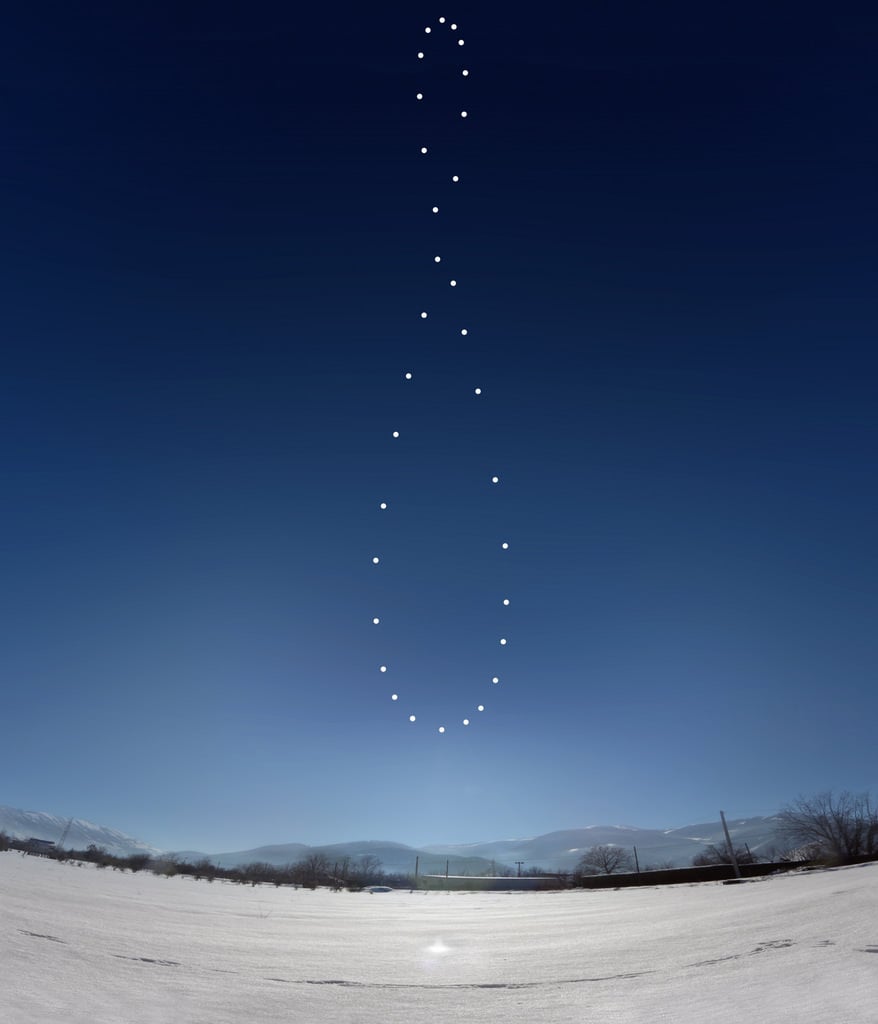
If you took a picture of the Sun every day, always at the same hour and from the same location, would the Sun appear in the same spot in the sky? A very fine image, compiled by astrophotographer Giuseppe Petricca from Italy, proves the answer is no.
“A combination of the Earth's 23.5 degree tilt and its slightly elliptical orbit combine to generate this figure "8" pattern of where the Sun would appear at the same time throughout the year,” said Petricca.
This pattern is called an analemma, the full version shown below:
The analemma is considered by many to be one of the most difficult and demanding astronomical phenomenon to image. Astrophotographers need to dedicate an entire year to the project. It requires diligence to take images 30 to 50 times throughout the year at the same time of day and same location.
It is interesting to note that analemmas viewed from different Earth latitudes have slightly different shapes, as well as analemmas created at different times of the day. Also, analemmas on the other planets have different shapes. Here’s one created by the Opportunity rover (ready more about the Martian analemma here):
If the Earth were not tilted, and if its orbit around the Sun were perfectly circular, then the Sun would appear in the same place in the sky throughout the year. But then, we also wouldn’t have seasonal change, so I vote to keep axial tilt!
In this compilation image, Petricca combined 32 pictures of the Sun taken at 12pm local time throughout the months and seasons, all shot with the same settings and exposure times (ISO 100, f/8.0 and 1/1000" exposure time). “I was lucky to have the last year with good sunny skies at the right times, even if some months were really difficult to image,” he explained via email. “The background view is the one from the first picture, January 4th, 2015, after three days of snow."
Petricca used a Nikon Coolpix P90 Bridge Camera mounted on a fixed tripod, with images taken from a field nearby his home Sulmona, Abruzzo, Central Italy. “To take pictures of the solar disk I used an Astrosolar filter in front of the camera, then I composed the analemma digitally, via Photoshop CC,” he said.
Our David Dickinson has written a great piece explaining the dynamics and history of analemmas, with instructions on how you can compile your own.
Also the the Stanford University Solar Center has a great page about it, with analemmas taken from around the world.