Mega-constellations of satellites. Credit: ESA-Science Office
Hardly a day goes by where a story hits the headlines about our abuse of the Earth’s precious environment be that the atmosphere or the oceans, forests or desert. When it comes to the atmosphere we all tend to immediately turn our attention to pollution, to gasses being released and disturbing the delicate balance. Yet a paper recently published points to a new demon, megaconstellations of satellites damaging the ionosphere – the ionised part of the upper atmosphere.
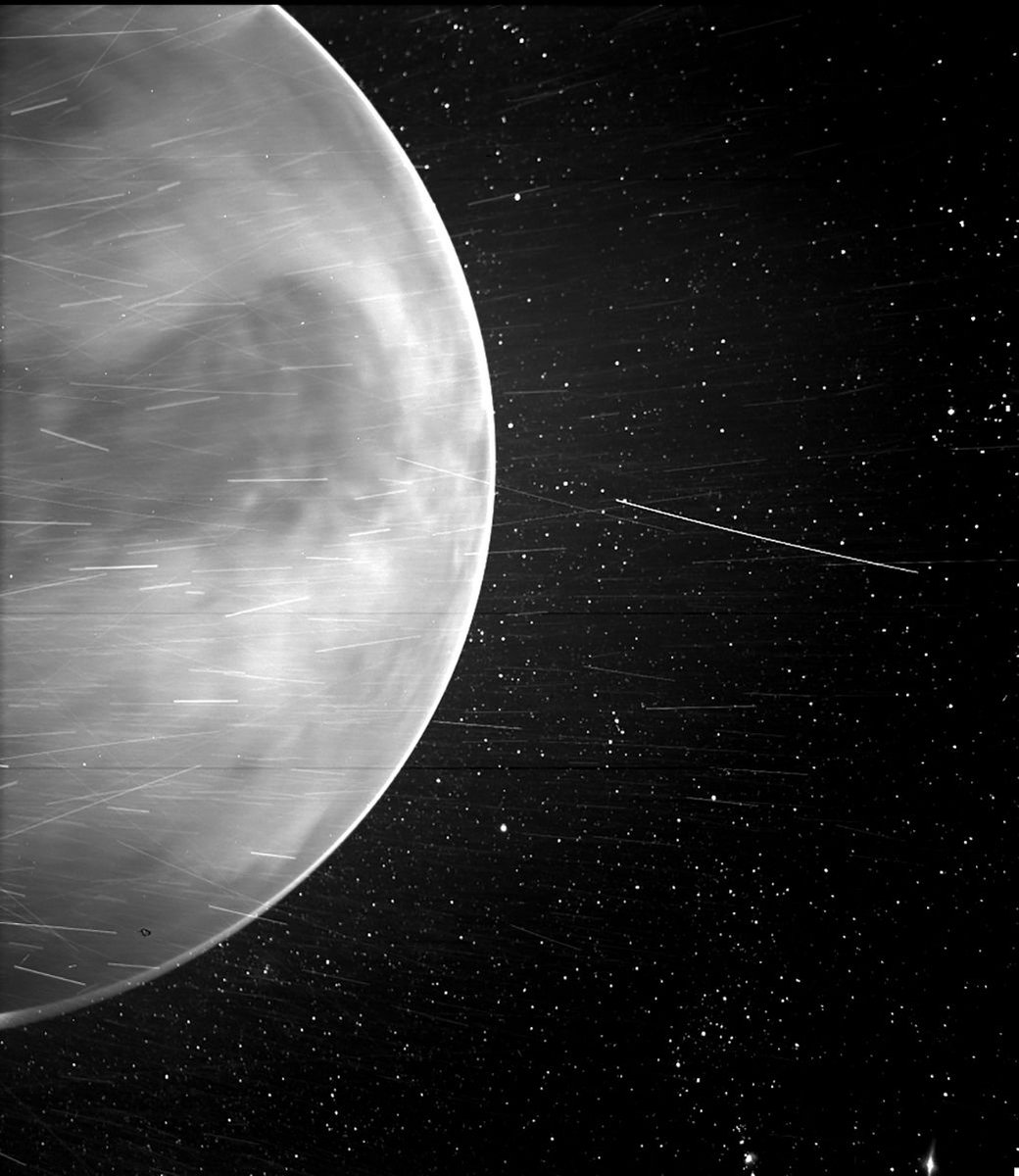
The Parker Solar Probe has been getting in a lot of extracurricular activity lately. Originally designed to observe the Sun, the probe has been taking full advantage of its path through the solar system. In addition to snapping pictures of comets, the probe has repeatedly focused on Venus, including capturing an image peering underneath the cloud cover of the notoriously hot world. Now a team led by Glyn Collinson of Goddard Space Flight Center found another serendipitous discovery in the data Parker collected during its latest flyby in the summer of 2020 – the probe actually flew through Venus’ upper atmosphere, and that atmosphere appeared different than it was almost 30 years ago.
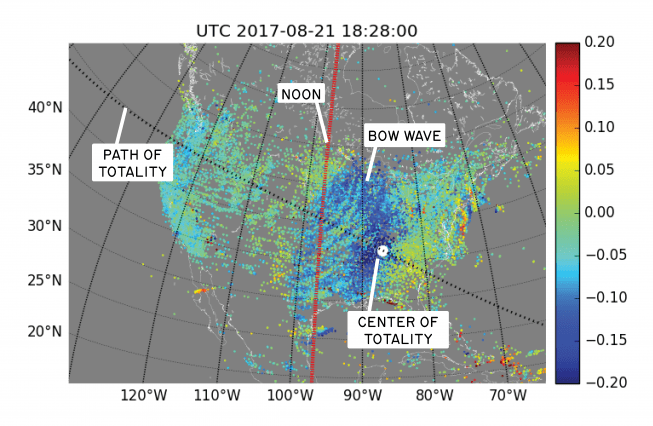
This graphic shows atmospheric bow waves forming during the August 2017 eclipse over the continental United States. Image: Shunrong Zhang/Haystack Observatory
It’s long been predicted that a solar eclipse would cause a bow wave in Earth’s ionosphere. The August 2017 eclipse—called the “Great American Eclipse” because it crossed the continental US— gave scientists a chance to test that prediction. Scientists at MIT’s Haystack Observatory used more than 2,000 GNSS (Global Navigation Satellite System) receivers across the continental US to observe this type of bow wave for the first time.
The Great American Eclipse took 90 minutes to cross the US, with totality lasting only a few minutes at any location. As the Moon’s shadow moved across the US at supersonic speeds, it created a rapid temperature drop. After moving on, the temperature rose again. This rapid heating and cooling is what caused the ionospheric bow wave.
The bow wave itself is made up of fluctuations in the electron content of the ionosphere. The GNSS receivers collect very accurate data on the TEC (Total Electron Content) of the ionosphere. This animation shows the bow wave of electron content moving across the US.
The details of this bow wave were published in a paper by Shun-Rong Zhang and colleagues at MIT’s Haystack Observatory, and colleagues at the University of Tromso in Norway. In their paper, they explain it like this: “The eclipse shadow has a supersonic motion which [generates] atmospheric bow waves, similar to a fast-moving river boat, with waves starting in the lower atmosphere and propagating into the ionosphere. Eclipse passage generated clear ionospheric bow waves in electron content disturbances emanating from totality primarily over central/eastern United States. Study of wave characteristics reveals complex interconnections between the sun, moon, and Earth’s neutral atmosphere and ionosphere.”
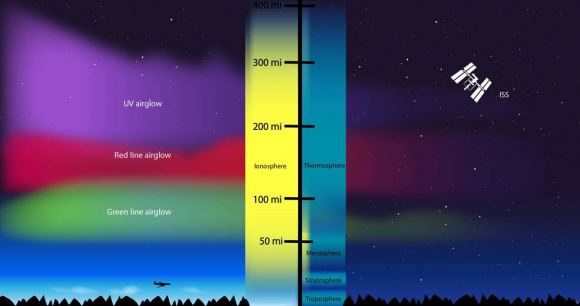
The ionosphere stretches from about 50 km to 1000 km in altitude during the day. It swells as radiation from the Sun reaches Earth, and subsides at night. Its size is always fluctuating during the day. It’s called the ionosphere because it’s the region where charged particles created by solar radiation reside. The ionosphere is also where auroras occur. But more importantly, it’s where radio waves propagate.
The ionosphere surrounds the Earth, extending from about 80 km to 650 km. Image Credit: NASA’s Goddard Space Flight Center/Duberstein
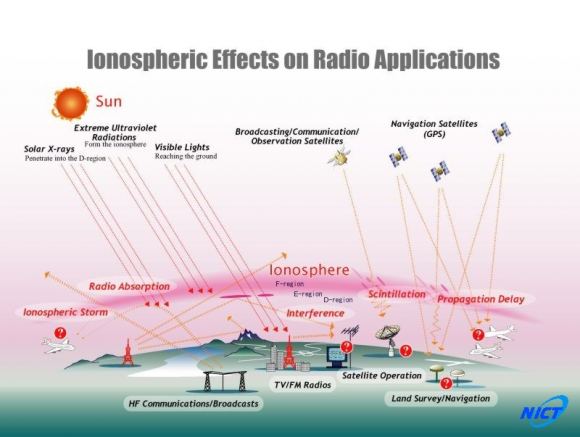
The ionosphere plays an important role in the modern world. It allows radio waves to travel over the horizon, and also affects satellite communications. This image shows some of the complex ways our communications systems interact with the ionosphere.
This graphic shows some of the effects that the ionosphere has on communications. Image: National Institute of Information and Communications Technology
There’s a lot going on in the ionosphere. There are different types of waves and disturbances besides the bow wave. A better understanding of the ionosphere is important in our modern world, and the August eclipse gave scientists a chance not only to observe the bow wave, but also to study the ionosphere in greater detail.
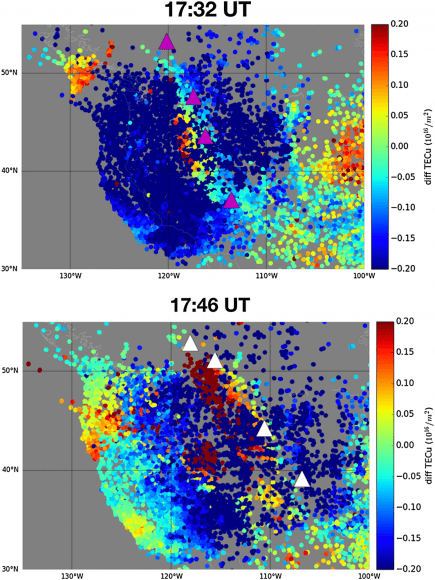
The GNSS data used to observe the bow wave was key in another study as well. This one was also published in the journal Geophysical Research Letters, and was led by Anthea Coster of the Haystack Observatory. The data from the network of GNSS was used to detect the Total Electron Content (TEC) and the differential TEC. They then analyzed that data for a couple things during the passage of the eclipse: the latitudinal and longitudinal response of the TEC, and the presence of any Travelling Ionospheric Disturbances (TID) to the TEC.
Predictions showed a 35% reduction in TEC, but the team was surprised to find a reduction of up to 60%. They were also surprised to find structures of increased TEC over the Rocky Mountains, though that was never predicted. These structures are probably linked to atmospheric waves created in the lower atmosphere by the Rocky Mountains during the solar eclipse, but their exact nature needs to be investigated.
This image of GNSS data shows the positive Travelling Ionospheric Disturbance (TID) structure in the center of the primary TEC depleted region. The triangles mark cities in or near the Rocky Mountains. Image: Coster et. al.
“… a giant active celestial experiment provided by the sun and moon.” – Phil Erickson, assistant director at Haystack Observatory.
“Since the first days of radio communications more than 100 years ago, eclipses have been known to have large and sometimes unanticipated effects on the ionized part of Earth’s atmosphere and the signals that pass through it,” says Phil Erickson, assistant director at Haystack and lead for the atmospheric and geospace sciences group. “These new results from Haystack-led studies are an excellent example of how much still remains to be learned about our atmosphere and its complex interactions through observing one of nature’s most spectacular sights — a giant active celestial experiment provided by the sun and moon. The power of modern observing methods, including radio remote sensors distributed widely across the United States, was key to revealing these new and fascinating features.”
The Great American Eclipse has come and gone, but the detailed data gathered during that 90 minute “celestial experiment” will be examined by scientists for some time.
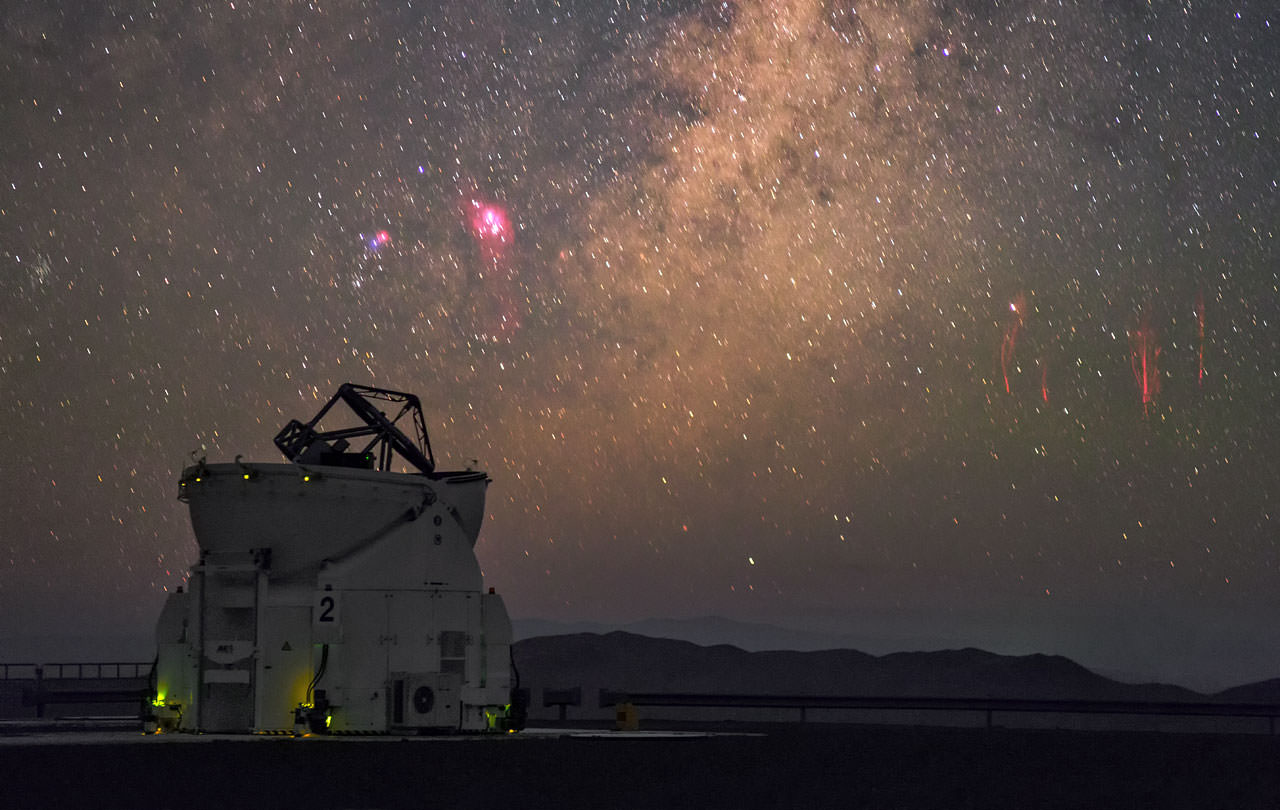
Distant sprites (right) captured from ESO's VLT by Photo Ambassador Petr Horálek. (P. Horálek/ESO)
At the ESO’s observatories located high in the Atacama Desert of Chile, amazing images of distant objects in the Universe are captured on a regular basis. But in January 2015, ESO photo ambassador Petr Horálek captured some amazing photos of much closer phenomena: red sprites flashing in the atmosphere high above distant thunderstorms.
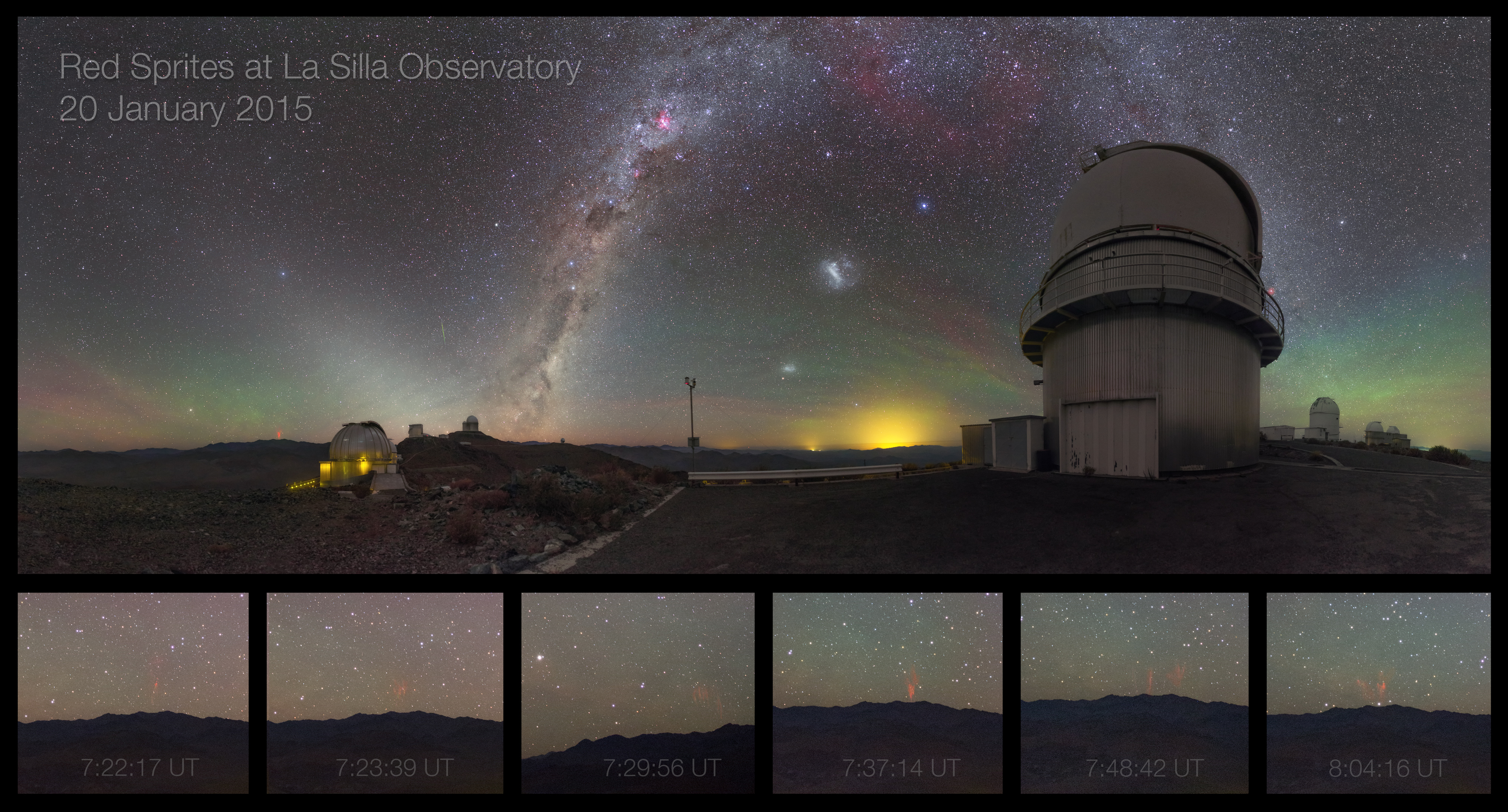
The photo above was captured from ESO’s Paranal Observatory. A few days earlier during the early morning hours of Jan. 20 Petr captured another series of sprites from the La Silla site, generated by a storm over Argentina over 310 miles (500 km) away.
Sprites spotted from ESO’s La Silla observatory by Petr Horálek (left horizon)
So-named because of their elusive nature, sprites appear as clusters of red tendrils above a lighting flash, often extending as high as 55 miles (90 km) into the atmosphere. The brightest region of a sprite is typically seen at altitudes of over 40-45 miles (65-75 km).
Because they occur high above large storms, only last for fractions of a second and emit light in the portion of the spectrum to which our eyes are the least sensitive, observing sprites is notoriously difficult.
These furtive atmospheric features weren’t captured on camera until 1989. Continuing research has since resulted in more images, including some from the International Space Station. When they are spotted, sprites – and their lower-altitude relatives blue jets – can appear as bright as moderate aurorae and have also been found to emit radio noise. It has even been suggested that looking for sprite activity on other planets could help identify alien environments that are conducive to life.
Find out more about sprite research from the University of Alaska Fairbanks, and check out the PBS NOVA program “At the Edge of Space” below about a sprite hunt in the skies over Denver, CO conducted by a team of American scientists and Japanese filmmakers.
From the ground, aurora have mystified humans since we began to question the world. The space age revealed more mystery - the Theta Auroral Oval (inset) and the challenge of understanding the phenomena. (Photo Credit: NASA/APOD)
The mystery of the northern lights – aurora – spans time beyond history and to cultures of both the southern and northern hemispheres. The mystery involves the lights, fantastic patterns and mystical changes. Ancient men and women stood huddled under them wondering what it meant. Was it messages from the gods, the spirits of loved ones, warnings or messages to comfort their souls?
Aurora reside literally at the edge of space. While we know the basics and even more, we are still learning. A new published work has just added to our understanding by explaining how one type of aurora – the Theta Aurora – is created from the interaction of the charged particles, electric and magnetic fields surrounding the Earth. Their conclusions required the coordination of simultaneous observations of two missions.
The Theta Auroral Oval as observed by the NASA IMAGE FUV camera on September 15, 2005 and anlayzed using Cluster data in the paper by Fear et al. (Credit: NASA/SWRI)
We were not aware of Thetas until the advent of the space age and our peering back at Earth. They cannot be recognized from the ground. The auroras that bystanders see from locales such as Norway or New Zealand are just arcs and subsets of the bigger picture which is the auroral ovals atop the polar regions of the Earth. Ground based all-sky cameras and polar orbiting probes had seen what were deemed “polar cap arcs.” However, it was a spacecraft Dynamics Explorer I (DE-1) that was the first to make global images of the auroral ovals and observed the first “transpolar arcs”, that is, the Theta aurora.
They are named Theta after the Greek letter that they resemble. Thetas are uncommon and do not persist long. Early on in the exploration of this phenomenon, researchers have been aware that they occur when the Sun’s magnetic field, called the Interplanetary Magnetic Field (IMF) turns northward. Most of the time the IMF in the vicinity of the Earth points south. It is a critical aspect of the Sun-Earth interaction. The southerly pointing field is able to dovetail readily with the normal direction of the Earth’s magnetic field. The northward IMF interacting with the Earth’s field is similar to two bar magnets turned head to head, repelling each other. When the IMF flips northward locally, a convolution takes place that will, at times, but not always, produce a Theta aurora.
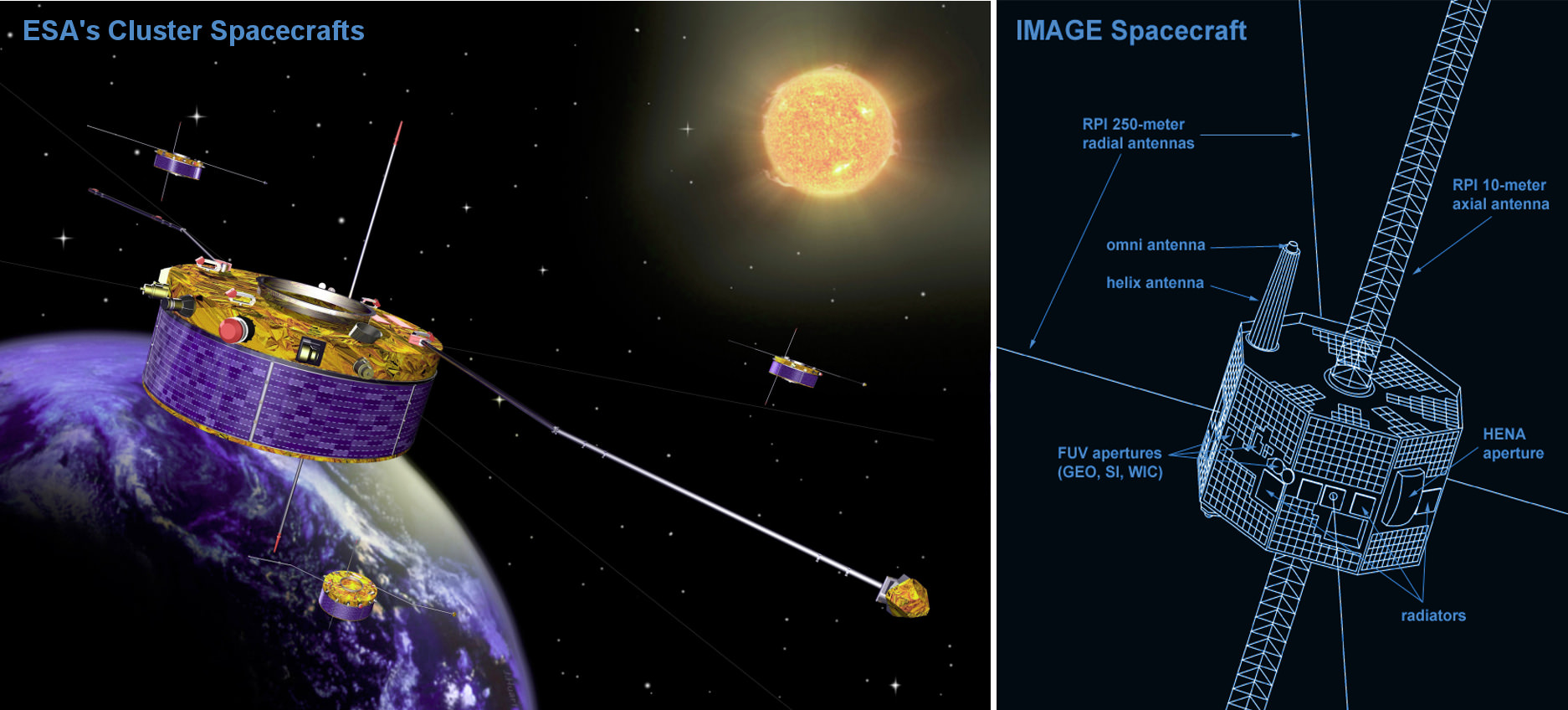
A group of researchers led by Dr. Robert Fear from the Department of Physics & Astronomy, University of Leicester, through analysis of simultaneous spacecraft observations, has identified how the particles and fields interact to produce Theta aurora. Their study, “Direct observation of closed magnetic flux trapped in the high-latitude magnetosphere” in the Journal Science (December 19, 2014, Vol 346) utilized a combination of data from ESA’s Cluster spacecraft mission and the IMAGE spacecraft of NASA. The specific event in the Earth’s magnetosphere on September 15, 2005 was observed simultaneously by the spacecraft of both missions.
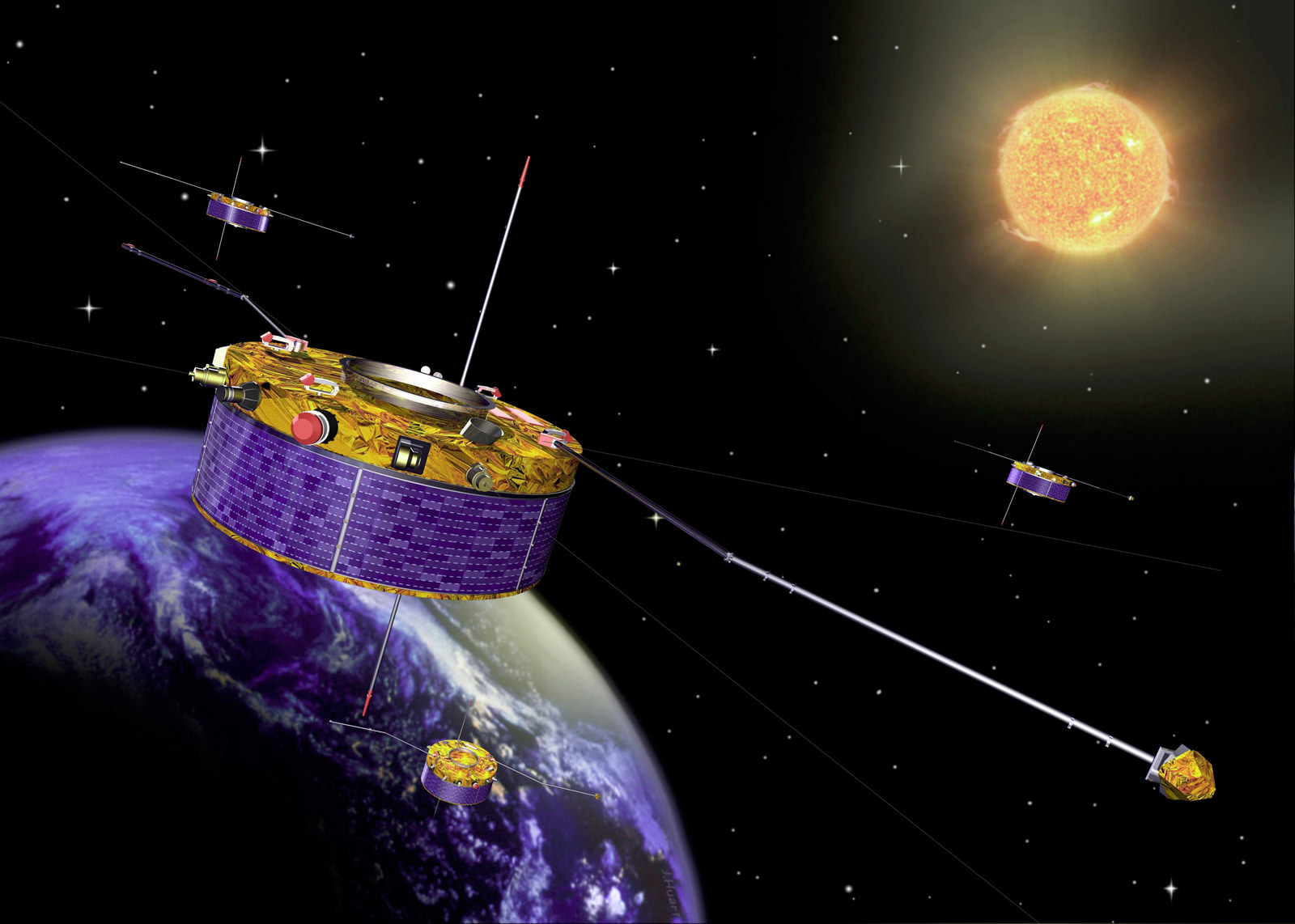
Illustrations of the Cluster II spacecraft in orbit and formation around the Earth and the NASA IMAGE spacecraft vehicle design. The two mission’s observations were combined to correlate numerous auroral and magnetospheric events. Cluster II remains in operation as of December 2014 (14 yr lifespan). (Credit: ESA, NASA)
Due to the complexity of the Sun-Earth relationship involving neutral and charged particles and electric and magnetic fields, space scientists have long attempted to make simultaneous measurements with multiple spacecraft. ISEE-1, 2 and 3 were one early attempt. Another was the Dynamics Explorer 1 & 2 spacecraft. DE-2 was in a low orbit while DE-1 was in an elongated orbit taking it deeper into the magnetosphere. At times, the pair would align on the same magnetic field lines. The field lines are like rails that guide the charged particles from far out in the magneto-tail to all the way down to the upper atmosphere – the ionosphere. Placing two or more spacecraft on the same field lines presented the means of making coordinated observations of the same event. Dr. Fear and colleagues analyzed data when ESA’s Cluster resided in the southern lobe of the magnetotail and NASA’s IMAGE (Imager for Magnetopause-to-Aurora Global Exploration) spacecraft resided above the south polar region of the Earth.
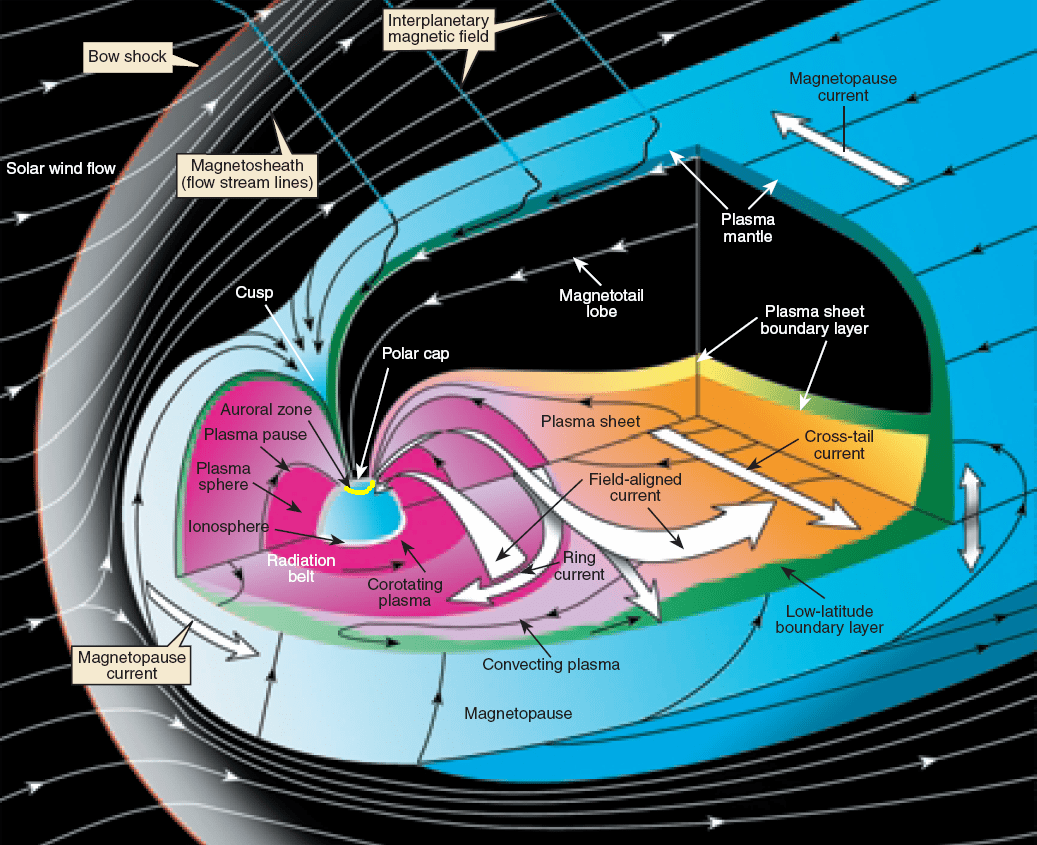
Cluster is a set of four spacecraft, still in operation after 14 years. Together with IMAGE, five craft were observing the event. Fear, et al utilized ESA spacecraft Cluster 1 (of four) and NASA’s IMAGE. On that fateful day, the IMF turned north. As described in Dr. Fear’s paper, on that day, the north and south lobes of the magnetosphere were closed. The magnetic field lines of the lobes were separated from the Solar wind and IMF due to what is called magnetic reconnection. The following diagram shows how complex Earth’s magnetosphere is; with regions such as the bow shock, magnetopause, cusps, magnetotail, particle belts and the lobes.
Illustration of the Earth’s magnetosphere showing it complexity. The Theta Aurora are now confidently linked to magnetic reconnection events in the lobes of the magnetotail. (Credit: NASA)
The science paper explains that what was previously observed by only lower altitude spacecraft was captured by Cluster within the magnetotail lobes. The southerly lobe’s plasma – ionized particles – was very energetic. The measurements revealed that the southern lobe of the magnetotail was acting as a bottle and the particles were bouncing between two magnetic mirrors, that is, the lobes were close due to reconnection. The particles were highly energetic.
The presence of what is called a double loss cone signature in the electron energy distribution was a clear indicator that the particles were trapped and oscillating between mirror points. The consequences for the Earth’s ionosphere was that highly energetic particles flooded down the field lines from the lobes and impacted the upper atmosphere transferring their energy and causing the magnificent light show that we know as the Northern Lights (or Southern) in the form of a Theta Auroral Oval. This strong evidence supports the theory that Theta aurora are produced by energized particles from within closed field lines and not by energetic particles directly from the Solar Wind that find a path into the magnetosphere and reach the upper atmosphere of the Earth.
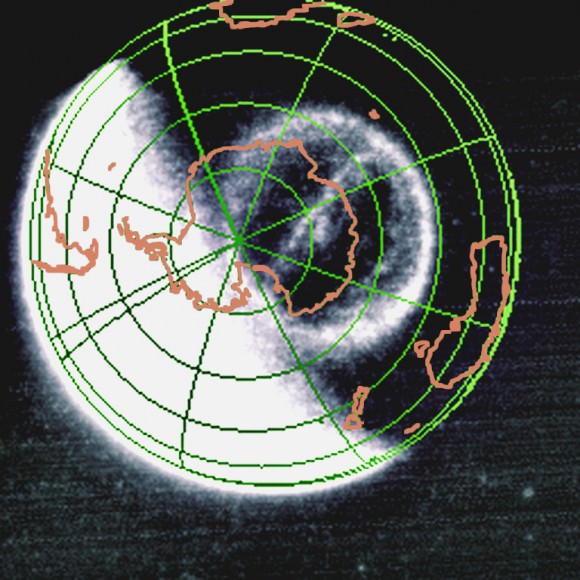
A video of an observed major geomagnetic storm (July 15, 2000, southward IMF) taken by the Far Ultraviolet Imaging System (FUV) on the spacecraft IMAGE. IMAGE operated from 2000 until December 2005 when communications were inexplicably lost. (Credit: NASA/SWRI) [click to view the animated gif]Without the coordination of the observations and the collective analysis, the Theta aurora phenomenon would continue to be debated. The analysis by Dr. Fear, while not definitive, is strong proof that Theta aurora are generated from particles trapped within closed field lines.
The analysis of the Cluster mission data as well as that of many other missions takes years. Years after observations are made researchers can achieve new understanding through study of arduous details or sometimes by a ha-ha moment. Aurora represent the signature of the interaction of two magnetic fields and two populations of particles – the Sun’s field and energetic particles streaming at millions of miles per hour from its surface reaching the Earth’s magnetic field. The Earth’s field is transformed by the interaction and receives energetic particles that it bottles up and energizes further. Ultimately, the Earth’s magnetic field directs some of these particles to the topside of our atmosphere. For thousands and likely tens of thousands of years, humans have questioned what it all means. Now another piece of the puzzle has been laid down with a good degree of certainty; one that explains the Theta aurora.
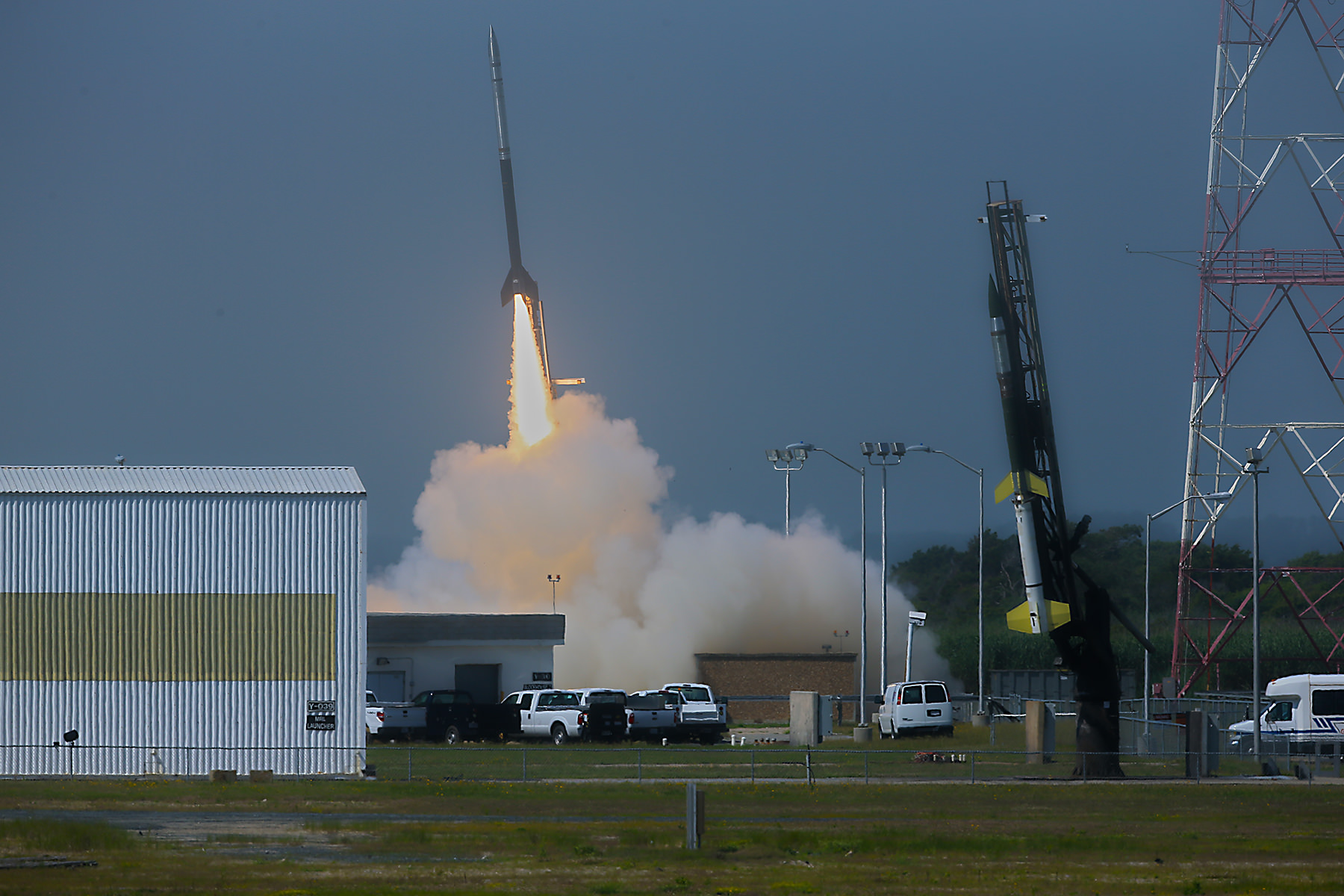
July 4 Morning Fireworks from NASA. A NASA Black Brant V Sounding Rocket launches in support of the Daytime Dynamo Mission on July 4, 2013 from NASA Wallops Flight Facility, VA, Credit NASA/J. Eggers
July 4 Morning Fireworks from NASA!
A NASA Black Brant V Sounding Rocket launches in support of the Daytime Dynamo Mission on July 4, 2013 from NASA Wallops Flight Facility, VA. Credit: NASA/J. Eggers[/caption]
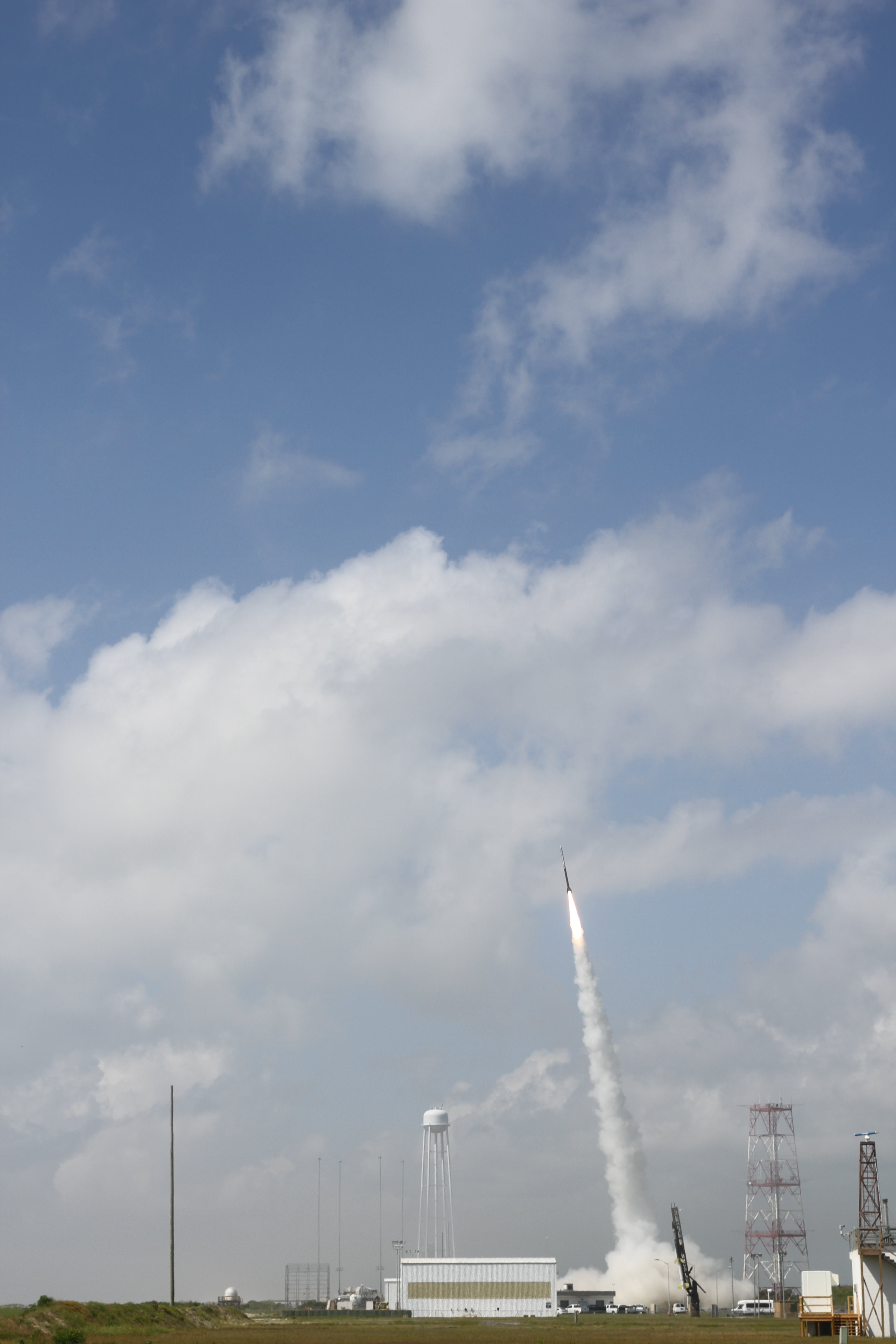
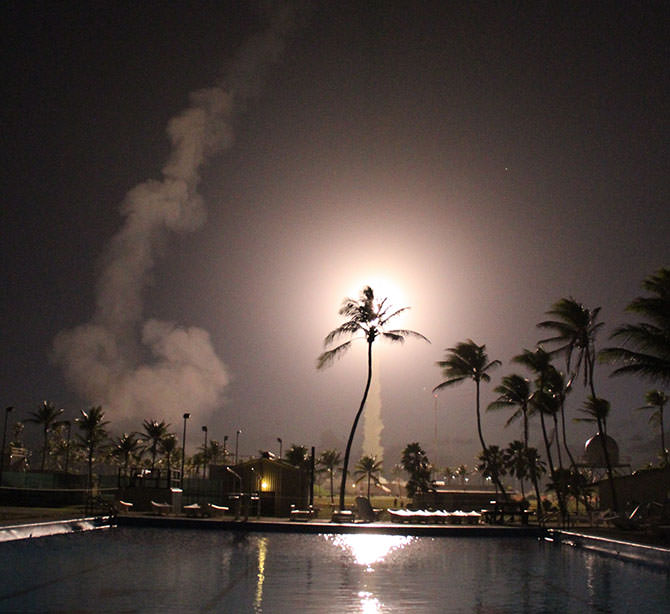
WALLOPS ISLAND, VA – Today, July 4, NASA celebrated America’s Independence Day with a spectacular fireworks display of a dynamic duo of sounding rockets – blasting off barely 15 seconds apart this morning from the agencies NASA Wallops Island facility on the Eastern Shore of Virginia on a science experiment to study the ionosphere.
The goal of the two rocket salvo was an in depth investigation of the electrical currents in Earth’s ionosphere – called the Daytime Dynamo.
The Dynamo electrical current sweeps through the ionosphere, a layer of charged particles that extends from about 30 to 600 miles above Earth.
Disruptions in the ionosphere can scramble radio wave signals for critical communications and navigations transmissions that can impact our every day lives.
The launches suffered multiple delays over the past 2 weeks due to weather, winds, errant boats and unacceptable science conditions in the upper atmosphere.
A Black Brant V launches first in support of Daytime Dynamo. Terroer improved Orion (at right) followed 15 seconds later from NASA Wallops on July 4, 2013. Credit: NASA/P. Black
At last, the Fourth of July was the irresistible charm.
The liftoff times were 10:31:25 a.m. for the Black Brant V and 10:31:40 a.m. (EDT) for the Terrier-Improved Orion.
The experiment involved launching two suborbital rockets and also dispatching a NASA King Air airplane to collect a stream of airborne science measurements.
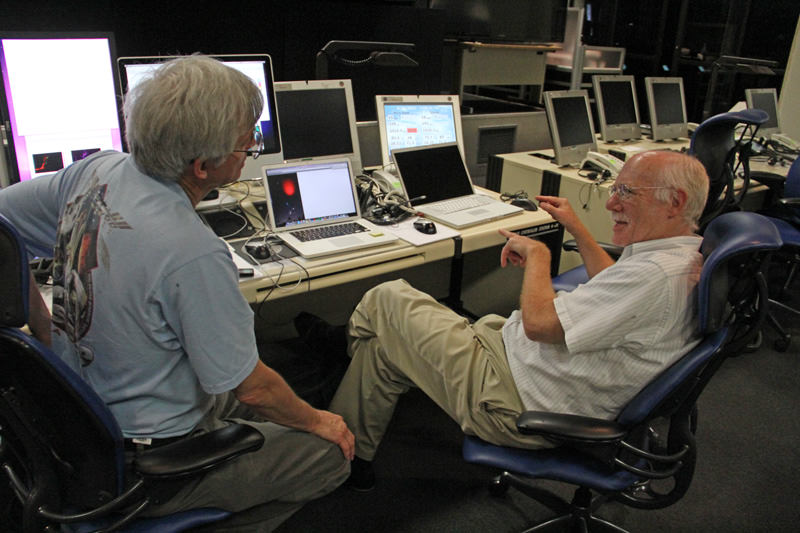
Daytime Dynamo is a joint project between NASA and the Japanese Space Agency, or Japan Aerospace Exploration Agency, or JAXA, said Robert Pfaff to Universe Today in an exclusive interview inside Mission Control at Wallops. Pfaff is the principle investigator for the Dynamo sounding rocket at NASA’s Goddard Space Flight Center in Greenbelt, Md.
“The dynamo changes during the day and varies with the season,” Pfaff told me.
But they only have one chance to launch. So the science team has to pick the best time to meet the science objectives.
“We would launch every month if we could and had the funding, in order to even more fully characterize the Dynamo.”
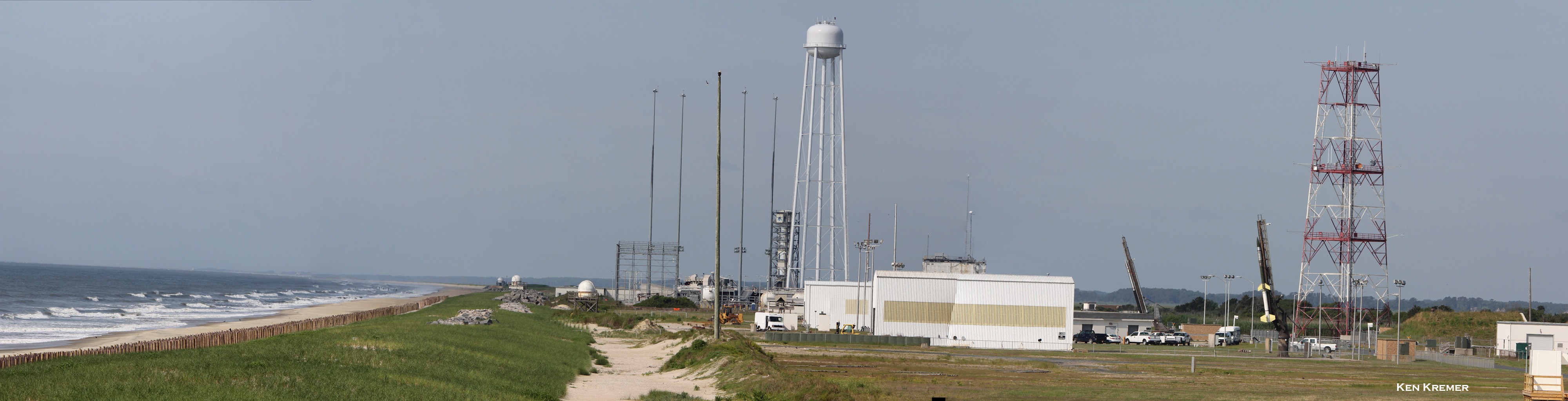
Two rocket salvo comprising a Black Brant V (left) and a Terrier-Improved Orion (right) sit ready to launch as part of the Daytime Dynamo mission in this panoramic view from NASA Wallops Flight Facility at Virginia’s Eastern Shore. Credit: Ken Kremer/kenkremer.com
The 35 foot tall single-stage Black Brant V launched first. It carried a 600 pound payload to collect the baseline data to characterize the neutral and charged ionospheric particles as it blasted skyward.
The 33 foot tall two-stage Terrier-Improved Orion took off just 15 seconds later in the wake of the exhaust of the Black Brant V.
Exhaust trails from Black Brant V and a Terrier-Improved Orion launched in support of Daytime Dynamo mission on July 4, 2013. Credit: NASA/P. Black
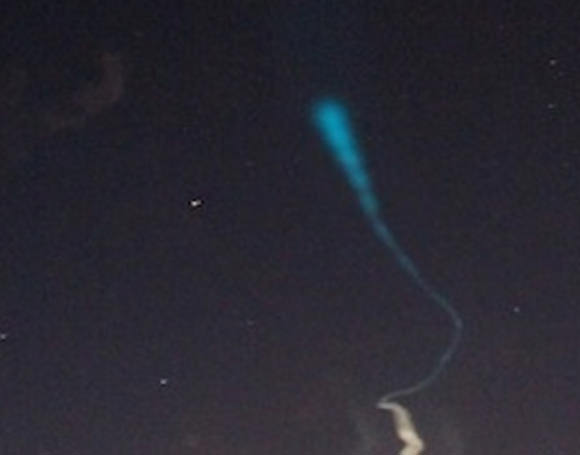
The Terrier-Improved Orion successfully deployed a lengthy trail of lithium gas from a pressurized canister that created a chemical tracer to track how the upper atmospheric winds vary with altitude. These winds are believed to be the drivers of the dynamo currents.
Both rockets fly for about five minutes to an altitude of some 100 miles up in the ionosphere. They both splashed down in the ocean after about 15 minutes.
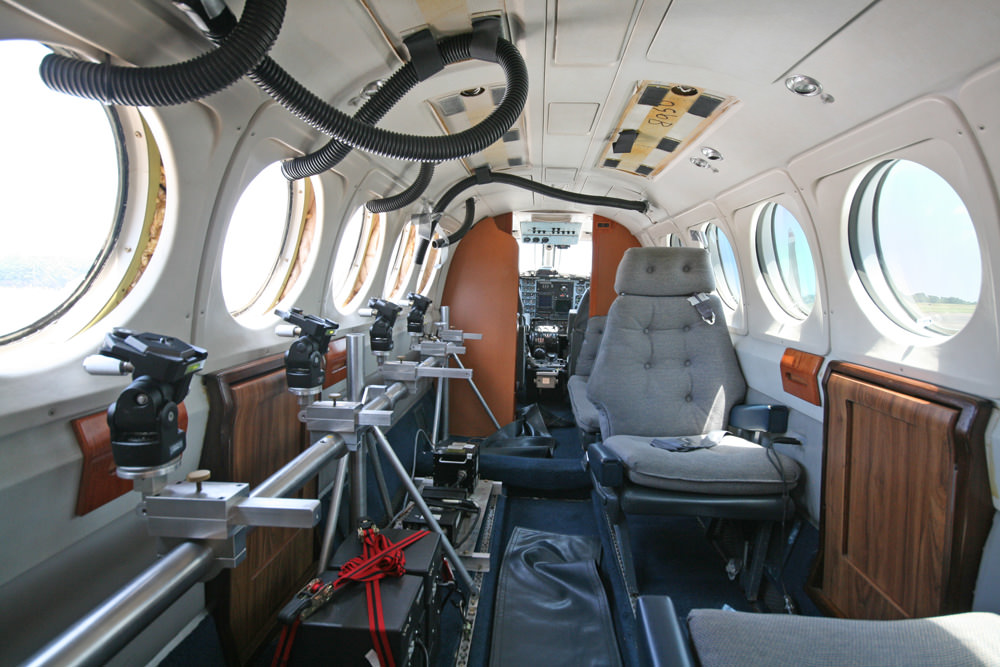
NASA’s King Air aircraft was essential to the mission. I toured the airplane on the Wallops runway for an up-close look inside. It is outfitted with a bank of precisely aimed analytical instruments peering through the aircraft windows to capture the critical science data – see my photos herein.
“The King Air launches about an hour before the scheduled liftoff time,” Pfaff told me.
“It uses special cameras and filters to collect visible and infrared spectroscopic data from the lithium tracer to characterize the daytime dynamo.”
The science instruments are newly developed technology to make the daytime measurements of the lithium tracer and were jointly created by NASA, JAXA and scientists at Clemson University.
“Everything worked as planned,” Pfaff announced from Wallops Mission Control soon after the magnificent Fourth of July fireworks show this morning.
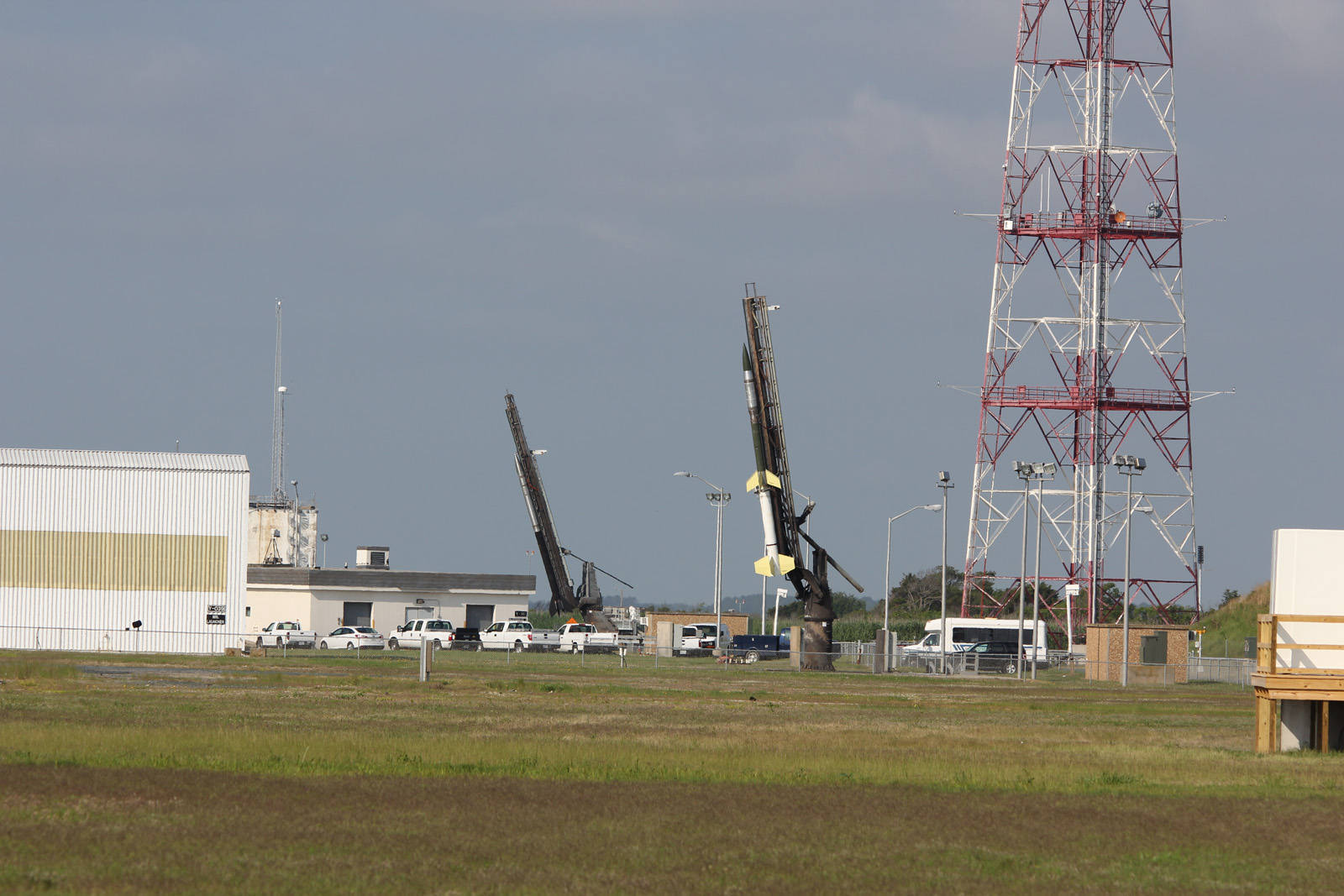
Black Brant V (left) and Terrier-Improved Orion (right) rockets sit on launch pads as part of the Daytime Dynamo mission in this up close view from NASA Wallops Flight Facility at Virginia’s Eastern Shore. Credit: Ken Kremer/kenkremer.com
Inside cabin view of NASA King Air aircraft outfitted with science instrument mounts to support a bank of cameras to capture visible and infrared spectroscopic measurements in support of Daytime Dynamic launches on July 4, 2013. Credit: Ken Kremer/kenkremer.com
Robert Pfaff (right), Science Principle Investigator and Ken Kremer of Universe Today (left) discuss NASA’s Daytime Dynamo mission inside NASA Wallop’s Mission Control. Credit: Ken Kremer/kenkremer.com
Glowing trails seen in the early morning sky over the Marshall Islands (NASA/Jon Grant)
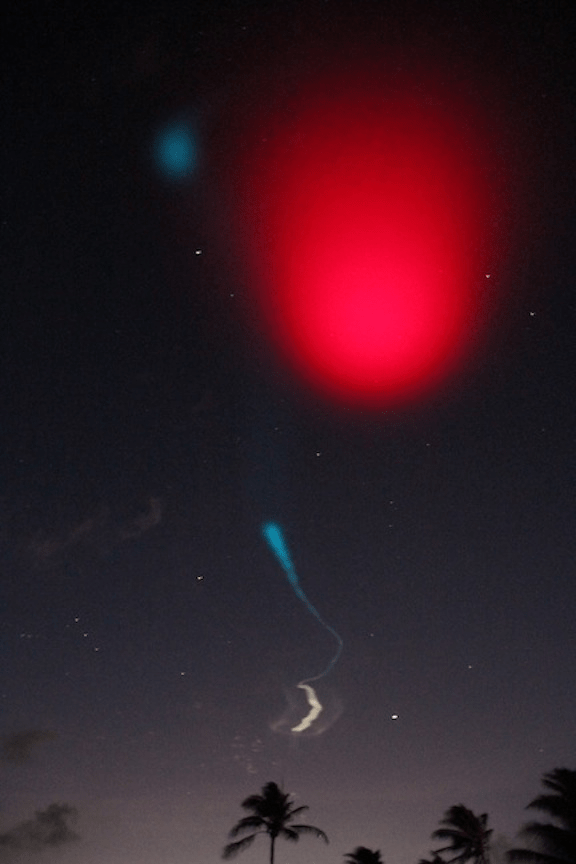
Ball lightning? Spectral orbs? Swamp gas? Early this morning, May 7, these eerie glowing trails were seen in the sky above the Marshall Islands and were captured on camera by NASA photographer John Grant. Of course, if NASA’s involved there has to be a reasonable explanation, right?
For a larger image (and to see what really caused the trails) click below:
Credit: NASA/John Grant
Although it might look like cheesy special effects, these colorful clouds are actually visible trails that were left by two sounding rockets launched from Roi Namur in the Marshall Islands, at 3:39 a.m. EDT on May 7. The rockets were part of the NASA-funded EVEX experiment to study winds and electrical activity in the upper atmosphere.
The red cloud was formed by the release of lithium vapor and the white-and-blue tracer clouds were formed by the release of trimethyl aluminum (TMA). These clouds allowed scientists on the ground from various locations in the Marshall Islands to observe neutral winds in the ionosphere.
“Neutral winds are one of the hardest things to study,” said Doug Rowland, an EVEX team member at NASA’s Goddard Space Flight Center in Greenbelt, Maryland. “One can’t physically see the wind, and it is difficult to measure from the ground, so we use the TMA as a tracer.”
Launch of the second EVEX rocket on the morning of May 7. The plume from the first is visible on the left. (NASA/John Grant)
The EVEX (Equatorial Vortex Experiment) rockets were launched 90 seconds apart. By staggering the launches the two rockets were able to gather data simultaneously at two altitudes through the ionosphere.
Beginning about 60 miles (96 km) up, the ionosphere is a crucial layer of charged particles surrounding our planet. This layer serves as the medium through which high frequency radio waves – such as those sent down to the ground by satellites – travel. Governed by Earth’s magnetic field, high-altitude winds, and incoming material and energy from the sun, the ionosphere can be calm at certain times of day and at other times turbulent, disrupting satellite signals.
The EVEX experiment is designed to measure events in two separate regions of the ionosphere to see how they work together to drive it from placid and smooth to violently disturbed. Such information could ultimately lead to the ability to accurately forecast this important aspect of space weather.
A rendering of the Cluster satellite, designed to measure electric fields, which Andre and Cully used to detect low-energy ions high above the Earth. (Credit: European Space Agency)
[/caption]
Thousands of miles above Earth, space weather rules. Here storms of high-energy particles mix the atmosphere, create auroras, challenge satellites and even cause disturbances with electric grids and electronic devices below. It’s a seemingly empty and lonely place – one where a mystery called “cold plasma” has been found in abundance and may well have implications with our connection to the Sun. While it has remained virtually hidden, Swedish researchers have created a new method to measure these cold, charged ions. With evidence of more there than once thought, these new findings may very well give us clues as to what’s happening around other planets and their natural satellites.
“The more you look for low-energy ions, the more you find,” said Mats Andre, a professor of space physics at the Swedish Institute of Space Physics in Uppsala, Sweden, and leader of the research team whose findings have been accepted for publication in Geophysical Research Letters, a journal of the American Geophysical Union. “We didn’t know how much was out there. It’s more than even I thought.”
Where does this enigma originate? The low-energy ions begin in the upper portion of our atmosphere called the ionosphere. Here solar energy can strip electrons from molecules, leaving atoms such as oxygen and hydrogen with a positive charge. However, physically finding these ions has been problematic. While researchers knew they existed at altitudes of about 100 kilometers (60 miles), Andre and colleague Chris Cully set their sites higher – at between 20,000 and 100,000 km (12,400 to 60,000 mi). At the edge, the amount of cold ions varies between 50 to 70%… making up most of the mass of space.
However, that’s not the only place cold plasma has been found. According to the research satellite data and calculations, certain high-altitude zones harbor low-energy ions continuously. As far fetched as it may sound, the team has also detected them at altitudes of 100,000 km! According to Andre, discovering so many relatively cool ions in these regions is surprising because there’s so much energy hitting the Earth’s high altitudes from the solar wind – a hot plasma about 1,000 times hotter than what Andre considers cold. Just how cold? “The low-energy ions have an energy that would correspond to about 500,000 degrees Celsius (about one million degrees Fahrenheit) at typical gas densities found on Earth. But because the density of the ions in space is so low, satellites and spacecraft can orbit without bursting into flames.”
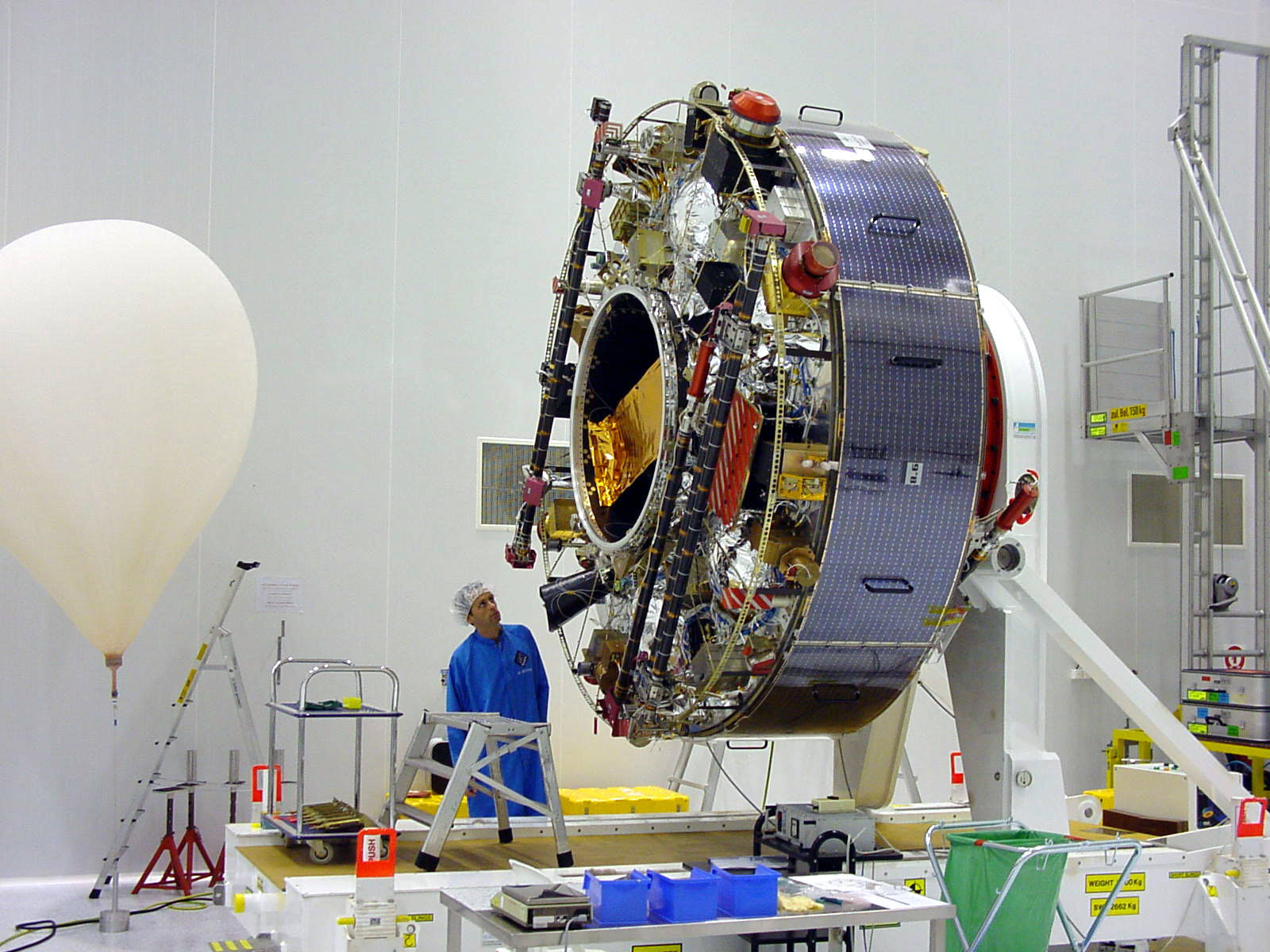
A scientist examines one of the European Space Agency's four Cluster satellites, used in a recent Geophysical Research Letters study to measure low-energy ions. (Credit: European Space Agency)
Pinpointing these low-energy ions and measuring how much material is leaving our atmosphere has been an elusive task. Andre’s workshop is a satellite and one of the four European Space Agency CLUSTER spacecraft. It houses a detector created from a fine wire that measures the electronic field between them during satellite rotation. However, when the data was collected, the researchers found a pair of mysteries – strong electric fields in unexpected areas of space and electric fields that didn’t fluctuate evenly.
“To a scientist, it looked pretty ugly,” Andre said. “We tried to figure out what was wrong with the instrument. Then we realized there’s nothing wrong with the instrument.” What they found opened their eyes. Cold plasma was changing the arrangement of the electrical fields surrounding the satellite. This made them realize they could utilize their field measurements to validate the presence of cold plasma. “It’s a clever way of turning the limitations of a spacecraft-based detector into assets,” said Thomas Moore, senior project scientist for NASA’s Magnetospheric Multiscale mission at the Goddard Space Flight Center in Greenbelt, Maryland. He was not involved in the new research.
Through these new techniques, science can measure and map Earth’s cold plasma envelope – and learn more about how both hot and cold plasma change during extreme space weather conditions. This research points towards a better understanding of atmospheres other than our own, too. Currently the new measurements show about a kilogram (two pounds) of cold plasma escapes from Earth’s atmosphere every second, By having a solid figure as a basis for rate of loss, scientists may be able model what became of Mars’ atmosphere – or explain the atmosphere around other planets and moons. It can also aid in more accurate space weather forecasting – even if it doesn’t directly influence the environment itself. It is a key player, even if it doesn’t cause the damage itself. “You may want to know where the low-pressure area is, to predict a storm,” Andre noted.
Modernizing space weather forecasting to where it is similar to ordinary weather forecasting, was “not even remotely possible if you’re missing most of your plasma,” Moore, with NASA, said. Now, with a way to measure cold plasma, the goal of high-quality forecasts is one step closer. “It is stuff we couldn’t see and couldn’t detect, and then suddenly we could measure it,” Moore said of the low-energy ions. “Now you can actually study it and see if it agrees with the theories.”
For his next big plan for the private space industry, Richard Branson is thinking up new ways to excite affluent space tourists: flying them into the biggest lightshow on Earth, the Aurora Borealis. Although the New Mexico Virgin Galactic Spaceport isn’t scheduled for completion until 2010, the British entrepreneur is already planning his next project intended for cruises into the spectacular space phenomenon from an Arctic launchpad.
Located in the far north of Sweden (in the Lapland province), the small town of Kiruna has a long history of space observation and rocket launches. The Arctic location provides the town with unrivalled views of the Aurora Borealis as it erupts overhead. The Auroral lightshow is generated by atmospheric reactions to impacting solar wind particles as they channel along the Earth’s magnetic field and down into the thickening atmospheric gases.
Once a view exclusive only to sounding rockets, this awe inspiring sight may in the future be seen from the inside, and above, by fee-paying space tourists as they are launched into space from a new spaceport, on the site of an existing base called Esrange. Although launching humans into an active aurora holds little scientific interest (if it did, it would have probably been done by now), it does pose some prudent health and safety questions. As Dr Olle Norberg, Esrange’s director, confidently states: “Is there a build-up of charge on the spacecraft? What is the radiation dose that you would receive? Those studies came out saying it is safe to do this.” Phew, that’s a relief.
The chance to actually be inside this magnificent display of light will be an incredible selling point for Virgin Galactic and their SpaceShipTwo flights. As if going into space were not enough, you can see and fly through the atmosphere at it’s most magnificent too.



![A video of an observed major geomagnetic storm (July 15, 2000) taken by the Far Ultraviolet Imaging System (FUV) on IMAGE. IMAGE operated from 2000 to December 2005 when communications were lost. (Credit: NASA/SWRI) [click to view the animated gif]](https://www.universetoday.com/wp-content/uploads/2014/12/IMAGE_Aurora-200007151.gif)