

Look up in the night sky. On a clear night, if you’re lucky, you’ll catch a glimpse of the Moon shining in all it’s glory. As Earth‘s only satellite, the Moon has orbited our planet for over three and a half billion years. There has never been a time when human beings haven’t been able to look up at the sky and see the Moon looking back at them.
As a result, it has played a vital role in the mythological and astrological traditions of every human culture. A number of cultures saw it as a deity while others believed that its movements could help them to predict omens. But it is only in modern times that the true nature and origins of the Moon, not to mention the influence it has on planet Earth, have come to be understood.
Size, Mass and Orbit:
With a mean radius of 1737 km and a mass of 7.3477 x 10²² kg, the Moon is 0.273 times the size of Earth and 0.0123 as massive. Its size, relative to Earth, makes it quite large for a satellite – second only to Charon‘s size relative to Pluto. With a mean density of 3.3464 g/cm³, it is 0.606 times as dense as Earth, making it the second densest moon in our Solar System (after Io). Last, it has a surface gravity equivalent to 1.622 m/s2, which is 0.1654 times, or 17%, the Earth standard (g).
The Moon’s orbit has a minor eccentricity of 0.0549, and orbits our planet at a distance of between 356,400-370,400 km at perigee and 404,000-406,700 km at apogee. This gives it an average distance (semi-major axis) of 384,399 km, or 0.00257 AU. The Moon has an orbital period of 27.321582 days (27 d 7 h 43.1 min), and is tidally-locked with our planet, which means the same face is always pointed towards Earth.
Structure and Composition:
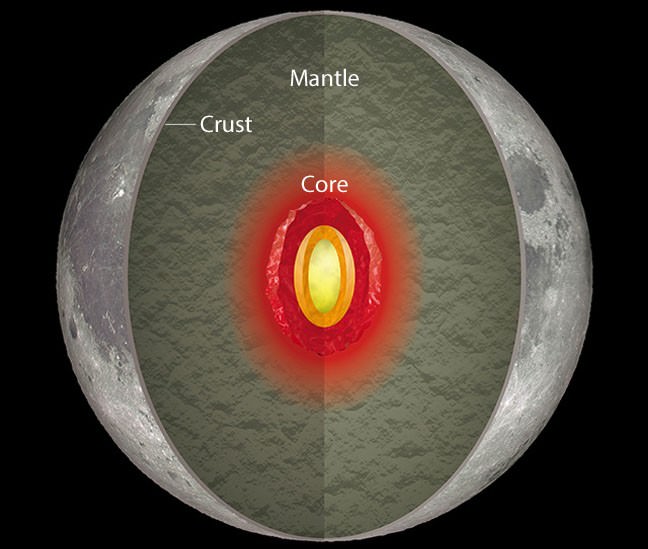
Much like Earth, the Moon has a differentiated structure that includes an inner core, an outer core, a mantle, and a crust. It’s core is a solid iron-rich sphere that measures 240 km (150 mi) across, and it surrounded by a outer core that is primarily made of liquid iron and which has a radius of roughly 300 km (190 mi).
Around the core is a partially molten boundary layer with a radius of about 500 km (310 mi). This structure is thought to have developed through the fractional crystallization of a global magma ocean shortly after the Moon’s formation 4.5 billion years ago. Crystallization of this magma ocean would have created a mantle rich in magnesium and iron nearer to the top, with minerals like olivine, clinopyroxene, and orthopyroxene sinking lower.
The mantle is also composed of igneous rock that is rich in magnesium and iron, and geochemical mapping has indicated that the mantle is more iron rich than Earth’s own mantle. The surrounding crust is estimated to be 50 km (31 mi) thick on average, and is also composed of igneous rock.
The Moon is the second densest satellite in the Solar System after Io. However, the inner core of the Moon is small, at around 20% of its total radius. Its composition is not well constrained, but it is probably a metallic iron alloy with a small amount of sulfur and nickel and analyses of the Moon’s time-variable rotation indicate that it is at least partly molten.
The presence of water has also been confirmed on the Moon, the majority of which is located at the poles in permanently-shadowed craters, and possibly also in reservoirs located beneath the lunar surface. The widely accepted theory is that most of the water was created through the Moon’s interaction of solar wind – where protons collided with oxygen in the lunar dust to create H²O – while the rest was deposited by cometary impacts.
Surface Features:
The geology of the Moon (aka. selenology) is quite different from that of Earth. Since the Moon lacks a significant atmosphere, it does not experience weather – hence there is no wind erosion. Similarly, since it lacks liquid water, there is also no erosion caused by flowing water on its surface. Because of its small size and lower gravity, the Moon cooled more rapidly after forming, and does not experience tectonic plate activity.
Instead, the complex geomorphology of the lunar surface is caused by a combination of processes, particularly impact cratering and volcanoes. Together, these forces have created a lunar landscape that is characterized by impact craters, their ejecta, volcanoes, lava flows, highlands, depressions, wrinkle ridges and grabens.
The most distinctive aspect of the Moon is the contrast between its bright and dark zones. The lighter surfaces are known as the “lunar highlands” while the darker plains are called maria (derived from the Latin mare, for “sea”). The highlands are made of igneous rock that is predominately composed of feldspar, but also contains trace amounts of magnesium, iron, pyroxene, ilmenite, magnetite, and olivine.
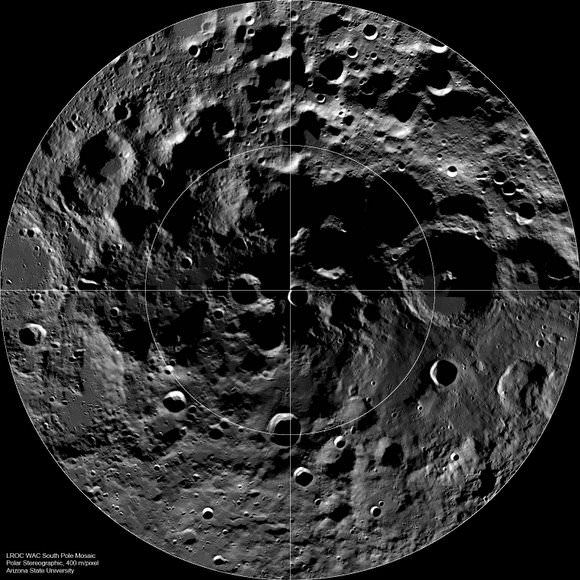
Mare regions, in contrast, are formed from basalt (i.e. volcanic) rock. The maria regions often coincide with the “lowlands,” but it is important to note that the lowlands (such as within the South Pole-Aitken basin) are not always covered by maria. The highlands are older than the visible maria, and hence are more heavily cratered.
Other features include rilles, which are long, narrow depressions that resemble channels. These generally fall into one of three categories: sinuous rilles, which follow meandering paths; arcuate rilles, which have a smooth curve; and linear rilles, which follow straight paths. These features are often the result of the formation of localized lava tubes that have since cooled and collapsed, and can be traced back to their source (old volcanic vents or lunar domes).
Lunar domes are another feature that is related to volcanic activity. When relatively viscous, possibly silica-rich lava erupts from local vents, it forms shield volcanoes that are referred to as lunar domes. These wide, rounded, circular features have gentle slopes, typically measure 8-12 km in diameter and rise to an elevation of a few hundred meters at their midpoint.
Wrinkle ridges are features created by compressive tectonic forces within the maria. These features represent buckling of the surface and form long ridges across parts of the maria. Grabens are tectonic features that form under extension stresses and which are structurally composed of two normal faults, with a down-dropped block between them. Most grabens are found within the lunar maria near the edges of large impact basins.
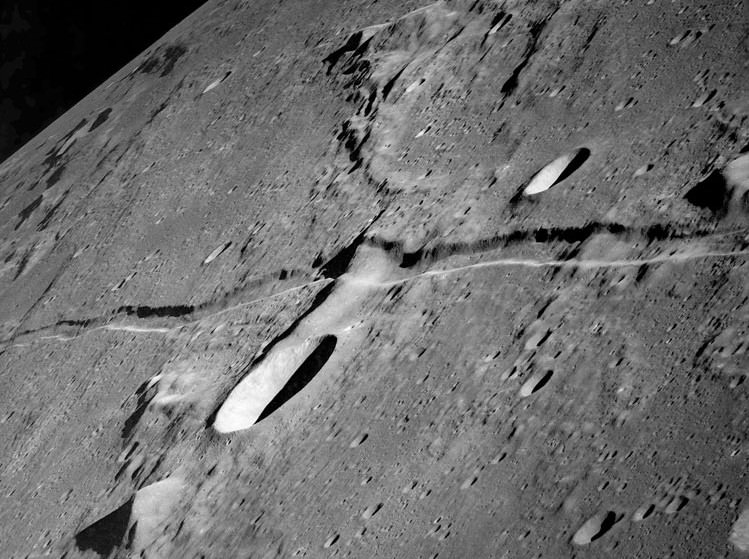
Impact craters are the Moon’s most common feature, and are created when a solid body (an asteroid or comet) collides with the surface at a high velocity. The kinetic energy of the impact creates a compression shock wave that creates a depression, followed by a rarefaction wave that propels most of the ejecta out of the crater, and then a rebounds to form a central peak.
These craters range in size from tiny pits to the immense South Pole–Aitken Basin, which has a diameter of nearly 2,500 km and a depth of 13 km. In general, the lunar history of impact cratering follows a trend of decreasing crater size with time. In particular, the largest impact basins were formed during the early periods, and these were successively overlaid by smaller craters.
There are estimated to be roughly 300,000 craters wider than 1 km (0.6 mi) on the Moon’s near side alone. Some of these are named for scholars, scientists, artists and explorers. The lack of an atmosphere, weather and recent geological processes mean that many of these craters are well-preserved.
Another feature of the lunar surface is the presence of regolith (aka. Moon dust, lunar soil). Created by billions of years of collisions by asteroids and comets, this fine grain of crystallized dust covers much of the lunar surface. The regolith contains rocks, fragments of minerals from the original bedrock, and glassy particles formed during the impacts.

The chemical composition of the regolith varies according to its location. Whereas the regolith in the highlands is rich in aluminum and silica, the regolith in the maria is rich in iron and magnesium and is silica-poor, as are the basaltic rocks from which it is formed.
Geological studies of the Moon are based on a combination of Earth-based telescope observations, measurements from orbiting spacecraft, lunar samples, and geophysical data. A few locations were sampled directly during the Apollo missions in the late 1960s and early 1970s, which returned approximately 380 kilograms (838 lb) of lunar rock and soil to Earth, as well as several missions of the Soviet Luna programme.
Atmosphere:
Much like Mercury, the Moon has a tenuous atmosphere (known as an exosphere), which results in severe temperature variations. These range from -153°C to 107°C on average, though temperatures as low as -249°C have been recorded. Measurements from NASA’s LADEE have mission determined the exosphere is mostly made up of helium, neon and argon.
The helium and neon are the result of solar wind while the argon comes from the natural, radioactive decay of potassium in the Moon’s interior. There is also evidence of frozen water existing in permanently shadowed craters, and potentially below the soil itself. The water may have been blown in by the solar wind or deposited by comets.
Formation:
Several theories have been proposed for the formation of the Moon. These include the fission of the Moon from the Earth’s crust through centrifugal force, the Moon being a preformed object that was captured by Earth’s gravity, and the Earth and Moon co-forming together in the primordial accretion disk. The estimated age of the Moon also ranges from it being formed 4.40-4.45 billion years ago to 4.527 ± 0.010 billion years ago, roughly 30–50 million years after the formation of the Solar System.
The prevailing hypothesis today is that the Earth-Moon system formed as a result of an impact between the newly-formed proto-Earth and a Mars-sized object (named Theia) roughly 4.5 billion years ago. This impact would have blasted material from both objects into orbit, where it eventually accreted to form the Moon.
This has become the most accepted hypothesis for several reasons. For one, such impacts were common in the early Solar System, and computer simulations modelling the impact are consistent with the measurements of the Earth-Moon system’s angular momentum, as well as the small size of the lunar core.
In addition, examinations of various meteorites show that other inner Solar System bodies (such as Mars and Vesta) have very different oxygen and tungsten isotopic compositions to Earth. In contrast, examinations of the lunar rocks brought back by the Apollo missions show that Earth and the Moon have nearly identical isotopic compositions.
This is the most compelling evidence suggesting that the Earth and the Moon have a common origin.
Relationship to Earth:
The Moon makes a complete orbit around Earth with respect to the fixed stars about once every 27.3 days (its sidereal period). However, because Earth is moving in its orbit around the Sun at the same time, it takes slightly longer for the Moon to show the same phase to Earth, which is about 29.5 days (its synodic period). The presence of the Moon in orbit influences conditions here on Earth in a number of ways.
The most immediate and obvious are the ways its gravity pulls on Earth – aka. it’s tidal effects. The result of this is an elevated sea level, which are commonly referred to as ocean tides. Because Earth spins about 27 times faster than the Moon moves around it, the bulges are dragged along with Earth’s surface faster than the Moon moves, rotating around Earth once a day as it spins on its axis.
The ocean tides are magnified by other effects, such as frictional coupling of water to Earth’s rotation through the ocean floors, the inertia of water’s movement, ocean basins that get shallower near land, and oscillations between different ocean basins. The gravitational attraction of the Sun on Earth’s oceans is almost half that of the Moon, and their gravitational interplay is responsible for spring and neap tides.
Gravitational coupling between the Moon and the bulge nearest the Moon acts as a torque on Earth’s rotation, draining angular momentum and rotational kinetic energy from Earth’s spin. In turn, angular momentum is added to the Moon’s orbit, accelerating it, which lifts the Moon into a higher orbit with a longer period.
As a result of this, the distance between Earth and Moon is increasing, and Earth’s spin is slowing down. Measurements from lunar ranging experiments with laser reflectors (which were left behind during the Apollo missions) have found that the Moon’s distance to Earth increases by 38 mm (1.5 in) per year.
This speeding and slowing of Earth and the Moon’s rotation will eventually result in a mutual tidal locking between the Earth and Moon, similar to what Pluto and Charon experience. However, such a scenario is likely to take billions of years, and the Sun is expected to have become a red giant and engulf Earth long before that.
The lunar surface also experiences tides of around 10 cm (4 in) amplitude over 27 days, with two components: a fixed one due to Earth (because they are in synchronous rotation) and a varying component from the Sun. The cumulative stress caused by these tidal forces produces moonquakes. Despite being less common and weaker than earthquakes, moonquakes can last longer (one hour) since there is no water to damp out the vibrations.
Another way the Moon effects life on Earth is through occultation (i.e. eclipses). These only happen when the Sun, the Moon, and Earth are in a straight line, and take one of two forms – a lunar eclipse and a solar eclipse. A lunar eclipse occurs when a full Moon passes behind Earth’s shadow (umbra) relative to the Sun, which causes it to darken and take on a reddish appearance (aka. a “Blood Moon” or “Sanguine Moon”.)
A solar eclipse occurs during a new Moon, when the Moon is between the Sun and Earth. Since they are the same apparent size in the sky, the moon can either partially block the Sun (annular eclipse) or fully block it (total eclipse). In the case of a total eclipse, the Moon completely covers the disc of the Sun and the solar corona becomes visible to the naked eye.
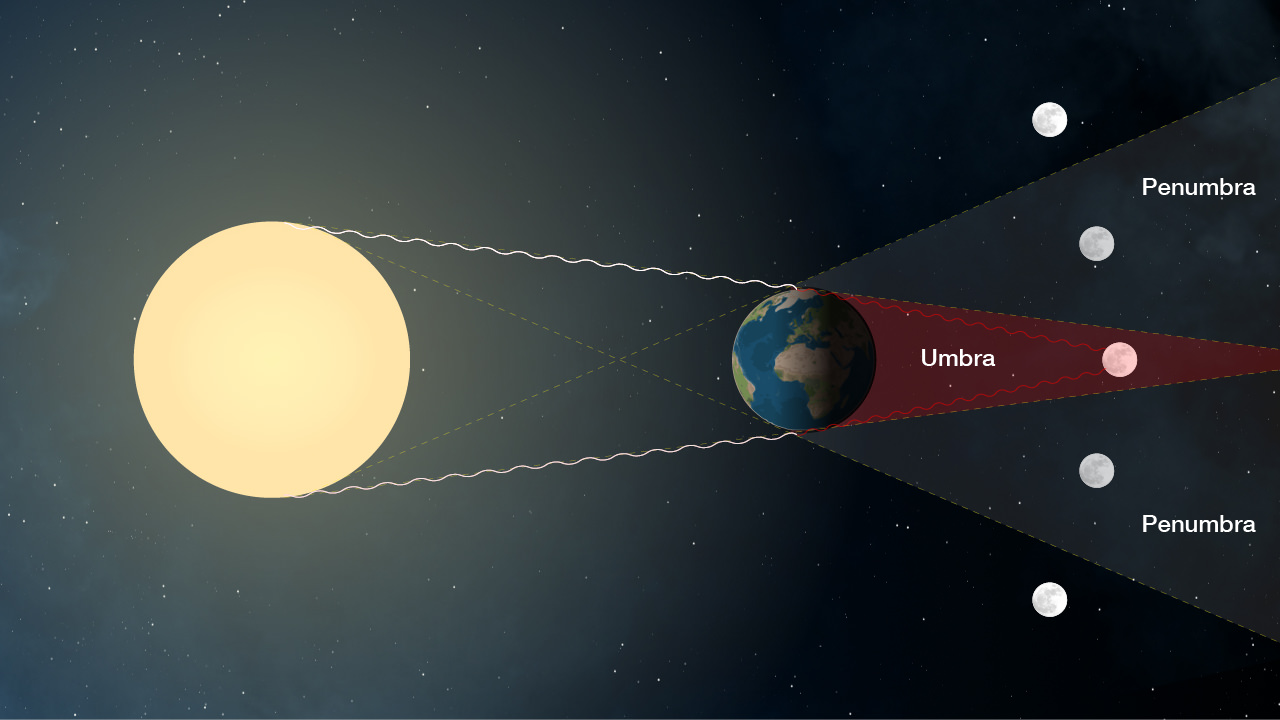
Because the Moon’s orbit around Earth is inclined by about 5° to the orbit of Earth around the Sun, eclipses do not occur at every full and new moon. For an eclipse to occur, the Moon must be near the intersection of the two orbital planes.The periodicity and recurrence of eclipses of the Sun by the Moon, and of the Moon by Earth, is described by the “Saros Cycle“, which is a period of approximately 18 years.
History of Observation:
Human beings have been observing the Moon since prehistoric times, and understanding the Moon’s cycles was one of the earliest developments in astronomy. The earliest examples of this comes from the 5th century BCE, when Babylonian astronomers had recorded the 18-year Satros cycle of lunar eclipses, and Indian astronomers had described the Moon’s monthly elongation.
The ancient Greek philosopher Anaxagoras (ca. 510 – 428 BCE) reasoned that the Sun and Moon were both giant spherical rocks, and the latter reflected the light of the former. In Aristotle’s “On the Heavens“, which he wrote in 350 BCE, the Moon was said to mark the boundary between the spheres of the mutable elements (earth, water, air and fire), and the heavenly stars – an influential philosophy that would dominate for centuries.
In the 2nd century BCE, Seleucus of Seleucia correctly theorized that tides were due to the attraction of the Moon, and that their height depends on the Moon’s position relative to the Sun. In the same century, Aristarchus computed the size and distance of the Moon from Earth, obtaining a value of about twenty times the radius of Earth for the distance. These figures were greatly improved by Ptolemy (90–168 BCE), who’s values of a mean distance of 59 times Earth’s radius and a diameter of 0.292 Earth diameters were close to the correct values (60 and 0.273 respectively).
By the 4th century BCE, the Chinese astronomer Shi Shen gave instructions for predicting solar and lunar eclipses. By the time of the Han Dynasty (206 BCE – 220 CE), astronomers recognized that moonlight was reflected from the Sun, and Jin Fang (78–37 BC) postulated that the Moon was spherical in shape.
In 499 CE, the Indian astronomer Aryabhata mentioned in his Aryabhatiya that reflected sunlight is the cause of the shining of the Moon. The astronomer and physicist Alhazen (965–1039) found that sunlight was not reflected from the Moon like a mirror, but that light was emitted from every part of the Moon in all directions.
Shen Kuo (1031–1095) of the Song dynasty created an allegory to explain the waxing and waning phases of the Moon. According to Shen, it was comparable to a round ball of reflective silver that, when doused with white powder and viewed from the side, would appear to be a crescent.
During the Middle Ages, before the invention of the telescope, the Moon was increasingly recognized as a sphere, though many believed that it was “perfectly smooth”. In keeping with medieval astronomy, which combined Aristotle’s theories of the universe with Christian dogma, this view would later be challenged as part of the Scientific Revolution (during the 16th and 17th century) where the Moon and other planets would come to be seen as being similar to Earth.
Using a telescope of his own design, Galileo Galilei drew one of the first telescopic drawings of the Moon in 1609, which he included in his book Sidereus Nuncius (“Starry Messenger). From his observations, he noted that the Moon was not smooth, but had mountains and craters. These observations, coupled with observations of moons orbiting Jupiter, helped him to advance the heliocentric model of the universe.
Telescopic mapping of the Moon followed, which led to the lunar features being mapped in detail and named. The names assigned by Italian astronomers Giovannia Battista Riccioli and Francesco Maria Grimaldi are still in use today. The lunar map and book on lunar features created by German astronomers Wilhelm Beer and Johann Heinrich Mädler between 1834 and 1837 were the first accurate trigonometric study of lunar features, and included the heights of more than a thousand mountains.
Lunar craters, first noted by Galileo, were thought to be volcanic until the 1870s, when English astronomer Richard Proctor proposed that they were formed by collisions. This view gained support throughout the remainder of the 19th century; and by the early 20th century, led to the development of lunar stratigraphy – part of the growing field of astrogeology.
Exploration:
With the beginning of the Space Age in the mid-20th century, the ability to physically explore the Moon became possible for the first time. And with the onset of the Cold War, both the Soviet and American space programs became locked in an ongoing effort to reach the Moon first. This initially consisted of sending probes on flybys and landers to the surface, and culminated with astronauts making manned missions.
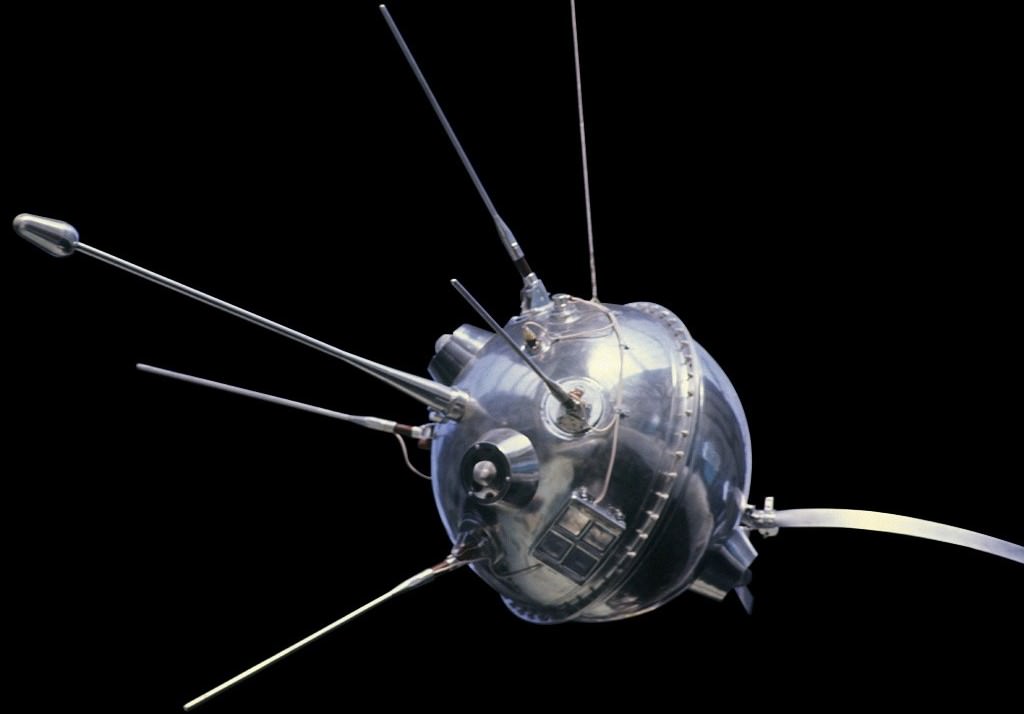
Exploration of the Moon began in earnest with the Soviet Luna program. Beginning in earnest in 1958, the programmed suffered the loss of three unmanned probes. But by 1959, the Soviets managed to successfully dispatch fifteen robotic spacecraft to the Moon and accomplished many firsts in space exploration. This included the first human-made objects to escape Earth’s gravity (Luna 1), the first human-made object to impact the lunar surface (Luna 2), and the first photographs of the far side of the Moon (Luna 3).
Between 1959 and 1979, the program also managed to make the first successful soft landing on the Moon (Luna 9), and the first unmanned vehicle to orbit the Moon (Luna 10) – both in 1966. Rock and soil samples were brought back to Earth by three Luna sample return missions – Luna 16 (1970), Luna 20 (1972), and Luna 24 (1976).
Two pioneering robotic rovers landed on the Moon – Luna 17 (1970) and Luna 21 (1973) – as a part of Soviet Lunokhod program. Running from 1969 to 1977, this program was primarily designed to provide support for the planned Soviet manned moon missions. But with the cancellation of the Soviet manned moon program, they were instead used as remote-controlled robots to photograph and explore the lunar surface.
NASA began launching probes to provide information and support for an eventual Moon landing in the early 60s. This took the form of the Ranger program, which ran from 1961 – 1965 and produced the first close-up pictures of the lunar landscape. It was followed by the Lunar Orbiter program which produced maps of the entire Moon between 1966-67, and the Surveyor program which sent robotic landers to the surface between 1966-68.
In 1969, astronaut Neil Armstrong made history by becoming the first person to walk on the Moon. As the commander of the American mission Apollo 11, he first sett foot on the Moon at 02:56 UTC on 21 July 1969. This represented the culmination of the Apollo program (1969-1972), which sought to send astronauts to the lunar surface to conduct research and be the first human beings to set foot on a celestial body other than Earth.
The Apollo 11 to 17 missions (save for Apollo 13, which aborted its planned lunar landing) sent a total of 13 astronauts to the lunar surface and returned 380.05 kilograms (837.87 lb) of lunar rock and soil. Scientific instrument packages were also installed on the lunar surface during all the Apollo landings. Long-lived instrument stations, including heat flow probes, seismometers, and magnetometers, were installed at the Apollo 12, 14, 15, 16, and 17 landing sites, some of which are still operational.
After the Moon Race was over, there was a lull in lunar missions. However, by the 1990s, many more countries became involve in space exploration. In 1990, Japan became the third country to place a spacecraft into lunar orbit with its Hiten spacecraft, an orbiter which released the smaller Hagoroma probe.
In 1994, the U.S. sent the joint Defense Department/NASA spacecraft Clementine to lunar orbit to obtain the first near-global topographic map of the Moon and the first global multispectral images of the lunar surface. This was followed in 1998 by the Lunar Prospector mission, whose instruments indicated the presence of excess hydrogen at the lunar poles, which is likely to have been caused by the presence of water ice in the upper few meters of the regolith within permanently shadowed craters.
Since the year 2000, exploration of the moon has intensified, with a growing number of parties becoming involved. The ESA’s SMART-1 spacecraft, the second ion-propelled spacecraft ever created, made the first detailed survey of chemical elements on the lunar surface while in orbit from November 15th, 2004, until its lunar impact on September 3rd, 2006.
China has pursued an ambitious program of lunar exploration under their Chang’e program. This began with Chang’e 1, which successfully obtained a full image map of the Moon during its sixteen month orbit (November 5th, 2007 – March 1st, 2009) of the Moon. This was followed in October of 2010 with the Chang’e 2 spacecraft, which mapped the Moon at a higher resolution before performing a flyby of asteroid 4179 Toutatis in December of 2012, then heading off into deep space.
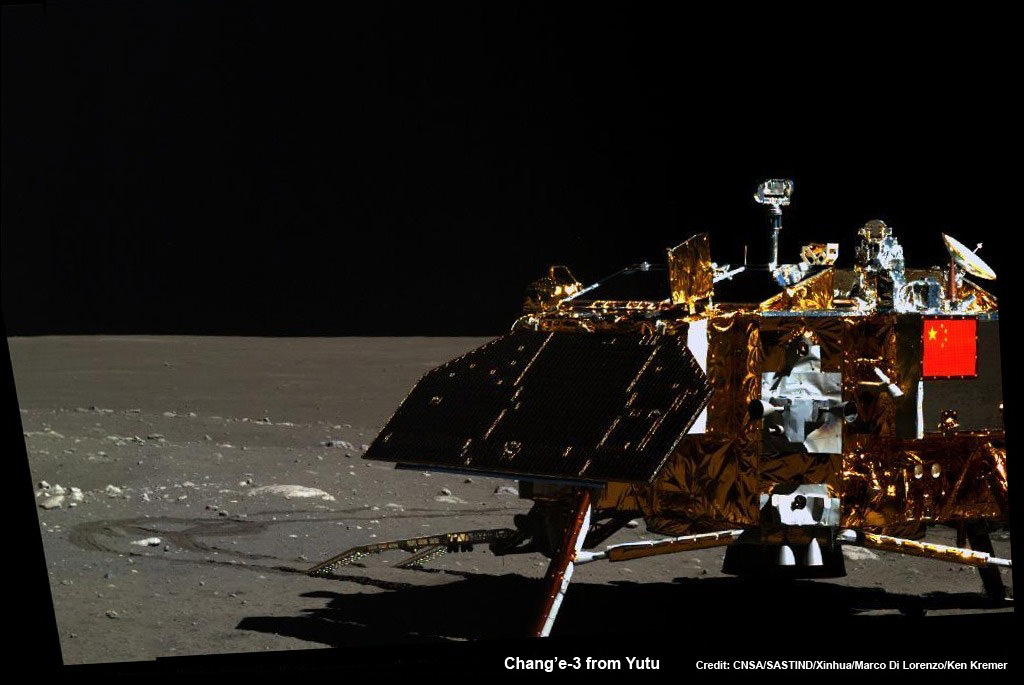
On 14 December 2013, Chang’e 3 improved upon its orbital mission predecessors by landing a lunar lander onto the Moon’s surface, which in turn deployed a lunar rover named Yutu (literally “Jade Rabbit”). In so doing, Chang’e 3 made the first soft lunar landing since Luna 24 in 1976, and the first lunar rover mission since Lunokhod 2 in 1973.
Between October 4th, 2007, and June 10th, 2009, the Japan Aerospace Exploration Agency‘s (JAXA) Kaguya (“Selene”) mission – a lunar orbiter fitted with a high-definition video camera and two small radio-transmitter satellites – obtained lunar geophysics data and took the first high-definition movies from beyond Earth orbit.
The Indian Space Research Organisation (ISRO) first lunar mission, Chandrayaan I, orbited the Moon between November 2008 and August 2009 and created a high resolution chemical, mineralogical and photo-geological map of the lunar surface, as well as confirming the presence of water molecules in lunar soil. A second mission was planned for 2013 in collaboration with Roscosmos, but was cancelled.
NASA has also been busy in the new millennium. In 2009, they co-launched the Lunar Reconnaissance Orbiter (LRO) and the Lunar CRater Observation and Sensing Satellite (LCROSS) impactor. LCROSS completed its mission by making a widely observed impact in the crater Cabeus on October 9th, 2009, while the LRO is currently obtaining precise lunar altimetry and high-resolution imagery.
Two NASA Gravity Recovery And Interior Library (GRAIL) spacecraft began orbiting the Moon in January 2012 as part of a mission to learn more about the Moon’s internal structure.
Upcoming lunar missions include Russia’s Luna-Glob – an unmanned lander with a set of seismometers, and an orbiter based on its failed Martian Fobos-Grunt mission. Privately funded lunar exploration has also been promoted by the Google Lunar X Prize, which was announced on September 13th, 2007, and offers US$20 million to anyone who can land a robotic rover on the Moon and meet other specified criteria.
Under the terms of the Outer Space Treaty, the Moon remains free to all nations to explore for peaceful purposes. As our efforts to explore space continue, plans to create a lunar base and possibly even a permanent settlement may become a reality. Looking to the distant future, it wouldn’t be far fetched at all to imagine native-born humans living on the Moon, perhaps known as Lunarians (though I imagine Lunies will be more popular!)
We have many interesting articles about the Moon here at Universe Today. Below is a list that covers just about everything we know about it today. We hope you find what you are looking for:
- A Red Moon – Not a Sign of the Apocalypse!
- Africa’s First Mission to the Moon Announced
- Age of the Moon
- Building a Moon Base: Part I – Challenges and Hazards
- Building a Moon Base: Part II – Habitat Concepts
- Building a Moon Base: Part III – Structural Designs
- Building a Moon Base: Part IV – Infrastructure and Transportation
- Could We Terraform the Moon?
- Diameter of the Moon
- Did We Need the Moon for Life?
- Does the Moon Rotate?
- Earth’s Second Moon Is About To Leave Us
- Edwin “Buzz” Aldrin – the Second Man on the Moon
- Golden Spike To Offer Commercial Human Missions To The Moon
- Gravity On The Moon
- How Can You See the Moon and the Sun at the Same Time?
- How Could We Destroy the Moon?
- How Do We Know the Moon Landing Isn’t Faked?
- How Did the Moon Form?
- How Long Does it Take to Get to the Moon?
- How Many People Have Walked on the Moon?
- How NASA Filmed Humans Leaving the Moon 42 Years Ago
- Is It Time to Return to the Moon?
- Is The Moon a Planet?
- Let’s Send Neil Back To The Moon
- Make a Deal For Land on the Moon
- Neil Armstrong; 1st Human on the Moon – Apollo 11, Tributes and Photo Gallery
- Neutral Hydrogen Bouncing off the Moon
- Old NASA Equipment Will Be Visible On The Moon
- Should We Go Back to Mars or the Moon?
- The Moon is Just 95 Million Years Younger Than The Solar System
- The Moon is Toxic?
- The Sun and the Moon
- There’s Poop On The Moon
- There Could be Lava Tubes on the Moon Large Enough For Whole Cities
- This is the Moon, the Whole Moon, and Nothing but the Moon
- Making the Moon: The Practice Crater Fields of Flagstaff, Arizona
- Neil Armstrong: The First Man To Walk On The Moon
- New Crater On The Moon
- Water On The Moon Was Blown In By Solar Wind
- What are the Phases of the Moon?
- What Is A Moon?
- What Color is the Moon?
- What Is The Gibbous Moon?
- What Is The Moon Made Of?
- What Is The Moon’s Real Name?
- What is the Distance to the Moon?
- What’s On The Far Side Of The Moon?
- Where We You When Apollo 11 Landed on the Moon?
- Who Were the First Men on the Moon?
- Why Does the “Man In the Moon” Face Earth?
- Why Does the Moon Look So Big Tonight?
- Why Does the Moon Shine?
- Why Doesn’t the Sun Steal the Moon?
- Why Is The Moon Leaving Us?
- Why There are no Lunar “Seas” on the Far Side of the Moon
- Yes, There’s Water on the Moon
- You Could Fit All the Planets Between the Earth and the Moon?
Awesome article! I’m really loving this series, you all! Thanks, Matt!
“Gravitational coupling between the Moon and the bulge nearest the Moon acts as a torque on Earth’s rotation, draining angular momentum and rotational kinetic energy from Earth’s spin. In turn, angular momentum is added to the Moon’s orbit, accelerating it, which lifts the Moon into a higher orbit with a longer period.”
This is a key orbital dynamics principle of which most people are blissfully unaware: going “faster” doesn’t actually make you go faster, it makes you go HIGHER. In practical terms, this means that if you’re in a spaceship trailing the ISS in the same orbit around earth (or are trying to get Cassini to catch up with a moon of Saturn, or whatever), you can’t just “hit the gas” because you’ll end up in a higher, slower orbit. Instead, you have to “hit the brakes” to get to a slightly lower, faster orbit in order to catch up. It is not at all an intuitive process, and while it can be learned and done without computer controlled systems, it is a cold, cast-iron bitch.
Great article, Matt.