
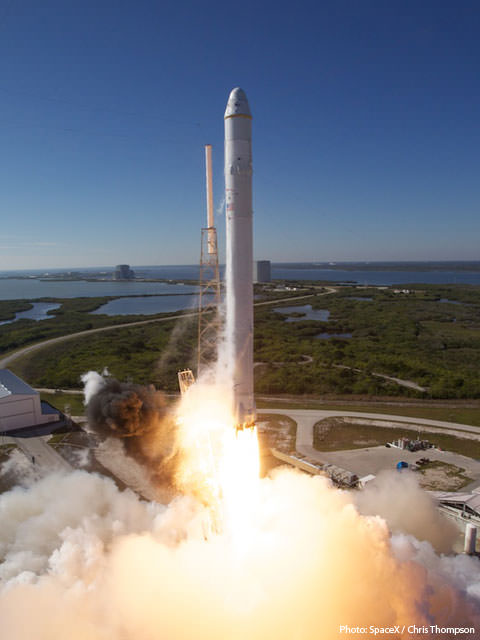
The United States has launched dozens of missions into space. Most people can only recall two with ease: Apollo 11 because it landed on the moon, though few can tell you its Apollo 11, just that Neil Armstrong landed on the Moon and the shuttle Challenger because it exploded so dramatically.
Over the course of 6 decades NASA, and its predecessor NACA, has launched 30 missions within projects Mercury and Gemini, not to mention the countless flights made by the five space shuttles. Every mission flown had at least on ‘first’: first in low Earth orbit, first in orbit, first to orbit the Moon, first American in space, and so on. In order to carefully list the accomplishments of each mission would take several hundred pages, so here on Universe Today we have compiled a list of links to articles about each mission. To shorten the list even further, we cut out some of the missions that were scrubbed or did not launch.
You will also find some links to unmanned flights like the Voyager project, Cassini, and the Mars rovers.
Be sure to follow as many of the links below as possible. You will discover many new and interesting facts about the American space program.
Uncrewed Space Flight
- Cassini-Huygens
- Dawn Mission
- Deep Impact Space Mission
- Explorer Program
- Galileo Spacecraft
- Helios probes
- Hubble Space Telescope
- Juno Spacecraft
- Lunar Orbiter Program
- Lunar Reconnaissance Orbiter (LRO)
- Magellan Probe
- Mariner Program
- Mars Exploration Rover (MER)
- Mars Pathfinder
- Mars Global Surveyor
- Mars Reconnaissance Orbiter (MRO)
- Mars Science Laboratory
- MESSENGER spacecraft
- New Horizons spacecraft
- Pheonix Lander
- Pioneer Program
- Ranger Program
- Surveyor Program
- Viking Program
- Voyager Program