Supermassive Black Hole
Written by Jean Tate

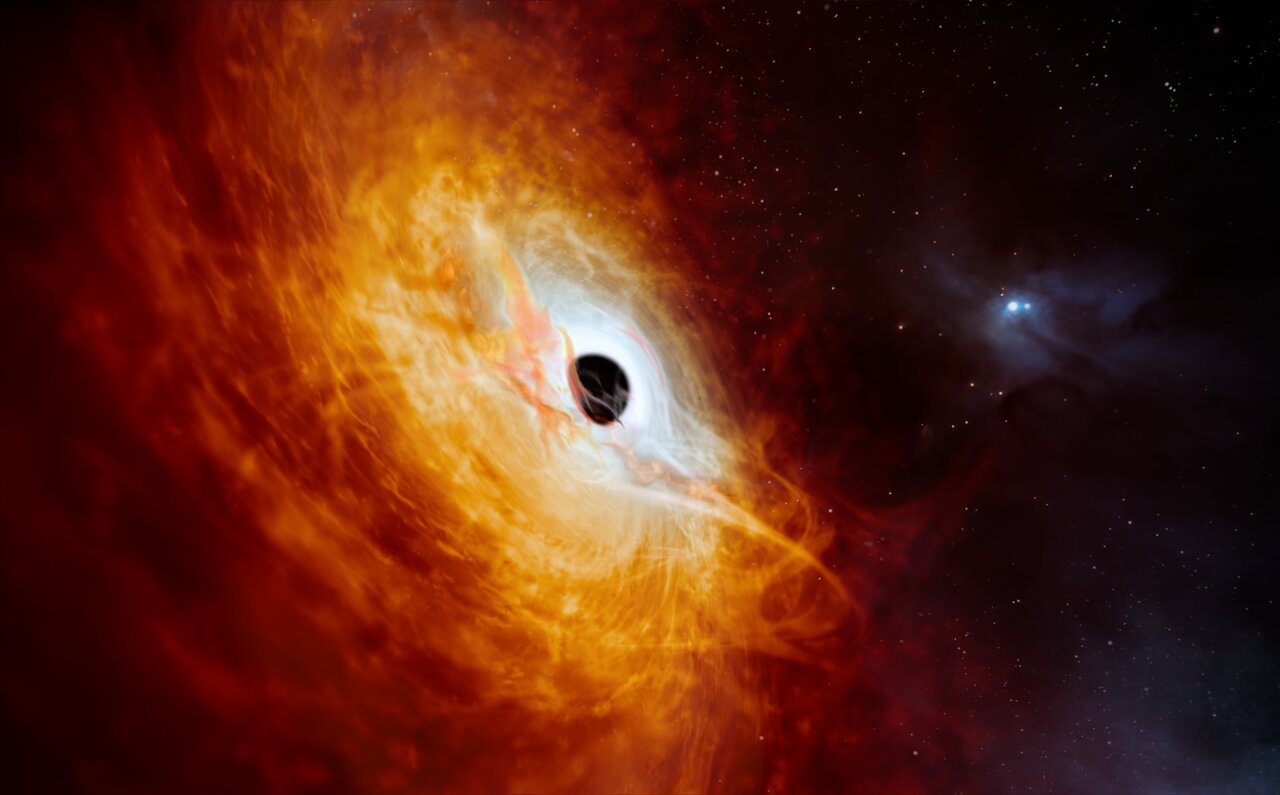
Supermassive black holes are black holes with masses estimated to be between a million or so sols and a billion (1 sol = mass of the Sun).
Black holes with two distinct ranges of mass have been observed – 'stellar mass' ones, with masses of a few sols (up to ~20), and supermassive black holes (SMBHs), with masses between a few hundred thousand sols and well over a billion sols. Of course, black holes emit no light, so their existence is inferred rather than directly observed; one method is that used to infer the existence of most exoplanets – the motion of nearby objects in the gravitational field of the black hole (it's the star's motion which gives away the presence of most exoplanets).
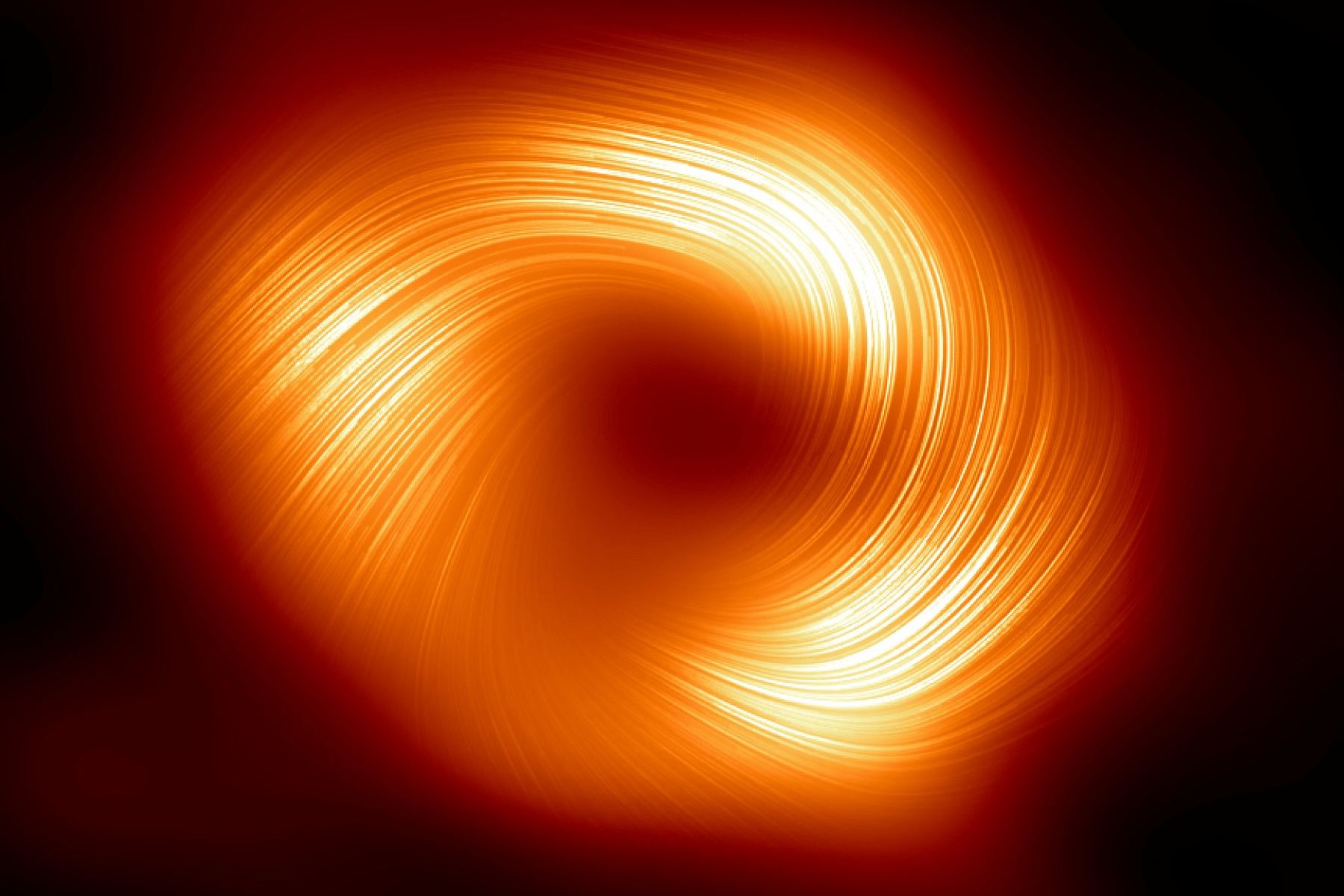
The nearest SMBH is at the center of our Milky Way galaxy, SgrA*, named after the point source in the brightest radio source in the constellation Sagittarius. Various teams of astronomers have been tracking the positions of stars close to SgrA* for some time now, and their paths trace orbits around the SMBH (they have to observe in the infrared, because the dust between us and SgrA* absorbs 31 magnitudes of optical light!). Here is a really cool summary of the data, as an animation. By applying Kepler's laws to the data, plus a dash of Newton and a pinch of Einstein, the mass of the SMBH can be estimated (it should come out the same, no matter which set of stars' data is use; it does) … about 4 million sols.
All galaxies which have bulges seem to have SMBHs – that includes all normal, and giant, ellipticals, spheroidals, and spirals; dwarf galaxies and irregulars without bulges do not seem to have SMBHs. In fact, galaxies' bulges and their SMBHs seem to know about each other: there is a strong correlation between the SMBH mass and the bulge velocity dispersion.
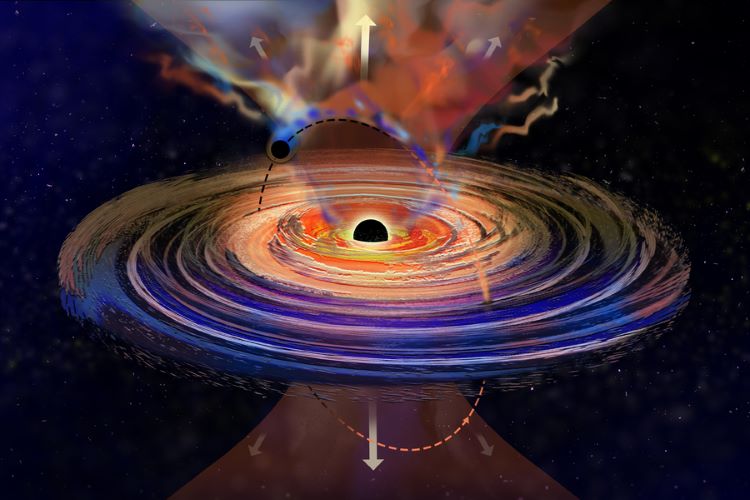
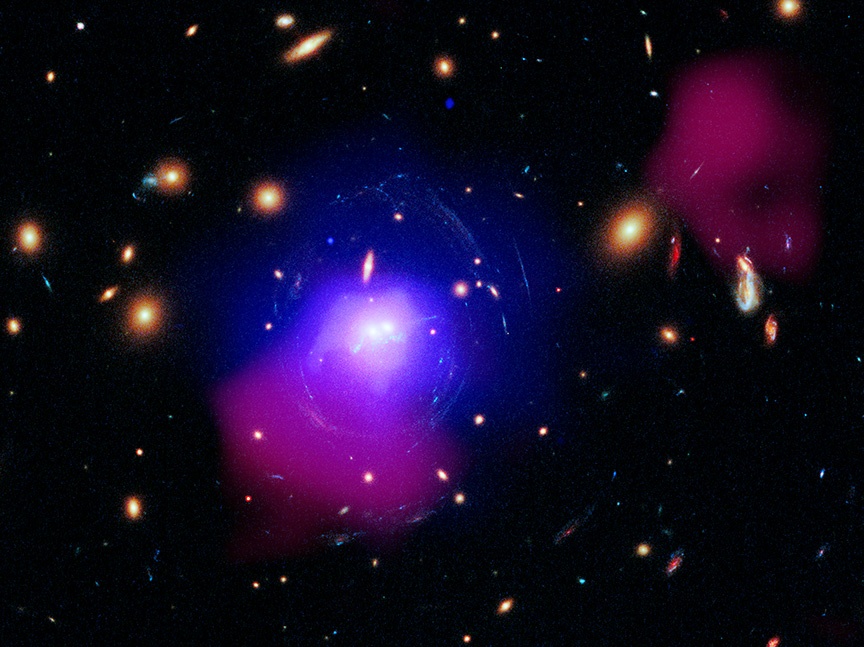
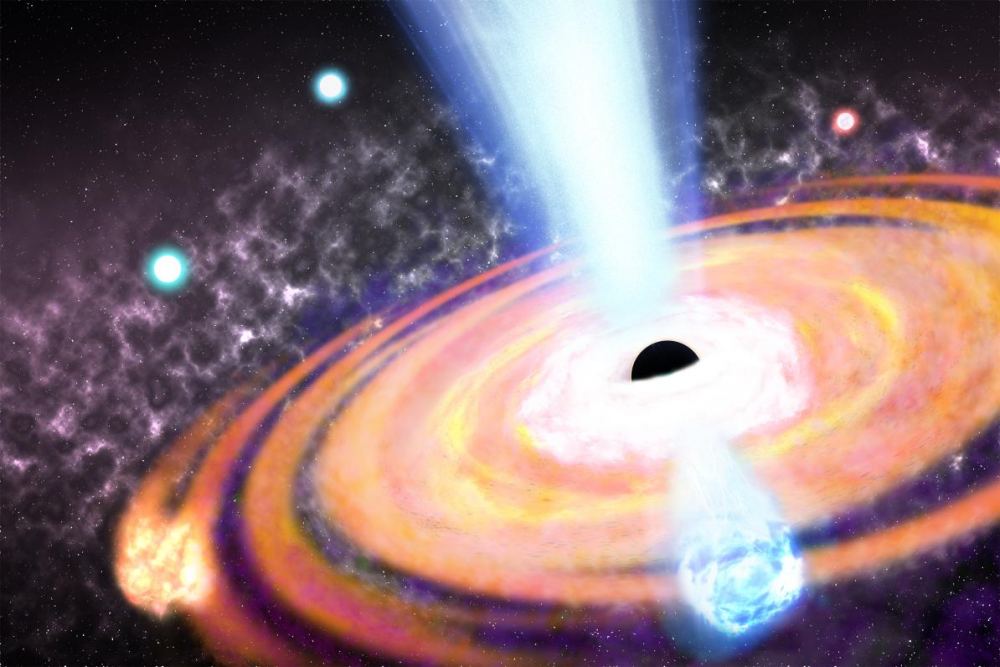
SMBHs can acquire mass in several ways, the most spectacular of which is when the hot plasma that pervades a rich cluster of galaxies falls into the gravitational center of the cluster, which is usually a cD galaxy (a kind of giant elliptical). At the heart of such galaxies is an SMBH, often with a mass of many billion sols. The plasma is compressed, heated, and ends up on an accretion disk around the SMBH; from there most disappears through the event horizon, but some is jetted out along the poles at ultra-relativistic speeds, to form giant radio lobes. These are called DRAGNs (double radio active galaxy nuclei).
It is the accretion disks around SMBHs that are responsible for quasars' brilliance and variability; look down the barrel of a jet … and you have a blazar; they are natural particle accelerators which can do in less than one second what the LHC can't, even in a dozen lifetimes.
How SMBHs formed in the first place is essentially unknown today … it is a hot topic!
Lots of Universe Today stories on supermassive black holes; for example, Beyond Any Reasonable Doubt: A Supermassive Black Hole Lives in Centre of Our Galaxy, X-Ray Flare Echo Reveals Supermassive Black Hole Torus, How Do You Weigh a Supermassive Black Hole? Take its Temperature, and What Happens When Supermassive Black Holes Collide?, to mention just a few.
More to explore: Astronomy Cast's episodes Quasars, and Black Holes Big and Small.
Filed under: Astronomy
Related stories on Universe Today
- Why are there Black Holes in the Middle of Galaxies?
- Supermassive Black Holes Spin at the Limits of Relativity
- Our Supermassive Black Hole Is a Natural Particle Accelerator
- Black Hole Pictures
- Black Hole Found in a Globular Star Cluster