Black Holes

Are Black Holes Planet Smashers?

October 31, 2011

Some supermassive black holes are obscured by oddly shaped dust clouds which resemble doughnuts. These clouds have been an unsolved puzzle, but last week a scientist at the University of Leicester proposed a new theory to explain the origins of these clouds, saying that they could be the results of high-speed collisions between planets and [...]

Read the full article →

Galaxy Interactions Could Cause Overweight Black Holes

October 27, 2011

Yep. It’s true. Almost all galaxies are guilty of having a supermassive black hole in their centers. Some even tip the scales at millions – or even billions – of times more mass than the Sun. However, how they came to be so weighty is a true enigma. Thanks to research done by Dr. John [...]

Read the full article →

Black Hole Secrets… Water Vapor Gives Clues To Star Formation

October 20, 2011

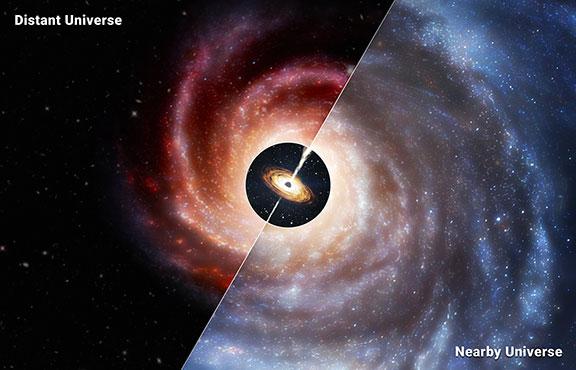
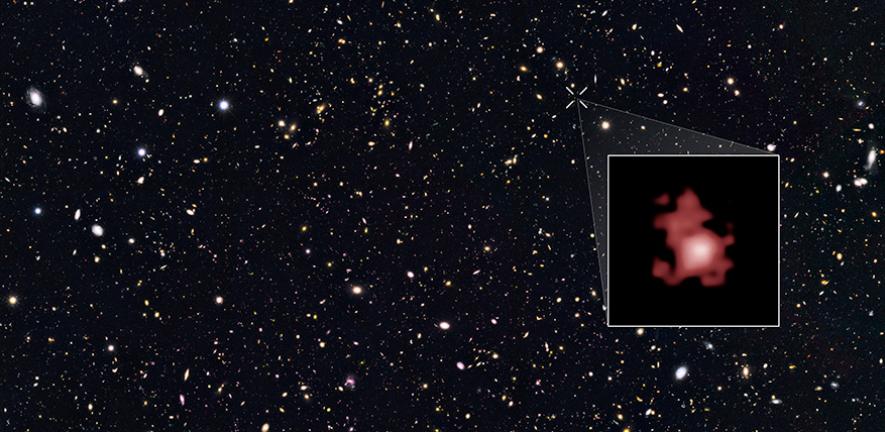
A eye-opening discovery has been made by an international team of scientists led by astronomer Paul van der Werf (Leiden University, The Netherlands). They have discovered a black hole in the early Universe located about 12 billion light years away that’s surrounded by a nearly impenetrable disk of gas and dust. The halo isn’t the [...]

Read the full article →

Is M85 Missing a Black Hole?

October 16, 2011

The conventional wisdom of galaxies is that they should have a central massive black hole (CMBH). The presence of such objects has been confirmed in our own galaxy as well as numerous other galaxies, including the Andromeda galaxy (M31) and even some dwarf galaxies. The mass of these objects, several million times the mass of [...]

Read the full article →

Looking Into The Eye Of A Monster – Active Galaxy Markarian 509

October 4, 2011

“The world is a vampire, sent to drain… Secret destroyers, hold you up to the flames…” Ah, yes. It’s the biggest vampire of all – the supermassive black hole. In this instance, it’s not any average, garden-variety black hole, but one that’s 300 million times the mass of the Sun and growing. Bullet with butterfly [...]

Read the full article →

AGNs As A New Standard Candle?

September 26, 2011

Nope. A standard candle isn’t the same red, green, blue, yellow and omni-present pink wax sticks that decorate your every day birthday cake. Until now a standard candle meant a Cepheid variable star – or more recently – a Type 1a supernova. But something new happens almost every day in astronomy, doesn’t it? So start [...]

Read the full article →

Big Ol’ Black Hole Jets

September 21, 2011

Some 20,000 light years away, a black hole named GX 339-4 has produced one of the most exciting visible events possible – a massive flare. This searing jet is an extraordinary occurrence and astronomers using NASA’s Wide-field Infrared Survey Explorer (WISE) were able to capture elusive data to further refine their studies of the extreme [...]

Read the full article →

Primordial Black Holes, Dark Matter and Stellar Collisions… Oh, My!

September 20, 2011

Well, we’re off to see the Wizard again, my friends. This time it’s to explore the possibilities of primordial black holes colliding with stars and all the implications therein. If this theory is correct, then we should be able to observe the effects of dark matter first hand – proof that it really does exist [...]

Read the full article →

Even Small Galaxies Can Have Big Black Holes

September 16, 2011

The Hubble Space Telescope has done it again. By utilizing a slitless grism, the Wide Field Camera 3 has uncovered evidence that supermassive black holes are right at home in some very small galaxies. Apparently these central black holes began their life when their host galaxies were first forming!

Read the full article →

Galaxy Bets On A Pair Of Black Holes

September 2, 2011

About 160 million light years away in the constellation of Hydra, spiral galaxy NGC 3393 has been keeping a billion year old secret. It might have a poker face, but it has a pair of black holes up its sleeve…

Read the full article →

More Details on the Black Hole that Swallowed a Screaming Star

August 25, 2011

Back in June we reported on the black hole that devoured a star and then hurled the x-ray energy across billions of light years, right at Earth. It was such a spectacular and unprecedented event, that more studies have been done on the source, known as Swift J1644+57, and the folks at the Goddard Space [...]

Read the full article →

Pardon Me, But Your Black Hole Is Leaking…

August 12, 2011

Yes. We thought we knew everything there was to know about black holes. We know they are massive and compact. We know they possess a gravity so intense that it even bends “space time”. We know they won’t even allow light to escape. But what we weren’t really prepared for is that our human line [...]

Read the full article →

Huge Reservoir of Water Discovered in Space 30 Billion Trillion Miles Away

July 22, 2011

From a Caltech Press Release: Water really is everywhere. Two teams of astronomers, each led by scientists at the California Institute of Technology (Caltech), have discovered the largest and farthest reservoir of water ever detected in the universe. Looking from a distance of 30 billion trillion miles away into a quasar—one of the brightest and [...]

Read the full article →

Turning On A Supermassive Black Hole

July 14, 2011

ESO’s Very Large Telescope and ESA’s XMM-Newton X-ray Space Observatory has just opened our eyes once again. While we thought that the massive black holes that lurk at the center of large galaxies (and they always lurk, don’t they? they never just lay about, lallygag, or loiter…) for the last 11 billion years were turned [...]

Read the full article →

Most Distant Quasar Opens Window Into Early Universe

July 1, 2011

Astronomers have uncovered yet another clue in their quest to understand the Universe’s early life: the most distant quasar ever observed. At a redshift of 7.1, it is a relic from when the cosmos was just 770 million years old – just 5% of its age today.

Read the full article →

Cygnus X-1: Blue Supergiant Pairs With Black Hole

June 22, 2011

Discovered in 1964 during a rocket flight, Cygnus X-1 holds the record for being the strongest X-ray source seen from Earth. The blue supergiant star designated as HDE 226868 is just part of this high-mass X-ray binary system… the other is a black hole.

Read the full article →

Black Hole Devours Star and Hurls Energy Across 3.8 Billion Light Years

June 17, 2011

Engaging the Hubble Space Telescope, Swift satellite and the Chandra X-ray Observatory, astronomers at the University of Warwick were quick to pick up a signal from Swift’s Burst Alert Telescope on March 28, 2011. In a classic line from Easy Rider, Jack Nicholson says: “It’s a UFO beaming back at you.” But this time it [...]

Read the full article →

Baby Black Holes Grew Up Fast

June 16, 2011

For more than six weeks, the watchful eye of NASA’s Chandra X-ray Observatory kept track of a small portion of sky dubbed the Chandra Deep Field South (CDFS). Its object was to research 200 distant galaxies dating back to about 800 million to 950 million years old. What Chandra was looking for was evidence of [...]

Read the full article →

Nearby Galaxy Has Two Monster Black Holes

June 10, 2011

Why does this galaxy appear to be smiling? The answer might be because it has been holding a secret that astrophysicists have only now just uncovered: there are two — count ‘em – two gigantic black holes inside this nearby galaxy, named Markarian 739 (or NGC 3758), and both are very active. While massive black [...]

Read the full article →

Black Holes Spin Outta’ Control

May 26, 2011

“Down in a hole and they’ve put all the stones in their place. I’ve eaten the sun so my tongue has been burned of the taste…” For the first time the evolution of the spin of the supermassive black holes has finally been examined. New research hints that supermassive black holes enlarged by swallowing matter [...]

Read the full article →