
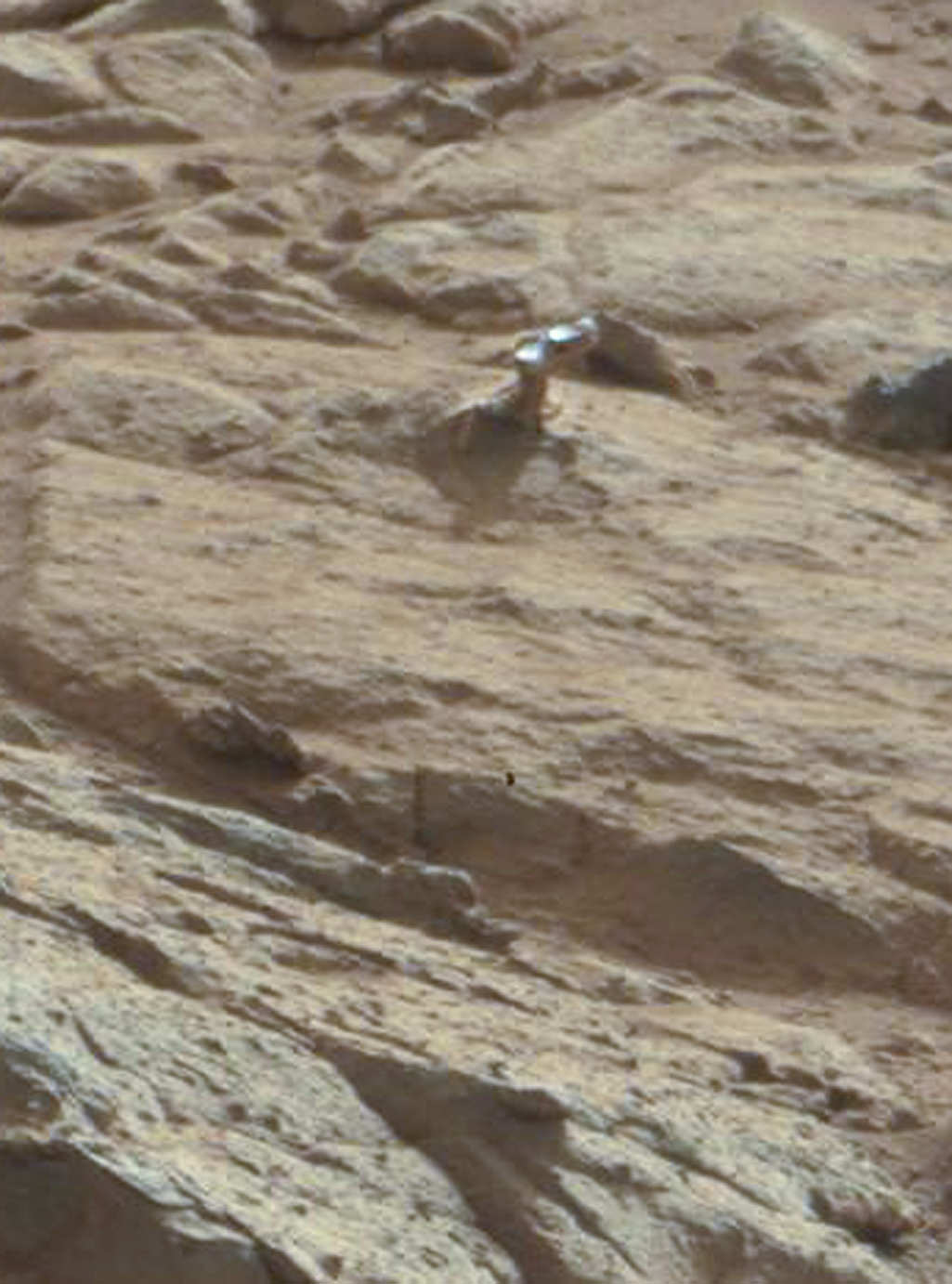
As we reported last week, images from the Curiosity rover showed what looked like a piece of shiny metal sticking out from a rock. Some of our readers suggested that it might be a handle or knob of some kind. It’s a knob, yes, says Ronald Sletten from the Mars Science Laboratory team, but a completely natural formation. Sletten, from the University of Washington, explained that, not surprisingly, it is actually a part of the rock that is different — harder and more resistant to erosion — than the rest of the rock it’s embedded in.
On Earth, as on Mars, “often you can see knobs or projections on surfaces eroded by the wind, particularly when a harder, less erodible rock is on top,” Sletten said, via an email to Universe Today from the Jet Propulsion Laboratory media relations office. “The rock on top of the projection is likely more resistant to wind erosion and protects the underlying rock from being eroded.”
As far as why it appears shiny, Sletten said, “The shiny surface suggests that this rock has a fine grain and is relatively hard. Hard, fine grained rocks can be polished by the wind to form very smooth surfaces.”
It also may be shiny because it is wind-blasted and therefore dust-free, Sletten said, “while the surfaces not directly being eroded by wind may have a fine layer of reddish dust or rock-weathering rind. The sandblasted surfaces may reveal the inherent rock color and texture.”
He added that the object is an interesting study in how wind and the natural elements cause erosion and other effects on various types of rocks.
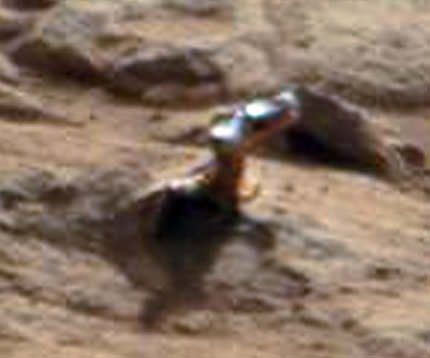
In looking at a zoomed-in close-up of the “knob” or protuberance from the rock, Sletten said, “This knob has a different type of rock on the end of the projection. This rock may vary in composition or the rock grain size may be smaller.”
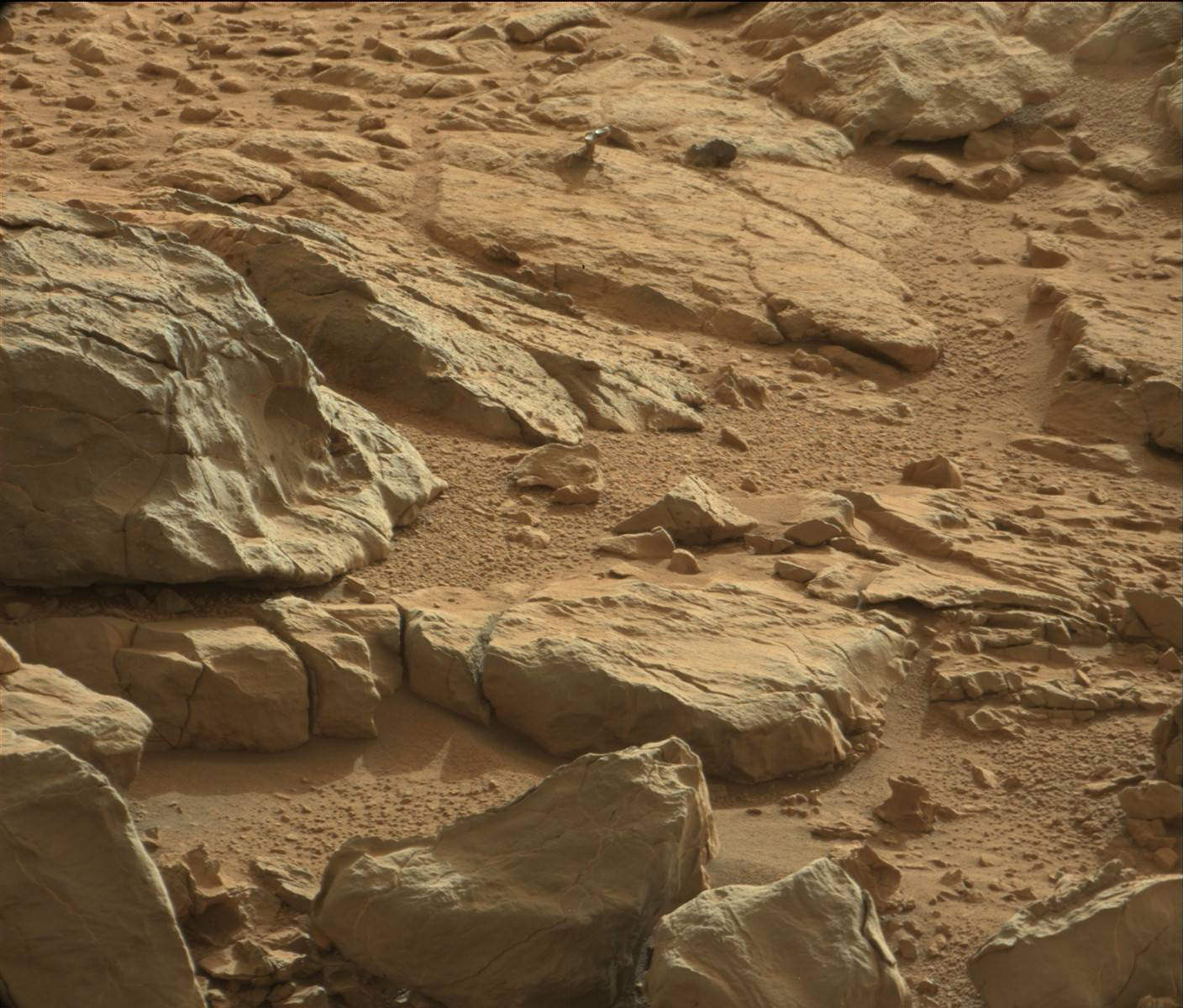
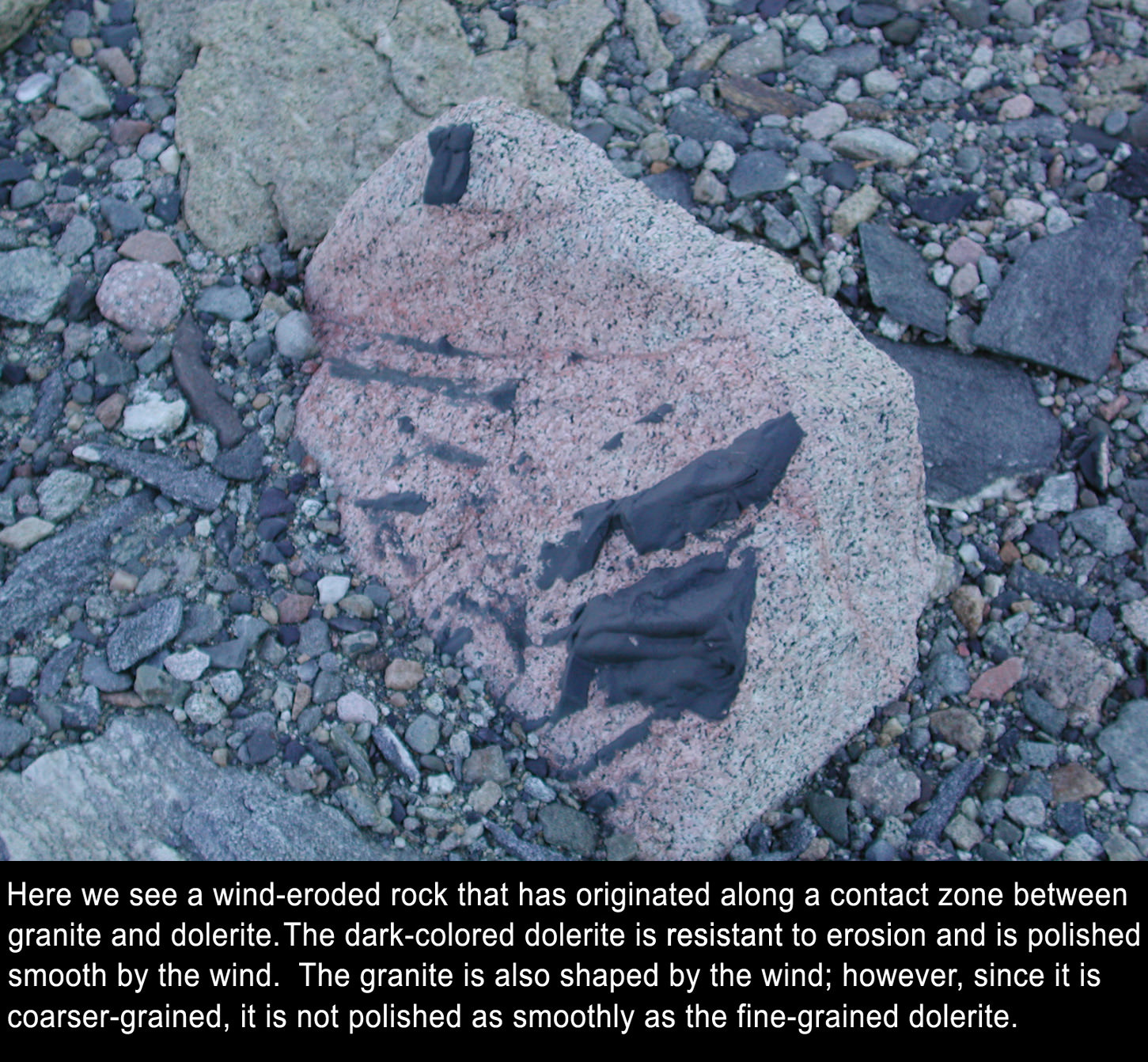
Because of the winds on Mars, there is quite a bit of erosion of rock, visible in the image above, as well as in many images from all the Mars rovers and landers. These type of surfaces are called “ventifacted” — wind-eroded surfaces caused by many fine particles of dust or sand impacting the surface over time. Areas of rocks may appear sculpted, as softer parts erode more easily or they may reflect small scale wind patterns, Sletten said.
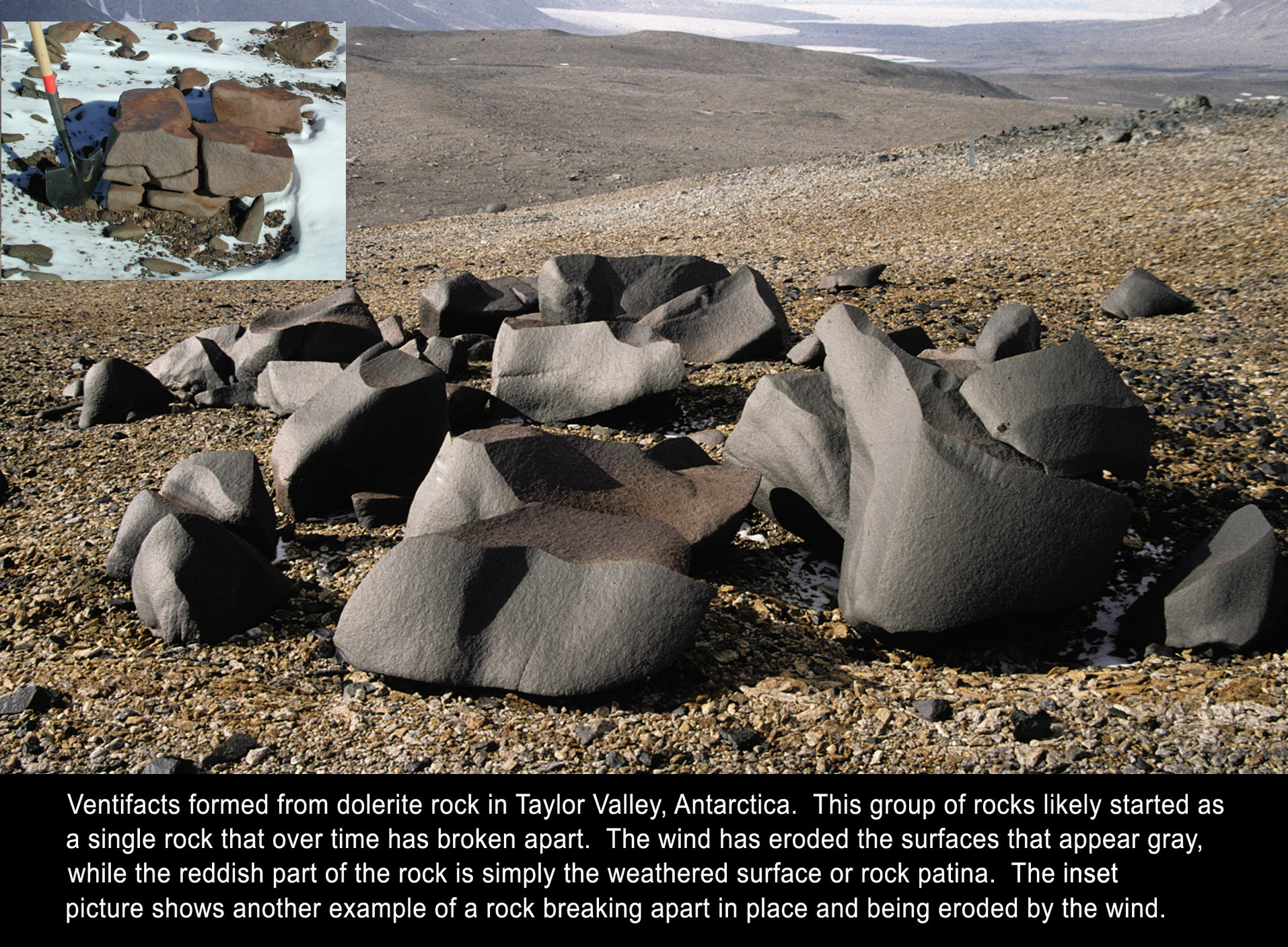
In some ways, he added, it’s a lot like what happens to rocks in Antarctica. See the annotated images he provided below:
So, this weird shiny thing on Mars is nothing too out of the ordinary — not a door handle, hood ornament or not even Richard Hoagland’s bicycle, as was suggested by readers on our previous article.
But for one more look, here’s the 3-D version(make sure you use the red-green 3-D glasses):
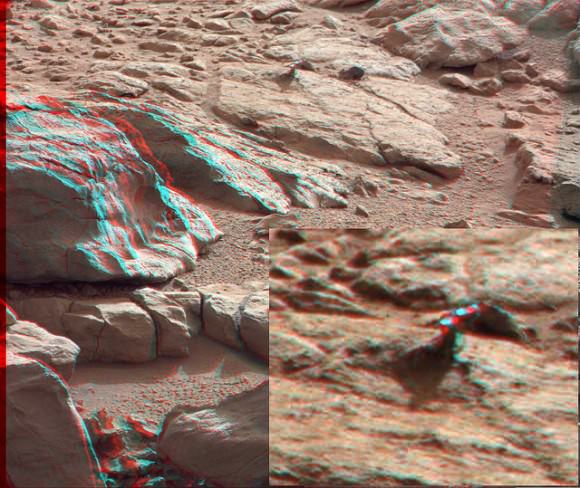
The original raw image from the Curiosity rover can be seen here, and our thanks to Elisabetta Bonora, an image editing enthusiast from Italy, who originally pointed this image out to us.
..and I thought it was a particle of pre animate matter caught in the matrix…haha
nice typo on the hoogland.
so we’ll be seeing more of these shiney things i take it, them being natural and all
stating the obv
and if not, what is the explanation that there is just one
If there is one ,why not two or more close by ?
Actually, there is one more very close by ! Look at the biggest chunk of rock on the left with the 45 deg slope – one of its ridges has a similar shiny protrusion ! I pointed it out in a comment to the 1st article – nobody seemed to notice.
As I mentioned in my 1st comment, it looks like there are veins of harder mineral permeating these rocks that take quite a shine to the wind polish.
Must be me, but I’m really not seeing it…
Me too, I can not see such other thing.
Well why do they send a multi billion dollar mobile laboratory to Mars if they can identify even the most curious things by low-medium quality jpg’s (remember the stream bed too)? Not even bothered to aim the ChemCam at that object just to be sure the visual identification as of “it looks like…” is valid eh? I would wish for a little bit more curiosity in the cause of this mission and not rely too much on visual identification only – albeit the imagery of MSL is very good compared to previous missions.
Regarding wind polishing (in a near vacuum atmosphere that is) vs. dust settling all around in the CURRENT environment: whats the difference on this object?
a little off-topic but significant here a statement from the Russian privateer who discovered a potentially dangerous asteroid recently:”In Mr Oreshko’s opinion, this once again proves that while technology plays a significant role in space exploration, attention to detail and open-mindedness are, in the end, what count the most.”
Yes, I was wondering the same: why, if the wind polishes protruding rocks, ridges and edges, is only this tiny protuberance so shiny? All the surrounding rocks are covered in dust.
Also, I think the Antarctic ventifacts analogy falls a little short as there is no dust (to speak of) there…
? There is dust in Antarctic dry valleys. It’s just a cold desert.
Of course there is … but there’s hardly any to be seen in the pictures provided. And I do think Mars is significantly dustier…
Investigating curious results of known processes isn’t why the NASA rover is on Mars.
So why are they bothering to look for evidence of water?
Hence its name curiosity? Seriously the “result of a known process” is nothing more or less than an educated or maybe a bit over-educated guess of busy mission scientists. MSL is or should not be an university seminar but pure exploration with a science background. Explorers would not take anything for granted and would love to investigate “curious results of known processes”. Who can say for sure that everything is what people/scientists think it is on an alien world.
For one thing, I don’t think it would be easy for the rover to turn around and go back and find something, especially something quite small, that we earthlings saw in a photo quite a while after the rover had left it behind.
He’s speaking awfully authoritatively for an object that hasn’t been inspected any closer than a pair of decent-resolution photographs. Be nice to find out what it’s actually composed of before dismissing it as “oh just a shiny wind-polished bit of rock”. I daresay it’s a natural formation, but it would be interesting to find out exactly what it is.
Knobs on Mars? What a load of bollocks!
That’s too perfect to be naturally formed. I think NASA have purposefully hidden high res images.
And another conspiracy theorist. Sheesh.
Wolkenkuckucksheim
Dumbass comment.
Looks like a Jaguar hood ornament to me . . .
Ancient metallic meteorite fragment trapped in sedementary rocks then eroded after eons.
Are we to assume mission managers have opted to not investigate further? Not that this object is critical to mission success, but still this interesting erosion artifact might prove beneficial to future martian construction efforts, composition dependent? What if it were proven to be made out of ‘unobtainium’?
nah…its the knuckle bone of a fossilized metallic Martian. That’s the story and I am sticking too it.
The object in question is obviously the main water shutoff valve for Mars. Once it is turned back on, the sprinklers will resume operation and terraforming may begin. The previous occupants turned the water off before they went on extended vacation.
Good one!!
ARE YOU F’N KIDDING ME??? Seriously… I mean do any of those pictures look remotely the same, and a smooth looking rock and something that looks like metal are two totally different things IMO. Like Hans said earlier. WHY on earth do the send this freaking rover to mars when they can’t make a pit stop at something that actually does look seriously interesting?? They could of used the chem cam on it and POW! We know exactly what it is….. I know you guys are on a schedule and all, but you have like 10 years to get where your going. JEEZ NASA, at least use our multibillion dollar TAXPAYER machine to analyze something that a good portion of the public finds strange! Stop looking for traces of water, when we all know that it was there in abundance and do something useful with that LIFE SIZE remote control car!!!!
Because the rover is long gone when we got a lot of these pictures.
As far as I remember, the image came in before they started drilling.
I believe it is natural but NASA is definitely hiding something from the public. It looks organic and you can clearly see a body, head, and legs. Especially the front legs which show the shadows under them as though the is a gap between them and the rock. Make up your own decission but it still looks wierd to me.
Maybe they cant image it because of the very rare possibility that it is a Martian life form and that it has moved and is not there anymore. And as Jamey Khamjani and Hans said they should inspect it more if it is still there.
Did anyone notice the ‘tracks’ on either side of the object? It looks like the rover’s tracks, and if so, maybe that object is a piece of the rover that fell off? It seems that almost anything is a better explanation than those of the experts….
Nah, this object is only about 5 mm in size (so tiny, really). If the depressions left and right of it were rover tracks (I don’t think they are) the object would be much, much bigger.
Nope… If you go to the MRL raw images page (http://mars.jpl.nasa.gov/msl/multimedia/raw/) and take a look at image Mastcam: Left 2013-01-30 23:39:17 UTC on day 173… you will see that the rover did not go any closer. The images on either side of this particular image are part of a panorama scan and can be ‘pieced’ together…. There are no tracks there. Perhaps you are seeing ‘tracks’ where actually there are dust/sand filled in gaps between the rocks?
I’m telling ya, it’s a hoodoo. A little one.
My problem with this story is that just like the crazies ready to label this a “alien object” science is ready to call this a piece of the rock that erodes slower than the rest of the mass. The truth is, unless you are there to actually examine it, test its compounds and physical make up then your really only guessing. Science is suppose to be based on fact and they should give their thoughts but exit with the parting comment that is is “only our best guess”.
How did you get from shiny to organic? And at most you could say it looks like a hammer. But head and legs?
I find this inacceptable. We send Curiosity to Mars and when it finds something conspicuous, instead of sending it there to investigate, we get far fetched partial guesses as explanation, even only based on low res images from the object. Of course it is a harder part more resistant to erosion, thats why it sticks out. Does not explain what that harder part is, or why or how it got embedded into the surrounding stone in the first place. So I have to say to NASA: “is this how you normally work, just hunches and guesses and stuff?”
Good point – I don`t understand why NASA prefere to say ““The shiny surface suggests that this rock has a fine grain and is
relatively hard. Hard, fine grained rocks can be polished by the wind to
form very smooth surfaces.” instead of making reaserch. It is not scientific approach.
http://www.ecliptic.ch/mars-rover-not-so-curiosity.html
It could be metal. If precious, it would suggest that intelligent life has never existed. Expect to find dimonds and rubies next.
Take a look at the interactive panorama (http://www.360cities.net/image/mars-panorama-curiosity-solar-day-177#-426.21,10.16,50.0) – this little knob is not very far away … just turn the rover to the right and drive a couple of meters! (if you can’t find it on the panorama: center the drill holes in your screen and go straight up).
Ereka!..R2D2 was on Mars many years ago, when the planets supported plant life, lush grass fields and an atmosphere. Down came the rain, and poor R2 was in way over his head in a mud slide, which over the years hardened to solid rock. What we see there is the top part of R2 that he raises to use as his eyes….poor R2…
Nope, BS not good enough.