
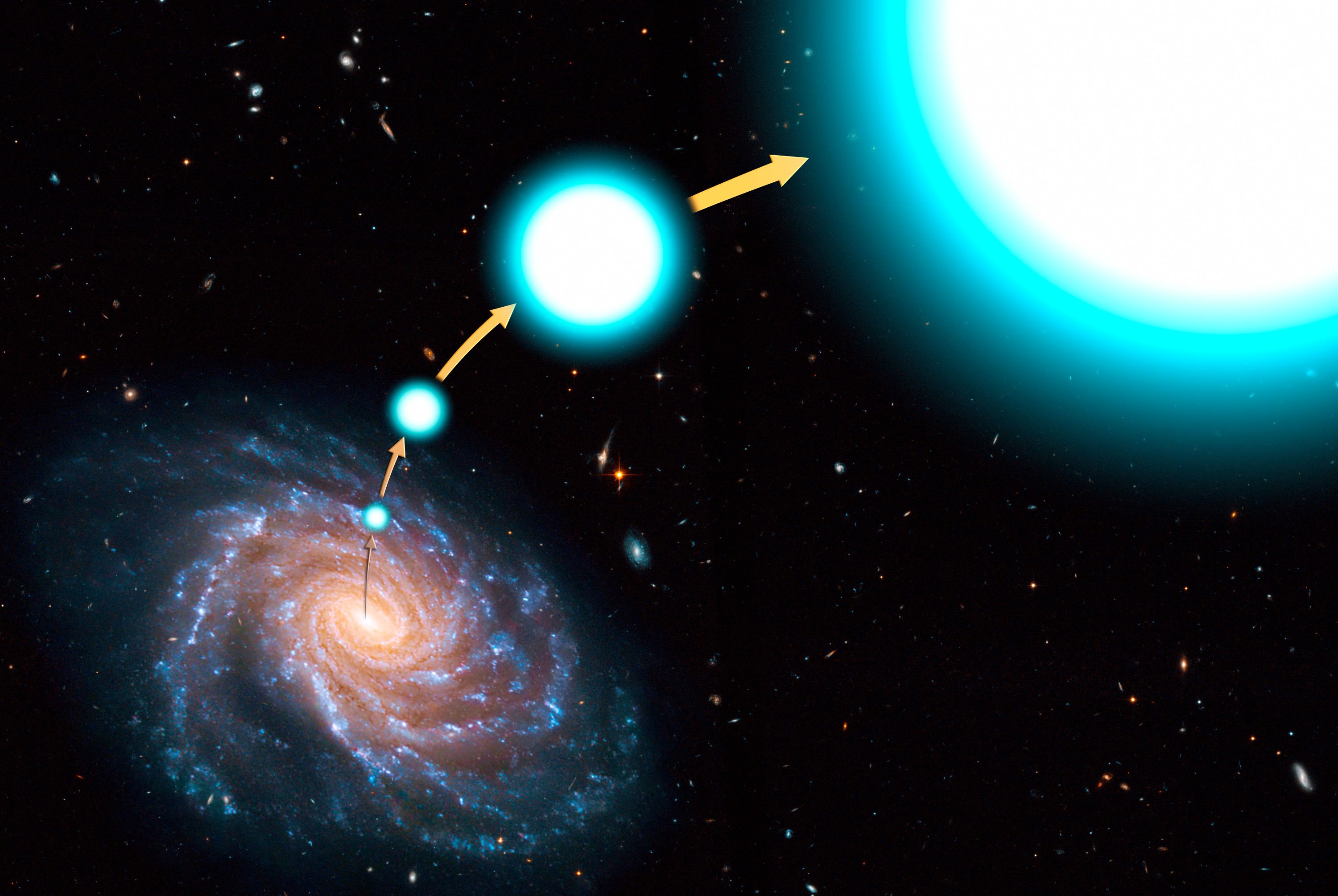
Back in 1988, astronomer Jack Hills predicted a type of “rogue”star might exist that is not bound to any particular galaxy. These stars, he reasoned, were periodically ejected from their host galaxy by some sort of mechanism to begin traveling through interstellar space.
Since that time, astronomers have made numerous discoveries that indicate these rogue, traveling stars indeed do exist, and far from being an occasional phenomenon, they are actually quite common. What’s more, some of these stars were found to be traveling at extremely high speeds, leading to the designation of hypervelocity stars (HVS).
And now, in a series of papers that published in arXiv Astrophysics, two Harvard researchers have argued that some of these stars may be traveling close to the speed of light. Known as semi-relativistic hypervelocity stars (SHS), these fast-movers are apparently caused by galactic mergers, where the gravitational effect is so strong that it fling stars out of a galaxy entirely. These stars, the researchers say, may have the potential to spread life throughout the Universe.
This finding comes on the heels of two other major announcements. The first occurred in early November when a paper published in the Astrophysical Journal reported that as many as 200 billion rogue stars have been detected in a cluster of galaxies some 4 billion light years away. These observations were made by the Hubble Space Telescope’s Frontier Fields program, which made ultra-deep multiwavelength observations of the Abell 2744 galaxy cluster.
This was followed by a study published in Science, where an international team of astronomers claimed that as many as half the stars in the entire universe live outside of galaxies.
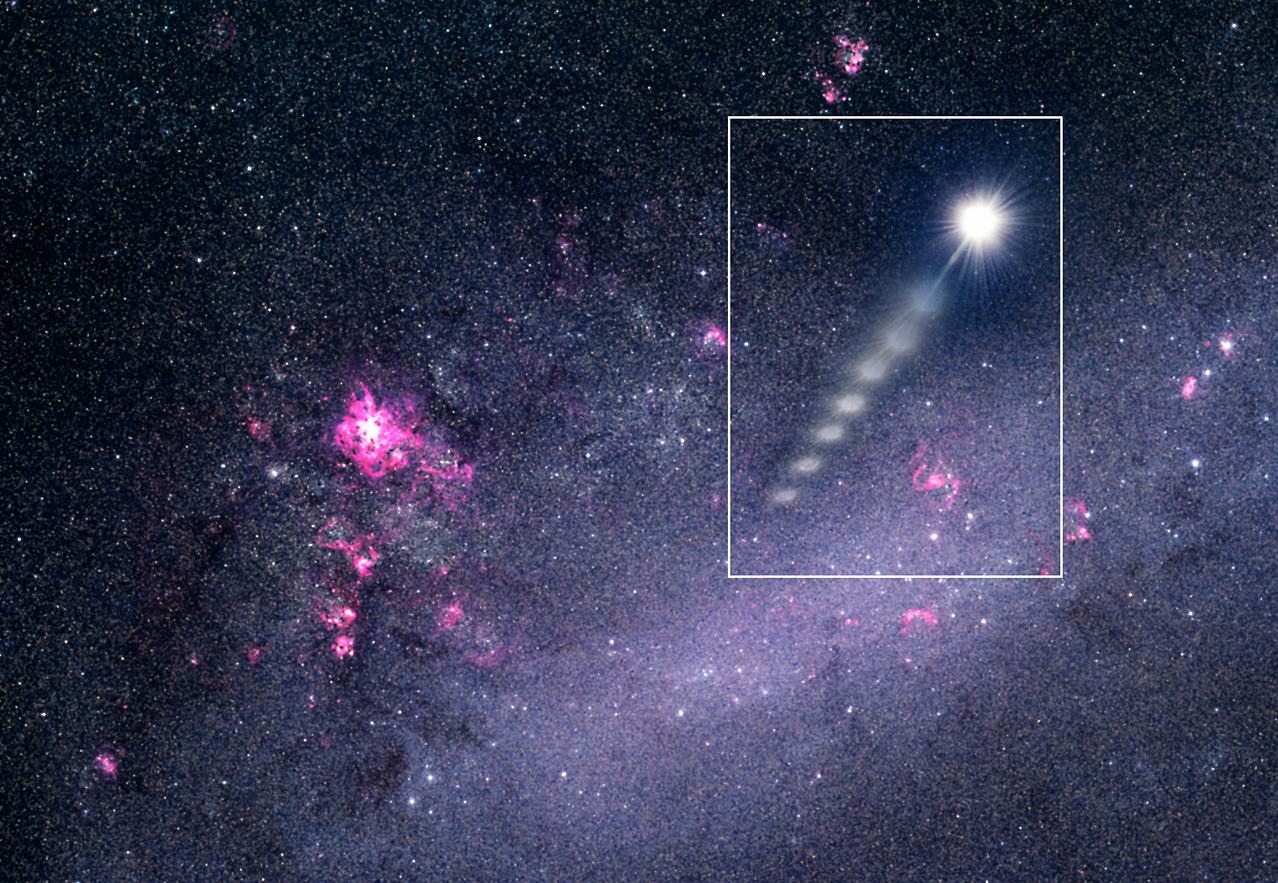
However, the recent observations made by Abraham Loeb and James Guillochon of Harvard University are arguably the most significant yet concerning these rogue celestial bodies. According to their research papers, these stars may also play a role in spreading life beyond the boundaries of their host galaxies.
In their first paper, the researchers trace these stars to galaxy mergers, which presumably lead to the formation of massive black hole binaries in their centers. According to their calculations, these supermassive black holes (SMBH) will occasionally slingshot stars to semi-relativistic speeds.
“We predict the existence of a new population of stars coasting through the Universe at nearly the speed of light,” Loeb told Universe Today via email. “The stars are ejected by slingshots made of pairs of massive black holes which form during mergers of galaxies.”
These findings have further reinforced that massive compact bodies, widely known as a supermassive black holes (SMBH), exist at the center of galaxies. Here, the fastest known stars exist, orbiting the SMBH and accelerating up to speeds of 10,000 km per second (3 percent the speed of light).
According to Leob and Guillochon, however, those that are ejected as a result of galactic mergers are accelerated to anywhere from one-tenth to one-third the speed of light (roughly 30,000 – 100,000 km per second).
Observing these semi-relativistic stars could tell us much about the distant cosmos, according to the Harvard researchers. Compared to conventional research, which relied on subatomic particles like photons, neutrinos, and cosmic rays from distant galaxies, studying ejected stars offers numerous advantages.
“Traditionally, cosmologists used light to study the Universe but objects moving less than the speed of light offer new possibilities,” said Loeb. “For example, stars moving at different speeds allow us to probe a distant source galaxy at different look-back times (since they must have been ejected at different times in order to reach us today), in difference from photons that give us just one snapshot of the galaxy.”
In their second paper, the researchers calculate that there are roughly a trillion of these stars out there to be studied. And given that these stars were detected thanks to the Spitzer Space Telescope, it is likely that future generations will be able to study them using more advanced equipment.
All-sky infrared surveys could locate thousands of these stars speeding through the cosmos. And spectrographic analysis could tell us much about the galaxies they came from.
But how could these fast moving stars be capable of spreading life throughout the cosmos?

“Tightly bound planets can join the stars for the ride,” said Loeb. “The fastest stars traverse billions of light years through the universe, offering a thrilling cosmic journey for extra-terrestrial civilizations. In the past, astronomers considered the possibility of transferring life between planets within the solar system and maybe through our Milky Way galaxy. But this newly predicted population of stars can transport life between galaxies across the entire universe.”
The possibility that traveling stars and planets could have been responsible for the spread of life throughout the universe is likely to have implications as a potential addition to the Theory of Panspermia, which states that life exists throughout the universe and is spread by meteorites, comets, asteroids.
But Loeb told Universe Today that a traveling planetary system could have potential uses for our species someday.
“Our descendants might contemplate boarding a related planetary system once the Milky Way will merge with its sister galaxy, Andromeda, in a few billion years,” he said.
Further Reading: arxiv.org/1411.5022, arxiv.org/1411.5030
“a cluster of galaxies some 400 billion light years away”
Surely this is wrong by a few orders of magnitude 😉
Thanks for noting the error… it is 4 billion ly. Fixed!
If the star and the planet are moving at 1/3 of speed of light, would there be an effect of time dilation? Would the time slow down at the planet? Would this be a new fountain of youth 🙂 ????
@markosombor The effect of time dilation really doesn’t start to gain much traction until you get past 1/2 the speed of light. At 1/3c, the relativistic factor is about 1.06. So if you are on this planet, one year to you would seem to be about 387 days to someone on Earth. Fountain of youth? Unfortunately, no. You would still experience a second as a second and an hour as an hour because all clocks including your body and thought processes are equally slowed. So while you might live longer in Earth years, you wouldn’t live longer in “rogue planet” years and wouldn’t experience any additional time.
So a life bearing planet traveling a good % of light speed somehow sheds its microbes to planets, comets whatever in another galaxy. I don’t think so. Relative velocity matters.
Ok, this way planets could traverse cosmic distances and reach us from other galaxies. But to deliver the seeds for life, how to stop them without destroing their freight? I regard this difficult at 0.1 c.
Extraterrestrial life is an interesting topic, but sometimes the link to potential extraterrestrial life appears exaggerated just to improve attention.
Semi-relativistic stars and planets are interesting enough, very nice topic for a new catastrophy movie (though the scenario would be exceedingly improbable).
If the only planets / solar systems traveling with relativistic speeds are the ones that came close to a SMBH, any life on the planet is improbable to survive a close encounter to an object surrounded with so much radiation. On the other hand, the planet might have “picked up” a seed of life somewhere on its way *after* the encounter with the SMBH. If it’s really moving at relativistic speeds, say around 0.5 c, it’d be fun to think about the evolution on the planet. For any outside observers, it would be running slower than the usual due to time dilation, but if the planet’s solar system encounters other stars more often, than it is bound to get more radiation from them, and therefore perhaps a more frequent modification of any DNA or a similar molecule of life.
The matter of actually stopping somewhere is an interesting question. The other one is that most of the time you’d be travelling in an intergalactic void. I suppose it might take several millions of years between each galaxy encounter and that is if you happen to travel along a filament or through a supercluster. Then, if you actually happen to “hit” a galaxy, what about the interstellar gas and dust there? Or even worse, if you happen to ram a rogue comet at relative velocity of 100000 km/s…