
[/caption]
A supernova is the explosion of a star. In an instant, a star with many times the mass of our own Sun can detonate with the energy of a billion suns. And then, within just a few hours or days, it dims down again. Some explode into a spray of gas and dust, while others become exotic objects like neutron stars or black holes.
Astronomers have classified supernovae into two broad classifications: Type I and Type II. Type I supernovae occur in binary systems, where one star pulls off mass from a second star until it reaches a certain amount of mass. This causes it to explode as a supernova. Type II supernovae are the explosions of massive stars which have reached the end of their lives.
All of the elements heavier than iron were created in supernova explosions. As a massive star runs out of hydrogen fuel, it starts to fuse together heavier and heavier elements. Helium into carbon and oxygen. And then oxygen into heavier elements. It goes up the periodic table this way, fusing heavier elements until it reaches iron. Once a star reaches iron, it’s no longer able to extract energy from the fusion process. The core collapses down into a black hole, and the material around it is fused together into the elements heavier than iron. If you’re wearing any gold jewelry, that was created in a supernova.
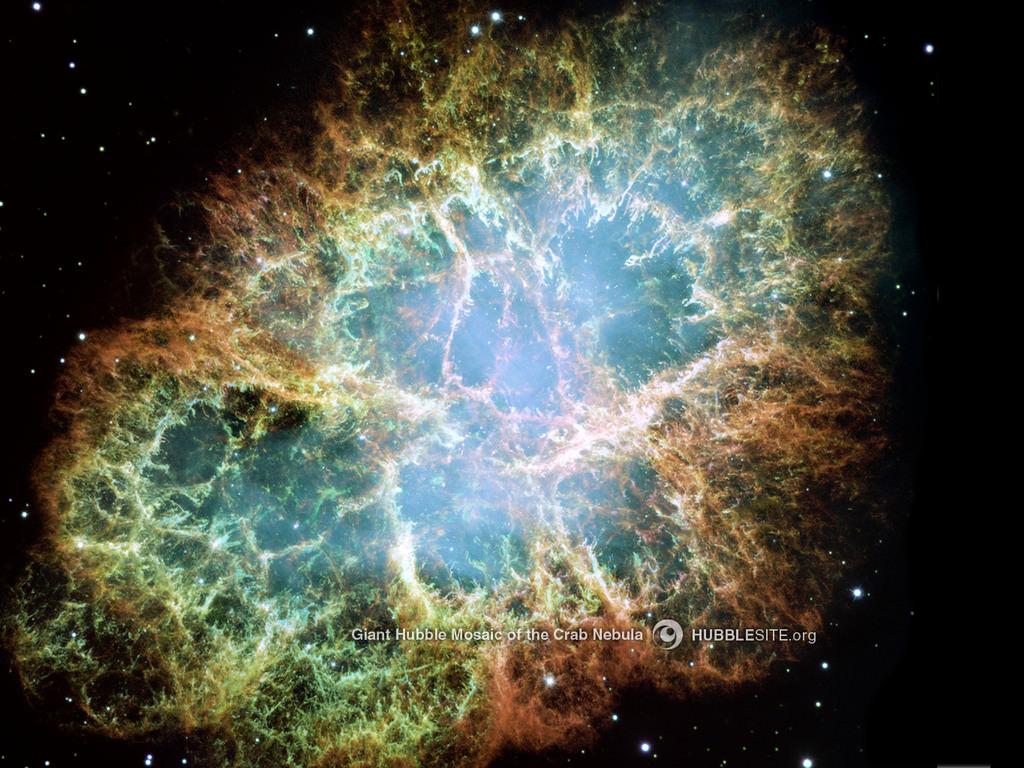
In 1054 Chinese astronomers saw a supernova explosion that was so bright it was visible in the middle of the day. The explosion of gas and dust is now visible as the Crab Nebula (that’s the picture at the top of this article). The most recent powerful supernova explosion occurred in 1987, when a star exploded in the Large Magellanic Cloud.
Astronomers use Type I supernovae to judge distances in the Universe. This is because they always explode with approximately the same amount of energy. When a white dwarf star collected approximately 1.4 times the mass of the Sun, it can’t support its mass and collapses. This amount is called the Chandrasekhar Limit. When an astronomer sees a Type I supernova, they know how bright it is, and so they can measure how far away it is.
We’ve written many articles about supernovae for Universe Today. Here’s an article about a slow motion supernova, and here’s an article about a theoretical supernova that was actually found to exist.
If you’d like to see a gallery of supernova photographs, check out this section of the Hubble Space Telescope site, and here’s NASA’s Photo Gallery of Nebulae.
We’ve also recorded several episodes of Astronomy Cast about supernovas. Check out this one, Episode 14: We’re All Made of Supernovae.
References:
http://www.cfa.harvard.edu/supernova//newdata/supernovae.html
http://en.wikipedia.org/wiki/Chandrasekhar_limit