
[/caption]
Carbon and oxygen have been spotted in the dust around stars in the center of the Milky Way galaxy, suggesting that the stars have undergone recent disruptions of some kind — and hinting how stars can send heavy elements — like oxygen, carbon, and iron — out across the universe, paving the way for life.
Scientists have long expected to find carbon-rich stars in our galaxy because we know that significant quantities of carbon must be created in many such stars. But carbon had not previously shown up in the clouds of gas around these stars, said Matthew Bobrowsky, an astrophysicist at the University of Maryland and a co-author of a new study reporting the discovery.
“Based on our findings, this is because medium-sized stars rich in carbon sometimes keep that carbon hidden until very near the end of their stellar lives, releasing it only with their final ‘exhalations’,” explained Bobrowsky.
The new results appear in the February issue of the journal Astronomy and Astrophysics.
Bobrowsky and his team, led by J. V. Perea-Calderón at the European Space Astronomy Centre in Madrid, Spain, used the Spitzer Space Telescope to view each star and its surrounding clouds of dust and particles, called a planetary nebulae. The researchers measured the light emitted by the stars and the surrounding dust and were able to identify carbon compounds based on the wavelengths of light emitted by the stars. Looking in an area at the center of the Milky Way called the “Galactic Bulge,” the team observed 26 stars and their planetary nebulae and found 21 with carbon “signatures.”
But the scientists did not just find carbon around these stars; they also found oxygen in these 21 dust clouds, revealing a surprising mixture of ingredients for space dust. They report in their paper that this is likely due to a thermal pulse where a wave of high-pressure gas mixes layers of elements like carbon and oxygen and spews them out into the surrounding cloud.
The finding of carbon and oxygen in the dust clouds surrounding stars suggests a recent change of chemistry in this population of stars, according to the authors.
“Stars in the center of the Milky Way are old and ‘metal-rich’ with a high abundance of heavy elements,” Bobrowsky said. “They are different in chemical composition than those found in the disc, farther out from the center.”
Studying the chemistry of the stars helps scientists learn how the matter that makes up our earth and other planets in our galaxy left its stellar birthplaces long ago.
As a star burns hotter and hotter, the hydrogen gas that originally made up almost all of its mass is converted, through nuclear fusion, first to helium, and then to progressively heavier elements. The hottest region in the core fuses together the heaviest elements. And these can reach the surface of the star only when its life is almost over.
“The Big Bang produced only hydrogen and helium,” Bobrowsky said. “Heavier elements like carbon and oxygen only come from getting ‘cooked up’ in stars. Nuclear reactions in stars created the heavier elements found in ‘life as we know it’.”
In the last 50,000 years of their 10 billion-year lives, sun-sized stars expel carbon atoms along with hydrogen and helium to form a surrounding cloud of gas that soon disperses into space, perhaps to eventually become the stuff of new stars, solar systems, or perhaps even life on some earth-like planet. Much larger stars expel their heavier matter in massive explosions called supernovae.
“All the heavy elements [which astronomers call ‘metals,’ and include all elements heavier than hydrogen and helium] on Earth were created by nuclear fusion reactions in previous generations of stars,” said Bobrowsky. “Those earlier stars expelled those elements into space and then our solar system formed out of that gas containing all the heavy elements that we now find in Earth and in life on Earth.”
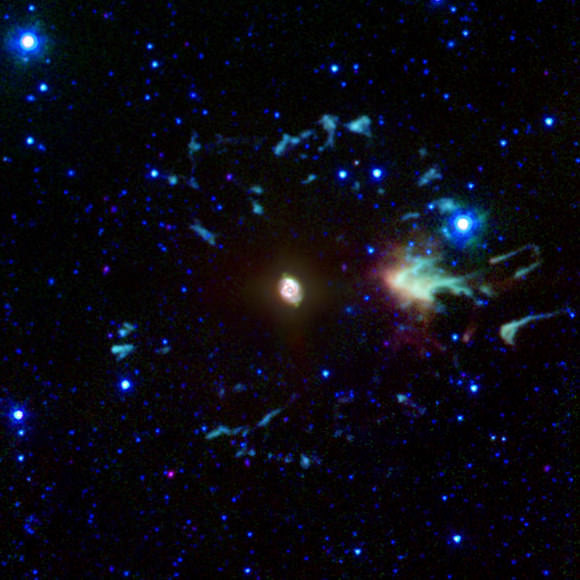
LEAD IMAGE CAPTION: Cat’s Eye Nebula. Researchers have found carbon and oxygen in dusty planetary nebulae surrounding stars at the center of the Milky Way. Credit: NASA/JPL-Caltech/J. Hora (Harvard-Smithsonian CfA)
Source: Astronomy & Astrophysics and Spitzer, via AAS
“Stars in the center of the Milky Way are old and ‘metal-rich’ with a high abundance of heavy elements,” Bobrowsky said. “They are different in chemical composition than those found in the disc, farther out from the center.” I thought the stars near the center of the Milky Way, like those in globular clusters are relatively metal poor population 2 stars, and the stars in the spiral arms are population 3 with higher metal content.
Nephish777 said:
“I thought the stars near the center of the Milky Way, like those in globular clusters are relatively metal poor population 2 stars, and the stars in the spiral arms are population 3 with higher metal content.”
This is completely wrong.
Population I or 1 stars are distributed throughout the galaxy, but are are predominate in the galactic core and the globulars (mainly as there is no large nebulous regions to form the Pop II stars.) These are considered as older stars than those found in the spiral arms, and are relative metal poor .
Population II or 2 stars are formed in the spiral arms, and are associated with active star-bearing nebula regions. Making about 2% of the entire galactic stellar population, they are formed in metal-rich environments where stars have already discarded their ‘metal’ elements during the Asymptotic Giant Branch (AGB) phase enriching the interstellar medium.
Population III or 3 stars are the theoretical first-born stars after the Big Bang that were made of hydrogen/ helium. Without the metal enrichment, these stars are thought to have behaved differently and have slightly discordant evolutions. These stars would be extremely metal poor, whose white dwarfs would spectrally be purer than Pop I or II, They have yet to be discovered.
* ‘metals’ or ‘metallicity’ refer to all elements heavier than helium, which are mostly by-products of nucleosynthesis in stars.
Comment to Anne :
While Bobrowsky has certainly produced and interesting paper as reported in this article, the quotes taken from him seen a little out of place against the stellar evolution context you have placed here.
Your statement; “… to view each star and its surrounding clouds of dust and particles, called a planetary nebulae.” is really very confusing. Planetary Nebula (PNe) are a class of objects formed by the ionisation of material discarded by its central star during the final stages of active nucleosynthesis with the its progenitor. The central star is called the Planetary Nebula Nucleus (PNN), which is ultra-hot and a newly formed white dwarf.
Arguably, all PNe includes the central star – the cause of the bright nebulosity that we see. The nebulosity is not some ‘cloud’ hanging around some star, but are expanding shock wave moving away from the central star at some 1000 kilometres per second. All material seen was once discarded during in superwinds expelled by the central star during the AGB (Asymptotic Giant Branch) stage when the star was a red giant.
It is the AGB phase and the stellar winds that show the composition of the nebulosity – whose distribution reflects the manufacture of these elements made when the star was burning its fuel in its core.
Significant carbon in planetary nebulae are more likely formed in the heavier stars – roughly between 5 and 8 solar masses. In solar-like stars carbon in the spectra would be relatively rare.
Carbon can also be formed by stellar mergers of close binary stars, as in explaining the nature of the relatively rare R Corona Borealis variable stars (RCB’s) which are surrounded by carbon clouds as soot.
I am also a bit confused of what this article implies. Are the interactions caused within the expanding PNe nebulosity, or is it interacting with other the nearby nebulosity not actually associated with the central star?
Also saying “…were able to identify carbon compounds based on the wavelengths of light emitted by the stars.”
What carbon compounds do you mean? I.e. Carbon Monoxide (CO), Carbon Dioxide (CO2), or do you mean carbon as soot?
Compounds are rarely formed in planetary nebulae, especially as the light we see from the nebulosity is caused by ionisation (ultra-violet light from the PNN) and not by any reflection nebulosity.
Sorry. This is a very confusing article whose message is not very clear. (Admittedly better than I could do, though)
I think there are more ways to bake a pie then we imagine. Nucleosynthesis theory has only just begun to reach into the cryogenic.
Cryogencic superconducting anomolies anyone?
Aqua said “Nucleosynthesis theory has only just begun to reach into the cryogenic.”
What his this got to do with it? The origin of material in the expanding shell (or exposed by the nebulosity) is likely caused by planets or cometary material (Oort cloud like) in orbit around the star itself.
Although not eluded to in this article or press release (I don’t know why, nor if it were actually purposely avoided) was the discovery of amorphous silicates from the infra-red spectra. The cause of these silicates is not known, but the actual paper ( http://arxiv.org/pdf/0902.1049 ) says enhance mass loss during the AGB phase (or sudden stop of nucleosynthesis burning) is a possibility, however, they say it could also be evaporation of Oort clouds, a pre-existing circumbinary O-rich disk, a brown dwarf consumed during the red giant expansion in the AGB phase – forming the silicates.
If silicates are real, then the oxygen-rich production is key to the discovery, as crystalline silicates are oxygen-rich themselves Ie, Silicon dioxide – Quartz (SiO2) or even olivines and pyroxenes (similar to that found on the earth and moon.)
These materials were found surrounding about half of the [WC] – Carbon Wolf-Rayets (against the Oxygen Wolf-Rayets) – enhanced planetary nebulae. Silicates would suggest oxygen-depletion by some unknown process – maybe explaining the odd chemistry they observed.
Formation of these products are far from the impression of being formed in cold environments – especially since most silicates are made in combination with high pressures and temperatures. With the doubt of the origin of the silicates, it is hard to say if the material was not from some solar system interaction with the winds originally occurring during the AGB-phase. Also without doubt, however, the carbon emissions were generated by the star’s nucleosynthesis process – which as they say in the paper;
“formation of C-rich PNe (so numerous in the GB [Giant Branch]) must originate in a final He-shell [Helium-shell] instability (probably violently) which exposes the He- [Helium] and C- [Carbon] layers only when the AGB phase is terminated.”
As for these being “cryogenic” or “superconducting” is unlikely and rather misleading. I.e. No evidence of a very cold environment nor of electric currents.
(Your sounding like Anoconda, but in reverse. Deliberate, eh?)
One important key issue in the original paper, that is totally glossed over in the press release and the article is that;
“The origin of the dual-dust chemistry in PNe is still unclear. In
general, several mechanisms may play a role:”
Cryogenic superconducting anomalies anyone?
I corrected your sloppy spelling.
Aqua, are you offering this as a confection? I would love some if they aren’t too expensive? Or maybe they are lethal?
Or are you saying that the carbox is produced by these effects?
I agree that we don’t know what these anomalies will present us with, but perhaps you are referring to another discovery?
Or are you going to attack a poor pedant with a dictionary/cunning trap?
Anne…
How does it feel to be told you have no idea what a planet nebula is by someone who only knows astro-physics by attending the college of Google?
The statement isn’t confusing at all, and at no point is an entire history of how planet nebulas are formed required to understand it.
SolaB… obviously you didn’t read the article as it is impressed. Since the new data revealed by this proves there has been a change resulting in different ways of creating heavier material, and it happens much sooner than previously thought for medium sized stars. In other words, the nebulizing of material stage happens much earlier than we could have seen in the past. Much before the star begins to exlode from the inside out.
Before you correct people around here, at least understand the main part of the story. All you did was define an old definition, which this story is changing. In other words… you look like a dope.
Thank you for your some what confusing response.
Aodhhan said;
…”you have no idea what a planet nebula is”
No I don’t. I have no idea what a “planet nebula”, I thought they were named “planetary nebulae”.
“Much before the star begins to exlode from the inside out.”
Planetary Nebulae Nuclei ‘stars’ don’t explode from the inside out, they blow off their layers like peeling layers from onions. Over time, the stages of the AGB phase are slowly expelled away from the star, whose end finally exposes the white dwarf of the once active core – the planetary nebula nucleus (PNN). From the observations of the shells in most planetary nebula, the process forms shock waves, where the stellar superwinds strengthen and abate depending on the what is happening to the remaining atmosphere surrounding the pre-PNN. All they are suggesting are reactions creating other materials are made in the mixing of nucleosynthesis products in the expanding envelope of the AGB-phase. Observations of WCPNe [Wolf-Rayet Carbon Planetary Nebulae] of this have been made before in 1998. (Also “carbon signatures” are known in about 10% of planetary nebulae. What is new though, is that the phenomena might not be restricted to these WC PNN stars alone. I.e. It might be a slightly different process between the Galactic PNe and Galactic Bulge PNe. (The difference being the enrichment of metals.]
The finally difficulty is the mechanism has yet to be ascertained, and only further observation will prove that.
As for “Since the new data revealed by this proves there has been a change resulting in different ways of creating heavier material, and it happens much sooner than previously thought for medium sized stars. In other words, the nebulizing of material stage happens much earlier than we could have seen in the past.”
What? Sorry, this makes no sense and is wrong. What does this actually “nebulizing of material stage” mean? As for the rest of the article or the original paper, it just doesn’t say anything like this!
Other than this, the article and comments given by Matthew Bobrowsky have been reduced so much so the common person is left confused, especially that it bears little relationship to the published paper. I.e. There is absolutely no mention of Asymptotic Giant Branch (AGB), silicates or the Polycyclic Aromatic Hydrocarbon (PAH)
The problem, as I see it, is weak connection between the AGB-phase, planetary nebula and the emission and formation of materials in between these two times in stellar evolution.
From your confused response above, and with all due respect, I don’t think you do understand it either.
As I said before This is a very confusing article whose message is not very clear. (Admittedly better than I could do, though)
I’ll also add based on the complexities of the what the observations they have made entail, writing material in such a short number of words is near impossible. (as I have already admitted.)
Note: The only article I have read here is from the original paper.
Solacious..
A medium size star does explode from the inside out. He’s right. You’re a dope.
Mr. Oblivious Said:
“A medium size star does explode from the inside out.”
Planetary Nebulae and the central newly formed white dwarf star (Planetary Nebula Nucleus) are formed by the original stellar mass of 1 to 8 solar masses. Such stars do not explode.
Mass loss, driven by 1000 kilometre per second winds, whose mass loss follows Reimer’s formula. The star, say originally of 5 solar masses will lose about 70% to 80% in total, leaving a single white dwarf between 1.2 and 1.3 solar masses. When the fuel burning stops, the materials tend to sink – heavier downwards lighter upwards. Convection within the white dwarf produces a thick atmosphere, and depending on the mass, is made of hydrogen, helium, carbon or oxygen. hence WC – white dwarfs are Carbon and WO white dwarfs are Oxygen.
Only star above about 8 solar masses will produce supernova because the core exceed the Chandresaker limit of ~1.4 solar masses.
Planetary nebulae shells are certainly NOT caused by novae outburst or explosions, but by the superwinds caused during the ADB phase. A generalised version of this is called the snow-plough model. The nebulosity shines by the ultra-hot core being exposed, whose ultra-violet radiation fluoresces the nebulosity at forbidden frequencies I.e [O-III] which cause it to be visible.
Impressive comments here! They go much deeper than the original article, which I appreciate — and which I see as part of the beauty of writing for a highly interactive site like Universe Today. I see my role as getting news out as quickly and plainly as I can for an eager and knowledgeable audience. If some of the concepts end up a bit thin, the added perspective from the comments becomes all the more valuable. Thanks! Keep ’em coming!
You guys are great at using Google and other search engines to find what we used to believe. Only shows you dont really know what you are talking about. You are only using others work.
Also, there is no ‘set’ mass. There are variables. That alone should make you think.
Oblivious (and Aodhhan) – The same person ??)
You are more lost than anyone thought. You accuse people of using Google (without any evidence mind you), then rabbit on about no one knows what they are talking about. On the other hand, you then offer nothing but wanton hostile criticism and say then nothing yourself. You when questioned to explain what you mean, you avoid this issue, then dump on those saying “they don’t know what they are taking about.”
Perhaps you should just instead face that sometimes others might know what they are actually talking about! Clearly you have no idea about planetary nebulae nor their evolution. If you did you would then say something remotely constructive or even factual.
Anyway, what are you trying to achieve here with such desperate emotive responses? Do you want people to be angry with you? Do you expect them to say nothing? Do you ewant them to heap praise on you for you cleverness? Oh I know. You think you have a sacred duty to bring down ‘tall poppies” to your level of thinking. Make other have doubt in what someone else says. So perhaps, this is just a petty vendetta for past sins made against you by me or others? (Sadly, I don’t even think you know.)
Pity clinical psychology was never a strong suit.
As for saying as a rebuttal – “Also, there is no ‘set’ mass. There are variables. That alone should make you think.”
What does this mean? Think about what??
What ‘set’ mass? (I never used the word ‘set’)
“There are variables” What variables do you mean?
It is not a question it is just gobbledygook.
translation “How dare you go to google and in 5 minutes destroy my arguments? It’s very frustrating. Please stop it.”
Those who read the article and comments might like to read the corresponding Science Daily, which has been released on 17 March 2009 matched with the recent publishing of the final paper on this topic.
It highlights some of the important points that have been raised in the comments.
Some credit much go to Universe Today, which publish some information on this topic FIVE days prior to Science Daily.
(Good place it seems for up to date news stories!)
The link to read this article version is;
http://www.sciencedaily.com/releases/2009/03/090316143831.htm
(Mr Oblivious should take note. Much I’ve what I’ve said is also here. Not bad I think for a “dope”.)