
I’m going to ask you how long a day is on Earth, and you’re going to get the haunting suspicion that this is a trap. Your instincts are right, it’s a trap! The answer may surprise you.
How long is a day on Earth? Or more specifically, how long does it take for the Earth to turn once on its axis? For all the stars to move through the sky and return to their original position? Go ahead, and yell your answer answer at the screen… 24 hours?
Wrong! It only takes 23 hours, 56 minutes and 4.0916 seconds for the Earth to turn once its axis. Unless that’s what you said. In which case, congratulations!
I’m sure you’re now stumbling around in an incoherent state, trying to understand how you could have possibly messed this up. Were you reprogrammed by the hidden chronology conspiracy? Have time travellers been setting back all your clocks every day by 4 minutes? How was your whole life a lie?
Here’s the deal. When you consider a day, you’re probably thinking of your trusty clock, or maybe that smartphone lock screen that clearly measures 24 hours.
What you have come to understand as a “day” is classified by astronomers as a solar day. It’s the amount of time it takes for the Sun to move through the sky and return to roughly the same spot.
This is different from the amount of time it takes for the Earth to turn once on its axis – the 23 hours, 56 minutes. Also known as a sidereal day.
Why are these two numbers different? Imagine the Earth orbiting the Sun, taking a full 365 days, 5 hours, 48 minutes and 46 seconds to complete the entire journey. At the same time, the Earth is spinning on its axis.
Each day that goes by, the Earth needs to turn a little further for the Sun to return to the same place in the sky.… And that extra time is about 4 minutes.
If we only measured sidereal days, the position of the Sun would slip back, day after day. For half of the year, the Sun would be up between 12am and 12pm, and for the other half, it would be between 12pm and 12am. There would be no connection between what time it is, and whether or not the Sun is in the sky.
Can you imagine teaching your children how to read a clock, and then getting them to multiply that by the calendar to figure out when My Little Pony: Friendship is Magic starts? Madness.
Better to keep them in the dark, teach them that a day is 24 hours, and deny all knowledge when they get a little older, and start to ask you challenging questions. But pedants among you already knew that, didn’t you?
You already knew that a sidereal day is a little shorter than a solar day, and that everyone else has been living a lie. You’re the only one who can read the signs and know the terrifying truth. Aren’t you? Well, I’m here to tell you that you’re wrong too. There’s a deeper conspiracy that you’re not a part of. Dear Pedant, your life is also a lie.
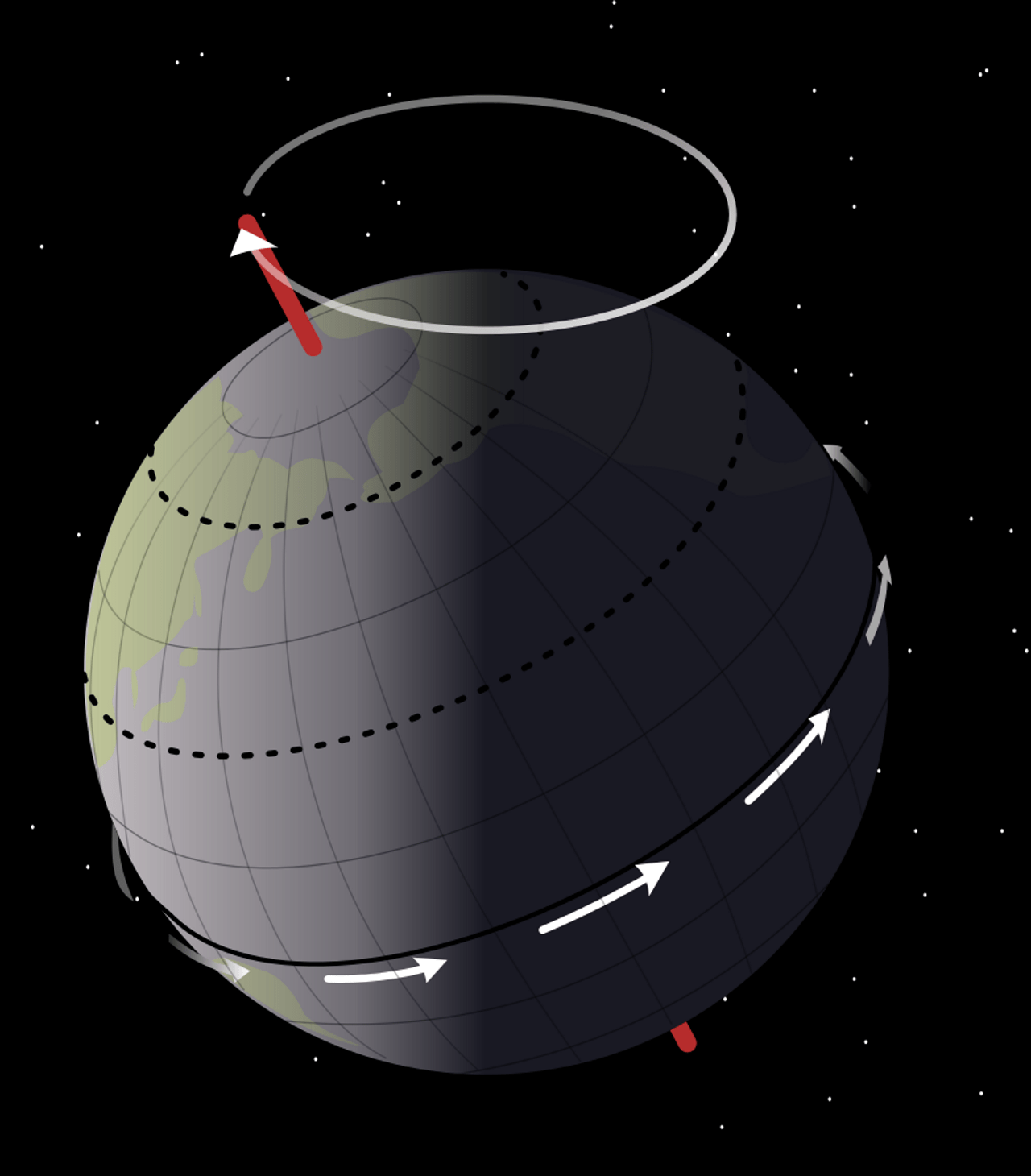
The axis of the Earth’s pole, the imaginary line that you could draw between the south pole and the north pole is currently pointed roughly at Polaris, aka The North Star. But we’re wobbling like a top, and where the axis is pointing is slowly precessing westward over the course of 26,000 years. This means that a sidereal day is actually 0.0084 seconds shorter when you account for this extra movement of the Earth’s axis.

There are other events that can increase or decrease the length of an Earth day. Because of our tidal interactions with the Moon, the length of a day on Earth has increased by about 1.7 milliseconds over the last 100 years. Powerful earthquakes can change the Earth’s rotation time by a few microseconds depending on how the tectonic plates shove around. Even as the glaciers melt, the rotation speed slows down a little more.
So, if someone asks you how long a day is, make sure they clarify whether it’s a solar day or a sidereal day. And then ask if they’d like you to incorporate the Earth’s precession, tidal locking and recent earthquakes into the calculation.
If they give you a knowing nod, congratulations, you’re talking to another member of the vast chronology conspiracy.
When did you discover your whole life was a lie? Tell us in the comments below.
The Earth is never in the same place twice because of the Corkscrew Effect, Thanks for the information Fraser and have a Great Day!…..Or is it?
I’ve know the difference between a solar day and a sidereal day since I was a teenager, and I’m in my 50’s, so the whole bit about the reader stumbling about incoherently, etc., was more than a bit overblown. It doesn’t make much difference to me in everyday life, although it does come into play when trying to explain to non-astronomy types why the stars don’t rise at the same time every day. It often occurs to me, however, when it comes to reading how long the days are on other planets. (Usually, the days described for other planets are sidereal, and for some planets with very slow rotation, like Mercury and Venus, it makes a big difference.)
Hello, R.S.,
“… So the whole bit about the reader stumbling about incoherently, etc., was more than a bit overblown. ”
I feel as though many times Fraser is just channeling his Dad-ness in these videos, like he was trying to explain these topics to his elementary/middle school-aged child who had just asked about it out of the blue. If you look at it that way, his style is not as annoying as it might first seem.
This coming from the father of nearly-adult kids who are NOT currently planning to join the community of space-related technicians. Whether despite or because of Smokey the Dad’s influence remains a deep mystery…
Also, you make a great point about the difference between the solar & sidereal days of slowly-rotating planets. A lot of times people will see , e.g,, the sidereal day for Mercury (not quite 59 Terran solar days) and think that if they somehow crash-landed there in the middle of the local night, they’d have about four weeks to find some seriously air-conditioned shelter. However, due to Nabu’s* odd orbital characteristics, the solar day there actually lasts almost half an Earth year; you might have as much as four Terran months to figure out a plan to either follow the shade of night, or construct your own!
Crazier still is the fact that at some points the orbital velocity & the spin rate of Mercury cause double sunrises & sunsets on the same day in some places, while in others the sun crosses directly overhead three separate times before slowly setting. That’s nothing to do with the actual length of the day, but still (as Fraser would say): “Madness.”
*(You didn’t think George Lucas came up with that name all by himself, did you? Of course Gene Roddenberry did it first w/”Vulcan,” so I’m certainly not judging. ^_^)
Excellent points, down the line.
Hi Fraser,
The statement:
” Even as the glaciers melt, the rotation speed slows down a little more.”
is incorrect.
As the glaciers melt the rotation speeds up.
Think of the classical example of the ice skater.
As he/she draws in his/her arms the rotational rate increases.
The slowing comes from the massive hydroelectric projects (damming rivers) (i.e. 3 Gorges, Upper Nile, etc.) of China, Turkey, Ethiopia, and other countries, plus other factors such as the tidal drag of the moon.
My opinion is that these hydroelectric projects are a better option than adding a coal fired generator every day, which was occurring because of the large increase in demand for electricity. Plus it offsets the rise in sea level from melting glaciers
Your ice skating example is a good way to look at it, but it actually tends to back what Fraser said. The idea is that melting glaciers tend to remove solid, inflexible mass of ice from the land nearer to the poles (i.e., more in line w/the skater’s axis of rotation), which is then added to the very fluid (aha) mass of the water in the oceans. Luna then pulls much of this newly mobile mass to the tidal bulges closer to the equator (i.e., away from the axis of rotation), slowing things down. In addition, larger tidal bulges (from more water mass) result in more Earth-slowing friction.
So it’s sort of like having our spinning ice dancer hold a single pose, while every silver sequin suddenly turns into an equal mass of quicksilver: once in liquid form, it all runs to her/his “equator,” slowing the rate of spin. Again, that’s the hypothesis, and in a perfect computer-model world it most definitely DOES slow the Earth’s rotation. Bigger tidal bulges = slower rotation. Just ask me. ^_^;;
Whether it actually works this way in the analog universe has proven extraordinarily hard to calculate/measure. There’s the question of the degree of the rebounding lithosphere, the compensatory large-scale shifting of tectonic masses in response to changes in crustal structure, and so on, and the whole thing is actually the subject of some fairly spirited scientific debate. (cf. every single UT article that mentions the Earth’s rotation responding to melting glaciers!)
And actually, Antarctic glaciers are growing, NASA research shows:
https://www.nasa.gov/feature/goddard/nasa-study-mass-gains-of-antarctic-ice-sheet-greater-than-losses/
So it’s the other way around again!
I think one of many examples is necessary here.
The Three Gorges dam in China took 9 years to complete and fill with 40 cubic kilometers of water. All of the glaciers in Switzerland have in total about 60 cubic kilometers of ice.
During the same nine years, the Swiss glaciers lost 9 cubic kilometers of ice.
The water from all of the Swiss glaciers that went into the oceans, evaporated, rained, and was trapped behind the 3 Gorges dam was not enough.
There were another 31 cubic kilometers necessary, that had to come from other glaciers and oceans.
This shows how difficult this problem is.
The water that came from the Swiss glaciers sped up the earths rotation, but the water that evaporated from the South China Sea and was trapped behind the Three Gorges dam slowed down the earths rotation.
Yes, Sweden and the rest of Scandinavia are rising because the pressure of the ice from the last ice age has been removed, and this would cause a slight rise in sea level (Some parts of the ocean become deeper because of the geological shift), but the next project of the Chinese on the Yangtze River is almost twice the size of the 3 Gorges, for two reasons.
First, the 3 Gorges dam does not help reduce flooding on the Yangtze river to the extent hoped.
Second, the 3 Gorges dam provides only about 1.7% of the electricity demand of China, and the Chinese need to get hydro power to about 30% of the electrical generating capacity of China.
Another example, if you are a Vietnam war era veteran, look at a current picture of the Mekong river. The water levels are way down because of a different Chinese dam project.
When taking all of these hydroelectric projects world wide together, I come to the conclusion, that the rise of the land mass of Scandinavia, and the melting of glaciers, while significant, can not be used without considering the hydroelectric projects, to determine the rate of the earths rotation, and most computer models do not properly factor in the amount of hydro power generated electricity needed in the future, and its effects.
Hello chfosmith,
I’ve mentioned in my comments on previous articles that the whole thing is like trying to figure out how much the top speed of a whale is affected by the amount/type of bacteria growing on its skin: the answer, regardless of net direction, is “NOT MUCH.” ^_^
That being said:
“The Three Gorges dam in China took 9 years to complete and fill with 40 cubic kilometers of water. All of the glaciers in Switzerland have in total about 60 cubic kilometers of ice. During the same nine years, the Swiss glaciers lost 9 cubic kilometers of ice. The water from all of the Swiss glaciers that went into the oceans, evaporated, rained, and was trapped behind the 3 Gorges dam was not enough. There were another 31 cubic kilometers necessary, that had to come from other glaciers and oceans.”
Aside from your math which compares various volumes of material with unlike densities (water & ice do not weigh the same per unit volume)… is Switzerland the only place on Earth with glaciers? I think Alaska and Greenland and Antarctica (among MANY others) are all going to be very surprised. What exactly was NASA measuring in the paper F.A.L.A. shared with us earlier in the comments?
Also, I would be very surprised if it was not China’s own glaciers which did most of the filling of the 3 Gorges Dam reservoir, as opposed to Switzerland’s; the mighty Yangtze’s headwaters & tributaries reach all the way to the mountains of Tibet… and yes, there are glaciers there, as well.
“The water that came from the Swiss glaciers sped up the earths rotation, but the water that evaporated from the South China Sea and was trapped behind the Three Gorges dam slowed down the earths rotation.”
I mean no disrespect, however this is exactly backwards per the figure-skating example we each keep citing. With the Swiss ice loss we are figuratively “spreading the arms” of the ice skater by pulling mass away from the axis of rotation and allowing it to move outward to the Equator; taking water from the South China Sea & trapping it behind the dam does exactly the opposite, pulling mass away from the Equator and towards the axis of rotation, “drawing the arms in” and increasing the spin rate.
Aside from your “GO HYDRO POWER!” stance (with which I don’t necessarily disagree), your fixation on Switzerland and Scandinavia — though both are in Europe, they are actually two separate & distinct regions — is curious to me. Not all glaciers in the Alps run through Switzerland, and the glaciers elsewhere in the world dwarf those of all the Alps together; is there something about Swiss ice which naturally contributes to the 3 Gorges Dam, while the rest of the world’s glacial melt — the vast majority — does not?
If you were simply using the amount of volume in Switzerland’s glaciers to demonstrate the massive scale of the Dam, that’s certainly fair, but it would take dozens (not to say scores or hundreds) of reservoirs on the scale of the 3 Gorges Dam to trap all of the glacial melt water in the world. And just as more dams are planned for China, in other places the lack of flooding and free water flow is causing issues for both human agriculture and the environment. This has led to a number of dams having to significantly scale back power production while the flows are being increased or decreased to match seasonal needs downstream, and in some cases it has led to them being removed altogether.
You are correct in this, though: the whole problem is particularly complex. Whatever the net effect of glacial melt or hydroelectric projects, the issue is not very easy to model, and in the end is mainly a lot to do about nothing terribly significant. You & I are certainly not going to profit or suffer very much from the gain or loss of a microsecond’s worth of sleep. ^_^