
We have no idea what it dark energy is, so how are we pretty sure it exists?
I’ve talked about how astronomers know that dark matter exists. Even though they can’t see it, they detect it through the effect its gravity has on light. Dark matter accounts for 27% of the Universe, dark energy accounts for 68% of the Universe. And again, astronomers really have no idea what what it is, only that they’re pretty sure it does exist. 95% of the nature of the Universe is a complete and total mystery. We just have no idea what this stuff is.
So this time around, lets focus on dark energy. Back in the late 90s, astronomers wanted to calculate once and for all if the Universe was open or closed. In other words, they wanted to calculate the rate of expansion of the Universe now and then compare this rate to its expansion in the past. In order to answer this question, they searched the skies for a special type of supernova known as a Type 1a.
While most supernovae are just massive stars, Type 1a are white dwarf stars that exist in a binary system. The white dwarf siphons material off of its binary partner, and when it reaches 1.6 times the mass of the Sun, it explodes. The trick is that these always explode with roughly the same amount of energy. So if you measure the brightness of a Type 1a supernova, you know roughly how far away it is.
Astronomers assumed the expansion was slowing down. But the question was, how fast was it slowing down? Would it slow to a halt and maybe even reverse direction? So, what did they discover?
In the immortal words of Isaac Asimov, “the most exciting phrase to hear in science, the one that heralds new discoveries, is not ‘Eureka’, but ‘That’s Funny’” Instead of finding that the expansion of the Universe was slowing down, they discovered that it’s speeding up. That’s like trying to calculate how quickly apples fall from trees and finding that they actually fly off into the sky, faster and faster.
Since this amazing, Nobel prize winning discovery, astronomers have used several other methods to verify this mind-bending reality of the Universe. NASA’s Wilkinson Microwave Anisotropy Probe studied the Cosmic Microwave Background Radiation of the Universe for 7 years, and put the amount of dark energy at 72.8% of the Universe. ESA’s Planck spacecraft performed an even more careful analysis and pegged that number at 68.3% of the Universe.
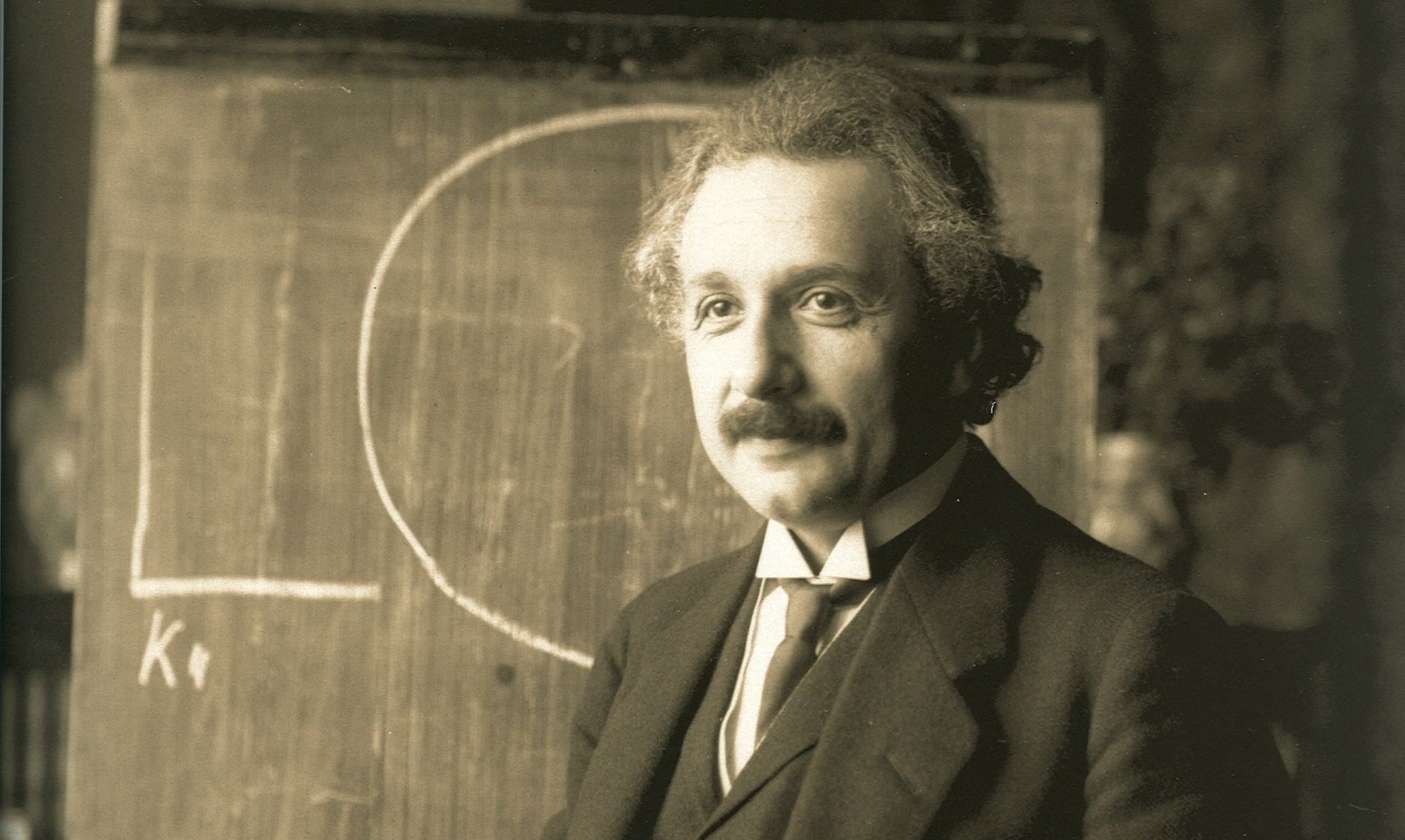
Astronomers know that dark energy exists. There are multiple lines of evidence. But as with dark matter, they have absolutely no clue what it is. Einstein described an idea he called the cosmological constant. It was a way to explain a static Universe that really should be expanding or contracting. Once astronomers figured out the Universe was actually expanding, he threw the idea out.
Hey, not so fast there “Einstein”. Maybe just one of the features of space itself is that it pushes stuff away. And the more space there is, the more outward pressure you get. Perhaps from virtual particles popping in and out of existence in the vacuum of space.
Another possibility is a phenomenon called Quintessence, a negative energy field that pervades the entire Universe. Yes, that sounds totally woo-woo, thanks Universe, Deepak Chopra crazy talk, but it might explain the repulsive force that makes up most of the Universe. And there are other theories, which are even more exotic. But mostly likely it’s something that physicists haven’t even thought of yet.
So, how do we know dark energy exists? Distant supernovae are a lot further away from each other than they should be if the expansion of the Universe was slowing down. Nobody has any idea what it is, it’s a mystery, and there’s nothing wrong with a mystery. In fact, for me, it’s one of the most exciting ideas in space and astronomy.
What do you think dark energy is?
Yeah – this is the one. Here’s the crux. It isn’t like dark matter. Dark matter just shows another example of a known phenomena – gravity attracting things. This is a new phenomena and is being constrained by what people think are right information that should be a context. I refer to the observation that the universe is flat – and if the visible amount of matter and the invisible amount of dark matter aren’t enough to make the universe flat then there must be something else that closes the universe from being “saddle” shaped to being flat. But without that constraint the universe would be “saddle” shaped. Is that where the 68% comes from? The amount of gravity it would take to flatten out the universe.
Here’s a question – would that saddle shape be exactly the observed behavior of the accelerating expansion of the universe? I don’t know – I think it might. But then that brings the more clear evidence that the universe is flat. I’ll leave that to the experts to poke at while I think about it too.
But as a result here we are proposing a new phenomena, aren’t we – some kind of gravity that is negative? Hmm?
Similar to my first thought: the shape of space/time may not be constant, resulting in expansion running differently as it expands. Maybe the overall shape of the universe is inside out, so local space time distortions act as we expect but the overall shape reverses or makes large scale expansion work with less energy than we theorize. ‘Course, I have no idea how this plays out with the macro-scale systems we’ve observed (large galaxy clusters and strands). Any real cosmologists to weigh in on matter?
So, this just makes me wonder if I understand this right: If the expansion is accelerating, then in the past it must have been slower, so if we look at very distant galaxies, for instance at a distance of 10 billion light-years away, we should see them flying away from each other more slowly than objects that are closer by. We see very distant objects in the state they were when light left hem, so very long ago, when expansion was said to be slower than today, right? I know the balloon analogy so I understand that their speed flying away from us will be higher, the farther the objects are, but you are talking about the acceleration, so that would mean not the speed but the the rate of CHANGE in speed over time, on top of the balloon effect. So is it like a balloon where you inflate air into, at constantly increasing rates? Like today 1 liter/hour, tomorrow 2 liters/hour and so on?
Looking at the Abel 123 cluster images dark matter does not appear to be attracted to dark matter. This suggests that dark matter is made in galaxies. If dark matter were presumed to have been made proportionately to the occurrence of supernovas, then dark matter distributions were determined for the most part early in the history of the universe. Galaxies could be viewed as forming from a dense population of supernovas. If somehow mass were consumed in the production of dark matter, perhaps dark energy is a reflection of this.
My understanding is that the white dwarf explodes at 1.4 solar masses, NOT 1.6. Did Fraser error????
Yep – Type Ia Supernova.
Our Universe is a larger version of a galactic polar jet.
‘Was the universe born spinning?’
http://physicsworld.com/cws/article/news/46688
“The universe was born spinning and continues to do so around a preferred axis”
Our Universe spins around a preferred axis because it is a larger version of a galactic polar jet.
‘Mysterious Cosmic ‘Dark Flow’ Tracked Deeper into Universe’
http://www.nasa.gov/centers/goddard/news/releases/2010/10-023.html
“The clusters appear to be moving along a line extending from our solar system toward Centaurus/Hydra, but the direction of this motion is less certain. Evidence indicates that the clusters are headed outward along this path, away from Earth, but the team cannot yet rule out the opposite flow. “We detect motion along this axis, but right now our data cannot state as strongly as we’d like whether the clusters are coming or going,” Kashlinsky said.”
The clusters are headed along this path because our Universe is a larger version of a polar jet.
It’s not the Big Bang; it’s the Big Ongoing.
Dark energy is dark matter continuously emitted into the Universal jet.
What if the universe is here and expanding because there is a force outside of it and not subject to its realm, time and Laws of Nature/Physics acting upon it? I believe the key lies in the “Origin” of life and matter.
Good Luck btraymd you will need it 🙂
@btraymd,
I’m the moderator who has deleted your rambling comment – total word count of 1072! – because it was in violation of Rule #2, especially, as well as Rules #3 and #4 of Universe Today’s commenting rules.
If you want to promote your stuff, or that of others of your ilk, then buy advertising – but don’t do it for free here!
Kudos to the moderating team for cracking down on this nonsense spam.
I’m not convinced we know that dark energy exists, or that the universe expansion rate is actually increasing.
First, type 1a supernova do not always explode with the same energy and it isn’t clear whether scientists understand all the implications of this variability (they do know the variability exists … see this article for example:
http://news.ucsc.edu/2009/08/3137.html
Second, there can be more than one interpretation of the increased dimming of the Type1a supernova over larger distances, and in some cases, the explanation negates the need to bring dark energy into the discussion.
The quote below is taken from the link below it:
“However, in 1998 and 1999, the observation that supernovas at greater distances are fainter than would be expected provided evidence that the rate of universe expansion has accelerated recently.
“The accelerated expansion of the universe has been attributed to the effects of dark energy,” Kipreos said. “However, there is no understanding of what dark energy is or why it has manifested only recently.
“The predicted effects of time being faster in the past would have the effect of making the plot of supernovas become linear at all distances, which would imply that there is no acceleration in the expansion of the universe. In this scenario there would be no necessity to invoke the existence of dark energy.”
http://phys.org/news/2014-12-alternative-explanation-dark-energy.html
I’m not saying “dark energy” does or does not exist, but invoking an unknown quantity as an explanation for the observed in order to explain it just seems so … unsatisfactory.