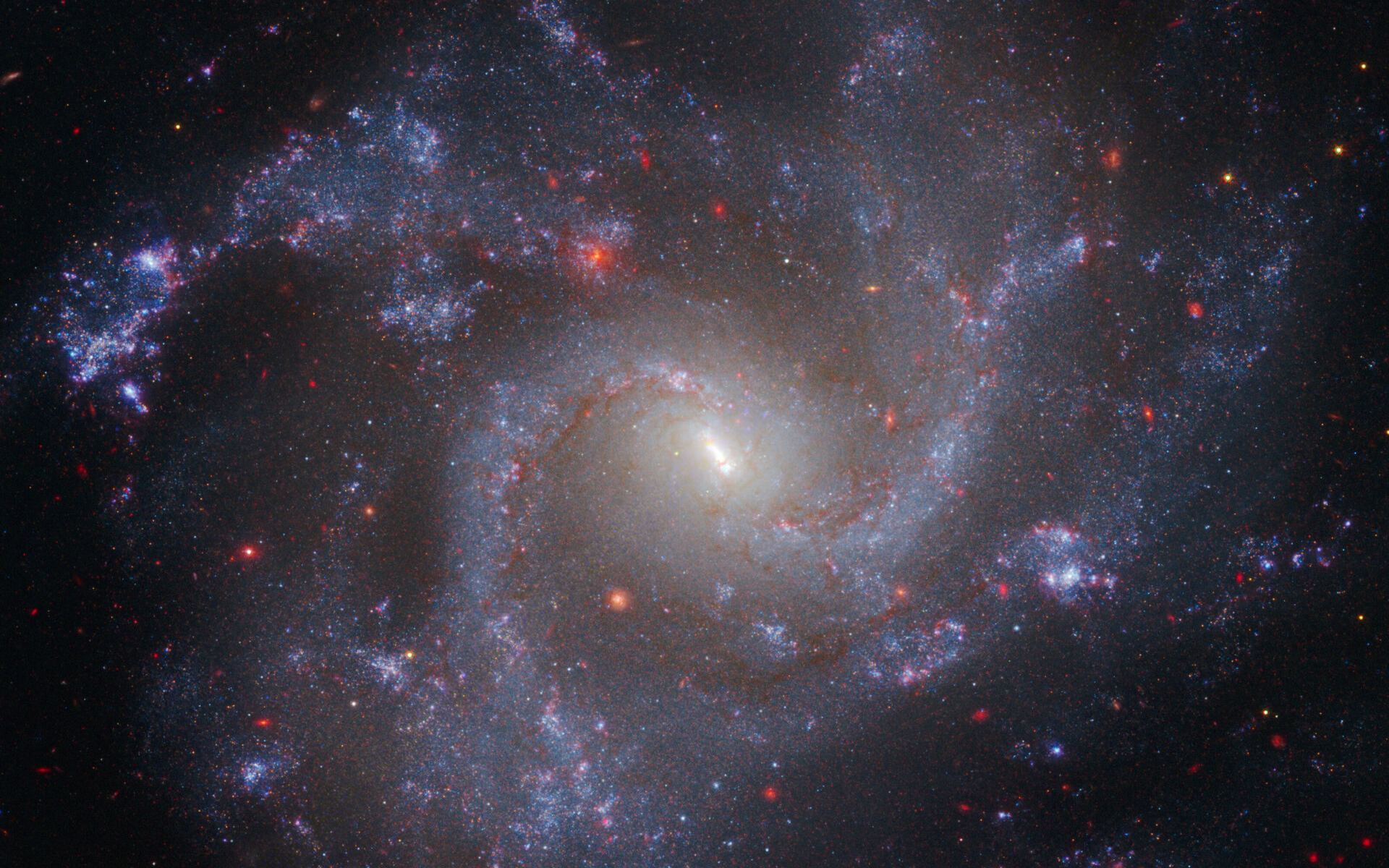
Hubble Space Telescope

by Jerry Coffey on October 15, 2010

Want to stay on top of all the space news? Follow @universetoday on Twitter

Hubble Space Telescope

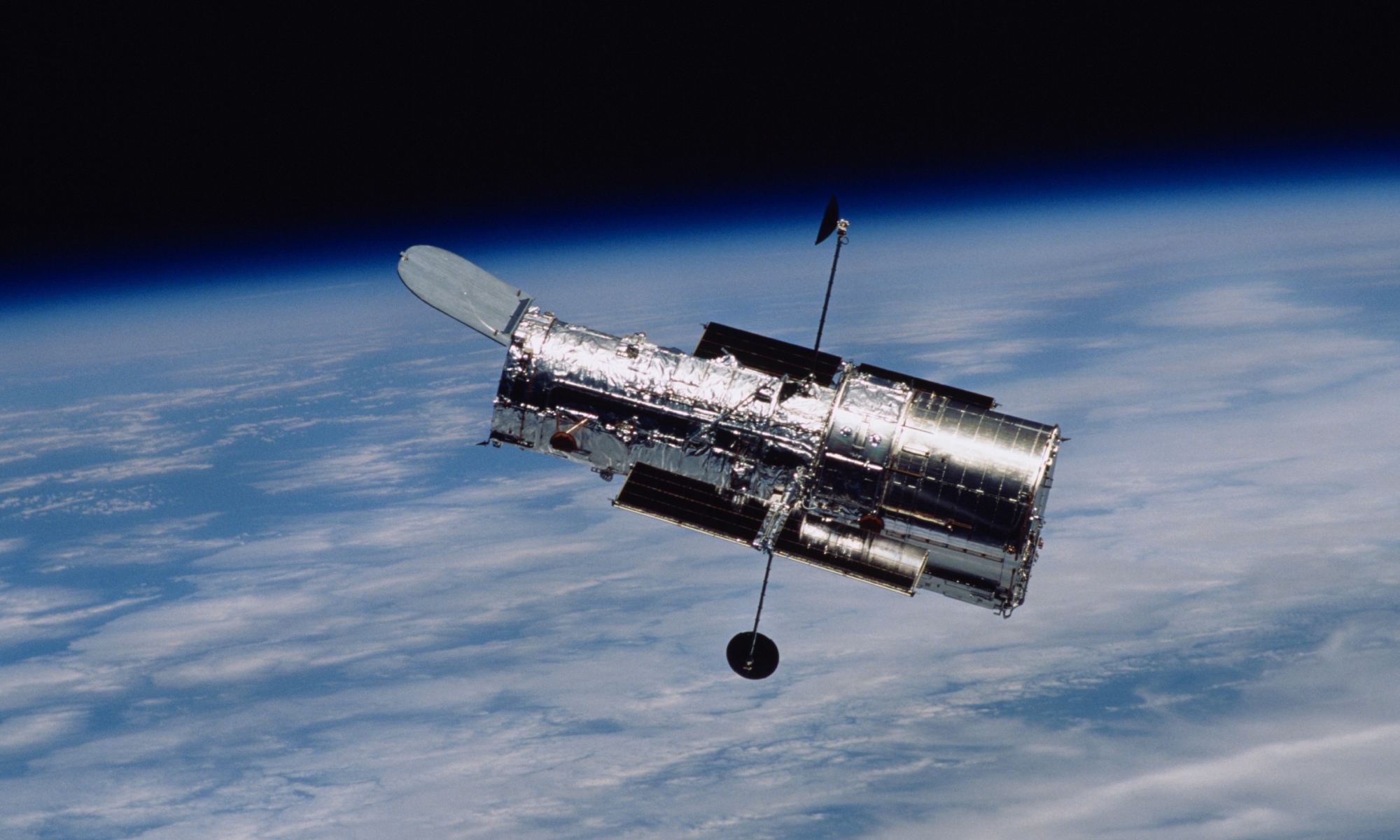
Hubble Against Earth's Horizon (1997)

The Hubble Space Telescope (HST) was carried into orbit in 1990. It was not the first space telescope, but it is one of the largest and most versatile. The HST was built by NASA with assistance from the European Space Agency. The HST is named after Edwin Hubble. Hubble’s orbit outside the distortion of Earth’s atmosphere allows it to take extremely sharp images with very little background light. Hubble observations have led to many breakthroughs in astrophysics. One of the best known is the ability to accurately determine the rate of expansion of the universe. After a servicing mission in 2009, the HST is expected to function until at 2014 at a minimum.

The HST is a Cassegrain reflector designed by Ritchy-Chretien. This design, with two hyperbolic mirrors, is known for good imaging performance over a wide field of view. The mirror and optical systems of the telescope determine the final performance, and they were designed to exacting specifications. Optical telescopes typically have mirrors polished to be accurate within a tenth of the wavelength of visible light, but the HST was intended for observations from the visible through the ultraviolet, so is diffraction limited. Because of this, its mirror needed to be polished to an accuracy of 10 nanometers of the wavelength of red light. This limits Hubble’s performance as an infrared telescope.
To keep the mirror’s weight to a minimum it consisted of inch-thick top and bottom plates sandwiching a honeycomb lattice. Construction began in 1979 and the mirror was completed by the end of 1981. It received a reflective coating of 65 nanometer thick aluminum and a 25 nanometer thick protective coating of magnesium flouride. Because of production delays NASA was forced to postpone the launch date until September 1986. By this time the total project budget had risen to $1.175 billion(U.S.).

The spacecraft that houses the telescope and instruments was another major engineering challenge. It has to adequately withstand frequent temperature extremes caused by passages from direct sunlight to the darkness of Earth’s shadow, while being stable enough to allow extremely accurate pointing of the telescope. This was solved by a shroud of multi-layer insulation that keeps the temperature within the telescope stable, and surrounds a light aluminum shell in which the telescope and instruments sit. In that shell, a graphite-epoxy frame keeps the working parts of the telescope firmly aligned.

When launched, the HST carried five scientific instruments: the Wide Field and Planetary Camera (WF/PC), Goddard High Resolution Spectrograph (GHRS), High Speed Photometer (HSP), Faint Object Camera (FOC) and the Faint Object Spectrograph (FOS). WF/PC was a high-resolution imaging device primarily intended for optical observations. It incorporated a set of 48 filters isolating spectral lines. The instrument contained eight charge-coupled device(CCD) chips divided between two cameras. The “wide field camera” (WFC) covered a large angular field at the expense of resolution, while the “planetary camera” (PC) took images at a longer focal length than the WF chips, giving it greater magnification. The GHRS was a spectrograph designed to operate in the ultraviolet and could achieve spectral resolution of 90,000. The FOC and FOS were also designed for ultraviolet observation and were capable of the highest spatial resolution of any instruments on HST. The HSP was optimized for visible and ultraviolet light observations of objects with variable brightness. It could take up to 100,000 measurements per second with a photometric accuracy of about 2%. The HST’s guidance system can also be used as a scientific instrument. Its guidance sensors are used to keep the telescope accurately pointed during observation, but can also be used to carry out astrometry measurements accurate to within 0.0003 arcseconds.

We have written many articles about the Hubble Space Telescope for Universe Today. Here’s an article about 5 spinoffs from the Hubble Space Telescope, and here are some Hubble Space Telescope images.

If you’d like more info on Hubble, check out the Hubblesite for recent stories and images, and the Hubble Heritage Project for some of the best pictures ever taken by Hubble.

We’ve also recorded an episode of Astronomy Cast all about the Hubble Space Telescope. Listen here, Episode 88: The Hubble Space Telescope.

Source: NASA

Comments on this entry are closed.

Previous post:

Next post: