

Welcome to another Messier Monday. In our ongoing tribute to the great Tammy Plotner, we bring you another item from the Messier Catalog!
In the 18th century, while searching the night sky for comets, French astronomer Charles Messier kept noting the presence of fixed, diffuse objects in the night sky. In time, he would come to compile a list of approximately 100 of these objects, with the purpose of making sure that astronomers did not mistake them for comets. However, this list – known as the Messier Catalog – would go on to serve a more important function, acting as a milestone in the history of the study of Deep Sky Objects.
However, not all objects in the catalog were first discovered by Charles Messier himself. Some, like the Lagoon Nebula, were observed sooner, owing to the fact that they are visible to the naked eye. This interstellar cloud, which is located in the Sagittarius constellation, has been known of since the late 17th century, and is one of only two star-forming nebulae that is visible to the naked eye from mid-northern latitudes.
Description:
The Lagoon Nebula is about 5200 light years away from Earth and covers an area of space about 140 by 60 light years. It is classified as an emission nebula, which are localized regions of ionized gas which emits light in different colors at wavelengths not always visible to the human eye. Its energy source is ionization from high-energy photons emitted from a nearby hot star, which causes it to glow. As with all nebulae, the colors we see in its bright clouds depend on the chemical composition and how much it is being ionized.
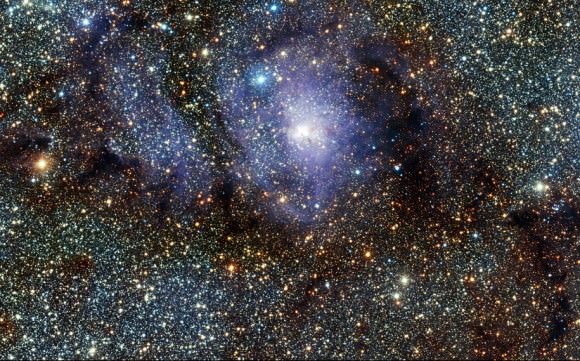
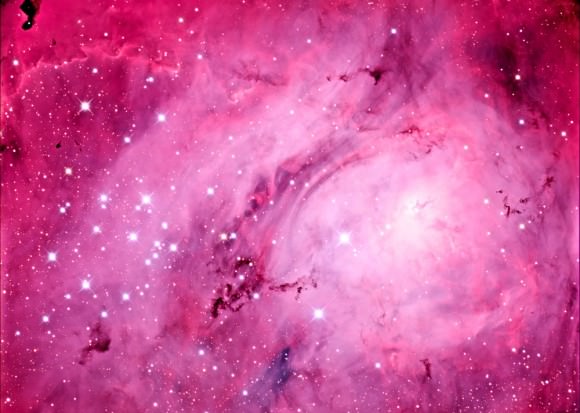
M8 appears gray (or gray/green) to the naked eye, which corresponds to it containing doubly-ionized oxygen. However, in time-exposure photos, M8 appears pinkish, which is due to the presence of ionized hydrogen. Like many emission nebulae, M8 also has dark areas where no stars or light seems to appear. These “dark nebula” are in fact just clouds of dust which block the light.
Inside the Nebula are a number of prominent star clusters and other nebulae. The most famous is the Hourglass Nebula (so named by John Herschel), which is not to be confused with the better-know Hourglass Nebula in the Musca constellation. In 2006 the first four Herbig–Haro objects were detected within the Hourglass. These small patches of nebulosity associated with newly born stars provided the first direct evidence of active star formation by accretion within the nebula.
It also includes a funnel-like structure caused by a hot O-type star that emanates ultraviolet light, heating and ionizing gases on the surface of the nebula. Inside you’ll also see young open star cluster NGC 6530. According to some theories, it may be situated just slightly in front of the nebula from our perspective, but interstellar reddening shows the nebula is also involved with the cluster. M8 is also famous for its Bok globules – dark, collapsing clouds of protostellar material. They were first discovered by E. E. Barnard and cataloged as B88, B89 and B296.
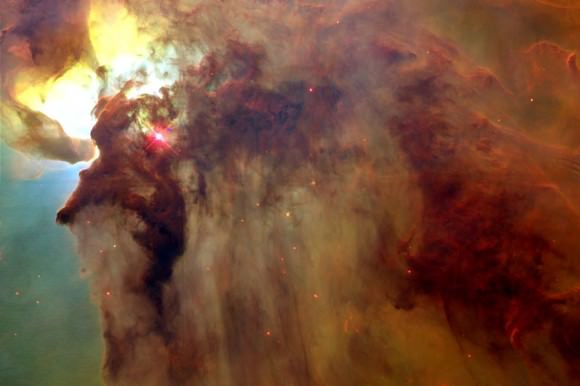
The picture shown above, which was taken by the Hubble Space Telescope, shows an area spanning about 5 light years of the Nebula. On the upper left, two long funnel-shaped clouds are shown, which measure half a light-year long and were formed by extreme stellar winds and intense, energetic starlight. The bright section is Hershel 36, an extremely bright star. Other stars appear read due to the vast walls of dust that shift their light towards the red end of the spectrum.
History of Observation:
The Lagoon Nebula was discovered by Italian astronomer Giovanni Battista Hodierna before 1654, and was then recovered by Guillaume Le Gentil in 1747 and independently noted as a “nebula” by John Flamsteed about 1680 – who cataloged it as his Number 2446. Fortunately, in 1746 Philippe Loys de Cheseaux was also peering southward. Although he couldn’t see the nebula, he did classify it as a cluster. A year later Guillaume Le Gentil picked it up, and noted both:
“The first [nebula] is between the left heel of Serpentarius [Ophiuchus] and the bow of Sagittarius, to the west of a star cluster which is located in this place in the sky, and which appears the same at eyesight, rather resembling the nebula of Cancer [Praesepe, M44]: That nebula has exactly the shape of an equilateral triangle, a bit elongated, and the turning point to the south-west. I have observed it with a refractor of 18 to 20 feet [FL], and it always appeared to me nebulous and transparent; it touches with its base a rather beautiful star, seen in the refractor, and which is the brightest of all those which compose the star cluster I have mentioned. The right ascension of this star is for the beginning of 1748, 266d 44′ 22″ [17h 46m 57s], its southern declination, 25d 8′ 10″, its [ecliptical] longitude, 26d 45′ 00″, and its southern [ecliptical] latitude 1d 30′ 00”.
Nicholas Louis de Lacaille had written down the Lagoon Nebula in his 1751-52 works as Lacaille III.14. But when Charles Messier cataloged this object on May 23, 1764, it became famous at last:
“I also have determined, in the same night [May 23 to 24, 1764], the position of a small star cluster which one sees in the form of a nebula, if one views it with an ordinary [non-achromatic] refractor of 3 feet [FL], but when employing a good instrument one notices a large quantity of small stars: near this cluster is a rather brilliant star which is surrounded by a very faint light: this is the ninth star of Sagittarius, of seventh magnitude, according to the catalog of Flamsteed: this cluster appears in an elongated shape which extends from North-East to South-West. I observed its position during its passage of the Meridian, comparing it with the star Delta Sagittarii, and I determined its right ascension as 267d 29′ 30″, and its declination as 24d 21′ 10″ south. This star cluster could have an extension, from North-East to South-West, of about 30 minutes of arc.”
Locating Messier 8:
Although the constellation of Sagittarius is recognized as the Archer, it is most familiar as an asterism known as the ‘teapot’. Where skies are dark, its simple house-like shape appears like a teapot in the sky and the steam escaping the spout is the Milky Way. Finding Messier 8 with binoculars or a telescope is therefore easy in a dark location, because you only need to start at the tip of the teapot’s spout and move your optics due north until the large, bright nebula appears.
However, not everyone is blessed with dark skies, and finding M8 from an urban location can be a little more difficult. From a well-lit location, both the teapot lid star (Lambda) and Alpha Scorpii (Antares) are apparent. You’ll find M8 just slightly north, at about 1/4 of the distance between Lambda and Alpha. For those using binoculars, it will be quite bright and you’ll see the beginnings of its embedded open cluster.
A telescope of any size will meanwhile resolve the cluster and bring up wonderful details in the wispy nebula. Large aperture should also look for accompanying dark nebula, too. Be aware that although it is bright, well-lit situations will greatly reduce contrast and a moonlit night or city lights will make it very difficult to find. Because of the Lagoon Nebula’s large apparent size, use low magnification to see the full extent of the nebula, but be sure to up the power to study its many features!
And for your convenience, here are the quick facts:
Object Name: Messier 8
Alternative Designations: M8, NGC 6523, Sharpless 25, RCW 146, Gum 72, Lagoon Nebula
Object Type: Emission Nebula
Constellation: Sagittarius
Right Ascension: 18 : 03.8 (h:m)
Declination: -24 : 23 (deg:m)
Distance: 5.2 (kly)
Visual Brightness: 6.0 (mag)
Apparent Dimension: 90×40 (arc min)
Enjoy this ancient beauty!
We have written many interesting articles about Messier Objects here at Universe Today. Here’s Tammy Plotner’s Introduction to the Messier Objects, Stunning, Colorful New Look at the Lagoon Nebula, Dive Into the Infrared Lagoon (Nebula)!, M1 – The Crab Nebula, and David Dickison’s articles on the 2013 and 2014 Messier Marathons.
Be to sure to check out our complete Messier Catalog. And for more information, check out the SEDS Messier Database.