
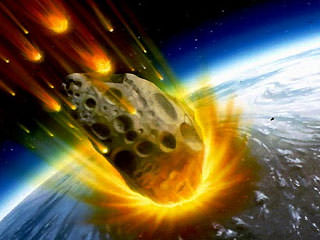
Over the years, scientists have debated the cause of the mass extinction that wiped out the dinosaurs 65 million years ago. Now, a panel of 41 international experts says it’s official: a massive asteroid around 15 kilometers wide slamming into Earth at Chicxulub, Mexico is the culprit. After surveying a wide variety of evidence for the competing theories, the panel said the telling evidence was the structures preserved in the interior of the crater. Computer models predicted how much rock was vaporized or ejected by the impact. “Our work lets us visualize the astonishing events of the few minutes after impact,” said Dr. Penny Barton, who led the group. “The front of the asteroid hit the Earth while the far side was still out in the upper atmosphere, punching a hole though the Earth’s atmosphere.”
The Cretaceous-Paleogene extinction was one of the biggest in earth’s history and geologic evidence of the impact has been discovered in rock layers from this time period, around the world. While the impact is widely accepted as the cause for the mass extinction, some critics disagreed, saying, for example, that the microfossils from the Gulf of Mexico show that the impact occurred well before the extinction and could not have been its primary cause.
The massive volcanism that produced the Deccan traps of India around this time has also been proposed as the main cause of the extinction. But in the panel’s review, the computer models synthesized the geologic evidence that support the impact hypothesis. The models showed that such an impact would have instantly caused devastating shock waves, a large heat pulse and tsunamis around the globe.
Moreover, a release of larger amounts of dust, debris and gases would have led to a prolonged cooling of Earth’s surface, low light levels and ocean acidification that would have decimated photosynthesizing plants and the species that relied on them.
The asteroid is believed to have hit Earth with a force one billion times more powerful than the atomic bomb at Hiroshima. It would have blasted material at high velocity into the atmosphere, triggering a chain of events that caused a global winter, wiping out much of life on Earth in a matter of days.
“As the asteroid vaporized explosively,” said Barton, from the University of Cambridge in the UK, “it created a crater 30 km deep and 100 km across, with sides as high as the Himalayas. However within only two minutes the sides collapsed inwards and the deepest parts of the crater rebounded upwards to leave a wide, shallow hollow.
“These terrifying events led to darkness and a global winter, resulting in the extinction of more than 70% of known species. The tiny shrew-like mammals which were around at that time proved better adapted to survival than the cumbersome dinosaurs, and the removal of these dominant animals paved the way for the radiation of the mammals and eventual emergence of humans on Earth.”
The team’s paper was published in the journal Science.
Sources: University of Cambridge
“The tiny shrew-like mammals which were around at that time proved better adapted to survival than the cumbersome dinosaurs, and the removal of these dominant animals paved the way for the radiation of the mammals”
Not only a teleological argument without any respect for the existence of likelihoods whatsoever, but wrong through and through:
– “the cumbersome dinosaurs” not only survived, but did so better than mammals, since the number of species today (of birds) outnumber the mammals 2:1. [IIRC, ~ 6 000 species vs ~ 3
000.]
– These “dominant animals” didn’t dominate the skies or the seas. But the parallel extinction of pterosaurs led to the dinosaurs subsequent dominance of the skies. (And the parallel extinction of mosasaurs and those newfound plankton-feeder fishes, Bonnerichthys with relatives, led to the mammals subsequent domination of the seas up to and including giant sifters.)
– Modern mammals started to radiate way before the Cretacean extinction.
But Penny Barton is in Earth Sciences, not biology.
OTOH, I note that they exclude the proposed earlier Indian impact by implication.
[And really, two of those events so close? That isn’t even likelihood but probability of Poisson processes, and apparently earth scientists can manage that.]
@ Jorge: Fascinating question! Unfortunately my curiosity hit a pay-wall. Hopefully someone can supply the answer here instead.
So 15km wide and….how what are the other dimensions? 60+km long to be hitting the surface and still in the upper atmosphere?
Something is amiss here or I’m blind to some info in this.
Help?
“paved the way for the … eventual emergence of humans on Earth”
So slightly teleological argument.
For those interested in further reading on the Chicxulub impact, may I suggest ‘T. Rex and the Crater of Doom’ by Walter Alvarez, one of the scientists involved in the great scientific detective story surrounding the KT extinction.
It’s a sobering thought that up to 1975 it was thought that craters were mainly volcanic in origin (both on the Moon and Earth). Then came Alavarez’s work and Gene Shoemaker and his wife who realised that Meteor Crater in Arizona, for example was caused by an impact.
Everything changed in 1994 with Shoemaker Levy 9’s impact on Jupiter… and the rest is history (a bit like poor old T Rex!!!)
Here’s a curiosity: would this impact be strong enough to blast Earth material out of Earth’s gravitational well? Could there be Terran asteroids out there, originated in Chicxulub?
Um, sorry about the bad spelling. Also about confusing two concepts of dominance (number of species vs number of large species).
This isn’t news, the dinosaurs have known this for years.
Jorge just had an awesome insight! Are there Terran asteroids? Where are they? What information could we gain from them?
If there are any, they are probably beyond our reach in the dark reaches of space, but maybe Mars has some. Reverse panspermia anyone?
I’m guessing that the initial impact transmitted so much energy that the “solid” layers of earth that were impacted were either liquefied or suspended enough to act like a fluid for a short time, and that a wave of earth traveled and persisted for a measurable amount of time — thus an initial crater with a final crater of different size and shape.Pandora accessories
Computer models CANNOT be used to conclusively prove anything. It reflects bias of the programmmer, confirming his suspisions. Models also cannot account for anything which may be totally unknown to the person programming the model.
I find it fascinating many gigantic creatures occupied terra firma for over 250 million years, yet seemingly were abruptly handed their hat and shown the cosmic door. So much for seniority privileges. 😉
250 million years is a daunting amount of time, yet a mere 2% of the Universe’s approximate age. Time for sleep…overwhelm just kicked in.
Torbjorn Larsson OM Says:
March 4th, 2010 at 4:21 pm
Well, at least one of your points is somewhat contentious. There has never been too firm a connection between modern birds and dinosaurs, and a few recent studies which I can’t be bothered tracking down seem to cast further serious doubt over it.
Seeing as I’m not providing any sources, feel free to take this as you will. I simply can’t be bothered trying to find them at the moment, though I did give them a cursory glance a while ago…
Well, as since Jorge says, the evidence is really, really solid on that one, I won’t take it at all.
But FWIW, here are some references on the current crackpot contenders:
Here and here. As Nash notes, these have never reached the technical literature, and there are reasons for that:
Meanwhile, AFAIU today every fossil find pertaining to these lineages confirm the prediction nicely. Feathers are older than birds, the proteins (!) extracted from dinosaurs are phylogenetically most related to birds, cetera.
There is no “somewhat contentious” on this one. As evolution, big bang or AGW there are some fabricated “controversy” of mainly outside interests [I believe the “birds are not dinosaur” crowd are mainly not paleontologists]. With the 99.9 % or so of the scientific majority proceeding with real research.
Sorry, Astrofiend, the evidence that birds are just winged dinosaurs is rock solid (pun intended). There are numerous anatomical hints to it, but the major evidence comes from the fossil record. Like relatively recent discoveries of raptor-like dinosaurs covered in feathers. Feathered animals much less bird-like than the Archaeropteryx (but still with plenty of bird-like characteristics other than the feathers) pretty much prove the connection.
It’s not so much the models that have led to this conclusion more that the tektites deposits further from the impact site are dated from the time of the impact. The deposits studied ‘in situ’ having being violently churned up have given a date 300,000 years too soon. The Deccan Traps were spread over 1.5 million years and no appreciable change occurred in the ecosystem in th efirst half million years.
Why no, they are probably on the Moon, since they would orbit the Earth and there’s that giant fly swatter right in the middle of the road.
Other places to search would be the NEOs and perhaps our Lagrange points.
Let us parse this:
– “Computer models CANNOT be used to” = I have never heard about theories and don’t know that/how they can be tested to desired remaining uncertainty.
– “conclusively” = I have never heard about theories and don’t know that/how they can be tested to desired remaining uncertainty.
– “conclusively” = I have never heard about theories and don’t know that/how they can be tested to desired remaining uncertainty.
Okay, thanks, we got it already at the “CANNOT” shout of crank fame.
Oops, commenting that much, so of course need to put up a correction: the 2nd “conclusively” in my reply to RUF should of course be “prove”.
In some sense “proving” is a convenient shorthand for the procedure of testing.
But more aptly that would be “disproving” anyway, passing a test gives either a falsification or a quantifiable uncertainty but no “proof”. And the use of “prove” is nowadays a pretty dead giveaway that there is a quasi-inductivist in the house, pretending science is math and math isn’t empirical but “platonic” or some such nonsense.
I swear, next time I see someone claiming that science “prove” stuff, I’m going to scream.
The computer model used for this research is pretty much dead on.
The model uses physics to come up with the answers to this scenario. The results are then checked against physical findings in order to figure accuracy. For instance, the model will say some of the ejecta would have been melted and would land as far away as point x. It would also provide the amount of certain ejecta at certain distances. Since we know the actual physical findings, if the model comes up with the same numbers then you know the data is reliable. They probably had at least 10 checks like this to test for accuracy.
This doesn’t mean your sceptism about the findings aren’t without merit. We haven’t heard how accurate the model is against physical findings, and whether or not another model All we know right now, is it must have been enough to convince some experts in the field.
It would be interesting to see the entire data from this simulation; especially to find out if some pieces could reach escape velocity.
Myself… I always felt it was a combination of the meteor, volcanos, etc. Not sure if just one alone would have put the Earth into a deep freeze. Another good reason to go through all the data from this experiment.
Rubbish. How can the 41 international experts explain the evidence in the fossil record that dinosaur species where becoming extinct millions of years before the asteroid impact .
The fossil record shows us that dinosaur species types had dropped from 30 plus to about 7 species types from 60 million years ago to 65 million years ago.
The asteroid impact occurred when dinosaurs where already basically extinct.
It’s interesting to contemplate just how “useful” mass extinctions are to jump-starting species down new paths of evolution. Maybe some mass extinctions are good, maybe some are bad in the grand scheme…I’m not sure.
Very interesting, isn’t possible the volcano could have triggered by the impact or it was already in process, its a puzzle we’ll never be able to answer for sure , just like the how the moon came to be.
Well Spoodle58, i will try to make sense of what you just said.
1. 65 Ma ago an astreoid hits the earth
2. Between 65 Ma ago and 60 Ma ago the population of dinosaurs drop from 30 to 7.
3. The asteroid in 1. hit before the dinosaurs was already basically extinct. Well, duh, it seems to have started the entire scenario.
Something hints to me that you have confused past timeline, 60 Ma ago is after 65 Ma ago, not before.
Could be 65 Million BC. 🙂
I have a question. Maybe somebody has looked into this. When the asteroid hit huge shock waves, or seismic waves went through the Earth. There is an effective lensing due to the acoustical propagation of various layers in the Earth. These would have partially focused a lot of this energy on the antipodal side of the Earth, or along a line of the asteroid’s trajectory. This then might have caused a pretty serious upheaval there. The Deccan flats or volcanoes also blew their stack around this time. The question is whether these might have been caused by this event.
As for dinosaurs going extinct, the line of microraptors which came about in the early Cretaceous did survive as birds. In fact by the end of the Cretaceous it appears these already constituted the largest number of species of dinosaurs.
LC
Very interesting, but is this called speculation
is it not? Any one notice the time corrolation
of the release of this ” DEFENITE” conclusion
and the recent quake in Chili?
If in accordense with this paper the Earth
MUST have moved its trajectory, not by an inch, but by several Kilometers and if an 8.8
Rigther can cause a shift in the Earth axis?
Then what would the shift in axis and the rotational speed be at such an impact?
If this would happen today, most live forms
would perris!
I convinced that they droped the ball on this one!
P.S. please elevate from the debate of who came first, the chicken or the egg?
Which is entirely unrelated. Is this some weird attempt at post-hoc-ergo-propter hoc? As if those who conducted the review of the literature started working after the earth quake.
So what’s the point you’re trying to make? The impact couldn’t happen because, well, “most live [sic] forms” would be in peril? That doesn’t make sense. Or are you just expressing your distress that if this were to happen again we’d be on our way out?
And actually, while an asteroid impact can alter the axial tilt of a planet the size of earth (not very significantly though), the TRAJECTORY will remain almost the same. The size difference, 12km vs. 12000km, is just too huge for that.
I thought about this a few weeks ago in fact. It is of course the case there was already was a tectonic plate boundary present. There may be been volcanism there. India at that time was detached from Asia and more tropical, putting it pretty darn close to the antipodal point of the Chicxulub impact point. Yet the huge seismic wave focused near this region might have caused enough of a rupture or dislocation to hyperdrive volcanism at the Deccan traps. I thought about writing a computer program to model this problem, but I have to carve out considerable amount of time to do that. If this is the case it was a gift from heaven that kept on giving, where subsequent decades of intense volcanism would have prolonged and compounded the change to the planetary environment.
I suspect the main cause for extinction was the chemical change in the environment. The large amount of sulfides released in the atmosphere would have acidified oceans and changed the background chemistry life had adapted to. It is worth pondering how we humans might be engineering such an change now.
LC
@ Excalibur
Sorry typo, glad you caught it.
It should read as.
The fossil record shows us that dinosaur species types had dropped from 30 plus to about 7 species types from 70 million years ago to 65 million years ago.