

Earth is the only planet in our Solar System where life is known to exists. Note the use of the word “known”, which is indicative of the fact that our knowledge of the Solar System is still in its infancy, and the search for life continues. However, from all observable indications, Earth is the only place in our Solar System where life can – and does – exist on the surface.
This is due to a number of factors, which include Earth’s position relative to the Sun. Being in the “Goldilocks Zone” (aka. habitable zone), and the existence of an atmosphere (and magnetosphere), Earth is able to maintain a stable average temperature on its surface that allows for the existence of warm, flowing water on its surface, and conditions favorable to life.
Variations:
The average temperature on the surface of Earth depends on a number of factors. These include the time of day, the time of year, and where the temperatures measurements are being taken. Given that the Earth experiences a sidereal rotation of approximately 24 hours – which means one side is never always facing towards the Sun – temperatures rise in the day and drop in the evening, sometimes substantially.
And given that Earth has an inclined axis (approximately 23° towards the Sun’s equator), the Northern and Southern Hemispheres of Earth are either tilted towards or away from the Sun during the summer and winter seasons, respectively. And given that equatorial regions of the Earth are closer to the Sun, and certain parts of the world experience more sunlight and less cloud cover, temperatures range widely across the planet.
However, not every region on the planet experiences four seasons. At the equator, the temperature is on average higher and the region does not experience cold and hot seasons in the same way the Northern and Southern Hemispheres do. This is because the amount of sunlight the reaches the equator changes very little, although the temperatures do vary somewhat during the rainy season.
Measurement:
The average surface temperature on Earth is approximately 14°C; but as already noted, this varies. For instance, the hottest temperature ever recorded on Earth was 70.7°C (159°F), which was taken in the Lut Desert of Iran. These measurements were part of a global temperature survey conducted by scientists at NASA’s Earth Observatory during the summers of 2003 to 2009. For five of the seven years surveyed (2004, 2005, 2006, 2007, and 2009) the Lut Desert was the hottest spot on Earth.
However, it was not the hottest spot for every single year in the survey. In 2003, the satellites recorded a temperature of 69.3°C (156.7°F) – the second highest in the seven-year analysis – in the shrublands of Queensland, Australia. And in 2008, the Flaming Mountain got its due, with a yearly maximum temperature of 66.8°C (152.2°F) recorded in the nearby Turpan Basin in western China.
Meanwhile, the coldest temperature ever recorded on Earth was measured at the Soviet Vostok Station on the Antarctic Plateau. Using ground-based measurements, the temperature reached a historic low of -89.2°C (-129°F) on July 21st, 1983. Analysis of satellite data indicated a probable temperature of around -93.2 °C (-135.8 °F; 180.0 K), also in Antarctica, on August 10th, 2010. However, this reading was not confirmed by ground measurements, and thus the previous record remains.
All of these measurements were based on temperature readings that were performed in accordance with the World Meteorological Organization standard. By these regulations, air temperature is measured out of direct sunlight – because the materials in and around the thermometer can absorb radiation and affect the sensing of heat – and thermometers are to be situated 1.2 to 2 meters off the ground.
Comparison to Other Planets:
Despite variations in temperature according to time of day, season, and location, Earth’s temperatures are remarkably stable compared to other planets in the Solar System. For instance, on Mercury, temperatures range from molten hot to extremely cold, due to its proximity to the Sun, lack of an atmosphere, and its slow rotation. In short, temperatures can reach up to 465 °C on the side facing the Sun, and drop to -184°C on the side facing away from it.
Venus, thanks to its thick atmosphere of carbon dioxide and sulfur dioxide, is the hottest planet in our Solar System. At its hottest, it can reach temperatures of up to 460 °C on a regular basis. Meanwhile, Mars’ average surface temperature is -55 °C, but the Red Planet also experiences some variability, with temperatures ranging as high as 20 °C at the equator during midday, to as low as -153 °C at the poles.
On average though, it is much colder than Earth, being just on the outer edge of the habitable zone, and because of its thin atmosphere – which is not sufficient to retain heat. In addition, its surface temperature can vary by as much as 20 °C due to Mars’ eccentric orbit around the Sun (meaning that it is closer to the Sun at certain points in its orbit than at others).
Since Jupiter is a gas giant, and has no solid surface, an accurate assessment of it’s “surface temperature” is impossible. But measurements taken from the top of Jupiter’s clouds indicate a temperature of approximately -145°C. Similarly, Saturn is a rather cold gas giant planet, with an average temperature of -178 °Celsius. But because of Saturn’s tilt, the southern and northern hemispheres are heated differently, causing seasonal temperature variation.
Uranus is the coldest planet in our Solar System, with a lowest recorded temperature of -224°C, while temperatures in Neptune’s upper atmosphere reach as low as -218°C. In short, the Solar System runs the gambit from extreme cold to extreme hot, with plenty of variance and only a few places that are temperate enough to sustain life. And of all of those, it is only planet Earth that seems to strike the careful balance required to sustain it perpetually.
Variations Throughout History:
Estimates on the average surface temperature of Earth are somewhat limited due to the fact that temperatures have only been recorded for the past two hundred years. Thus, throughout history the recorded highs and lows have varied considerably. An extreme example of this would during the early history of the Solar System, some 3.75 billion years ago.
At this time, the Sun roughly 25% fainter than it is today, and Earth’s atmosphere was still in the process of formation. Nevertheless, according to some research, it is believed that the Earth’s primordial atmosphere – due to its concentrations of methane and carbon dioxide – could have sustained surface temperatures above freezing.
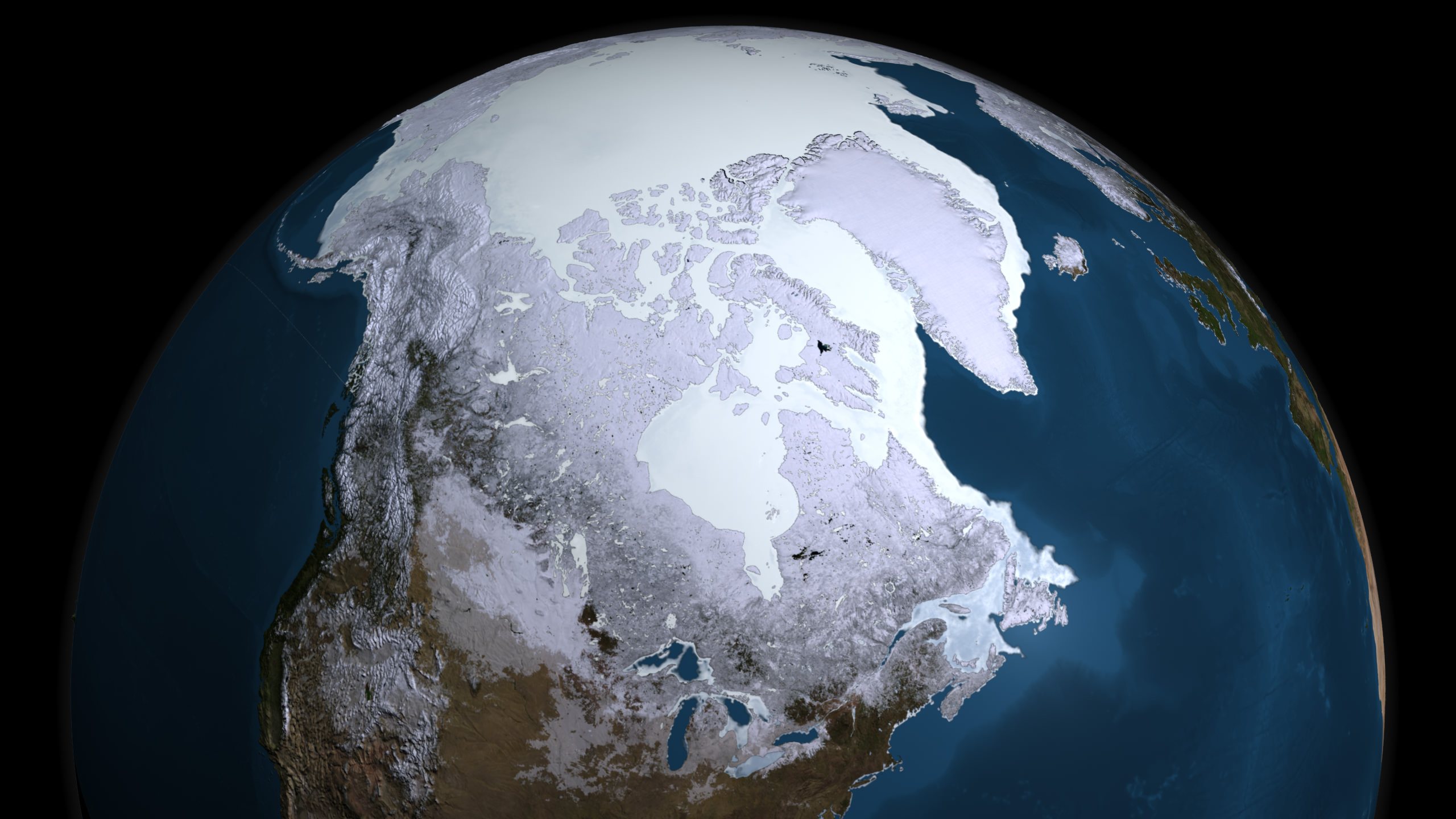
Earth has also undergone periodic climate shifts in the past 2.4 billion years, including five major ice ages – known as the Huronian, Cryogenian, Andean-Saharan, Karoo, and Pliocene-Quaternary, respectively. These consisted of glacial periods where the accumulation of snow and ice increased the surface albedo, more of the Sun’s energy was reflected into space, and the planet maintained a lower atmospheric and average surface temperature.
These periods were separated by “inter-glacial periods”, where increases in greenhouse gases – such as those released by volcanic activity – increased the global temperature and produced a thaw. This process, which is also known as “global warming”, has become a source of controversy during the modern age, where human agency has become a dominant factor in climate change. Hence why some geologists use the term “Anthropocene” to refer to this period.
Thanks to increasing concentrations of CO² and other greenhouses gases, which are generated by human activity, average surface temperatures have been steadily increasing since the mid-20th century. For the past few decades, NASA has been charting average surface temperature increases through the Earth Observatory.

Internal Temperatures:
When talking about the temperatures of planets, there is a major difference between what is measured at the surface and what conditions exist within the planet’s interior. Essentially, the temperature gets cooler the farther one ventures from the core, which is due to the planet’s internal pressure steadily decreasing the father out one goes. And while scientists have never sent a probe to our planet’s core to obtain accurate measurements, various estimates have been made.
For instance, it is believed that the temperature of the Earth’s inner core is as high as 7000 °C, whereas the outer core is thought to be between 4000 and 6000 °C. Meanwhile, the mantle, the region that lies just below the Earth’s outer crust, is estimated to be around 870 °C. And of course, the temperature continues to steadily cool as you rise in the atmosphere.
In the end, temperatures vary considerably on every planet in our Solar System, due to a multitude of factors. But from what we can tell, Earth is alone in that it experiences temperature variations small enough to achieve a degree of stability. Basically, it is the only place we know of that it is both warm enough and cool enough to support life. Everywhere else is just too extreme!
Universe Today has articles on the temperature of Earth and the temperature of the planets. Here are some interesting facts about planet Earth, and here’s an article about why Earth has seasons.
If you’d like more info on Earth, check out NASA’s Solar System Exploration Guide on Earth. And here’s a link to NASA’s Earth Observatory.
For more information, try Earth’s temperature tracker and seasonal temperature cycles.
We’ve also recorded an episode of Astronomy Cast all about planet Earth. Listen here, Episode 51: Earth.
dihydrogen monooxyde is to blame 70% of the time, where it concerns Earth, on the surface of it all.
It might be suffocating below the more obvious transition line, but it would be way hotter if there was none of it on Earth. Not to mention that its transition state from 3rd to 2nd phase instigates a lot radiation prevention due to its reflective nature.
Quite an article, Matt. A whole lot of history and information for just one piece.
I have to take issue with your statement that an inclination of the earth’s orbit causes our seasons. It is the inclination of the earth’s axis that does that, not of its orbit. I was never aware that the orbit was inclined several degrees to the sun’s equator. Where does that claim originate?
Be that as it may, I need to ask because I’ve either plain forgotten or plain didn’t know in the first place:
Where is Earth in our sun’s Goldilocks zone? Is it centered or toward the inner or outer edge, and if so, how far from an edge?
Respectfully,
Woops! That would be what we call a typo, thanks for catching it.
It would be highly unlikely for a planet to orbit it’s star at an inclination of exactly 0°, maybe impossible? All of the planets’ orbits (not including dwarf planets) are inclined several degrees to the Sun’s equator. Actually, I believe Earth’s orbit is inclined the most (as viewed from the Sun’s equator), by maybe a degree or two more than the other planets. Although they are all inclined fairly closely together, and at fairly small inclinations all under 7-8° if I recall correctly (again, from the Sun’s equator).
We are pretty well in the middle of our Sun’s conservatively estimated habitable zone, maybe a hint towards the inside (towards the Sun). This zone extends out to just before the orbit of Mars, and extends in to just before the orbit of Venus. However, some less conservative estimates put the HZ out to 3AU, just past the orbit of Ceres.
Goldilocks is a very relativistic notion which is very direct reported to the life we know. For another types of life (not based on DNA or even carbon) our zone may be out of their pleasure. For example even here there are types of life (extremofiles) like on the ocean floor near hydrothermal vents that like (and only can) live at temperatures between 80–122 °Celsius (248 °F).
“And given that Earth has an inclined orbit (approximately 7.15° to the Sun’s equator), the Northern and Southern Hemispheres of Earth are either tilted towards or away from the Sun during the summer and winter seasons, respectively. And given that equatorial regions of the Earth are closer to the Sun”
Hi Matt, The Earths seasons are caused by the Earths 23.5 degree axis tilt and has nothing to do with the inclined orbit. Also, the equatorial regions being closer to the sun is insignificant because of the distance involved. The suns rays are overhead and more direct than other latitudes.
Gaugin beat you to it. But thanks 🙂