

[/caption]
Arthur C Clarke allegedly said that the space elevator would be built fifty years after people stopped laughing. The first space tower though… well, that might need a hundred years. The idea of raising a structure from the ground up to 100 kilometers in height seems more than a bit implausible by today’s engineering standards, given that we are yet to build anything that is more than one kilometer in height. The idea that we could build something up to geosynchronous orbit at 36,000 kilometers in height is just plain LOL… isn’t it?
Space tower proponents point to a key problem with the space elevator design. It may only be after we have spent years inventing a method to manufacture 36,000 kilometers of flawless carbon or boron nanotube fiber – which is light enough not to break under its own weight, but still strong enough to lift an elevator cabin – that we suddenly realize that we still have to get power to the cabin’s lifting engine. And doesn’t that just mean adding 36,000 kilometers of conventional (and heavy) electrical cable to the construction?
Mind you, building a space tower brings its own challenges. It’s estimated that a steel tower, containing an elevator and cabling, of 100 kilometers height needs a cross-sectional base that is a 100 times greater than its apex and a mass that is 135 times greater than its payload (which might be a viewing platform for tourists).
A solid construction capable of holding up a launch platform at 36,000 kilometers altitude might need a tower with ten million times the mass of its payload – with a cross-sectional base covering the area of, say, Spain. And the only construction material likely to withstand the stresses involved would be industrial diamond.
A more economical approach, though no less ambitious or LOL-inducing, are centrifugal and kinetic towers. These are structures that can potentially exceed a height of 100 kilometers, support an appreciable mass at their apex and still maintain structural stability – by virtue of a rapidly rotating loop of cable which not only supports its own weight, but generates lift through centrifugal force. The rotation of the cable loop is driven by a ground-based engine, which can also drive a separate elevator cable to lift courageous tourists. Gaining altitudes of 36,000 kilometers is suggested to be achievable by staged constructions and lighter materials. But, it might be sensible to first see if this grand design on paper can translate to a proposed four kilometer test tower – and then take it from there.
There are also inflatable space towers, proposed to be capable of achieving heights of 3 kilometers with hot air, 30 kilometers with helium or even 100 kilometers with hydrogen (oh, the humanity). Allegedly, a 36,000 kilometer tower might be achievable if filled with electron gas. This is a curious substance argued to be capable of exerting different inflationary pressures depending on the charge applied to the thin-film membrane which contains it. This would allow a structure to withstand differential stresses – where, in a highly charged state, the highly excited electron gas mimics a molecular gas under high pressure, but with a reduced charge it exerts less pressure and the structure containing it becomes more flexible – although, in either case, the overall mass of the gas remains unchanged and suitably low. Hmmm…
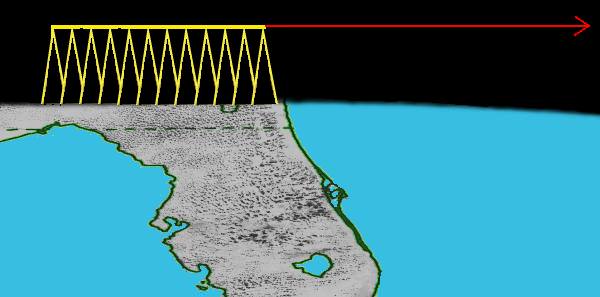
If this all seems a bit implausible, there’s always the proposed 100 kilometer high space pier that would enable horizontal space launch without rocketry – perhaps via a giant rail gun, or some other similarly theoretical device that works just fine on paper.
Further reading: Krinker, M. (2010) Review of new concepts, ideas and innovations in space towers. (Have to say this review reads like a cut and paste job from a number of not-very-well-translated-from-Russian articles – but the diagrams are, if not plausible, at least comprehensible).
Interesting article, Steve, but one minor nitpick…
At the fourth paragraph, in the third line, “like” should be likely. 🙂
N.B. If anyone has a problem with the term “centrifugal force”, then click here. 😉
@ IVAN3MAN_AT_LARGE
Thanks, typos are more than likely from this writer.
Acknowledged that centrifugal is a psuedo-force, although it’s not the same as the centripetal force (as is kind of implied by the cartoon). If you are thrown against a wall – that’s either padded or brick – the brick wall collision hurts a lot more, even if the throwing force was the same.
It’s useful to have a shorthand term for ‘the reactive force that counters centripetal force’ – i.e. centrifugal.
Yeah, let’s build it for the LULZ! :d
Why bother tethering it to the ground. ? String a few hundred balloons together as a high altitude platform in near space and then use a rail gun as a launch platform. The platform itself can itself be traveling at speed and assist launches. Of course you still need to be able to ferry materials up to the platform, and that would require aircraft that can (catch up). I wonder if its even possible to land a 747 @ altitude. 🙂
Actually, A plane would not have to land, Just dock At speed. Transfer cargo and separate. Each dock would actually help (push) the platform.
BTW, the new website design sucks, comments have weird lines through the text and every posts comes up with a Node Unavailable message.
@ STEVE NERLICH,
Actually, I agree with the bad guy in that cartoon, and also with Dr. Phil Plait: “When I say centrifugal, I mean centrifugal!” 🙂
@ DAMIAN,
I also complained about those two website issues; Nancy said that they are “working on it”!
Hey, I looked at the source code for the comments, and the line problem is pretty easy to fix.
You need to edit comments.php (if it exists) and add:
to the end of the
uhh.. sorry forgot that you can post html to comments…
I can fix your comments problem for free, please email me
the cloud minders in star trek confined the masses all poorly paid workers to live on the surface in underground mines. Maybe the corilous force that causes water to rotate clockwise or counterclockwise depending on earths latitude and location away from the equatoral rotation plane, could support these kinds of structures?
@ At Damian and others
You say – why bother tethering it to the ground? These one hundred kilometer high structures are not tethers, but ladders. The majority of energy expended by current rocketry involves getting from sea level up to an altitude of one hundred kilometers. The first stage of the Saturn V only managed to launch an Apollo mission up to 70 kilometers altitude, although the first stage was over one third (2.3 million kg) of the total mass of the launch vehicle.
@ anyone
I understand a website upgrade/fix is close. Mind you, I do like how most of the related posts to my articles are written by me. I hope they don’t fix that 🙂
We know that Helium Balloons could get halfway there (about 50km up). The Max altitude for an average 747 is some 10 km. So an orbital platform would have to be altitude maneuverable, dropping down to under 10 km for Cargo delivered by regular aircraft and then gaining max altitude for orbital launch. Use hydrogen gas as part of the platform for fuel. (Cryogenic storage should be much easier at altitude, although @ 50km up it can be a balmy -3 Celsius due to temperature inversion)
Its my understanding that once your close to 80km up you can start to use ion propulsion. (GOCE satellite as example). If you have Delta V. (Mach 3 to 5)
I do admit its not pretty, but it can be done with todays technology, and as you mention Steve, 1/3 of the weight of the Saturn V was to get it 70KM up. @ 50Km with the help of centrifugal force (I think the platform could easily get up to speeds of 500km per/h) your lifting more useful mass into space then just fuel.
Of course you still have to get your spacecraft up to escape velocity so rockets aren’t dead yet, but the costs should be far lower. Isn’t this essentially what Branson is doing with the the two plane Virgin Galactic system?.
The tethered idea is great, but this is something potentially achievable now. Besides a low earth platform has many science applications, not just launch.
🙂 Sunday Musing are fun.
Damian
I think what’s needed here is a “Baseline Assisted Ballistic Electromagnetic Launcher”, IF I get the ‘space pier’ concept right?
The ‘base’ connecting to the Earth being a tower… or The tower of BABEL? And you KNOW what happened in THAT story? The ‘Sky People’ were not pleased with our efforts and tore that building down!
Your only prospect for this, and I think it is extremely remote at that, or for building anything like a space elevator is to build from space down. I think you will have to catch a near Earth asteroid, attack an ion propulsion system to the thing and slowly push it so you can park it in geosynch. From there you use the materials in the asteroid to build your elevator from space down to Earth, meanwhile also building up the counter weight beyond geosynch. It does not take much physical or engineering sense to think on why building up will never work.
LC
Can we not wait a while longer?
Untill we have solved the anti gravity issue?
If we can nuetralize gravity by creating a force field, we do not need space elevators. It works similar to levitation rail transport. This will cost a lot less to get in
orbit?
LAWRENCE B. CROWELL:
The problem with that is the low thrust of ion propulsion systems, when compared with chemical or nuclear rockets.
Also, I think that you had meant to say attach there, not “attack”. 😉
Damn it! I forgot to close the bold tag after “attach”. Sorry about that. 😐
Many comments here (especially those from Damian) make a very good description of a SpaceShaft. What is missing is the fact that a SpaceShaft is not only a tower/scaffolding system but also a unidirectional elevator system.
A SpaceShaft is a hybrid system because the whole structure of buoyant building blocks is levitated with new building blocks insertions at the base and so the top ones (@ > 50 km of altitude get jacked-up further into space thanks to the buoyancy below.
A building using this method of construction, with a diameter of 100 m will have a gross upthrust 5000 tonnes at the Karman line. From the summit of the structure “free-ride” assisted launches of spacecraft/spaceplanes is possible with economical fuel consumption, with the benefit of the mobility that rockets offer.
Since reaching beyond the Karman line is possible thanks to the potential energy, structures intended to into space will need to be constructed with space-grade materials since regular plastics, (like Mylar on its own are not suitable,) will need to be engineered.
Such structures could be built also anywhere, not just at the Equator since they employ mooring/guy lines pretty much like tall telecom antennae.
More info visit http://spaceshaft.org
Because anti-gravity is like time-travel: it can’t happen, for fundamental reasons of physics.
Gravitation isn’t a force, where you can have equal but opposite charges from a field. Say, in electromagnetism. There like charges repel, unlike charges attract, and in your picture one could be chosen to be the “anti” interaction.
Gravity is curvature of space-time (which can be approximated as a force in many cases, and indeed is thought to have one charge, gravitons). How would you “anti-curve” space-time?
FWIW, you _can_ lower a gravitational relative energy, locally straighten out a curved space, simply put another Earth close to ours with “some” diamond pillars in between. (So you use the same force to set up your “anti”- picture.) But that would only get you Earth-“Earth” cheap travel.
@ anyone
I thought someone might comment on the issue of powering the space elevator cabin – which strikes me as a non-trivial problem for space elevator design. Is the answer to have a 72,000 km nanotubule loop and a ground based engine that draws the loop around – while the cabin (perhaps with battery power for light and heating) is just passively fixed to the loop?
The problem with anti-gravity is similar to why warp drives and time machines are not likely possible. The problem is that anti-gravity violates the Hawking-Penrose energy conditions. The most general energy condition is the averaged weak energy condition. This is that the 0-0 or time-time component of the momentum-energy tensor must be positive. This component is energy density, and if it is equal to zero or positive it guarantees the curvature of spacetime is such that paths in spacetime focus towards each other on average. For instance a cloud of particles around the earth will fall towards Earth and in a spacetime sense their paths focus into each other. This also means the curvature of spacetime is positive, or that it curves so that any circle in that space (spacetime) there is less space enclosed than one would expect from the formula Area = 4pi R^2. In a finite element language, a flat circle with a disk has a wedge cut out of it and the wedge closed up by gluing the wedge up. This gives a little cone, and if we then “smooth that out,” since a cone as a singularity at its point, this is an example of positive curvature.
If the energy density is negative, this defocuses geodesics. This gives the meaning of anti-gravity already, for it involves the repulsive motion of particles. This is needed for wormholes, where a thin layer just above where the event horizon of a black hole has this exotic matter. This defocuses geodesics, but requires this defocusing to occur on an opening topologically connected to this first opening that appears similar to a black hole. The Alcubierre warp drive solution also requires this negative energy. This involves negative curvature of space or spacetime. In the finite element example above, we may make the cut of a flat disk to its center, but instead of cutting out a wedge we take a wedge and glue it in there. This amounts to inserting “more space” into the disk, which creates instead of a cone a saddle shape.
So all we have to do to get anti-gravity is to get this exotic matter, some sort of quantum field, and employ it in various ways. To solve the problem of anti-gravity amounts to solving the problem of faster than light and wormholes and even time travel. So what is the problem? The violation of the averaged weak energy condition means there is not lower bound on the quantum spectrum of this exotic quantum field. The Hawking-Penrose averaged weak energy condition is equivalent to saying there is some lower bound on the energy levels of the field. This fact is what solved the hydrogen atom catastrophe predicted by classical mechanics. A charged particle, such as an electron, that is accelerated will emit radiation and lose energy. The nucleus of the atom has a potential V = -ke/r (k = constant) and so the inspiral of the electron will produce an infinite amount of radiation. Quantum mechanics then comes in to produce a discrete set of energy levels with a minimal energy level at the bottom — the S-shell. This fact persists in all quantum systems.
I could go into considerable depth here, for quantum mechanics is a sort of logical framework. The Bell theorem or the violation of classical inequalities is a sort of logical apparatus to nature. Spacetime physics appears to respect the same logic, and I wrote a paper 20 years ago on how quantum theory and general relativity, within admittedly a restricted setting, have underlying equivalent Galois field extensions. The two are in some sense fundamentally the same thing, but under different categorical maps.
So to conclude it seems highly unlikely we will derive anti-gravity machines. For those who crave the opening of the space frontier this is unwelcome news, but unfortunately this is how the cards read.
LC
I don’t know what schemes are proposed, but I have always thought the cabin lofted on the elevator would be propelled by electromagnetic means, such as using the jxB Lorentz force used to propel a projectile from rail guns proposed for the SDI or “StarWars” program in the 1980s. The cabin will need to travel with some speed, say at least 1000km/hr on average. Of course any nonlinear instability here would be a problem, which could cause vibrations to propagate along the “wire.” The energy required is fairly considerable. The potential energy of gravity V = -GMm/r which gives an approximate energy required E ~ m*5.4e10J/kg, for m the mass of the space capsule or cabin lofted on the elevator. This is far less though than the energy employed by rockets.
LC
I just visited Seattle and the Space Needle last week. Very fun. Lots of coffee shops, but they apparently don’t eat breakfast.
I agree that the space-down approach would make more sense. That laser-plasma spinning top-looking engine that was demonstrated a while back might be useful. (Forgive me for the poor description.) It apparently needs a wire to ride in order to stay in the laser path. It might make a good elevator to said captured asteroid.
Even though its now Monday in my part of the world. 🙁
The reason I questioned the need to have this thing tethered to the ground is it strikes me as quite a energy inefficient way to lift mass to altitude. (power requirements and power delivery remain challenges.) Not to mention the (continuing) need for as yet hypothetical ” carbon” materials that would have to be mass produced in vast quantities.
The energy consumption simply for the mass manufacture of materials strong enough outweighs the cost benefits of chemical lift. Also at stake is the expenditure on a (infrastructure) that I dont believe many would like to have in their backyard. Its a risky gamble investing all that energy in such a monolithic structure.
I’m with Lawrence B Crowell here in thinking that if you really wanted to get a tether going then it needs to be built down from a asteroid. If for nothing else but the raw materials and potential manufacturing advantage of zero gravity and abundant solar energy. I dont think maneuvering an asteroid into geosynchronous orbit is is unachievable, mass drivers are a simple and effective concept. But for a mass driver you have to consider a manufacturing facility on the asteroid (a mass driver would be a mining device converting mass to energy), and therein lies the chicken and egg problem. You have to move significant amounts of technology out of our gravity well first.
I stand by my opinion that a tethered system is unnecessary. Buoyancy inherent in a lighter then air craft can lift substantive mass halfway to LEO now. I suggested using conventional planes as a cargo delivery method as I believe that a high altitude balloon is likely be (stabilized) to work at high altitudes better then one that needs to descend all the way to the ground. (supposition)
Also a Balloon platform can be modular and built by many nations on the earth, it can (with some design inventiveness) be joined or split depending on the applicable purpose and ultimately provides a viable stepping stone to space. Its one inherent advantage in my mind is the fact that it does not have to be anything as large as a tethered platform. Much less raw materials and energy need to be invested in its construction.
But ultimately, i think it has a kind of popular appeal that a monumental tower does not. Think Sky City rather then tower of Babel, and that alone gives it brownie points from a marketing perspective.
Not only that, The US military have already invested funds in building high altitude (20Km capable ) airships for surveillance purposes. And there is a worldwide industry and expertise to draw upon.
http://en.wikipedia.org/wiki/WALRUS_HULA
Not to say that some serious challenges (in materials science) dont exist in order to make a platform like this go as high as 50Km. Hydrogen and Helium are (very) hard materials to work with. However some interesting ideas do abound on how to contain the gas.
I believe its was here @ UT that previous discussions on this subject touched on the possibility of using Vacuum and Electrical charge and even such far flung ideas a Positronium or Ionic balloons. 🙂 Areogels are another facinating area of research for this topic. Metal areogels have the characteristics of carbon nanotubes with the lightweight properties of areogels. They can store hydrogen far better then mylar or other enclosing materials and being electrically conductive give some hope to using electrical or magnetic methods or entrapment.
http://www.aerogel.org/?p=932
Perhaps to touch on Steve’s question on how to power a ascending lift on a tethered platform, perhaps such materials could be employed?. They would essentially be lightweight and strong enough to conduct electricity to power mechanical or electrical systems. As for the source, i would have to say LEO solar would be the way to go. 🙂
Also something rarely considered is using helium in a plasma stage as opposed to a gas one. (think neon)
This is the kind of research I wish NASA would be doing in liu of the canceled Constellation program. Instead its the US military and not with the right application in mind.
Damian
Mr. Crowell
Thank you for the valuable explanations above. I want to point out that I thought that the comments in this webpage were meant to be related to towers and space elevators so when I started to read about quantum physics I shied away until you posted your first explanation.
Regarding your second comment; some systems could be combined as to take advantage of other sources of forces, such as buoyancy during the journey through the dense regions of the atmosphere and then gradually switching on electrically powered motors which could drive traction wheels on a cable, pretty much as what the standard CNT tether folks are trying to promote.
If a SpaceShaft were to be a possible system, some PV configurations, (still unknown,) could be used to draw energy from sunlight and supply it the form of electricity for the above mentioned motors. Doing so will eliminate the use of power beaming technologies while allowing for controllable speeds.
I am assuming that your reference to the 1000 km/hr is because you are assuming the use of that velocity as part of the desired final “vertical” escape-velocity needed for space vehicles to escape gravity. Is this correct?
The reason you want to go relatively fast is that this would be a 37,000km ride. At 1000km/hr that is a day and half ride. I would presume that a ride more than a week in duration would not be desirable. So the capsule would have to move with at least bullet train speeds. Speeds comparable to airlines might be advisable. The distance also illustrates why buoyancy is not very relevant here. Balloons only go up 30km at most, which is less than 1/1000 the entire distance.
This is not escape velocity. Escape velocity is computed easily from the energy of a particle moving in a gravity field,
E = (m/2)v^2 – GMm/r,
Where if you set the energy E = 0 and the radius r = 6400km for the radius of the earth you get the velocity v = sqrt(2GM/r) ~= 10km/sec. That is the escape velocity, or the velocity required to leave the Earth’s surface with total energy = 0, and so that you reach “infinity” at zero velocity. This is a whole lot faster than the elevator ride. Of course this is ballistic flight, for the rocket only operates for 10 minutes or so and then sends a craft on an inertial trajectory. The difference is that with the elevator car there is some engine which continually operates and propels the car upwards.
BTW, I forgot to include the fact that the car reaches geosynchronous orbit moving with a velocity v = r*omega, omega = 2pi/T, for T = period of one day. The energy from this is E = (m/2)v^2 and v = 2*pi*3.7e4km/86400s = 2.7 km/s, and so the kinetic energy is K = m*3.6e6J/kg, which is a rather small percentage of the potential energy change.
The point of illustrating the problem of anti-gravity is that it sounds so compelling to have a device that you turn on and it counters the action of gravity. The anti-gravity machine is a sort of magic carpet that you could ride, say the proverbial flying saucer. There are probably 10,000 guys trying to work something like this up in their garages right now. It would be so nice in a way. However, the problem is that if this sort of thing is possible then the universe ultimately makes no sense. A universe which does ultimately make sense puts fundamental constraints upon our abilities. Given a choice between living in a universe that makes sense and constrains us, and a universe that fundamentally makes no sense and gives us this freedom, I will choose the first of these.
LC
Mr. Crowell
I agree with the formulae you have presented, but I am not delving into quantum mechanics for the means of transportation that should be discussed under the title of space towers and space elevators.
I am sure you are familiar with the proposals from Prof. Quine at York University, (Canada,) regarding an inflatable tower and I am assuming you are also familiar with Dr. Guenov’s (Cranfield Universty UK) paper on Airship-assisted Space Launch.
I may not be a prestigious researcher as those mentioned but I believe you have missed in reading about the proposed system going by the name of a SpaceShaft. I include here a hyperlink you may want to look at
http://www.google.com/url?sa=t&source=web&cd=1&ved=0CBIQFjAA&url=http%3A%2F%2Fksjtracker.mit.edu%2F2009%2F07%2F01%2Fspace-shaft-or-the-story-that-would-have-been-a-bit-finer-if-only-one-had-known%2F&rct=j&q=knight%20science%20spaceshaft&ei=fCuFTOVtjY84s6y1pw4&usg=AFQjCNE3dczkOLqmB8aQnRvOkAphuD1lZw&sig2=Ar3tIjfnSZl-arSndyq2rQ&cad=rja
I question whether this is practical. It is also a long ways from being a space elevator. There are two problems with it right away. The first is we are running out of helium. It will not be too long before helium becomes a scarce and very expensive commodity. This will present problems with lots of cryrogenic applications, such as MRI. We need to stop using helium for blowing up party balloons. Of course you can use hydrogen, but then as far as I see this becomes a vertically poised Hindenburg that I would not get anywhere close to. I frankly think the epitome of insanity is any idea that involves inflating large structures with hydrogen that we are supposed to climb on board.
Yep, count me out of that for sure.
LC
Mr. Crowell
Thank you for you comments. I see you cannot see beyond Helium, and I don’t blame you for it. I am familiar with the scarcity of He gas and the inherent danger of Hydrogen and some other LTH gases such as Ammonia, … etc.
I look forward to a day we meet and discuss not only the scarcity of the He gas and that of CNT. but also the mechanics of spar-buoys.
Bye for now.
oTay Mr. Nerlich, I will take on the challenge of powering a Space Elevator!?
What about using the HUGE electric ground potential generated by a ‘cable’ whipping through the Earth’s magnetosphere? Perhaps similar to the shuttle/tether experiments of the late 90’s? ZAP!
http://www-istp.gsfc.nasa.gov/Education/wtether.html
The magnetic field is rotated around with the Earth. The space elevator would then be at rest with respect to the Earth’s magnetic field.
I suppose ammonia might work as a lifting gas. I am not sure what its density is at ordinary temperatures. NH_3 has an gram molecular wieght (GMW) of 17 and O_2 is 32. I would presume it is not as efficient as H_2 and He with GMWs of 2 and 4.
LC
How might our telescopes detect a wormhole in space? Tiny wormholes are unstable but exist briefly, so could large stable wormholes form and last up to a year and be discovered photographed and later vanish? would they be aligned between two large black holes, or out in the vast voids?
Has weather extremes been considered in these grand plans ? DON’T SHOOT!
Come back in a couple of thousand years and we won’t be able to move for space towers and space elevators. Roman engineers would have scoffed at the very idea of the Humber suspension bridge or the spectacular Viaduc de Millau bridge in southern France. Just because we can’t imagine how mega-structures/new technologies etc might spring up today does not rule them out.
@ LAWRENCE B. CROWELL,
The density of ammonia is 0.73 kg/m^3 (1.013 bar at 15 °C); however, at below -33.3 °C, it is a liquid with a density of 681.9 kg/m^3; air has a density of 1.2 kg/m^3 at sea level at 15 °C.*
* Source: Wikipedia.
HEY IVANMAN, NOBODY GIVES A RATTS ASS ABOUT YOUR SPELLING CORRECTIONS, GO AWAY LOSER
HEY IVANMAN, NOBODY CARES ABOUT A FEW SPELLING ERRORS, GO GET A LIFE YOU LOSER
It works to about the same value. The ratio of densities 0.73 kg/m^3/1.2 kg/m^3 = .608 and the average GMW of air is 29 and the ratio of GMWs is 17/29 = .586.
LC
Probably Flogging a dead horse now.
I was doing some research on the idea of a “Plasma Balloon” and came across on of Nasa’s Technology Seed Project; Mini-Magnetosphere Plasma Propulsion (M2P2).
What I found that I feel is pertinent to a (tower), my ranting about using balloons and even the ‘Anti-Gravity’ posts is this little snippet:
“In theory, it is possible for a magnetic sail to launch directly from the surface of a planet near one of its magnetic poles, repelling itself from the planet’s magnetic field. However, this requires the magnetic sail to be maintained in its “unstable” orientation. A launch from Earth requires superconductors with 80 times the current density of the best known high-temperature superconductors.”
http://en.wikipedia.org/wiki/Magnetic_sail
A magnetic or (energy) tower has a lot of appeal. The Idea of using superconducting loops to enclose Hydrogen plasma as a lift mechanism is in a literal sense a form of anti gravity. If they can pull it off that is.
Food for thought.
Damian
@FLOGGER11,
Nobody cares about a few spelling errors, eh? I suggest that you read this:
Top 20 of the Most Hilarious Spelling Mistakes on Resumes and Cover Letters.
Oh, and one more thing… THERE IS NO NEED TO BLOODY SHOUT!