
[/caption]
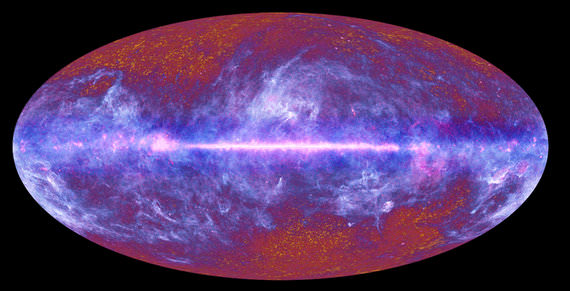
After a year of observations, the Planck observatory team released an all-sky microwave image, and what a gorgeous image it is! The Planck satellite looks at the entire sky in the microwave region of the electromagnetic spectrum, (30 to 857 GHz) with the main goal of tracking down the echoes of the Big Bang, the Cosmic Microwave Background (CMB.) This new image reveals the cosmic signal is literally hidden behind a fog of foreground emission, arising mostly from the interstellar medium (ISM), the diffuse mixture of gas and dust filling our Galaxy.
At the top and bottom of the image in the red and yellow marbled region is where the CMB is visible.
“By contrast, a good part of the sky is dominated by the Milky Way contribution, shining strongly along the Galactic Plane but also extending well above and below it, albeit at a very much lower intensity,” said Jan Tauber, Planck Project Scientist.
To produce this image, the Planck team combined data from the full frequency range of Planck. The main disc of our Galaxy runs across the center of the image, with streamers of cold dust reaching above and below the Milky Way. This galactic web is where new stars are being formed, and Planck has found many locations where individual stars are edging toward birth or just beginning their cycle of development.
To get your bearings of where everything is locatated, here is an annotated version.
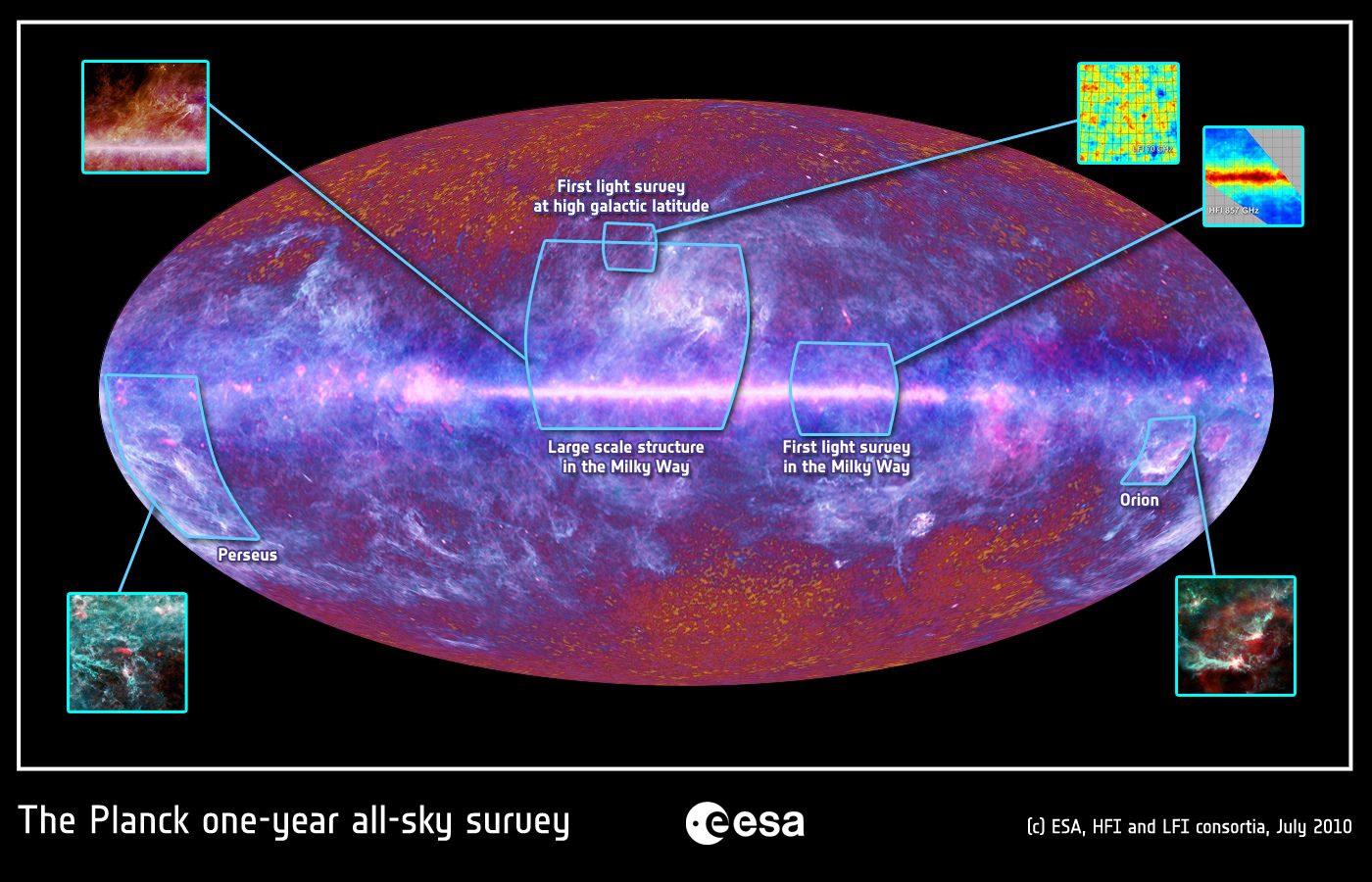
“Planck has ‘painted’ us its first spectacular picture of the Universe,” said Dr. David Parker, Director of Space Science and Exploration for the UKSpace Agency. “This single image captures both our own cosmic backyard — the Milky Way galaxy that we live in — but also the subtle imprint of the Big Bang from which the whole Universe emerged. We’re proud to be supporting this great new discovery machine and look forward to our scientists unraveling the deeper meaning behind the beauty of this first image.”
And this is just the beginning of beautiful things from Planck!
Here’s another annotated version:
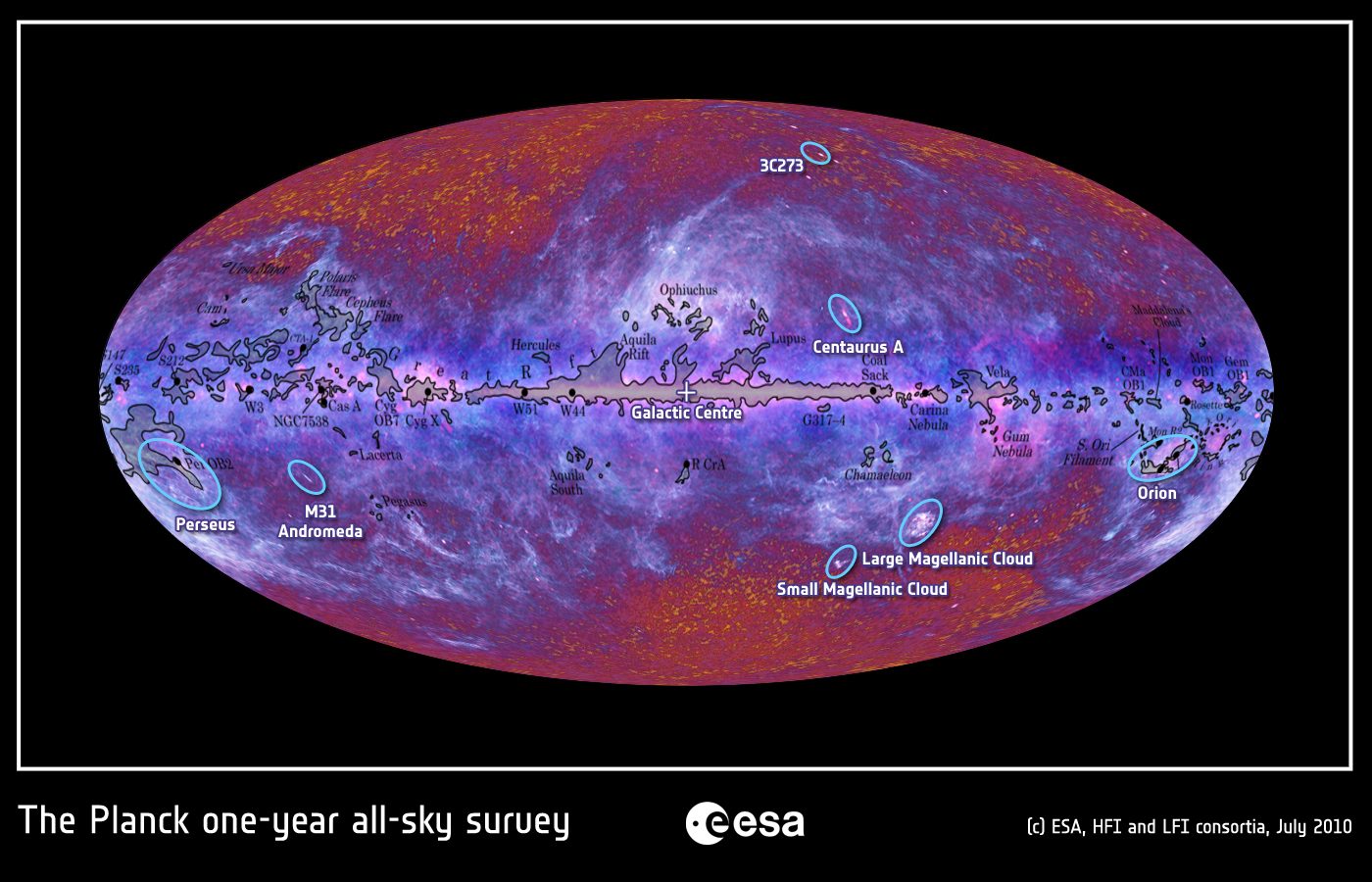
(Thanks to IVAN3MAN for suggesting to add this image.)
For more info see this ESA webpage, and the Planck website.
Can you imagine that this pictures is actually a time-distorted image?
It would be interesting if they also could create a time undistorted image. The stars at the location as it would be if there exists no speed of light.
I wonder how far to galactic north or south we would have to send a probe to start to see around the galactic equator.
This looks good! There needs to be some signal processing done to remove the galactic microwave noise.
The big issue is whether B-modes can be found in the CMB. In the big bang at its earliest moments quantum gravity decoupled from the rest of the forces of nature and become classical. The gravitons were stretched into classical gravity waves which are now stretched to nearly the length of the cosmological horizon. These should have a footprint in the CMB. It is interesting to think that the CMB is a sort of gravity wave detector, and we are now trying to detect the reading of that detector.
LC
@SteveZodiac – Are you suggesting overlaying deep optical imagery to compare the visible anisotropies in this image? I wonder if the resolution in the Planck data is high enough to do that? If so… bet its been done already.
Gravity waves, shmawity waves! 😀 I’m more interested in the cosmology which is its primary mission.
So I’ll settle for a 3 sigma test of remaining standard cosmology parameters. Inflation needs to be verified as best as it can be, and more of the remaining plethora of big bang theories needs to be rejected. But therein lies a certain correlation of interest, since AFAIU chaotic inflation models may have gravity wave B-mode signatures:
“Planck may also detect the B-mode polarization anisotropies, if tensor modes contribute at a level of a few percent or more of the amplitude of the scalar modes. The amplitude of the tensor component remains
a free parameter of inflationary models of the early Universe, but amplitudes of this order are
predicted in an important class of models, namely the ‘chaotic’ inflationary models advocated
by Linde (see, e.g., Linde 1983, 1991). The detection of primordial gravity waves would provide
unassailable proof that the Universe went through a period of inflation and would establish
the energy scale of the inflationary phase.
[…]
The most ambitious goal of CMB polarimetry experiments is to map the B-mode polarization. A
detection of a large-angle signal with a thermal spectrum would provide a smoking-gun signature
of a stochastic background of gravitational waves. In models of inflation, the amplitude of the B-mode of polarization is a direct measure of the inflationary energy scale, and so a detection would provide a firm observational link with physics of the early Universe.
[…]
The results presented in Figures 2.16 and 2.17 show that Planck will be sensitive to a Bmode
polarization signal if the scalar-tensor ratio r is greater than a few per cent. This marks
an important science goal for Planck, for if it can be achieved it will be possible to confirm or
rule out an important class of inflationary models—the chaotic inflationary models advocated
by Linde and collaborators. If Planck fails to detect tensor modes, then this would imply that
the energy scale for inflation is low. A detection of tensor modes, however, would imply in a
model independent way that the inflaton must have changed by factors of order unity or more
in Planck units from the time that the fluctuations were generated until the end of inflation.
If this is indeed the case, then it is unlikely that inflation can be understood in terms of a low
energy effective field theory.
[…]
Can we probe through the Big Bang to a previous phase of the Universe’s history? [Planck “Bluebook”]”
Sigh, still a couple of years away.
[Btw, I liked the Bluebook discussion of … pretty much anything … but especially the pity review of small vs hybrid vs large field inflation models, from “standard quantum field theory … difficult to find a compelling particle physics motivation” (fine tuned) vs “possibility [for] a particle physics explanation” (natural parameter range) vs “the entire Universe can inflate from a single Planck-sized patch” (chaotic, tensor components). Perhaps I had gathered some of that before in my stumbling way, but as a layman it is always good to see a simple collection on contrast of possibilities.
We’ll see!]
Duh, I didn’t realize the quoting would be so extensive. Feel free to delete my previous comment if it is a nuisance.
Short version: Looking for B-modes looks good! (Learning of gravity waves is learning about essential physics of inflation.)
@Torbjörn Larsson OM,
Had too much coffee today, eh? 😉
What if when they process our galaxy out the CMB just looks like more extremely distant galaxies? That would upset some apple carts.
IVAN3MAN_AT_LARGE, good guess! It’s a heat wave, so I’ve had too much liquid of just about everything but alcohol (too hot).
Torbjorn Larsson OM, Detecting B-modes is crucial. this will tell us much about inflationary cosmology and anisotropy. Further, these B-modes are CMB detection of an analogue of the CMB that involved gravitons. Prior to the inflationary period the universe was quantum gravity dominated. The decoupling of gravitons from the other fields and its transition to classical behavior is the source of these gravity waves. These B-modes are induced by huge gravity waves that were produced in a sort of black body radiation of gravitons.
LC
This is only the first of four all-sky surveys the Planck will make… “This image is just a glimpse of what Planck will ultimately see,” says Jan Tauber, ESA’s Planck project scientist.”
So it looks like the resolution WILL eventually be high enough for optical comparisons? Hmm…
LBC, yes, well, as the Bluepaper says, can we probe through the big bang? If large field inflation is correct, there likely was no “prior” before the end of inflation.
While we can quantize gravity (lagrangian of general relativity) for its low field case we don’t know about the similar natural scale of inflation. (If I’m reading the Bluepaper correctly.) And as per above we might not need to quantize gravity to predict the resulting multiverse; (semiclassical) inflation and GR may be the relevant effective theory for cosmology.
Quantum gravity is an iffy theory at best. However string theory seems eminently predictive on the very same parameter space as inflation.
A question for the experts.
Is this Cosmic background radiation the big bang itself the moment the universe became transparent?
Is it OK to visualise it to be the big ball of energy during the big bang when I would wrap it inverted on a sphere?
Or is it just some leftover remnant of something that happened a few millions of years after the big bang?
And another question pops to mind.
Space if growing exponentially, so is this cosmic background radiation a fixed place where space and time stops just behind it? Or could space and time have expanded faster than the cosmic background radiation after 13.7 billion years so it want way past it?
Torbjorn Larsson OM What is the blue paper?
Inflation is a period where the spacetime expanded according to an exponentially growing scale factor. The space or spacetime is still classical. Any region of space would have contained a gas of extremely high energy particles at unification plus gravity waves. The gravity waves are similar in this phase to what the CMB photons are to us now. The start of inflation is due to a decoupling of the quantum gravity field from the rest of the quantized conformal field theory. To push things back to where our cosmology connects up into the multiverse (a universe of spacetime cosmologies) you do have to go back to this quantum gravity period where our cosmos quantum tunneled as a “vacuum blob” from some other cosmos into its own nascent spacetime cosmology. This probably happened near a black hole singularity. I discussed some of this on the blog page on popIII stars and the origin of anisotropy.
In string theory quantum gravity can be derived on scales larger than the string. The string in spacetime has coordinates along it given by X^a(t,s), for t and s the time and space string parameters — the string world sheet. Then for a perturbation of the string in spacetime one can derive spacetime curvatures. This is a bi-metric approach to gravity. For general relativists this is not entirely satisfactory, and I don’t find it completely satisfactory either. Yet it does sort of work, and there are other results that remove most concerns over this.
Olaf, yes the CMB is the surface of last photon scatter. It is the end of an earlier period in the universe where photons scattered off of free electrons in a plasma. Then as the universe expanded and cooled this radiation dominated phase ended. This transitioned into the matter dominated phase, where now we are in the dark energy phase. This dark energy is the residual bit of vacuum energy left after the end of inflation. During inflation the vacuum energy density was about 12-14 order of magnitude smaller than (1/L_4)^4 ~ 10^123cm^{-4}. The potential for the inflaton scalar field had a slow downwards slope, where this resulted in the inflationary expansion. Then this abruptly ended and the vacuum energy density dropped to 120 orders of magnitude smaller, but not zero. That residual bit left over is what is now driving the accelerated expansion of the universe and is labeled as “dark energy.” The matter dominated phase ended around the time life started on Earth and we are now in the dark energy dominated phase — a sort of latent inflationary period.
The CMB reflects the anisotropy in the early conditions of the universe, including the gravity waves in the early universe I mention in the first paragraph. These have been stretched out enormously and can only be detected in how they perturbed the CMB. Signatures of the ancient gravity waves should then exist in the CMB, and these are the B-modes. The Planck spacecraft stands a good chance of finding them.
LC
@ Olaf:
I’m no expert, but my take on these interesting questions:
– “Is this Cosmic background radiation the big bang itself the moment the universe became transparent?”
As LBC said, yes, the last photons that were scattered.
– “Is it OK to visualise it to be the big ball of energy during the big bang when I would wrap it inverted on a sphere?”
Define “wrap it inverted”. The energy density was uniform, so any inversion wouldn’t be noticeable.
– “is this cosmic background radiation a fixed place where space and time stops just behind it? Or could space and time have expanded faster”
Also the energy filled the whole universe: it has to expand with it. Which is why it is still uniform, blackbody like, _much_ cooler, et cetera.
Btw, you can’t have a spacetime geometry that “stops”. Think of an expanding balloon where you live on the boundary, there is nothing stopping you from go around indefinitely. (I’m sorry I have no better intuition for you.)
Lawrence B. Crowell: Sorry I misstated, it was the ESA Blue Book on Planck. It isn’t a paper, though it has certainly been scrutinized in some form.
The cosmological physics may not be, if large field inflation is true. That is why it can grow out of a Planck volume. Surely spacetime breaks down before that.
You don’t have to go back to such a period at all, as I understand it. For example, Andrei Linde suggests that our universe comes out of the end of an inflation period. Eternal (say, chaotic) inflation scenarios, say, has no specific quantum gravity period with tunneling happening, yet they are multiverse cosmologies.
Sorry for my unwarranted analogy, but this has always reminded me of creationists that complain that gene scaffolding is not an “irreducible complex” pathway (well duh).
Spacetime scaffolding are no different from field potential biases, if you think about it. To claim that they are not “entirely satisfactory” is to make unsubstantiated claims on the physics for no apparent reason. If it is part of a predictive theory it is always okay.
But really, I mentioned this not as a competition but because it shows that “quantum gravity” is not in evidence nor necessary. The insistence on that it matter is neither supported nor helpful, the later especially since it has severe problems.
[At least it had around ~ 00 when I tried to see what had been done; no version with dynamics AFAIU, so no actual physics, for one; no version with lower energy bound, so no actual energy levels, for another; I’m sure the list can be made much longer.]
I guess I am irritated about it being mentioned when discussing cosmology, is all. To make a warranted analogy this time: it is like when people on Wall street mentions that selling stocks is a game, and someone in their company notes that he likes shuffling cards.
The fact is we can have an open mind on the inflation era now, or we will at least be forced to, since we are starting to probe its physics.
I think I understand my logic flaw.
We are probably looking form inside the big bang, like inside the ball towards the inner-part of the ball shell.
I was wondering if we were looking outward towards the big bang ball. Outside looking at the outer shell of the ball. But this does not sound ok. It was just an idea that popped up.
Ah, I can do better:
Provided that it is internally consistent, that is.
But it hits me that the same analogous procedure is already accepted in 2nd quantization. (Which, ironically, I believe quantum gravity theories also have problems with.) A bit awkward since I have never studied quantum field theory, but here goes:
2nd quantization has AFAIU never been axiomatized. What you do appears to be that you do reasonable physical assumptions (scaffolding), perform quantization (removes scaffolding), but then has to check that the result is an actual solution (check energy conditions et cetera).
The similarity between 2nd quantization/world sheet perturbation is likely more than a coincidence, since string theory AFAIK is a generalized quantum field theory method.
More generally, this is how math is done. A scaffolding of heuristic proof methods gives non-scaffolded results, which has to be verified. (In computer science it is AFAIU understood that proofs are untrustworthy, and the results has to be run through a verifier.)
So I honestly don’t see the problem, neither the empirical one nor the mathematical puristic one.
[Goes on to wildly speculate that the inability to axiomatize the algorithmic physics in quantization/scaffolding is why quantum gravity neither “like” the former nor accept the later … 😀
But really, axiomatic methods is a small subset of algorithmic methods, and the later is physics as far as we know. Or at least that is what the 2nd quantization method tells us, among other things.
A program like quantum gravity which, as long as I have seen it, seems set on axiomatization of all of physics, would then never succeed. Or at least that is my understanding, as much as I understand this; which is not much.]
Can I reach out and touch a CMB photon?
wjwbudro, You need a bit of electronics to catch a CMB photon.
As for visualizing the CMB boundary, it is important to bear in mind this an observation of the past. So you are not just observing far out in space, but backwards in time as well. The CMB we observe is about 54 billion light years out — further out than the age of the observable universe in light year units. That sounds odd, and I will give an explanation of that below. The material at that distance away, as we observe now, is in a state similar to what we have locally — galaxies, stars, planets, and so forth. An observer 54 billion light years away on the simultaneous Hubble frame would see our region in the universe in the past as the CMB.
Is quantum gravity an axiomatization of physics? I think that would certainly be premature. For various reasons I think any theory of quantum gravity and cosmology can only at best be an effective theory. One reason for this is that what I am working on with the Jordan matrix algebra and the Mathieu quantum coding algebra is an automorphism over a much larger system. This is pure mathematics at this point, but this much larger system is the monster group, and it is truly enormous in size. This system I am working on is a sort of extension of string theory, where the logico-algebraic system preserves quantum information. It is the minimal system that can do this which will embed string theory. The relationship between this system and the monster group is such that it strongly suggests this monster is what underlies quantum gravity far more fundamentally. Curiously there is nothing found beneath that, which means we in effect run out of mathematics. If there is some structure beneath this it involves a completely new type of mathematics.
More immediately second quantization is not a route to quantum gravity. That has been pretty firmly established. The problem is that general relativity and quantum physics have two concepts of time. The invariant time of general relativity is the proper time, or the distance in the Lorentzian metric. Coordinate time in general relativity is a sort of book keeping device, or something imposed by the analyst. Quantum mechanics on the other hand, and in particular quantum field theory, involves dynamical wave-field equations that use the coordinate time. One then must define a spatial surface where the “arrow of time” at every point is known, the field amplitude specified as data at every point and this is then run in the field equation. This view runs into a bit of trouble with curved spacetime. The existence of event horizons results in a thermalization of quantum field into black body radiation. Yet there is no fine grainded underlying interpretation, which lead to the idea that quantum information is destroyed. Yet, this is a disaster.
There were some schools of thought on axiomatic quantum field theory, mostly in France though it has been taken up some in S. America. The enterprise has failed to produce much, and I suspect it will not for a long time.
LC
“You need a bit of electronics to catch a CMB photon.”
Wouldn’t an analog TV suffice?
That works, but you need a filter to remove the shot noise internal to the electronics. Once you do that you do get a residue of snow that are CMB photons. In a way this is how Penzias and Wilson detected them in the first place.
LC
I was, of course, being a bit facetious, I do have a grasp of distance and time and the light speed restrictions placed upon the photon but seriously, what I really wanted to ask, is what you expanded upon LC and I appreciate you and others taking your time to share your knowledge.
Now, I wasn’t prepared for 54 blys out. If the consensus is that our Universe is ~13.7 bys old, you know what my next question is. I’m getting a bit worried now; I don’t have that much time left. lol
I am a bit confused.
Is it like this?
It is 13.7 billion years OLD
We see the CMB now that was 13.7 Billion lightyears away when it stated the journey.
But meanwhile after 13.7 billion years the real CMB has moved away and is now at 54 Billion lightyears from us but that light is just departing from that location.
I am wondering the noise of the TV, how many flashes would there be per second when it comes from the CMB?
I think it would be related to the surface area of the antenna?
Or is it the striking of the phosphor layer on a CRT that detects the CMB? Probably not.
Sorry, I said I would give a brief explanation of that. The distance to the CMB is larger than 13.7 billion light years because the space is being dynamically stretched out. On any local region the motion of particles is slower than light, but globally that rule does not apply because the space is over a large enough a distance is dynamically expanding, or a scale factor for lengths is increasing. As a result particles are being frame dragged apart and in ways which appear to violate relativity.
It is similar to the reason that a particle falling into a black hole reaches and surpasses the speed of light upon crossing the event horizon. Of course an external observer never sees the particle cross the horizon, but only approach very slowly in a time dilated motion. However, for an observer falling into the black hole this horizon is quickly crossed. That observer looking outwards would see things redshifted in a ways which corresponds to a v > c. In effect the space around the black hole is flowing into the black hole (dynamically stretching in a way) which frame drag particles into the BH faster than light upon crossing the event horizon.
LC
Thank you for that explanation LC. I won’t ask how the expansion horizon was calculated to be now at 54 blys. I will ask if the metric is outward progressive from any locality? Although I can’t quite picture it, it must.
The metric appears to be expanding outwards from every point. The only caveat on that is the observable universe may be a pocket universe, where there are inhomogeneous boundaries. Byeond that boundary the vacuum assumes inflationary values. This boundary defines a bubble with a radius of about 10^8 billion light years.
LC
This is so mind boggling. How are they arriving at this. I wish I could get a picture of this in my head. Sounds to me as though that continuing “vacuum” inflation beyond our visible universe is reducing the pressure surrounding our baryonic bubble allowing the accelerating expansion. The ultimate “dirt devil”. lol
I know, this belongs in the BAUT alt stuff.
This is so mind boggling. How are they arriving at all this? I wish I could get a picture of this in my head. r=10^8 blys? That’s a hundred million billion lys! Yes?
I’ll go away now. I could fire questions at you till the cows come home but, you got better things to do, I’m sure.
The sight said the previous post didn’t get posted. I wished that were true. Pls ignore.
For you grammatically correct, I wish that were true. lol
This region that is up to 100 million billion light years in diameter is a pocket universe. This is a defect in the general vacuum of the universe that is an inflationary cosmology (still inflating as we know in the early stage of our observable pocket universe) and there may be some 10^{23} (about a mole) of these pocket universes inside this spacetime. Now consider that this spacetime is due to strings on a D-brane in an infinite foliation of them.
Kinda makes one feel small.
LC
“Pocket universe”, so we’re talking multi-verse cosmology right? And that 10^8 bly “region” was not the result of the big bang singularity that produced our “baryonic bubble” right?.
D-branes, the Casimir effect between the sheets. lol
Back to Googling…..
I forgot to add, I have felt” small ever since I contemplated it’s infinity as a small child.
The pocket universe is the first level of the multiverse. Each pocket exists in a single spacetime cosmology. Thnk of each pocket as a ball containing a regions with near zero vacuum energy. These balls are contained in a huge vacuum density and are flying apart at inflationary accelerations. The type II multiverse involves other spacetimes, each with their pockets and so forth. These are due to brane- stacks or quantum tunneling of vacuum energy from one spacetime cosmology into the the M-string bulk. These first two types are what I hope we manage to get some tangential evidence for. The structure of quantum fluctuations of spacetime, which may be imprinted on the CMB, may bear signatures of this sort of physics.
The third type involves the quantum many worlds eigen-branching of elementary quantum events. I will resist going into this, for this really is based on an interpretation of quantum mechanics that is not an effective theory. Then there is Tegmark’s fourth type which is an infinite number of alternate realities with entirely different mathematical structures. This is also highly speculative and I suspect beyond any observational prospect.
LC
Thanks once again LC,
I don’t mean to keep imposing and I want you to know I sincerely appreciate your time. I can’t wait for more secrets to be revealed from the new data. Maybe another brush stroke or two on the canvas.
Meantime, I’ll be watching UT and the other science forums and doing a lot of googling till I die. Maybe that’s when it’ll all come to light, so to speak. lol
The thing which has to be done is to filter out the cloudy stuff due our local galaxy. That effort is not something I understand entirely well. In fact with the WMPA data I often wondered whether data on the equator and particularly where the galactic center (around Taurus) is could be taken as that reliable.
LC
I meant WMAP data not WMPA, which reads like a New Deal program of the 1930s.
LC
The Universe According To Planck
A. From “The universe according to Planck”
Science News editor in chief Tom Siegfried reports on a new image of the early cosmos from the Euroscience Open Forum meeting in Turin, Italy.
http://www.sciencenews.org/view/generic/id/60903/title/The_universe_according_to_Planck
“(Early) history of the universe, including the formation of galaxies and their growth into huge structures”
B. From “On Energy, Mass, Gravity, Galaxies Clusters AND Life, A Commonsensible Recapitulation”
http://www.the-scientist.com/community/posts/list/184.page#2125
– “Galaxy Clusters Evolved By Dispersion, Not By Conglomeration”
– Introduction of E=Total[m(1 + D)]
– “Dark Energy And Matter And The Emperor’s New Clothes”
Galaxy clusters are, rationally and commonsensibly, the archetypes of original cosmic Newtonian bodies. They move and accelerate Newtonianly.
They move and accelerate Newtonianly because they evolved at the start of inflation from the mass
just resolved from energy. They evolved by dispersion of the resolved mass into particles that became galaxy clusters. Their dispersion was/is fueled by mass reconverting to energy. At singularity, at D=0, all cosmic energy was in mass format. The start of inflation was the start of mass-to-energy reconversion, the start of gravity and of the clusters’ acceleration against gravity.
Dov Henis
(Comments From The 22nd Century)
03.2010 Updated Life Manifest
http://www.the-scientist.com/community/posts/list/54.page#5065
Cosmic Evolution Simplified
http://www.the-scientist.com/community/posts/list/240/122.page#4427
Gravity Is The Monotheism Of The Cosmos
http://www.the-scientist.com/community/posts/list/260/122.page#4887