

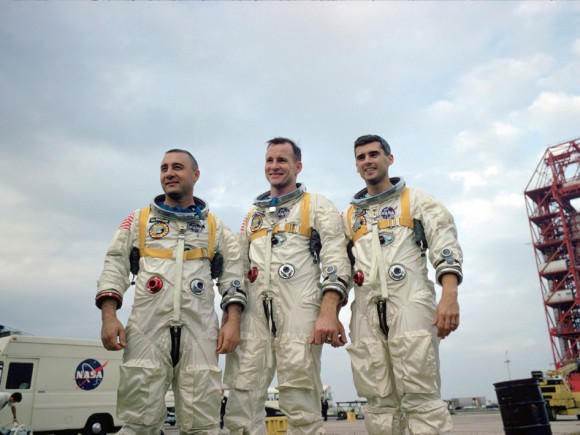
Reader Jeff Arnoldi recently approached me with an intriguing question about this Apollo 1 picture:
Note that the U.S. flag is on their right shoulders. Every other Apollo mission crew and all mission crews since then wear the flag on their left shoulders. Did the astronauts change after the Apollo 1 fire? Why did they make the change?
In response, Universe Today put a call out to several people with knowledge of those spacesuits that were used in the Apollo 1 mission, which ended fatally in January 1967 when all three crew members died in a pad fire.
A lot of redesigns were made to the equipment to prevent the same situation from happening again, but it appears the flags were not that crucial to the spacesuit design — even though a new spacesuit was used in Apollo 7.
Weeks of searching later, we have some great theories from the experts about why the flags were switched, but no definitive answer. Feel free to let us know if you have heard anything!
There’s some important historical context about the suit that we’ll get into in a moment, but first, here’s some feedback we received from a few spacesuit experts:
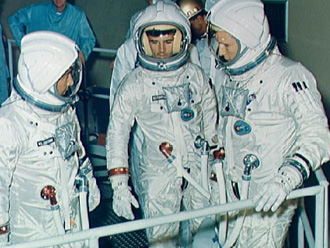
Walter Cunningham, Apollo 7 astronaut and backup crew member for Apollo 1:
Our crew, obviously, wore both. We were concerned about flexibility and security of the suits. We had no time to be concerned with style or decorations. I know of no policy decision on the question you asked.
Shawn McLeod, field operations manager for David Clark Co. (which constructed the suit):
Our archives indicate photos in the field of the Apollo A1-C suits both with and without the U.S. flag. Based on our literature search, our team believes positioning/placement of the U.S. flag was more than likely performed in the field after the suits were delivered from David Clark Company. Field installation of patches is not unusual – especially, for a program as fast-paced as Apollo. […]
Anecdotal evidence leads us to believe that the flags were sewn on whichever arm there was room. The left arm has a pencil pocket, and maybe with the pencils sticking out they would cover part of the flag, whereas the right arm has the neck seal pocket and a little more room. Furthermore, the referenced photo shows the flag was incorrectly positioned per U.S. Flag code. If they wanted to use a flag on the right sleeve, they would need to use the version with the field of stars facing forward. Perhaps someone noted that at some point and the correction was made.
Ronald Woods, NASA spacesuit expert for 45+ years:
I spoke with one of the suit technicians that supported Apollo 1 and he didn’t remember the flags being on the right arm. I have seen them in several pictures of the Apollo crew at different events, all on the right arm. Not sure at this time why and who may have sewn them on. During Apollo, we technicians would only sew the crew patches on the flight suits several weeks before launch.
Nicholas de Monchaux, author of Spacesuit: Fashioning Apollo:
I think there is a simple explanation, which is that the Apollo 1 suits were modified Gemini suits made by the David Clark Co., and the Apollo 7 suits were the first generation of [newer manufacturer] ILC suits. My guess is that two different manufacturers took two different approaches.
To learn more about this type of Apollo spacesuit, Universe Today approached Cathy Lewis — a curator who specializes in spacesuits at the Smithsonian National Air and Space Museum.
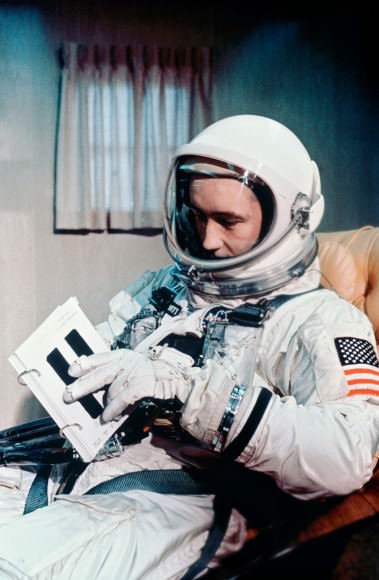
Intriguingly, it appears every NASA spacesuit that has a flag on it — besides the A1-C used in Apollo 1 — has its flag on the left. More from Lewis:
In all other suits in our collection where a flag is present, the flag is on the left. The collection includes suits made for NASA for programs and those made as prototypes and suits made for the USAF [United States Air Force] for the Manned Orbiting Laboratory program. Just as a note there were no flags in the Mercury suits that B.F. Goodrich made for NASA.
As the Bill Nye: The Science Guy show used to repeat … but wait, there’s more.
Lewis also gave us some great background on the suits used for Gemini and Apollo. The Apollo missions actually had two different sets of pressure garments — the A1-C and the A7-L, while the Gemini missions used the G4-Cs. Essentially, the G4-C and A1-C suits were the same thing (a high-altitude suit design adapted for space), made by the same prime manufacturer — David Clark Co. The next set of suits, the A7-L (made exclusively for space work), had ILC Dover as the prime manufacturer.
Lewis added that she does not see the flag switch as being tied to the change in manufacturer.
Lewis did a great job summarizing a lot of history in a few paragraphs, so we decided to include her entire e-mail here.
It is not likely to have anything to do with the manufacturers per se, because, DCC had placed the flag on the left shoulder for the Gemini program. The shift between DCC and ILC is a very long and complex story that began in 1962 with the first solicitations for suit prototypes for the Apollo program. ILC was selected as the suit manufacturer in 1965 with Hamilton Standard as the primary contractor by virtue of their government contracting and systems engineering experience.
That corporate relationship fizzled and left NASA with the option of putting off the design of the Moon-walking suits and falling back on their Earth orbital experience with DCC and Gemini for the early, Earth-orbiting Block I missions.
While DCC was making A1-C suits based on the G4-Cs that Ed White had used for the first US spacewalk, they were also competing with ILC, HS and others for the new Moon-walking suit contract.
The 1967 Apollo 204 fire changed NASA’s plans for different Block I and Block II (lunar orbiting and lunar landing) spacesuits. The resulting contract went again to ILC as primary with HS [Hamilton Standard] as sub with responsibility for the life support systems and systems integration for a suit that worked in Earth and lunar orbit and moon-walking.
Unless I am missing something, I don’t see an engineering issue over the placement of the flag.
If you have any other thoughts about why the flag switch occurred, feel free to let us know in the comments!
Clearly, someone noticed the violation of the flag code, and switched. Maybe it’s difficult to get patches with the field on the right.
I’d go with Shawn McLeod’s theory. Flag Code part.
I figure placing it on the left shoulder allows the stars and stripes to be more visible from the front. Otherwise it may appear as red and white bars which may not look enough like a flag unless the patched was reversed.
Pic has been flipped horizontally
Can’t have been. In the other photograph the NASA “meatball” is oriented correctly. It would be mirrored if the photo had been flipped.
Also, the flags are still backwards! 🙂
Now you have the wedding bands on the >right< hands. And the lettering is now backwards. The original picture is indeed correct.
Usually the flag is oriented so that it’s being carried forward, and the orientation of the flags on the suit looks like it’s being led backward.
I’d always thought that the flag should be seen as advancing. So I agree with Elliot here.
Scout position is not with the flag advancing. See the Scout patch placement inspection sheet as here: http://www.scouting.org/filestore/pdf/34283.pdf
Gus Grissom was a lifetime member of his troop, and as all had been members, this may have been done as a token to the Scouts (just a guess).
Another shocking breach of standards. Nowadays that would have to go through a committee and change control.
The Apollo 1 flag placement may have just been aesthetic, given the use of the American flag as a border on their mission patch, the placement allowed the two flags to be near each other and play off each other — but that is just speculation.
Conjecture aside, a couple of possibly related-points with regards to how the flags came to be on the suits and when and how they were sewn on.
1) The Gemini 4 crew considered the U.S. flag to be their mission patch (they were the first crew to wear the flag). In fact, the crew bought the flags themselves, as Jim McDivitt relates in “All We Did Was Fly to the Moon” by Dick Lattimer.
“Ed White and I used the American flag on our shoulders as our patch. This was the first time the American flag had been worn on a pressure suit and it has continued to be used there ever since. The original flags we had sewn on we purchased ourselves. Later on, of course, NASA made this an integral part of the pressure suit.”
Given that it was the GT-4 crew’s choice to add the flag, it is not unreasonable to believe they selected the placement too (which in their case was the left shoulder).
2) There was a difference between the U.S. flags worn by the Apollo 1 crew (and earlier crews) and those worn by every crew member since, which could have affected when and how they were sewn on: the material.
The Apollo 1 (and earlier mission) flags were nylon; the post-Apollo fire flags (and all mission patches, name tags, etc.) were silk-screened on non-flammable Beta cloth, which was also used as the outer layer of the redesigned suits.
The Beta patches and flags therefore, had to be specially produced — not something the crew could just purchase themselves — and as such became a more formal part of the preparing the suit for flight.
RIP brave men and heroes, humanity owes them gratitude for their tragic sacrifice.
Gus Grissom and Roger Chaffee were Eagle Scouts. Edward White II had also been a Boy Scout. The flags are placed and oriented correctly by Scout standards.
none of these folks is alive to tell us why so we can presume all day … just as we can presume what King Tut had for breakfast on 3 days before he died …
It is what it is … I choose not to judge or presume … just accept …
They were great men.
They are following the military practice of the time. The placement of the flag with the union/canton in front so the flag appears to be “advancing” is a more recent practice. It wasn’t that way back then. In addition, the “Flag Code” doesn’t actually mention how flags should be placed on uniforms. Title 4, Section 8(j) of the U.S. Code states, “no part of the flag should ever be used as a costume or athletic uniform. However, a flag patch may be affixed to the uniform of military personnel, firemen, policemen, and members of patriotic organizations.”
Military personnel often wore the flag on the right sleeve, because the division patch is worn on the left sleeve. Look for photos of paratroopers from the Second World War. The paratroopers participating in large multi-national operations like Operation Torch, Operation Overlord (D-Day), or Operation Market Garden wore flag patches or armbands on their right sleeve.
John Wayne as Lt. Col. Benjamin Vandervoort in “The Longest Day” and members of the 502nd Parachute Infantry Regiment.
Mike Collins of Apollo 11 fame has written what is widely considered the BEST astronaut memoir of them all — “Carrying The Fire”. He devotes a lot of ink to his “little old ladies with their glue pots”, an affectionate reference to all the fine people who built the Apollo space suits — since his assignment in the astronaut office was to be in charge of the space suits. You should ask him.
Interesting suit fact for those who may be interested — the Apollo suit contract was awarded — after a tremendous nationwide engineering and evaluation program involving the best in the aerospace industry — to Playtex — that’s right the best bra and girdle people of the 1960s — they had the best design as they had the best engineers for “stretchy” clothing. Its true, Google “Playtex Apollo suit” and there are many references including this — http://www.fashioningapollo.com — “ILC Dover” was just the administrative contractor arm of the suit program.
It’s really simple. In the changing of government from a Democratic to a Republican administration the Republicans would naturally assume that if the flags are on one side or the other they must be on the wrong side, and therefore ordered a change then, as Republicans are wont to do, they covered it up by deletng all documentation to the change.
Not that simple-this was nearly two years before the election!
in reference to the spacesuits, i believe the arm placement was changed because U.S. flag code states that if the flag is on the arm the star field must face forward
I think it was an irrelevant change.
If its on the right shoulder you see the blue and the stars designating USA. If its on the left shoulder you just see the red and white bars and it could be Liberia or some other nation!
A right-handed person would want the pencil-pocket on the left shoulder. Most people are right-handed (don’t know about the Apollo 1 astronauts). So maybe there was more room on the right shoulder for the patch.
I love the idea of it being proper Boy Scout placement.