
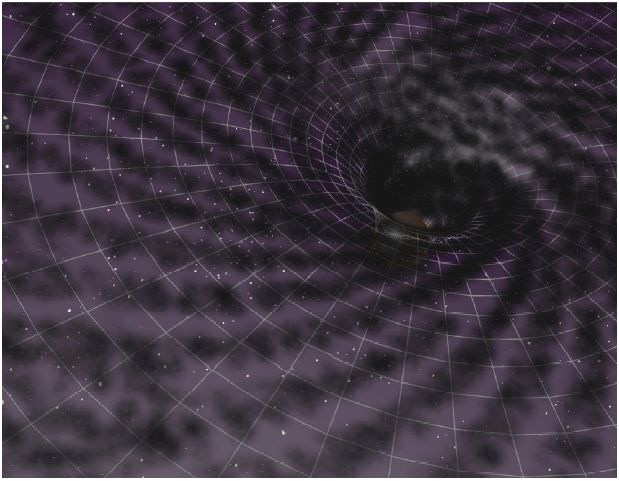
[/caption]
There’s the common notion that black holes suck in everything in the nearby vicinity by exerting a strong gravitational influence on the matter, energy, and space surrounding them. But astronomers have found that the dark matter around black holes might be a different story. Somehow dark matter resists ‘assimilation’ into a black hole.
About 23% of the Universe is made up of mysterious dark matter, invisible material only detected through its gravitational influence on its surroundings. In the early Universe clumps of dark matter are thought to have attracted gas, which then coalesced into stars that eventually assembled the galaxies we see today. In their efforts to understand galaxy formation and evolution, astronomers have spent a good deal of time attempting to simulate the build up of dark matter in these objects.
Dr. Xavier Hernandez and Dr. William Lee from the National Autonomous University of Mexico (UNAM) calculated the way in which the black holes found at the center of galaxies absorb dark matter. These black holes have anything between millions and billions of times the mass of the Sun and draw in material at a high rate.
The researchers modeled the way in which the dark matter is absorbed by black holes and found that the rate at which this happens is very sensitive to the amount of dark matter found in the black holes’ vicinity. If this concentration were larger than a critical density of 7 Suns of matter spread over each cubic light year of space, the black hole mass would increase so rapidly, hence engulfing such large amounts of dark matter, that soon the entire galaxy would be altered beyond recognition.
“Over the billions of years since galaxies formed, such runaway absorption of dark matter in black holes would have altered the population of galaxies away from what we actually observe,” said Hernandez
Their work therefore suggests that the density of dark matter in the centers of galaxies tends to be a constant value. By comparing their observations to what current models of the evolution of the Universe predict, Hernandez and Lee conclude that it is probably necessary to change some of the assumptions that underpin these models – dark matter may not behave in the way scientists thought it did.
There work appears in the journal Monthly Notices of the Royal Astronomical Society.
This is incredible. I asked this question – does dark matter get absorbed by black holes – on the Astronomy Cast podcast a while ago and the answer was yes, which appears to have been the common thinking at the time. The fact that it does not get absorbed really boggles the mind – if the only way we can detect this matter is through its gravitational pull, how can it not itself be effected by the strongest source of gravity in our galaxy?
I’m curious as to how the dark matter was modeled in this simulation. Assuming the model is valid, this finding would seem to lend credence to the suspicion that dark matter is merely the result of our failure to fully understand gravity.
Probably a dumb question, but do neutrinos pass through black holes too, or are they captured.
So what you are saying here, if I, say, had a beam of streaming dark matter particles, it would pass through a black hole? Here dark matter only exude gravitation, but oddly, is not affected by the strong gravitational source of the black hole (to be captured) or even knows the mass of the black hole is there?
Really sounds more like something akin to quantum mechanics to me!
Hard to wrap one’s head around I think!
[Free thinking suggests that dark matter particles might be few in number but are many parsecs across, or that they have properties quite foreign to physical objects. Another odd possibility could be dark matter might be captured then destroyed by the black holes. Idle speculation, but I can’t think of other possibilities. Perplexing.]
I don’t like to say it, but there is a possibility that the idea of inactions between neutrinos, dark matter and dark energy or where dark matter is coupled with dark energy. Not only would this have consequences for cosmology, but it would also have problems with interactions with large and strong gravitational sources.
Such ideas have been discussed in the literature, like in the Brookfield, et.al. paper Cosmology with massive neutrinos coupled to dark energy” (2005)
It is all really heavy stuff, and I don’t quite 100% grasp the importance of this, but it explains what seem to be mass variances in neutrinos or odd observed energy / flux changes in neutrinos from different gravitational sources. As the magnitudes of the masses of neutrinos and the vacuum energy density that likely creates the dark matter are similar, implies they may interact. (This may explain the issue with the missing solar neutrinos) Studies suggest this may have some importance as the universe evolves, but it may also provide some issues when interactions are near dense astronomical objects like black holes.
There is also the suggestion that this dark energy interaction might have something to do with the manifestation dark matter too. (It would require new field physics (dark spinors, I think they are called) to explain this possibility.)
Nasty stuff, methinks.
Sorry, one important error here.
I said;
“As the magnitudes of the masses of neutrinos and the vacuum energy density that likely creates the dark matter are similar, implies they may interact.”
I should have said “dark energy” NOT “dark matter, here.
Sorry!
OMG! OMG! Black holes *and* dark matter, at the same time! Two “fictitious” “things” being computer simulated at the same time. This will make any EU/PC person’s brain go explody and stuff.
I try not to tease EU/PC people before they arrive but I could not help it here. Sorry.
I never thought of dark matter particles as being several parsecs wide. That might be an interesting way to look at them.
Still, DM must be some tricky sfuff if it can influence regular matter gravitiationally, but not be influenced by it. Doesn’t this beak a law of physics or two?
Maybe it’s just me, but it seemed obvious from the first lecture I heard on dark matter that to be where it is theorized to be and to impact galaxies as it is theorized to it must be self repellent and this limits the density of dark matter in any location. Otherwise , since it is agnostic to other forces it would congregate at the center of galaxies and not in their halos. This observation reinforces that idea.
I am wondering if this dark matter is not some ripples in space-time. Mass bends spacetime, but maybe space-time ripples cased by some events long time ago could mimic this appearence of dark matter.
They aren’t saying black holes don’t consume dark matter, they are saying they don’t consume as much of it, if there is a large concentration within 1 cubic lightyear of it.
Which itself is strange… since I’m not aware of any black hole which reaches out a cubic lightyear to pull in material.
The consistency of dark matter probably isn’t dependent upon the black holes in the center of a galaxy, but rather all the matter near the center of a galaxy, which for many galaxies would be consistent.
To say a black hole would grow to a rediculous size if it consumed all of the dark matter is a bit rediculous, since there is no way it would reach out so far as to claim all of it. Perhaps… a black hole can only consume so much in a given time frame. This would explain why it doesn’t consume dense dark matter quickly.
There are too many questions about black holes, and also dark matter…. which we really have no idea what it is. The dark matter could break down into nothing and create radiation when being consumed by the black hole… which means it wouldn’t gain all the matter expected. Just because something hits the event horizon as one thing, doesn’t mean it isn’t affected so much, that it is pulled apart into individual pieces. The radation has to come from somewhere.
In any case, I’m just a bit sceptical about this report, and will be until we get some hold on exactly what dark matter is.
@ ND: Your sarcasm is underwhelming. What has your comment to do with anything whatsoever in this article? Typical pseudo-skeptical nonsense.
Shouldn’t you be elsewhere picking the wings off flies or something?
This makes no sense whatsoever. If dark matter consists of particles and exert gravitational influence on their surroundings then why can’t gravity act upon it and suck it into a black hole like ordinary matter? Isn’t there supposed to be an equal and opposite reaction to every action? I like the idea that dark matter may consist of filaments too large to get pulled into the black hole. I don’t see how dark matter can be self-repelling. It would mean that it carries something akin to an electrical charge and it has to be electically inert by definition. What do string theorists have to say on this? This should be good fodder for them. The easiest explanation is that the authors made some kind of miscalculation.
It is too early to suppose radical new properties of physics from one paper that suggests dark matter densities never exceeded 7 solar masses per cubic light year around super massive black holes. Dark matter halos do not behave like gas clouds. For instance, dark matter particles will rarely, if ever, collide with anything, so there is no mechanism for a halo to collapse. And if dark matter density did exceed the critical threshold in the early universe, one can suggest that super massive black holes first formed after the density dropped below the critical value. This paper may constrain models of the early universe, but I am sure it will take more to invalidate general relativity.
@mgmirkin: “Your sarcasm is underwhelming. ”
and you responded to it?
If dark matter are made of exotic particles, the intrinsic heat-component may have something to do. Since dm isnt expected to interact electromagnetically this ‘gas’ would not heat nor cool down in any traditional manner. If that gas is hot to start with (particles moving in an average speed comparable with galaxy escape speed, but below cluster escape speeds) then dm would not settle down inside galaxies.
Self-anihilation is another possible aspect, whenever dm would increase density, it would also start to anihilate faster. Possibly being part of the energy source for the accretion disc.
Either way, these notions are not in any way new. The articles conclusion that dm is not the major component of black hole growth, however, is very interesting.
So the concept of gravitic attraction being mutual between two bodies has now been modified. Dark matter attracts baryonic matter more than the other way round. What shall we call this then, Dark anti-gravity?
Some already mentioned that DM should also have some kind of angular momentum. But since cannot get rid of it (at least in no way that we know of), it cannot fall into any gravitational well, even if it is a black hole.
So, I think it is not that disturbing that a BH cannot suck down DM. It is difficult enough for a black hole to suck down normal matter (accretion disk, OMG!), and with DM it should be naturally harder!
@Aodhhan
“Which itself is strange… since I’m not aware of any black hole which reaches out a cubic lightyear to pull in material.”
Aodhhan, you do realize that gravity does not stop after 1 light year?
Sounds to me that DM may not exist entirely in our universe and therefore doesn’t have to play by entirely by our rules… M-Theory 101… We see its influence due to supergravity but that’s all we see. The same goes for Dark Energy and the Dark Flow. They don’t exist entirely within our universe, we just see the results.
If all matter and energy can be reduced to plank length strings (not vibrating particles), and all strings vibrate a specific and quantifiable way in our 11-D continuum to define OUR universe… Then you have to ask what happens when all of those vibrations (or frequencies – which I like better) don’t exactly match. You can get things like DM.
Any thoughts?
Ok, some really fundamental questions are coming to mind here. Using the relativity model if dark matter exerts gravitational influence it must apply not just to ordinary matter, but to itself as well. Things that warp space-time tend to clump together over time, this is why there are black holes in the first place. So if dark matter anihilates itself when it contacts itself then this would keep concentrations down and should release measurable energy. But then why is there any dark matter left 13 billion years after the big bang? If it tends to clump together due to gravity and then anihilate itself when it does, it should be long gone by now (like how anti-matter is long gone after being abundant after the big bang) . Also this makes black holes very interesting as they are potentially factories that should be bringing fark matter collisions together all of the time. Just where does all of that energy go? No matter what the answers end up being, they are going to be bizzare and represent new fundamanrtal discoveries. Apparently there is much more to learn.
This sounds like circumstantial evidence for MOND to me.
Jesus. Matter that doesn’t get eaten up like regular matter when it encounters a Black hole? This is throwing my mind into a logic loop.
Perhaps LC can weigh in with some physics. I wouldn’t mind hearing from some guys in the string theory department as well.
Dark matter, Dark flow, dark energy, negative energy, the multiverse… whatever happened to the innocent days of just trying to understand antimatter? (=
@ Nancy, Kawarthajon, HSBC, Greg, SteveZodiac, DrFlimmer, LID, GrahamC, Uncle Fred:
Folks, the very first sentence in the abstract:
“We study the growth rates of massive black holes in the centres of galaxies from accretion of dark matter from their surrounding haloes.”
The article doesn’t claim that DM isn’t absorbed by black holes, it claims it does!
Furthermore, the second sentence:
“By considering only the accretion due to dark matter particles on orbits unbound to the central black hole, we obtain a firm lower limit to the resulting accretion rate.”
So the article puts a lower bound on the accretion rate. In no way does it claim that DM isn’t absorbed by black holes, nor that it differs in principle from baryonic matter doing so.
The only thing that doesn’t quite jam with current models is that: “These limits suggest dark halo density structures are characterised by constant density central regions, rather than divergent cuspy profiles.”
But OTOH there is not yet conflict with observation: “Comparing the upper limiting central dark matter density of 250M pc?3 with the dynamically inferred structure of galactic dark haloes, it is reassuring that when a constant density core is used to model observations, the inferred central dark matter densities always lie below this limit, typically at ~= 1M pc?3, or below.”
Now, I haven’t had time to read the paper and I certainly don’t know much about black hole and DM physics. But the crucial assumption of the paper is that the surrounding matter behaves constant density isothermal:
“In Hernandez & Lee (2008) we showed through direct comparison with high resolution N-body simulations, that the analytic expression in eq. (1) accurately describes the response of a constant density isothermal region to the presence of a point mass.”
I dunno, but does that sound like any baryonic visible galactic core you know of? Or like the result the _cuspy_ DM models give?
Between a conflict with a cuspy DM model and an isothermal isodense core, I would bet money that the later would have to give.
Also, if I may:
It is very easy to take a model that directly contradicts the current ones, and derive a conflict.
But that doesn’t mean anything in itself. As I said in my previous comment, if the current model is likely to adhere to observations, the conflicting model is more unlikely to be correct anyway.
@Olaf..
Yes sir. However, the affect of gravity becomes weaker as distance increases. There is no “single” black hole I am aware of, which can greatly influence an object one light year away from it.
@Torbjorn…
You’re on the right track I believe, and there are quite a few assumptions about dark matter which would have to be used in the simulation. The worst being its density; which affects its effect on space time.
Good job saying something… it is apparent, many people didn’t read the article.
@Torbjorn and Aodhhan
Probably dumb questions.
Is Dark Matter like ordinary matter (baryons) and crunches together or is it like neutrinos and ignores matter altogether? Or does it interact in a completely different way?
Do you think it more likely that just dark matter and matter interact (gravitationally), that dark matter might ignores other dark matter, or dark matter is highly ‘transparent’ to matter?
Does dark matter contribute at all to the Earth’s ‘apparent” mass (gravitation field) or is only due solely to baryonic mass?
Just interested in your opinion?
Note: I’m not setting you up here to attack you here. I’m just wondering how you see this problem.
Open question.
What happens to dark energy when it is near a black hole?
A naive question re dark matter.
If the known mass of black holes is based on observations of the orbital rates of stars and galaxies around them, but galaxies look like they’re moving too fast, doesn’t that imply that supermassive black holes may simply be a whole lot more massive than we assume? If so, couldn’t that account for the missing mass in the universe that we currently label dark matter?
@ sciencebase:
No, sadly not. Even though an SMBH has a strong influence on its nearer environment, it has literally no effect on things further away. The SMBH in the center of the Milky Way has no effect on us. Of course, if the SMBH is active, then it has an effect, but that’s not due to gravity and thus another story 😉 .
The star S2 in the galactic center orbits the center in an orbit larger than Pluto around the sun, but in just 13 years. This implies a mass of at least 6 million solar masses.
The stars in the disk far away from the SMBH are moving faster than they should be, if the luminous matter (stars, gas, etc) would be responsible for the gravity of a galaxy alone. Since the SMBH has no effect on the outer parts, we need other mass, additional mass — dark matter.
Aodhhan does have this right. Dark matter interacts via gravitation, for it is detected by Einstein lensing. A dark matter particle which crosses the event horizon at r = 2GM/rc^2 is frame dragged into the center with no causal escape. Yet dark matter is very weakly interacting cold and extremely diffuse. So a black hole can pass through a region with dark matter and gain only a very tiny amount of mass.
LC
“Dark matter interacts via gravitation.”
Q: With what?
Does dark matter “move” like neutrinos and ordinary matter?
Is distributed like ordinary matter?
@ DrFlimmer,
As you correctly pointed out in your response to sciencebase, the activity of a SMBH can lead to effects on the development of the host galaxy over time. The arXiv site describing how this interactive ‘feedback’ mechanism may work in active galaxies. “The Formation of Supermassive Black Holes” can be found here: http://arxiv.org/abs/1003.4404
From the abstract:
“Evidence shows that massive black holes reside in most local galaxies. Studies have also established a number of relations between the MBH mass and properties of the host galaxy such as bulge mass and velocity dispersion. These results suggest that central MBHs, while much less massive than the host (~ 0.1%), are linked to the evolution of galactic structure.”
I noticed many facets of MBH growth explored, including studies and discussion of the role of DM in the growth of SMBHs (and some simulations). I should also mention that certain relationships have been found between SMBH mass and particular charcteristics of galaxy clusters!, indicating some sort of relationship over a vast range of scales. This work was first published in the last 5-10 years and seems quite astonishing.
Oooops,
That should read “The arXiv site has a paper posted describing how this interactive ‘feedback’ mechanism may work in active galaxies.”
@ Hon. Salacious B. Crumb: Anything with energy and mass interacts gravitationally. Dark matter particles might be neutralinos (the most likely candidate) which are mixed eigenstates of the supersymmetric pairs of the photon, Z^0 and the Higgs. This particle only interacts with the world according to gravitation and the weak interactions. So Dark matter particles move around, have wave functions (quantum field amplitudes etc) just like ordinary matter. They are just very hard to find.
Dark matter is cold and diffuse, and may only populate the local universe with one particle per cubic meter or so. They probably move around at a few 100 m/sec in a cool or cold Boltzmann distribution for a gas. The weak interactions are as we say weak, and tend to only renormalize in strength with greater energy. So these would be very hard to find.
Now a SMBH would present an area of
A = 6pi GM/rc^2
for slow moving matter to fall in. So for every meter the 10^8M_{sol} BH moves through a DM cloud the BH would absorb only about 10^{20} DM particles. The neutralino is about 1TeV in mass and so only about a milligram of DM would be absorbed. By various arguments the 6pi above should be replaced by 32pi, to account for gravity more effectively, but this really does not change much! So for a relative motion of 100km/sec between the DM cloud and the black hole there would only be a few grams of DM picked up by the black hole each second. For a 10^{8}M_{sol} SMBH that is insignificant. Over a year period this only amounts to ~ one ton and so forth. Almost zero!
LC
The posts here have been helpful explaining the basis of the article as it applies to the current steady state. The SMBH cannot be pulling in more than a ton of dark matter particles per year given what we know. Had the initial concentration of dark matter been higher and it had been pulling in more then the structure of the galaxy we see to day would not have been possible.
The remaining questions I have are indirectly related to this topic.
In the very early universe dark matter concentrations were supposedly much higher. Does this result imply that they were not since if it was the shape of most galaxies should be different now?
If dark matter self anihilates on contact and interacts gravitationally then why is any of it still around 13 billion years later?
Black holes should be a great way of bringing dark matter together (concentrating) as it swirls in towards the central singularity. A ton of particles per year would should pack quite a punch. What happens to the energy of dark matter collisions within the event horizon? How much of the active energy output from an active smbh is a result of these collisions outside the event horizon?
To me this offers support to m theory. Specifically the notion that what we call our universe is a 4-dimensional space-time that itself is just a surface in a higher dimensional space, called a brane, a 4-brane in this case. Let’s say for simplicity’s sake that the bigger space is 5-dimensional and that our spacetime continuum is a flat plane in that space. Its probably more like a finite hypersphere (4-dimensional sphere-like-thing). But here’s the cool thing: let’s say that gravitons are not bound to this sphere but the other 3 forces are. Brian Greene explained this very well. So, perhaps dark matter is just matter that is nearby but not directly in contact with our brane’s surface. Those objects would still interact with stuff in our universe gravitationally but would appear to be places in space where there is a source of gravity but nothing else. We could have stuff in our universe orbiting stars that not visible in our universe, except for their gravitational interactions. In all the reading I have done about actual observations I don’t believe this has been contradicted.
The topic was very interesting. But after reading the article am rather disappointed. The article does not say that the black holes don’t consume dark matter. Assuming the dark matter distribution is under the critical density, nothing is exciting..
If black holes do absorb dark matter, is this mass available to be evaporated away through Hawking radiation? I’m presuming the answer is that mass is mass; so yes. Any thoughts? It just seems slightly odd that mass that doesn’t interact with photons will, in time, be converted into them.
@ Lawrence
Much thanks for you lovely reply. My own questions here were more rhetorical, as i was really hoping to get a feel of the consensus on what people actually thought about dark matter. I was interest to see you favour the cold neutrino “family” explanation than the other rival dark matter / dark energy tensor conjecture.
What surprises me more in the paper discussed here, is that no one has cottoned on that this paper is mostly a way to prove the nature of dark matter. (The general interaction is merely speculation, and to gain observational proof.)
As to the “100 m/sec” value, frank;y I had not considered it. I still like the general idea that dark matter might be just “tired neutrinos” – not moving near the speed of light but more pedestrian speeds – and having small mass but no interest in baryonic matter at all!
As for the suggestion of the supersymmetry neutralino</B. – well, perhaps. My worry is the assumption that it is :"cold" or even as "small". Neutralino dark matter was formulated because "it might be observable" through gamma ray emissions. (Time may show it is a dead end.)
My own unsubstantiated suspicion is that dark matter is somehow tangled with neutrinos and dark energy, perhaps in a alternative dimensional mode or manifestation.
(Please understand me here. I'm not being cynical here of your proposition. I am guiding questions via an indirect suggestion by UT writer Jean Tate (who a gained for more respect from me more than she actually knows!)
Note; I am disappointed that Torbjorn or Aodhhan responded to my pen question. I would like to hear what they think (without the taint or fear of my own (usual or) possible criticism.
As for saying "Aodhhan does have this right." Good on you for saying so. If Aodhhan was to be a bit more positive, this little forum might shine a little brighter! 🙂
@ GrahamC: Yes the mass from DM does re-emerge in Hawking radiation. The black hole will emit most of this radiation in the form of photons. It is only until the BH gets to subatomic sizes (after a huge amount of time ~ 10^{70} to 10^{100} years) that Hawking radiation reflects the spectra of elementary particles in the radiation emitted. This would include DM as well. I just worked out a scheme where there is a quantum critical point with extremal black holes which turn out to have the (8,1) representation or spectra of the E_8 group.
@ Hon. Salacious B. Crumb: The cold neutrino theory was popular in the early 1990s or so. I remember a DPF conference where there was a flurry of such papers presented around that time. I even had a beer with a guy who was into this. The problem with this idea, which in part explains why it is not upheld by many any more, is that the neutrino mass matrix (Pontecorvo–Maki–Nakagawa–Sakata matrix) with the super-Kamiokande data gives ~10-100ev for the neutrino masses. This turns out to be too small to account for DM, and further for it to exist in clouds the kinetic energy of these particles must be very small ~ milli-ev range. So they do not turn out to be a workable component of cold DM.
LC
I always envisioned, based on some interpretations of observation, that DM seems to be a sort of incubator or cocoon in which the baryonic plasma cooled and began galaxy/cluster formation. It would therefor be out of reach of the BH influence. Well, it does stand to reason, don’t it?
Why did you remove all my remarks?
LC,
You mentioned Higgs in the same breath as photon, Z^0 supersymmetry. Are you suggesting that DM is a force rather than a particle. Interesting. Maybe the DM influence is a force acting in concert with gravity that gives rise to the large scale matter structure similar to what is speculated at the QM level.
What if the LHC finds it? Will this influence cosmology?I know I’m late here but, damn this is fascinating stuff to ponder, even for a non-scientist.
Torbjorn Larsson OM:
Thanks for your comments about my misunderstanding of the article in question, but forgive my misunderstanding when the TITLE of the article reads: Astronomers Find Black Holes Do Not Absorb Dark Matter.
I don’t have a back ground in physics and I’ve never actually taken a physics course – not even in high school – but I am very curious about astronomy and try to read as much about it as I can. I don’t understand any of the comments you made to correct my misunderstanding because of my lack of science background.
thank you LID and Jason Kurant. I’ve been considering for some time that M theory might be the right way to explain DM. I’ve run it past a few people, and not gotten much encouragement. Now at least I know there’s _someone_ else that thinks this is a plausible explanation.
This speculation about results of DM incorporation into BHs may yield some testable hypotheses for M theory, as well as some particular parameter estimates for the notoriously prolific (and non-testable) constants inherent in string and related theories.
If we assume that DM resides on a (series of ) different brane(s), then it is specifically non-interacting with matter on our brane. However, each brane can interact with matter in its brane – leading to potential friction and clumping of matter surrounding our-brane BHs. The size of the flat-density DM region surrounding black holes may give us a way to estimate the per-brane density of matter, and it may also give us a means to estimate the cross-brain falloff in gravity (and thus potentially the dimensional length of dimensions propagating gravity). These two estimates will probably be linked.
Observations of diverse-sized BHs and surrounding DM density may give us enough data to disentangle cross-brane propagation v. matter density per brane.
Unfortunately, that’s where I run out of ideas. I’m not a trained physicist/cosmologist, and don’t have the framework to set up the equations.
This is powerful evidence that Dark Matter does not exist. First it was postulated that dark matter only interacted gravitationally. But if it resists “assimilation” into a black hole, it is not obeying gravitational laws. If real, it could pass through a star’s heart and escape by flying on through without interacting. But nothing may do this if it passes inside the event horizon of a black hole UNLESS it is travelling faster than light.