
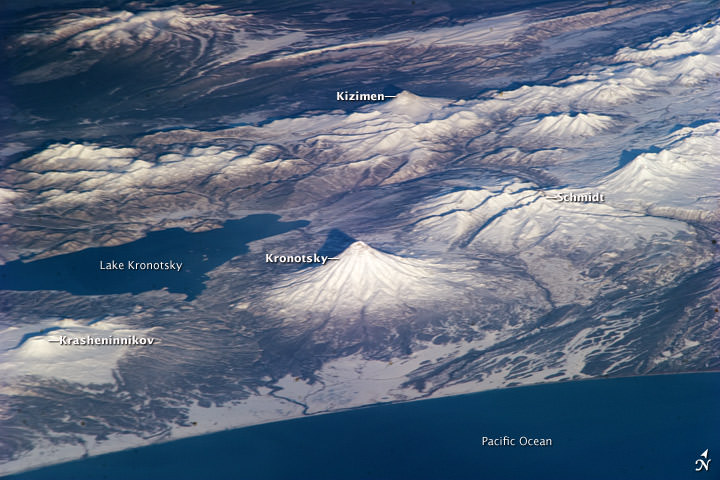
A volcano is an opening in the Earth’s surface where molten rock can escape from underneath. The Earth’s surface is made up of tectonic plates, which are spreading apart, crunching into each other, or sliding beside one another. Volcanoes are typically found at the fault lines between these plates. There can be active volcanos, which are currently, or have recently erupted. There are also dormant volcanoes, which haven’t erupted recently, and extinct volcanoes, which will never erupt again.
There are 4 major types of volcanoes:
Cinder Cone Volcanoes:
These are the simplest type of volcano. They occur when particles and blobs of lava are ejected from a volcanic vent. The lava is blown violently into the air, and the pieces rain down around the vent. Over time, this builds up a circular or oval-shaped cone, with a bowl-shaped crater at the top. Cinder cone volcanoes rarely grow larger than about 1,000 feet above their surroundings.
Composite Volcanoes:
Composite volcanoes, or stratovolcanoes make up some of the world’s most memorable mountains: Mount Rainier, Mount Fuji, and Mount Cotopaxi, for example. These volcanoes have a conduit system inside them that channels magma from deep within the Earth to the surface. They can have clusters of vents, with lava breaking through walls, or issuing from fissures on the sides of the mountain. With all this material coming out, they can grow thousands of meters tall. As we’ve seen with the famous Mount Saint Helens, composite volcanoes can explode violently.
Shield Volcanoes:
These are large, broad volcanoes that look like shields from above – hence the name. The lava that pours out of shield volcanoes is thin, so it can travel for great distances down the shallow slopes of the volcano. These volcanos build up slowly over time, with hundreds of eruptions, creating many layers. They’re not likely to explode catastrophically. Perhaps the best known shield volcanoes are the ones that make up the Hawaiian Islands, especially Mauna Loa and Mauna Kea.
Lava Domes:
Volcanic or lava domes are created by small masses of lava which are too viscous (thick) to flow very far. Unlike shield volcanoes, with low-viscosity lava, the magma from volcanic domes just pile up over and around the vent. The dome grows by expansion of the lava within, and the mountain forms from material spilling off the sides of the growing dome. Lava domes can explode violently, releasing a huge amount of hot rock and ash.
We have written many articles about volcanoes for Universe Today. Here’s an article about how a volcano sparked lightning storms.
Here are more article about volcanoes:
- What are Volcanoes?
- What is the Biggest Volcano on Earth?
- What is the Tallest Volcano on Earth?
- Cinder Cone Volcanoes
- Shield Volcanoes
- Composite Volcanoes
- Lava Domes
- Most Active Volcanoes
- How Are Volcanoes Formed
- Supervolcano
- Stratovolcano
- Temperature of Lava
- Types of Lava
- What is the Difference Between Lava and Magma?
- What is Lava?
- Lava Flow
- Underwater Volcanoes
- Dormant Volcanoes
- Extinct Volcanoes
- List of Volcanoes
- Parts of a Volcano
- Volcanic Ash
- Molten Lava
- Lava Tube
- Pahoehoe Lava
- Magma
- Volcanic Rocks
- Volcanic Vent
- Pyroclastic Flow
- Plinian Eruption
- Strombolian Eruption
- Volcanic Gas
- Magma Chamber
- A’a Lava
- Pillow Lava
- Active Volcanoes
- Volcano Dangers
- Vesuvian Eruption
- Pelean Eruptions
- Vulcanian Eruptions
- Volcano Pictures
- Volcanic Eruption
- How Volcanoes Erupt
- How Many Volcanoes Are There?
- Ring of Fire Volcanoes
- Volcano Crater
- Volcano Observatories
- Volcano Caldera
- Volcano Block
- Vulcan and Volcanoes
- Volcano Conduit
- Volcanic Tuff
- Lava Viscosity
- Volcano Hot Spot
- Maar Volcanoes
- Obsidian
- Basalt
- Igneous Rock
- Difference Between Active and Dormant Volcanoes
- Lava Rock
- Famous Volcanoes
- 10 Facts About Volcanoes
- Volcano Lahar
- Pumice
- Scoria
- Volcano Videos
- Volcanic Tephra
- Benefits of Volcanoes
- Largest Active Volcano
- Largest Eruption Ever
- Yellowstone Eruption
Want more resources on the Earth? Here’s a link to NASA’s Human Spaceflight page, and here’s NASA’s Visible Earth.
We have also recorded an episode of Astronomy Cast about Earth, as part of our tour through the Solar System – Episode 51: Earth.