
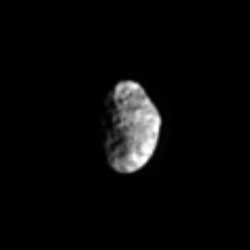
Saturn’s chaotically tumbling moon, Hyperion. Image credit: NASA/JPL/SSI. Click to enlarge.
Saturn’s chaotically tumbling moon Hyperion is captured in this view. At the top is a 130-kilometer-wide (80-mile) crater seen in some NASA Voyager spacecraft images. Detecting specific features is the first step in trying to understand the current rotation state of Hyperion, compared to that at the time of Voyager. Hyperion is 266 kilometers (165 miles) across.
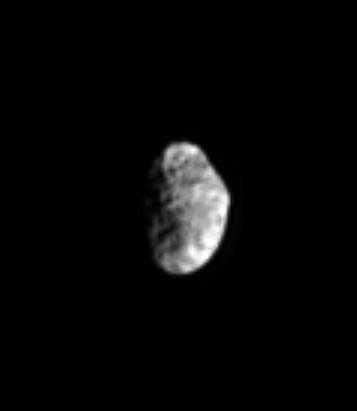
This is the second-closest view of Hyperion obtained by Cassini so far. The closest view was included in a previously released montage of Hyperion images.
The image was taken in visible light with the Cassini spacecraft narrow-angle camera on March 19, 2005, at a distance of approximately 1.3 million kilometers (824,000 miles) from Hyperion and at a Sun-Hyperion-spacecraft, or phase, angle of 63 degrees. Resolution in the original image was 8 kilometers (5 miles) per pixel. The image has been contrast-enhanced and magnified by a factor of three to aid visibility.
The Cassini-Huygens mission is a cooperative project of NASA, the European Space Agency and the Italian Space Agency. The Jet Propulsion Laboratory, a division of the California Institute of Technology in Pasadena, manages the mission for NASA’s Science Mission Directorate, Washington, D.C. The Cassini orbiter and its two onboard cameras were designed, developed and assembled at JPL. The imaging team is based at the Space Science Institute, Boulder, Colo.
For more information about the Cassini-Huygens mission visit http://saturn.jpl.nasa.gov . For additional images visit the Cassini imaging team homepage http://ciclops.org .
Original Source: NASA/JPL/SSI News Release