
[/caption]
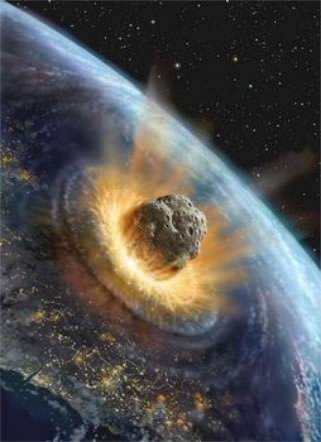
If Earthlings discovered a large asteroid heading towards our planet, how would we react? But more importantly would the space agencies and/or world governments be prepared for such an event? “Mankind is now technically able to predict, sometimes several decades in advance, the trajectory of Near Earth Objects (NEOs),” said Frans von der Dunk, professor of space law at the University of Nebraska-Lincoln. “Additionally, existing space technology could deflect the vast majority of threatening asteroids.” But even if a threatening object is discovered, von der Dunk said no mechanism exists for effective international decision-making on how to deal with a threat. To examine these issues, UNL hosted a conference on April 23 & 24, “Near-Earth Objects: Risks, Responses and Opportunities,” to look at the legal and institutional challenges of creating an international protocol of dealing with NEOs.
NEOs are an increasing area of concern among the world’s space scientists. Many experts believe that over the next 15 years, advances in technology will allow for the detection of more than 500,000 NEOs – and of those, several dozen will likely pose an uncomfortably high risk of striking Earth and inflicting local or regional damage.
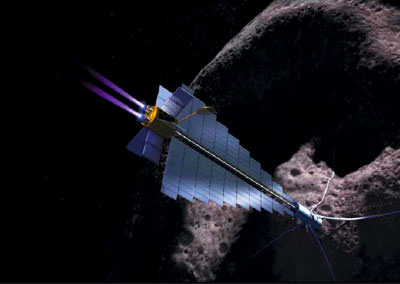
Right now, if an Earth-bound asteroid were discovered, we have the technology today to send a spacecraft to an asteroid to act as a gravity tractor, or to impact the asteroid to alter the space rock’s trajectory. Other current options are to use a mass driver, rocket engines or a solar sail to push the asteroid on a different course.
But, von der Dunk told Universe Today, completely lacking is an official structure for preparation, planning and timely decision-making in the event of a potential collision, as well as what country or entity would have the authorization and responsibility to act, or take care of the financial implications.
Von der Dunk hopes the conference will shed more light on these issues.
“We hope to accomplish two things,” he said. “One is to generate more attention to this problem and make sure it will remain on people’s agenda, even though we recognize there are more immediate pressing global concerns, such as climate change or economic issues.” But even in terms of economic concerns von der Dunk said making decisions now about asteroid deflection is worthwhile because we can develop a proper process which could save millions or billions of dollars.
Instead of using scenarios like the movies “Deep Impact” or “Armageddon” – the typical Hollywood approach, von der Dunk said, we could take action early in the game. “Gravity tractors only require a couple of million dollars in cost.”
The other goal of the conference is to shed more insight into the protocols and legal issues of an Earth-bound asteroid. “What protocols should be followed to tackle the problem, what threshold would be sufficient to start taking action, who should take the action, who should pay for it, and who would be liable if something goes wrong? Those are the types of issues that we are putting on the table.”
While the actual capacities to take action against an NEO are still limited to a few space-fairing nations, von der Dunk said there’s also the possibility of global political fallout if there is a divergence between them. “One country may decide at a certain point not to bother about it, while another country with a greater chance of being hit, might want to take action,” he said. “The idea is to create a protocol and procedure of how we deal with these things to try to avoid the worst political fallout from happening, so if tomorrow, or ten years or hundred years from now and we know we have an asteroid heading in our direction we know we can actually do something about it and have a general legal understanding of how things will work.”
Von der Dunk specializes in space law and is a member of a panel created by the Association of Space Explorers, chaired by Apollo astronaut Rusty Schweickart. Von der Dunk has looked at what current protocols could be used in the event of an impending asteroid hit, but says nothing really exists. “I have looked at this issue and it quickly became clear to me that the current international treaty dealing with liability simply never foresaw the possibility of something going wrong in a case such as if the asteroid were deflected and then hit a different part of Earth than where it originally was going to hit,” he said. “And then a lawyer would be faced with taking some existing clauses which come closest and stretching them beyond what they were ever meant to be. We need to consider drafting a new international treaty agreement for this. At the conference we will discuss what such a treaty should look like, how should we phrase it, what particulars should be targeted.”
A number of members of Schweickart’s panel will be presenting at the conference, as well as “speakers from outside the community to broaden the issue,” von der Dunk said. “We will take stock of what is happening now, is it going in the right direction, discuss in more detail some of the legal issues such as liability, and add to that something in a more positive tone. Asteroids are not only about ‘deep impact,” but also about the possibilities of creating access to potentially very valuable minerals. If someone is going to mine an asteroid, we need the appropriate legal framework for that.”
Von der Dunk said attendees of the conference are lawyers, policy makers, members of think-tanks, and government representatives. Other speakers include former NASA astronaut Tom Jones, and Vice-Chairman of the United Nations Committee on the Peaceful Use of Outer Space (COPUOS), Ciro Arevalo.
The conference ends today with a simulation led by Dr. Eligar Sadeh of the Eisenhower Center For Space & Defense Studies of what actions and decisions would need to be made in the event of the discovery of an Earth-bound asteroid. “From this we may come to an understanding of why certain decisions have to be made at a certain point in time and how the consequential logic of a process like that flows,” von der Dunk said.
Von der Dunk is the leading academic expert on space law, and UNL’s College of Law is has the only master of laws program in space and telecommunications law offered in the United States.
We’ve been to long without one,I’d hope but don’t see how we all could get “off the Earth” if ones comes at us till we could come back
As this affects everyone and transcends national or even continental borders, surely it is something in which the United Nations should be actively involved.
Most if not all nations in the UN Security Council have been involved in space projects, and this is obviously one of the most major security threats to the whole planet…. even nuclear war is insignificant compared to the effects of a KT impactor!
i still am of the idea that we should start thinking of a Global Space Agency.. or Terra Space Agency .. dunno , something like that
if not for the pratical use of unifying efforts and money to make more missions faster , then at least to , like Von der Dunk sayes , have some rules and laws , to help us act better in case of something like a big rock heading to us :p
plus maybe this will help all of us feel more 1mankind , instead of a bunch of ugly tribes
Instead of using scenarios like the movies “Deep Impact” or “Armageddon” – the typical Hollywood approach, von der Dunk said, we could take action early in the game. “Gravity tractors only require a couple of million dollars in cost.”
This cost is wrong by a factor of several hundred. The power of a gravity tractor is in its mass, and getting a lot of mass to rendezvous with an asteroid is going to be expensive – $1000 per gram or so. Still it’s better than Armageddon. Anything is better than Armageddon.
The technology for defense isn’t much different from the technology for offense. The ability to aim asteroids is a bit scary. Will the chance of being hit intentionally be less than the chance of being hit accidentally?
Lets hope this eventual event does not happen until our technology starts to catch up, perhaps a least 100 years, otherwise, where it hits will be a matter of bad luck or luck, depending if your city got clobbered or spared,- human nature being as flakey as it is, a macabre game of citizens of a city egging the ‘rock’ on to the next city, or betting on odds they will be spared at the expense of 10 million people a state or country away
Humm, after reading this article good,it talks about the ‘big KT event’ . IMHO, realistically,
unless we have + 20 years to prepare for something this massive, and whatever futile countermeasures we can deploy, we are in bad shape!!! Lets’ hope something this big is millions of years away, and try to live with the ‘Metro killers’ that hits Earth perhaps once or twice per century. This is a bad thing to think about trying to shift a ‘Metro Killer Rock’, if we had perhaps 1 year to prepare and use countermeasures but only partially sucessful, and the ‘rock’ strikes another large City instead of the original target which was another Large City a 1000miles or 1620KM away, at the least, litigation is quite certain, perhaps ‘bad blood’ if different nations are involved which can have secondary effects like a large war which is far worst than what the ‘rock’ caused directly.!!!!,