
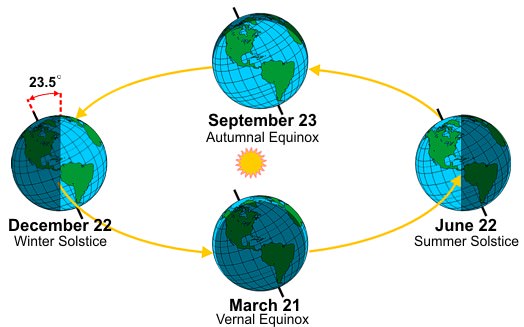
[/caption]
Spring officially arrives for everyone, including astronomers on March 20. The word “Equinox” literally means “equal night”. It’s all about the balance of light – not the myth of balancing eggs. On the universal date (UTC) of Friday, March 20, 2009 at 11:44 (am) both the day and night are the same length. But what’s so special about it? It’s a date that most of us recognize as symbolic of changing seasons. North of Earth’s equator we welcome Spring, while people south of the equator are gearing up for the cooler temperatures of Autumn. But what’s all this about balancing eggs?
These all too brief, but monumental moments in Earth-time, owe their significance to the slightly more than 23 degree tilt of the Earth’s axis. Because of our planetary angle, we in the northern hemisphere receive the Sun’s rays most directly during the Summer. In the Winter, when we are tilted away from the Sun, the rays pass through the atmosphere at a greater slant, bringing lower temperatures. If the Earth rotated on an axis perpendicular to the plane of the Earth’s orbit around the Sun, there would be no variation in day lengths or temperatures throughout the year, and we would not have seasons. At Equinox, the midway between these two times in Spring and Autumn, the spin axis of the Earth points 90 degrees away from the Sun.
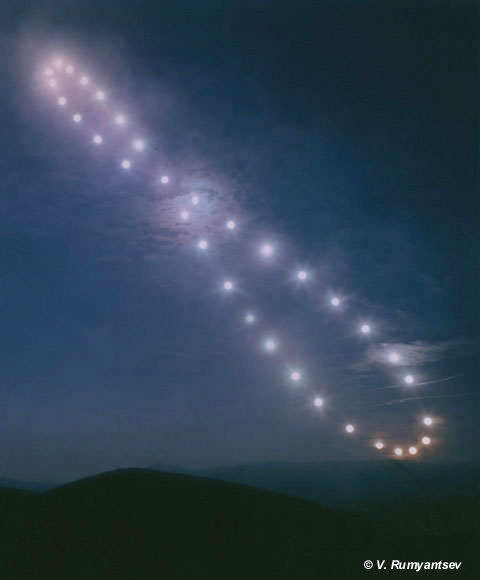 If your head is spinning from all of this, sit and ponder for a moment. Now is a great time to choose a marker and observe what’s happening for yourself. Trying a real science experiment for equinox is much better than the myth of balancing eggs. Just place a stake of some type into the ground (or use a fencepost or signpost) and periodically over the next few weeks measure the length of the shadow when the Sun is at its highest and write down your measurements. I use my south facing deck railing and mark its shadow on the deck boards in chalk. It won’t take long before your marker’s shadow length changes and you notice how the Sun’s position changes in the sky, and with it the ecliptic plane.
In the language of astronomy, an equinox is either of two points on the celestial sphere where the ecliptic and the celestial equator intersect. The Vernal Equinox is also known as “the first point of Aries” – a the point at which the Sun appears to cross the celestial equator from south to north. This is also the the zero point of longitude – the reference plane at which right ascension is defined as 0. Believe it or not, this was defined in 1950 as the northern vernal equinox, but it has moved to the constellation of Pisces now! Why? The equinoxes are not fixed points on the celestial sphere but move westward along the ecliptic, passing through all the constellations of the zodiac in 26,000 years. This is what’s known as the precession of the equinoxes – a motion first noted by Hipparchus roughly in 120 B.C. But what causes it?
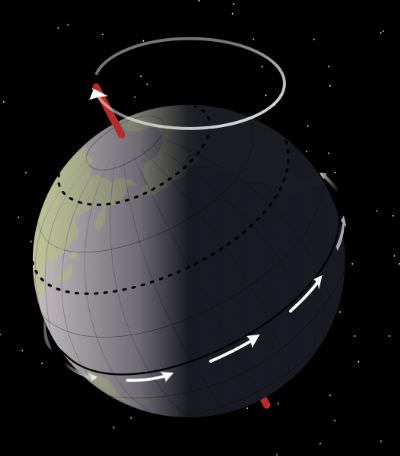 The precession is caused the gravitational attraction of both the Moon and Sun on the equatorial bulge of the Earth. Imagine the Earth’s axis patterning itself in a cone as it moves, like a spinning top. As a result, the celestial equator, which lies in the plane of the Earth’s equator, moves on the celestial sphere, while the ecliptic, which lies in the plane of the Earth’s orbit around the Sun, is not affected by this motion. The equinoxes, which lie at the intersections of the celestial equator and the ecliptic, now move on the celestial sphere. Much the same, the celestial poles move in circles on the celestial sphere, so that there is a continual change in the star at or near one of these poles.
After a period of about 26,000 years the equinoxes and poles lie once again at nearly the same points on the celestial sphere. Because the gravitational effects of the Sun and Moon aren’t always the same, there is some wobble in the motion of the Earth’s axis called nutation. This wobble causes the celestial poles to move, not in perfect circles, but in a series of S-shaped curves with a period of 18.6 years that was first explained by Isaac Newton in 1687.
So where did the urban myth of balance eggs on vernal equinox come from? Probably because at one time Easter was celebrated at this time and eggs play a very big role in the whole Esotere, rebirth, and cultural symbolism of this holiday. It may very well have been the good folks in China who orginally began the myth by patiently practicing standing eggs on end during vernal equinox to symbolize the restoration of balance to the world after a season of darkness. If this symbol of fertility could be balanced on such a day of significance, then surely nature was in harmony!
Go ahead and balance eggs for fun… But believe in science.
P.S. The Bad Astronomer Phil Plait has a tutorial video on his website, teaching you how to stand an egg on end, any time of the year. Click here to watch it.
Many thanks to Vasilij Rumyantsev (Crimean Astrophysical Obsevatory) for the excellent solar analemma as it appeared in the July 9, 2002 APOD.
Where I live, sunrise and sunset times were both 7:22 about two days ago. How could this happen on a day other than the equinox?
@Marjorie:
This might help-
http://www.usno.navy.mil/USNO/astronomical-applications/astronomical-information-center/faq-equinoxes
Thanks, Amy. Your link was very helpful.
“Spring arrives for everybody on the 20th March” I think not!
Maybe for the Northern Hemispherians, for the Deep South ours arrives September 23rd.
There is more to this “Little Blue Dot” than you can imagine.
The Bad Astronomer Phil Plait has a tutorial video on his website, teaching you how to stand an egg on end, any time of the year.
Yes, but that would be cheating. You can only use the salt to prop up the egg during an equinox; otherwise, spilling salt is very bad luck and your egg will likely rot.
The article brings back wonderful memories. My mother, wanting to impress the garden club she to which she had been inducted, asked my father to put a sundial in her garden. He built a wooden deck surrounding a gazebo in the form of a horizontal sundial, with its dial marked by alternating planks of walnut and oak with insets of ebony and mahogany marking minutes, points of the compass and the equinoxes. It’s acid test: March 21st, and smiles all around. Time and denser residential zoning have all conspired to turn that wonderful garden into an address for upscale thirtysomethings.