
We’re in the middle of Summer here on Vancouver Island, the Sun is out, the air is warm, and the river is great for swimming.
Three months from now, it’s going to be raining and miserable.
Six months from now, it’s still going to be raining, and maybe even snowing.
No matter where you live on Earth, you experience seasons, as we pass from Spring to Summer to Fall to Winter, and then back to Spring again.
Why do we have variations in temperature at all? What causes the seasons?
If you ask people this question, they’ll often answer that it’s because the Earth is closer to the Sun in the summer, and further in the winter.
But this isn’t why we have seasons. In fact, during Winter in the Northern Hemisphere, the Earth is actually at the closest point to the Sun in its orbit, and then farthest during the Summer. It’s the opposite situation for the Southern hemisphere, and explains why their seasons are more severe.
So if it’s not the distance from the Sun, why do we experience seasons?
We have seasons because the Earth’s axis is tilted.
Consider any globe you’ve ever used, and you’ll see that instead of being straight up and down, the Earth is at a tilt of 23.5-degrees.
The Earth’s North Pole is actually pointed towards Polaris, the North Star, and the south pole towards the constellation of Octans. At any point during its orbit, the Earth is always pointed the same direction.
For six months of the year, the Northern hemisphere is tilted towards the Sun, while the Southern hemisphere is tilted away. For the next six months, the situation is reversed.
Whichever hemisphere is tilted towards the Sun experiences more energy, and warms up, while the hemisphere tilted away receives less energy and cools down.
Consider the amount of solar radiation falling on part of the Earth.
When the Sun is directly overhead, each square meter of Earth receives about 1000 watts of energy.
But when the Sun is at a severe angle, like from the Arctic circle, that same 1000 watts of energy is spread out over a much larger area.
This tilt also explains why the days are longer in the Summer, and then shorter in the Winter.
The longest day of Summer, when the Northern Hemisphere is tilted towards the Sun is known as the Summer Solstice.
And then when it’s tilted away from the Sun, that’s the Winter Solstice.
When both hemispheres receive equal amounts of energy, it’s called the Equinox. We have a Spring Equinox, and then an Autumn Equinox, when our days and night are equal in length.
So how does distance from the Sun affect us?
The distance between the Earth and has an effect on the intensity of the seasons.
The Southern Hemisphere’s Summer happens when the Earth is closest to the Sun, and their winter when the Earth is furthest. This makes their seasons even more severe.
You might be interested to know that the orientation of the Earth axis is actually changing.
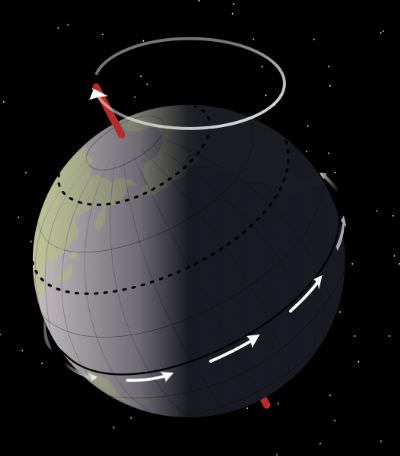 Over the course of a 26,000 year cycle, the Earth’s axis traces out a great circle in the sky. This is known as the precession of the equinoxes.
At the halfway point, 13,000 years, the seasons are reversed for the two hemispheres, and then they return to original starting point 13,000 years later.
You might not notice it, but the time of the Summer Solstice comes earlier by about 20 minutes every year; a full day every 70 years or so.
I hope this helps you understand why the Earth – and any planet with a tilted axis – experiences seasons.