
Asteroids, meteors, and meteorites … It might be fair to say these rocks from space inspire both wonder and fear among us Earthlings. But knowing a bit more about each of them and how they differ may eliminate some potential misgivings. While all these rocks originate from space, they have different names depending their location — i.e. whether they are hurtling through space or hurtling through the atmosphere and impacting Earth’s surface.
In simplest terms here are the definitions:
Asteroid: a large rocky body in space, in orbit around the Sun.
Meteoroid: much smaller rocks or particles in orbit around the Sun.
Meteor: If a meteoroid enters the Earth’s atmosphere and vaporizes, it becomes a meteor, which is often called a shooting star.
Meteorite: If a small asteroid or large meteoroid survives its fiery passage through the Earth’s atmosphere and lands on Earth’s surface, it is then called a meteorite.
Another related term is bolide, which is a very bright meteor that often explodes in the atmosphere. This can also be called a fireball.
Let’s look at each in more detail:
Asteroids
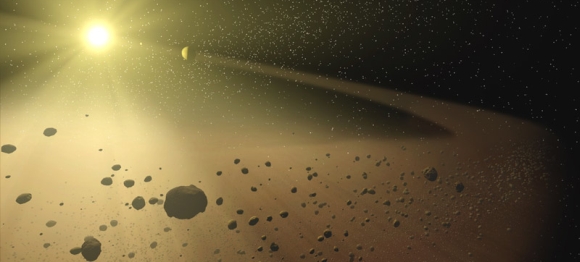
Asteroids are found mainly in the asteroid belt, between Mars and Jupiter. Sometimes their orbits get perturbed or altered and some asteroids end up coming closer to the Sun, and therefore closer to Earth. In addition to the asteroid belt, however, there have been recent discussions among astronomers about the potential existence of large number asteroids in the Kuiper Belt and Oort Cloud. You can read a paper about this concept here, and a good article discussing the topic here.
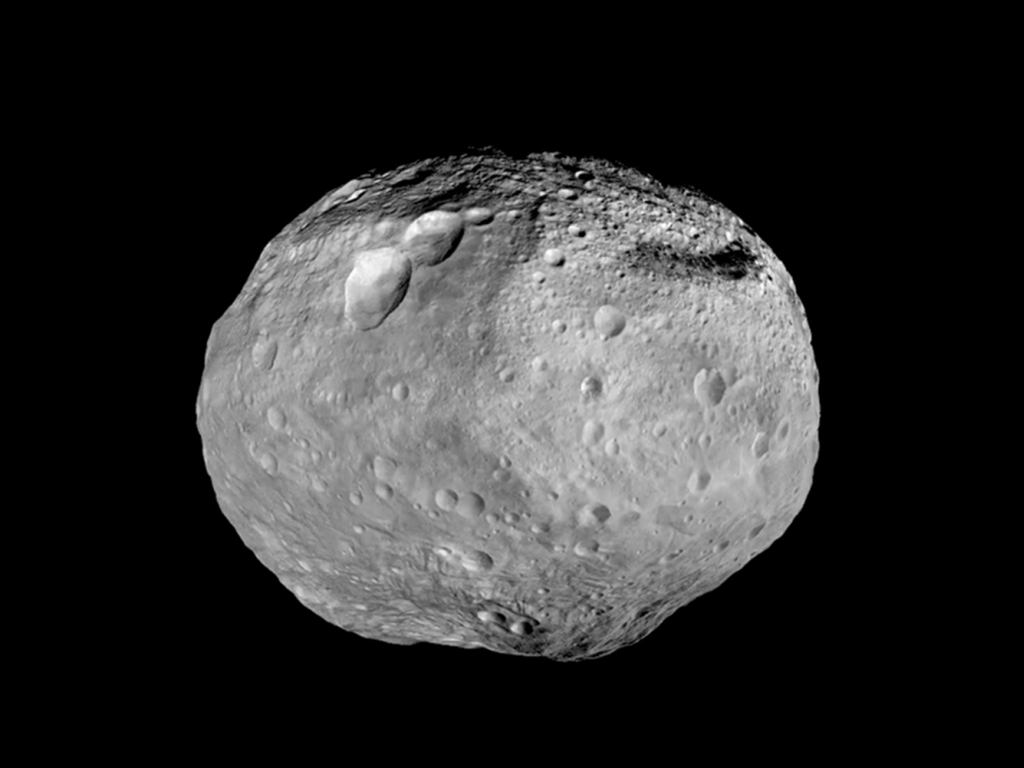
Asteroids are sometimes referred to as minor planets or planetoids, but in general, they are rocky bodies that do not have an atmosphere. However, a few have their own moons. Our Solar System contains millions of asteroids, many of which are thought to be the shattered remnants of planetesimals – bodies within the young Sun’s solar nebula that never grew large enough to become planets.
The size of what classifies as an asteroid is not extremely well defined, as an asteroid can range from a few meters wide – like a boulder — to objects that are hundreds of kilometers in diameter. The largest asteroid is asteroid Ceres at about 952 km (592 miles) in diameter, and Ceres is so large that it is also categorized as a dwarf planet.
Most asteroids are made of rock, but as we explore and learn more about them we know that some are composed of metal, mostly nickel and iron. According to NASA, a small portion of the asteroid population may be burned-out comets whose ices have evaporated away and been blown off into space. Recently, astronomers have discovered some asteroids that mimic comets in that gas and dust are emanating from them, and as we mentioned earlier, there appears to be a large number of bodies with asteroid-like compositions but comet-like orbits.
How Often Do Asteroids Hit Earth?
While we know that some asteroids pass very close to Earth’s orbit around the Sun, we’ve been lucky in the history of humanity that we haven’t had a large asteroid hit Earth in the past several thousand years. It wasn’t until satellite imagery of Earth became widely available that scientists were able to see evidence of past asteroid impacts.
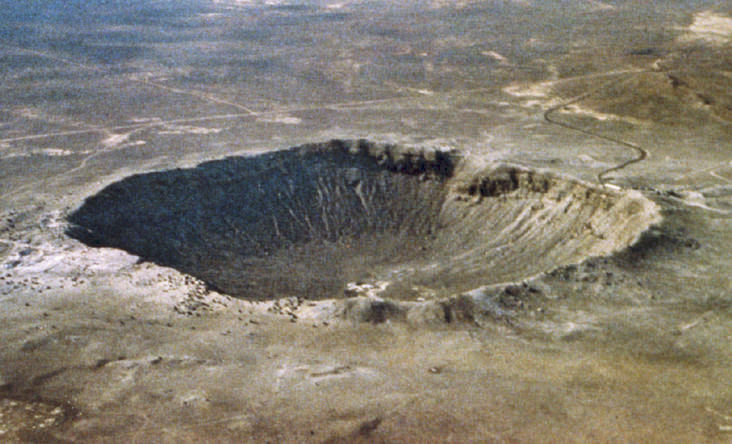
One of the more famous impact craters on Earth is Meteor Crater in Arizona in the US, which was made by an impact about 50,000 years ago. But there are about 175 known impact around the world – a few are quite large, like Vredefort Crater in South Africa which has an estimated radius of 190 kilometers (118 miles), making it the world’s largest known impact structure on Earth. Another notable impact site is off the coast of the Yucatan Peninsula in Mexico, and is believed to be a record of the event that led to the extinction of the dinosaurs 65 million years ago. You can see images of some of the most impressive Earth impact craters here.
These days, asteroid impacts are less of a threat. NASA estimates that about once a year an automobile-sized asteroid enters Earth’s atmosphere, creates an impressive fireball and disintegrates before ever reaching the surface. Studies of Earth’s history indicate that about once every 5,000 years or so on average an object the size of a football field hits Earth and causes significant damage. Once every few million years on average an object large enough to cause regional or global disaster impacts Earth. You can find more information about the frequency of impacts in this article from NASA.
Meteors, Meteoroids and Bolides
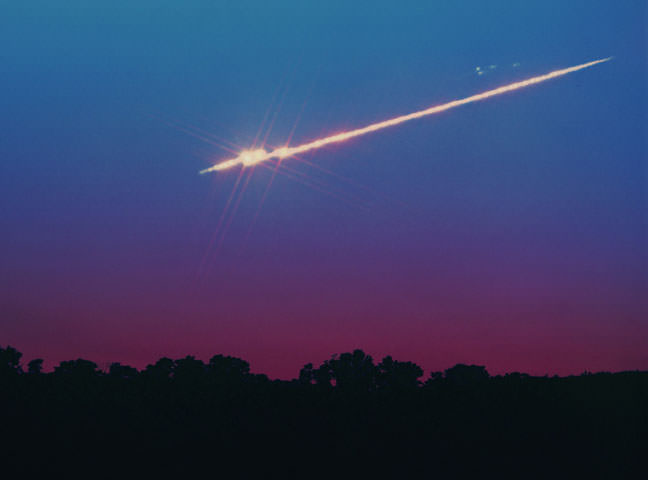
Space debris smaller than an asteroid are called meteoroids. A meteoroid is a piece of interplanetary matter that is smaller than an asteroid and frequently are only millimeters in size. Most meteoroids that enter the Earth’s atmosphere are so small that they vaporize completely and never reach the planet’s surface. When they burn up during their descent, they create a beautiful trail of light known as a meteor, sometimes called a shooting star.
Mostly these are harmless, but larger meteors that explode in the atmosphere – sometimes called bolides — can create shockwaves, which can cause problems. In February 2013 a meteor that exploded over Chelyabinsk, Russia shattered windows with its air blast. This meteoroid or bolide was estimated to be 18 meters (59 feet) in diameter. In 1908, a rocky meteoroid less than 100 meters in diameter is believed to have entered the atmosphere over the Tunguska region of Siberia in 1908 and the resulting shockwave knocked down trees for hundreds of square kilometers
How often is Earth hit by meteroids?

Because of the Chelyabinsk meteor in 2013, astronomers have acquired more information about the frequency of larger meteors that hit Earth, and there is now a growing consensus that the Earth gets hit by bigger space rocks more often than we previously thought. You can read more about that concept here.
This video from the B612 Foundation shows a visualization of the location of 26 space rocks that hit Earth between 2000 and 2013, each releasing energy equivalent to some of our most powerful nuclear weapons. The B612 foundation says that a Hiroshima-scale asteroid explosion happens in our atmosphere on average once a year, but many are not detected because they explode high in the atmosphere, or because most of the Earth’s surface is water and even a large percentage of land is fairly uninhabited by humans.
Estimates vary of how much cosmic dust and meteors enter Earth’s atmosphere each day, but range anywhere from 5 to 300 metric tons. Satellite observations suggest that 100-300 metric tons of cosmic dust enter the atmosphere each day. This figure comes from the rate of accumulation in polar ice cores and deep-sea sediments of rare elements linked to cosmic dust, such as iridium and osmium.
But other measurements – which includes meteor radar observations, laser observations and measurements by high altitude aircraft — indicate that the input could be as low as 5 metric ton per day. Read more about this here.
For a documented list of bolide events, you can check out this page from JPL.
Meteorite
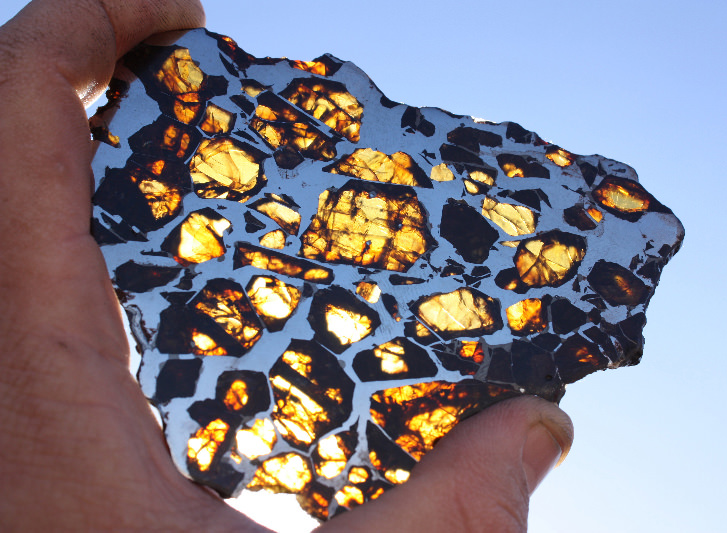
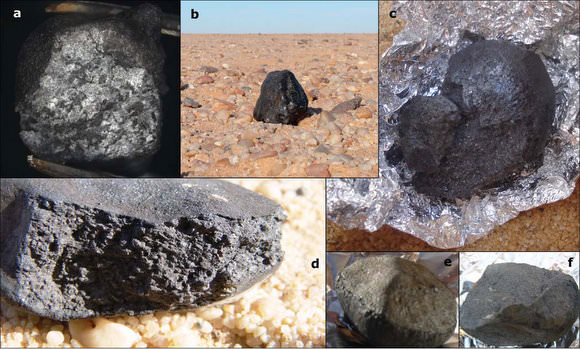
If any part of a meteoroid survives the fall through the atmosphere and lands on Earth, it is called a meteorite. Although the vast majority of meteorites are very small, their size can range from about a fraction of a gram (the size of a pebble) to 100 kilograms (220 lbs) or more (the size of a huge, life-destroying boulder). Meteorites smaller than 2mm are classified as micrometeorites.
Meteorites have traditionally been divided into three broad categories, depending on their structure, chemical and isotopic composition and mineralogy. Stony meteorites are rocks, mainly composed of silicate minerals; iron meteorites that are largely composed of metallic iron-nickel; and, stony-iron meteorites that contain large amounts of both metallic and rocky material.
Meteorites have also been found on the Moon and Mars and conversely, scientists have traced the origination of the meteorites found here on Earth to four other bodies: the Moon, Mars, the asteroid 4 Vesta, and the comet Wild 2. Meteorites are the source of a great deal of the knowledge that we have have about the composition of other celestial bodies.
How Often Do Meteorites Hit Earth?
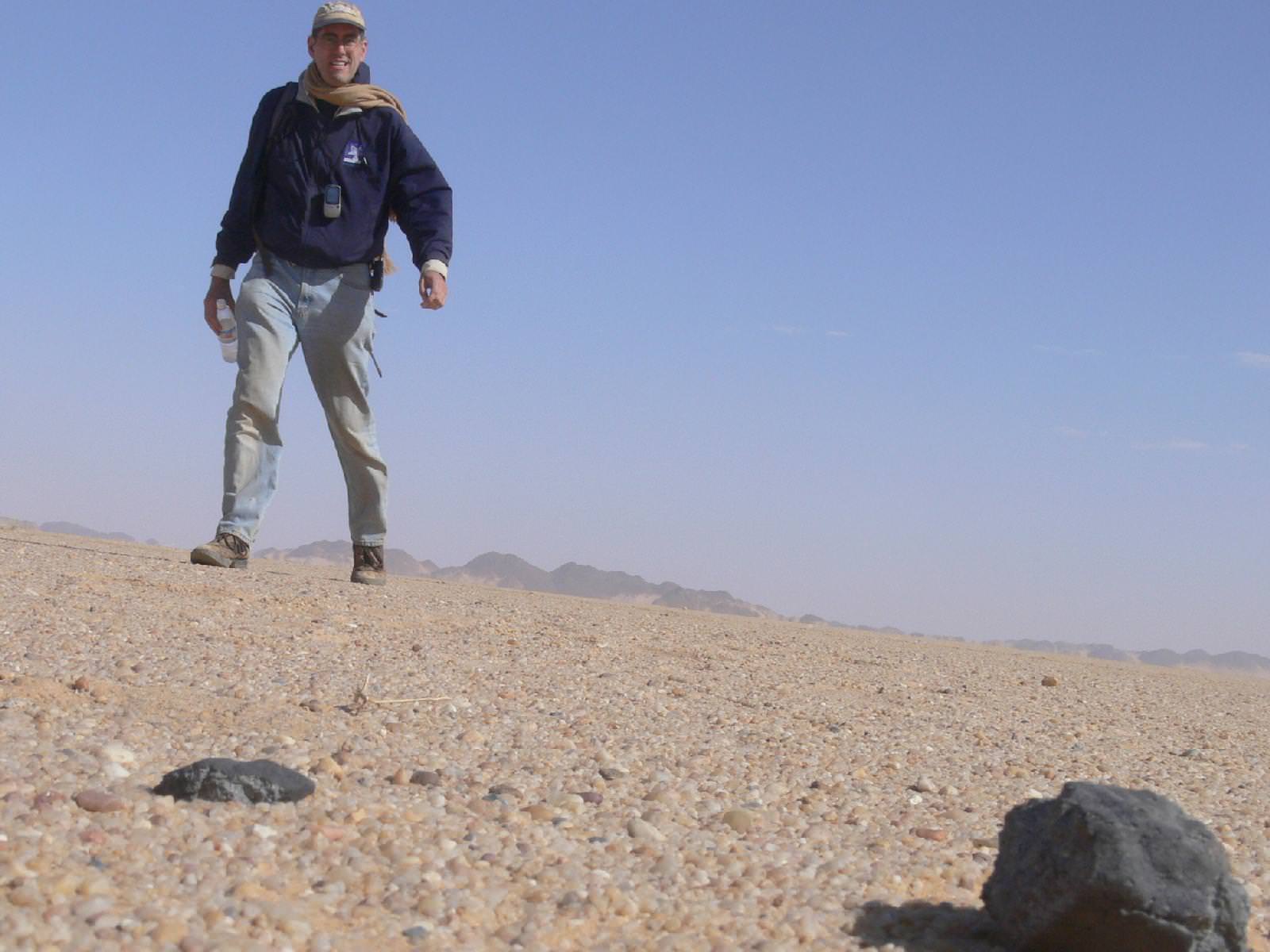
According to the Planetary Science Institute, it is estimated that probably 500 meteorites reach the surface of the Earth each year, but less than 10 are recovered. This is because most fall into water (oceans, seas or lakes) or land in remote areas of the Earth that are not accessible, or are just not seen to fall.
You can read more about meteorites that were found from the Chelyabinsk meteor here.
Summary
In short, the difference between asteroids and meteors all comes down to a question of location. Asteroids are always found in space. Once it enters an atmosphere, it becomes a meteor, and then a meteorite after it hits the ground. Each are made of the same basic materials – minerals and rock – and each originated in space. The main difference is where they are when they are being observed.
We have many great articles on the subject of asteroids and meteorites here at Universe Today, such as this general information article on asteroids, this article and infographic about the difference between comets, asteroids and meteors, and these articles that deal with Ceres and Vesta. And here are some recent articles about the Chelyabinsk meteor that landed in Russia, as well as a 2 billion-year old Martian meteorite that contains evidence of water on Mars.
There is some good information on a NASA page as well as some great information here on Universe Today and Astronomy Cast.
Sources:
JPL’s Near Earth Asteroid Office
Planetary Science Institute
NASA: Asteroids
NASA: Meteors
Without reading, my first thought was whether you get to complain about being hit…. lol
Nancy,
Is there any basic difference between an asteroid and a comet?
But at what point, presumably in terms of mass or volume, do we say; ‘More than this, is an asteroid, less than this, is a meteoroid?’
I don’t care how arbitrary it is, as long as there’s official agreement on it…
Not really a SciFi short: So there you are at a Bar-B-Que one Sunday afternoon, when suddenly there is a flash of light and a loud sonic boom shortly thereafter shattering an otherwise perfect day. Moments later a shower of stones falls from the sky. The fall seems to last forever for those unfortunate enough to witness the event, but in reality radar images show that it only lasts seconds. Some of the stones are fist size and do major roof damage to houses while dozens of car have their roofs and hoods dented or windows smashed. Several power lines are knocked down, adding to the confusion with a community wide blackout. Miraculously no one is hurt during the fall, other than a few bruises suffered by witnesses injured while fleeing. Later, the impact field is determined to be some 5 km in diameter and one cow is found struck dead by the largest piece of meteorite found to date. Film @ 11!
Got hardhat and gold undies?